

As the number of refugees in low- and middle-income countries has surged over the past two decades, high-income countries face labor shortages in skilled trades, threatening their green transition plans. CGD’s work with the Green Horizons coalition has helped mobilize millions in funding to help refugees and people from host communities move into jobs needed for the green transition, while contributing to a new UK visa that could enable thousands of displaced people to take up skilled jobs.
The challenge
The economic case for facilitating labor mobility is compelling. In the past 20 years, the number of refugees in low- and middle-income countries has risen 215 percent, while many high-income countries face labor shortages in skilled trades, health, and long-term care. Green sectors alone are expected to create 14 million jobs by 2030, and labor gaps could hamper countries’ green transition ambitions despite expanded domestic skills pipelines.
Migration can help fill these gaps while increasing a worker's lifetime income ten- to twenty-fold. Migrants bring complementary skills that improve quality of life in the communities where they settle and send home substantial remittances as foreign aid declines. Green-skilled migration can also accelerate decarbonization: a single migrant electrician installing rooftop solar in Europe enables an estimated 700–1,200 tons of CO₂ abatement over nine years—the equivalent of planting thousands of trees.
Some countries have created small-scale work and study visa programs to close these gaps. Trusted organizations help workers move from low-income to high-income contexts, navigating language and skill certifications and securing ethical employment opportunities. Talent Beyond Boundaries pioneered this approach for refugee populations, known as “complementary pathways,” but this work needs to be scaled.
What we did
In October 2024, a group of actors met in the Rockefeller Foundation’s Bellagio Centre, launching an ambitious new coalition known as Green Horizons. The goal? Build a bridge between climate funding and programs that put skilled workers into jobs, aiming to raise $50 million over three years. Green Horizons identifies high-potential labor mobility programs and matches them with the right funders. To do this, it has built a pipeline of diverse, investor-ready pathways to places like the United Kingdom, Italy, and Germany. It also surfaces high-quality impact analyses, showing how successful mobility programs accelerate the green transition, strengthening the case for investment. Green Horizons seeks to scale labor mobility solutions for 10,000 refugees and host community members, with an initial focus on roles relevant to the green transition, such as electricians, HVAC technicians, and construction specialists.
CGD experts are at the heart of these efforts, playing three key roles: (1) designing and expanding pathways that link training and mobility, based on CGD’s long-term project “Linking Training and Migration for the Green Transition”; (2) collecting data on the impact of these pathways; and (3) providing general support with convening and engagement.
What we helped achieve
In October 2025, one year after the initial conversations that started Green Horizons, CGD experts helped convene a Commitment Summit in Venice, bringing together implementers who could showcase existing and planned pathways moving refugees to support the green transition, and funders who may be interested in supporting their expansion.
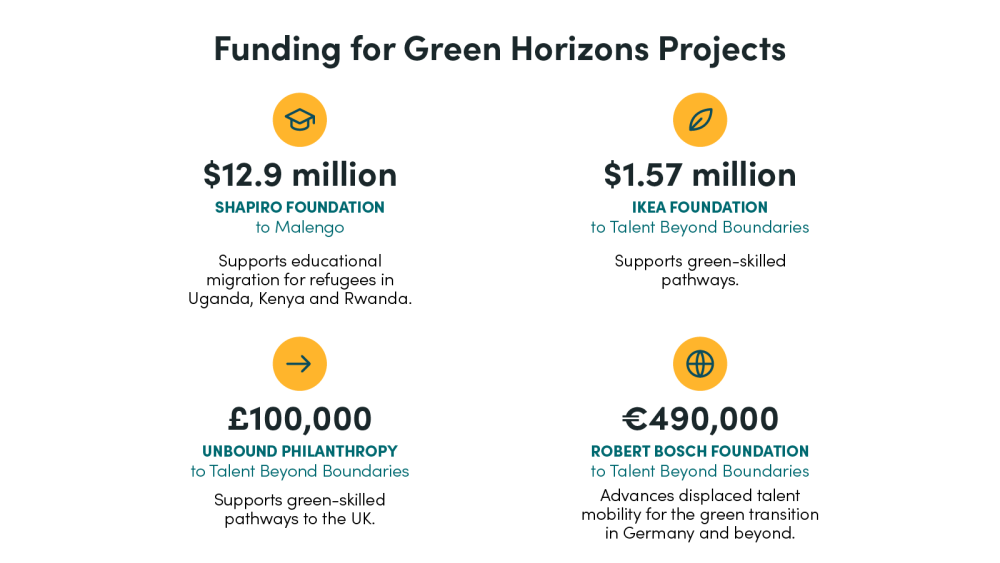
At the summit, the Shapiro Foundation announced a multi-year $12.9 million commitment to Malengo—an organization that facilitates educational migration for refugees—enabling it to scale operations in Uganda and Kenya, and expand into Rwanda. With engagement by CGD experts, Green Horizons has directly secured another $2.28 million. The IKEA Foundation provided $1.57 million and Unbound Philanthropy provided £100,000 to enable Talent Beyond Boundaries to build green-skilled pathways to the UK. Finally, the Robert Bosch Foundation provided €490,000 to Talent Beyond Boundaries to advance displaced talent mobility for the green transition in Germany and beyond.
These grants have already paid dividends. For example, Talent Beyond Boundaries has worked with CGD and others to support the UK Home Office in designing the world’s first visa dedicated to displaced talent. This uncapped visa will be operational early in 2027, enabling potentially thousands of skilled refugees to move to the UK, supporting its net zero ambitions.
What’s next
Expanding complementary pathways is key to realizing the UNHCR High Commissioner’s vision: reduce the number of people reliant on humanitarian assistance by 50 percent by 2035. Indeed, the Roadmap 2030 goal is to admit 2.1 million refugees through such pathways by 2030. This should be possible, given it is one of the only refugee routes with broad political support. 246,000 permits were issued in 2024, bringing the total number of permits issued since 2019 to around 1.2 million, well on the way to meeting the 2030 target.
CGD and the Green Horizons team plan to continue creating and expanding pathways to support such mobility, thereby helping reach the target and advance climate goals at the same time. To do this, we are targeting traditionally climate-focused funders. We are demonstrating the CO2 reduction impact of addressing key workforce bottlenecks and the resilience-building benefits to climate-vulnerable communities, showing why they should do everything in their power to reduce such bottlenecks. We are also building bridges between diverse coalitions to make the case for expanded pathways.
Related Work

Publication
Designing the UK’s Displaced Talent Visa

Support More Work Like This.
Your contribution makes it possible for the Center’s researchers to devise practical, evidence-based solutions for today’s most pressing development challenges.