Recommended



A few text messages per school, costing under $1 per student, turned a national education program in Tanzania from one that failed to improve learning into one that succeeded.
This finding shows how a small tweak in the implementation of a government program can make a big difference. The text messages were a cheap add-on to an existing, expensive reform, fixing one weak link in implementation. That tweak ranks among the most cost-effective interventions on record, at least among the rigorously evaluated programs with cost data in a recent review.
A reform and an evaluation at national scale
Our study first evaluated and then strengthened an ambitious government reform. Between 2017 and 2019, Tanzania rolled out a new school inspection model to more than 21,000 schools. Teams of school quality assurance officers spent several days at a school, observed teaching, talked to parents and students, and produced a report that rated the school and recommended specific improvements. The recommendations reached the school community at a closing meeting and then went to the district government.
That national scale is what makes the setting valuable. Promising programs often fall apart when a government takes them at scale, a pattern known as the voltage drop. Two reasons stand out: pilots are often run on unrepresentative samples, and implementation quality drops when a government takes a program over. We studied a program already running across the country, not a pilot in hopes of later scale-up.
Our sample matches that scale. The sample is nationally representative—nine regions, 23 districts, roughly 400 wards—so the findings speak to Tanzania as a whole. We also randomized at the ward level rather than at the school level. Because each monitor oversees several schools, randomizing at the ward level lets us test for spillovers between targeted schools and other schools within the same ward.
The program was well run. Inspectors were trained, visits occurred, and the reports contained genuine information: schools that scored higher went on to teach their students more. Headteachers said they learned something new about their own schools.
And yet, on its own, the program did nothing for student learning.
The weak link
The recommendations only translate into improved learning if someone actually follows up to make sure schools act on them. That job falls to close-to-school monitors called Ward Education Officers, who visit each of their schools regularly and know the headteachers personally. Ward Education Officers were well-placed to chase compliance, except for one detail: they report to a different ministry than the inspectors do, and the inspection reports were not sent to them directly.
We found that only one-fifth of monitors could produce a copy of the report. Only half attended the closing meeting. The reports landed on the desk of an overloaded District Education Officer responsible for roughly 100 schools. That officer was expected to digest the reports and redirect the monitors, but had neither the time nor the budget to do so.
This points to a more general problem endemic to public service delivery: government programs often need multiple ministries to cooperate, but this runs counter to each agency's own incentives. Sharing information across ministries is hard, and contributing to a shared program means diverting effort from the priorities on which each agency is actually judged.
The low-cost solution
To bypass this bottleneck, we sent the recommendations directly to the monitors. For a randomized half of the schools in the study, we collected the inspection reports as they came in, summarized the main recommendations, and texted the summaries to the monitors’ phones, repeating the messages roughly every two months.
Two study design choices mattered. The messages were specific to each school: we translated and classified all 754 recommendations we sent and found the recommendations to be unique and tailored to each school's needs. The messages also bore the name of the monitor's own boss, the District Education Officer, who had publicly endorsed the program at workshops beforehand. That turned a text from an outside researcher into a directive the monitor could act on with authority.
Results
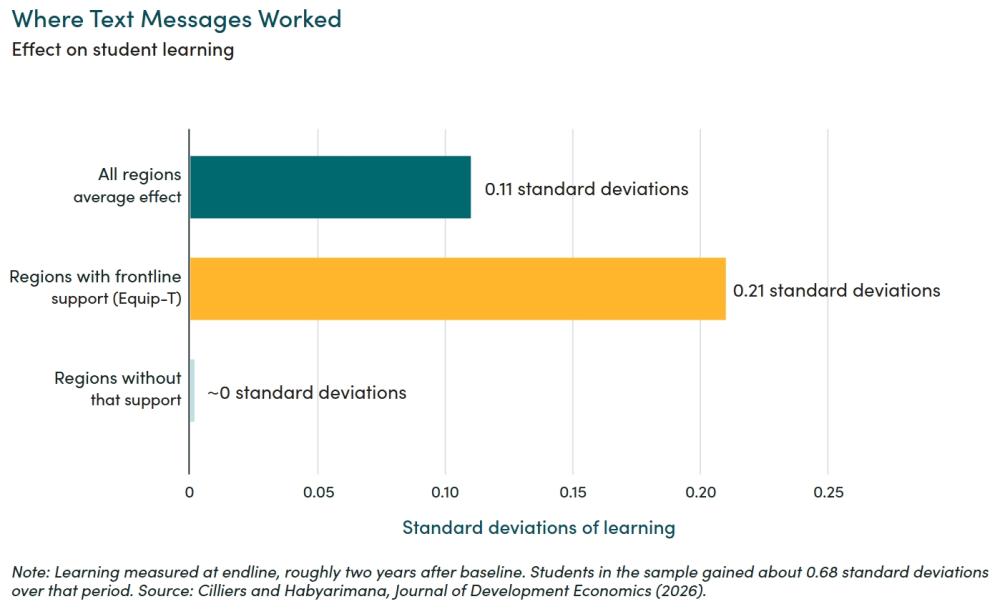
The text messages increased learning by 16 percent compared with the inspection alone. In schools that received an inspection, adding the text messages raised student learning by 0.11 standard deviations after two years. To make that concrete, students in those schools learned about 16 percent more than students in schools that only received the inspection. The gains appeared in the subjects Kiswahili and English, but not in math. In absolute terms, the effect is modest; per dollar spent, it is among the largest in education: between 0.16 and 0.61 standard deviations per dollar spent, depending on whether you include the upfront costs of the workshop or not.
All the learning gains came from regions where local monitors already had basic capacity. In three of our six study regions, a separate donor program, Equip-T, had provided monitors with motorbikes, fuel budgets, training, and monthly coordination meetings with their superiors. Where monitors had that capacity, the text messages raised learning by 0.21 standard deviations—31 percent more than the inspection alone. Where monitors did not, the effect was indistinguishable from zero.
Figure 1. Where text messages worked?
How did the messages work?
The text messages worked by delivering school-specific information into the hands of the people best positioned to follow up. Three pieces of evidence point in the same direction.
First, the messages did not push monitors to visit schools more often; the messages changed what monitors did on those visits. Monitors were already visiting the schools in their ward roughly every two weeks. The text messages steered the existing visits toward the specific recommendations for that school, rather than adding new ones.
Second, schools improved most in their weakest areas. When we interacted treatment effects with school quality ratings in each domain—management, community engagement, and school environment—the gains were largest where the inspection had flagged the biggest problems. This is what we expect if monitors act on the tailored content of each school's report, and this explains why average effects on any single domain look modest: different schools improved on different margins.
Third, monitors valued information that was timely, specific, and easy to act on. In follow-up interviews and a phone survey, monitors told us that the text messages reached them faster than official reports, were easier to act on than a 10–15 page document, and could be referred to or forwarded to schools directly from their phones.
The gains did not come at other schools' expense. A common worry with targeted interventions is that they rob attention from other schools. These messages did not. Schools in the same wards that were not part of our study saw no drop in monitoring visits or exam performance.
What policymakers should take from this
There are high returns to fixing the programs that governments already run. Governments and donors face strong incentives to design and announce new programs. But the greater gain often comes from finding a weak link in an existing program and repairing it. Doing so requires understanding a program well enough to see where implementation actually breaks down.
Make bureaucrats' jobs easier, not harder. Too many reforms pile new tasks on already overloaded officials. This one reform removed a task: it spared the district education office from having to read, digest, and relay 100 reports. Interventions that reduce the cost of doing existing work are more likely to stick.
Work through existing lines of authority, not around them. The messages worked because they came from the monitors’ bosses, within the government's own chain of command. That took real upfront effort to arrange, but it made an outside nudge feel like a legitimate instruction.
Don't expect cheap information fixes to work where the frontline can't act. The same messages did nothing where monitors lacked the means to follow up. Targeting bottlenecks pays off only once the basic capacity to deliver is in place.
Who pays for the cheap fix?
This highly cost-effective intervention was not adopted. Some reasons are familiar: leadership turnover, shifting priorities, and a pandemic in the middle of it all. But the deeper reason, we believe, is institutional. No single official is rewarded for taking on a fix that spans two ministries, which is exactly the coordination gap the messages were designed to address. And even a small budget must come from somewhere—meaning those funds must be reallocated from activities the responsible bureaucrats are rewarded for. A cheap intervention is not the same thing as a free one, once you account for what the people running it would otherwise be doing.
Governments usually resolve such coordination failures by giving someone the authority to compel coordination across agencies and to fund fixes that no individual office would pay for on its own. Whether a small, dedicated unit could play that role for fixes like this one is, we think, worth trying.
Based on Addressing Weak Links in Government Implementation at Scale: Experimental Evidence from a School Governance Reform in Tanzania, by Jacobus Cilliers and James Habyarimana, Journal of Development Economics (2026).
Topics
DISCLAIMER & PERMISSIONS
CGD's publications reflect the views of the authors, drawing on prior research and experience in their areas of expertise. CGD is a nonpartisan, independent organization and does not take institutional positions. You may use and disseminate CGD's publications under these conditions.
Thumbnail image by: Global Partnership for Education - GPE/ Flickr