Recommended
POLICY PAPER
A Landscape Analysis of Green Skills TVET Providers

This week, we will be partnering with Jacob’s Ladder Africa (JLA) to deliver the #GreenWorks4Africa Forum in Nairobi. Bringing together governments, institutional investors, industry leaders, and young innovators, the aim of the event is to develop a unified African framework for green jobs, skills, and investment, ahead of COP32 hosted by Ethiopia in 2027. This blog, written with the African Non-State Actors Platform for Migration and Development, outlines why mobility should be part of the conversation.
The green transition is an opportunity for Africa
Agenda 2063 (the African Union's 50-year master plan to transform Africa into a global powerhouse) provides a strategic framework for achieving inclusive growth and sustainable development through deeper regional integration, trade, and the free movement of people. At the heart of this vision are two flagship initiatives: the African Continental Free Trade Area (AfCFTA) and the Protocol on the Free Movement of Persons (FMP). Now in the second decade of delivery, focus has shifted to accelerating implementation and aligning national plans with sub-regional and continental ones.
Climate policy is playing an increasingly important role in Africa’s strategic framework, with unified goals for the continent, adopted by the Addis Ababa Declaration last year. The Declaration emphasised linking AfCFTA to sustainable and inclusive development through a "green first" approach.
Africa holds 60 percent of the world’s renewable energy resources, but just 2 percent of global renewable jobs. The green transition is an opportunity for African economies to benefit from new sectors, technologies, and jobs. Forecasts by FSD Africa suggest there will be 1.5– 3.3 million new direct green jobs by 2030. But there is a huge gap to bridge to get from the present reality to these job forecasts, with only 344,000 renewable energy jobs across Africa in 2024 .
Fig 1. Renewable energy jobs today vs new green jobs forecast for 2030
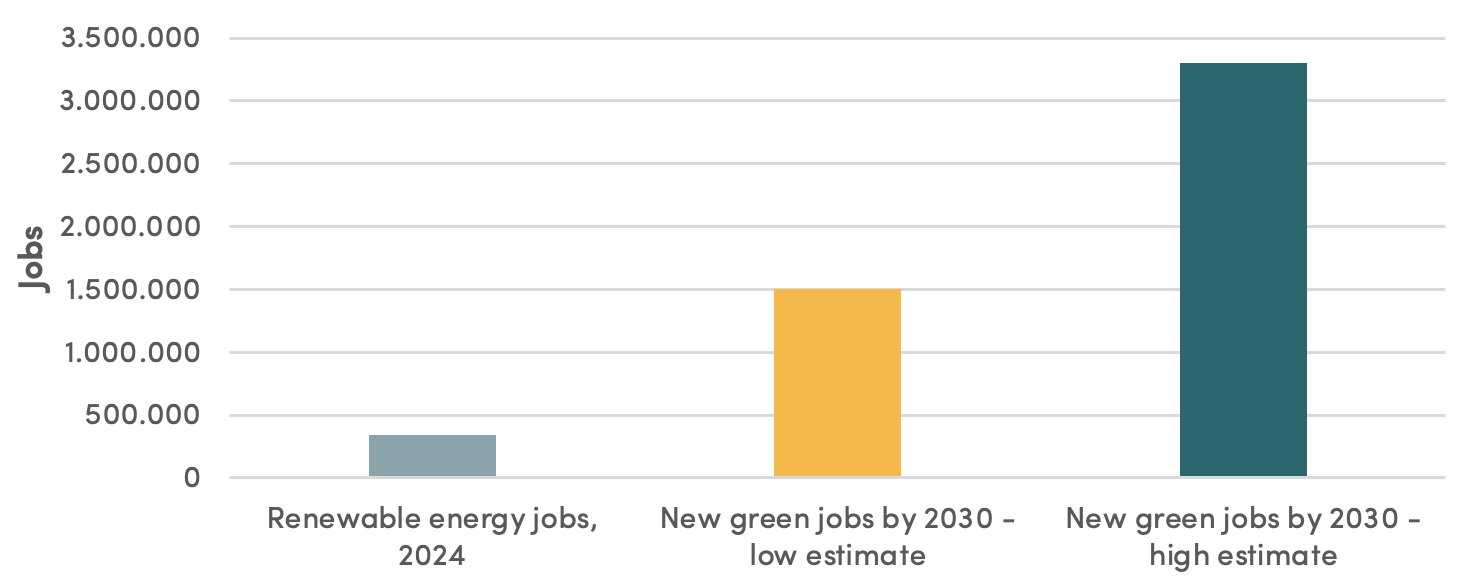
Source: IRENA and ILO, FSD and Shortlist
Now is the time to build green skills
Africa has a demographic advantage—but only if investments are made correctly. Roughly 60 percent of green jobs will require some form of training or certification. Some 83 percent of Africa’s workforce is in the informal sector, and this has shaped how skills are acquired. Informal apprenticeships are the dominant route, leading to a misalignment between skills systems and sector needs, with low levels of employer engagement in the skills system.
During a series of thematic pre-convenings organised by JLA ahead of the Forum, we heard frustration that large companies were bringing in international workers to build green infrastructure in Africa rather than hiring locally. These projects require skilled workers, with recognised credentials; African workers must be the main beneficiaries of these jobs.
The African Union’s Climate Change and Resilient Development Strategy calls on members to invest in green job creation and capacity development. Largely, these skills will need to be delivered through technical and vocational education and training (TVET). Yet meta-analyses find that fewer than a third of TVET programmes significantly improve employment or earnings. Specific to green skills, our research with IREX found training programmes were:
- Outdated and failing to meet current employer needs, largely due to governance and delivery models that did not prioritise responsiveness to industry;
- Had limited access to green training technology and equipment, due to rapid development and cost; and
- Were hampered by a lack of trainer knowledge of green jobs and practices; in government programmes they are often civil servants rather than active practitioners.
But we did find some bright sparks. Typically structured through public-private partnerships, established as Centres of Excellence, or connected to public utilities, they prioritised work-based learning and were seeing placement rates of 73-91 percent. At the Forum, we will be exploring these case studies and how to best scale their approaches.
There are also good examples at the national level. Kenya and Ghana have national green strategies in place, and Ghana’s Technical Vocational Education and Training (TVET) commission now requires green skills to be embedded across curriculum development. Achieving these benefits requires a skilled, adaptable workforce that can respond to demand both within and outside the continent.
Labour mobility can support these objectives
There is a shortage of green skills globally: half of energy firms worldwide report critical skills shortages, and 40 percent more qualified workers will be needed by 2030. With the right accreditations, skills recognition protocols, green skills can be portable, and the workforce is already highly mobile, often travelling from site to site.
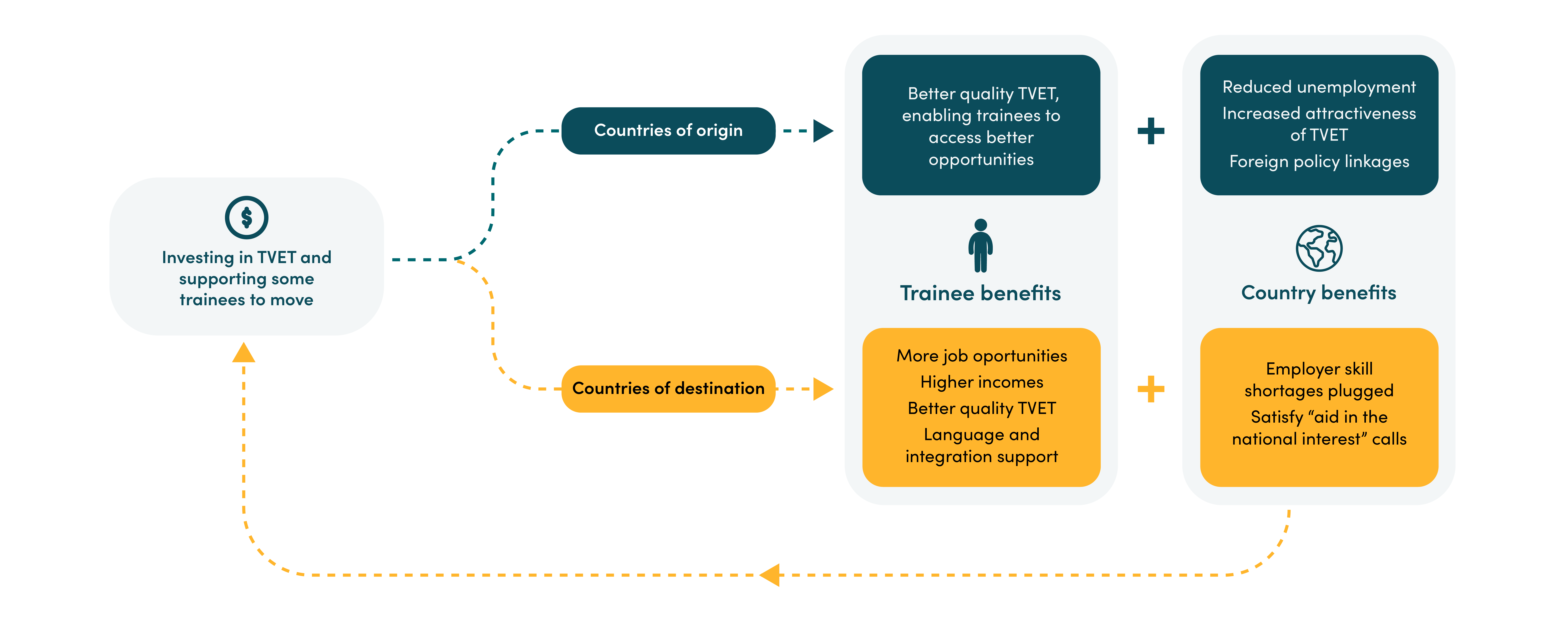
Adding a regional and international dimension to green skills portability gives workers access to larger labour markets and TVET systems access to international investment (Figure 2). The World Bank’s EASTRIP is an example of this approach, developing 236 regional qualifications and 44 harmonised occupational standards, benchmarked to ASEAN and EU frameworks. There are a number of individual projects working at this intersection, but scaling them to meet demand will require stronger institutions and sustained international investment.
Fig 2. The benefits of more closely linking TVET and labour mobility
The impacts of mobility depend on policy choices. Designed well—through bilateral cooperation and structured partnerships—emigration can be a powerful instrument for development; managed poorly, migrants are put at risk, skills leave, and countries lose the investment benefit. As labour mobility continues to gain traction across the continent, labour mobility institutions and policy need to be strengthened to support workers, protect against "brain drain", and ensure Africa is training and keeping the skilled workers it needs.
One way to do this is through CGD's Global Skill Partnership model. Destination countries invest in TVET systems in origin countries, in sectors where both need skilled workers; after training, some trainees are placed abroad and the majority stay. Because the origin country always trains more than it sends abroad, the model is structurally protective against brain drain while expanding training capacity. For green skills, external investment combined with training to global standards can raise quality, resources and employment outcomes. It also pairs employer finance with donor finance—important as development budgets shrink.
The agenda is being set now. We have proposed one model and look forward to hearing others. At the Forum, our discussion will ask: is Kenya's formal training system set up to supply green labour markets at home and abroad? How could working internationally help — would it improve quality, employer alignment, and crowd in international investment?
To discuss these issues in more detail, we are holding a side event on Thursday 13th of August at the #GreenWorks4Africa Forum in Nairobi.
Topics
DISCLAIMER & PERMISSIONS
CGD's publications reflect the views of the authors, drawing on prior research and experience in their areas of expertise. CGD is a nonpartisan, independent organization and does not take institutional positions. You may use and disseminate CGD's publications under these conditions.