In the current international aid environment, where bilateral funding for education has been significantly cut, multilateral financing mechanisms are likely to play an increasingly important role in enabling low- and middle-income countries to access the external financing needed to tackle the learning crisis many of them face. The Global Partnership for Education (GPE) replenishment conference is happening this month on the sidelines of the UN General Assembly, so donors have a decision to make. One important question is whether the value of GPE extends beyond the grants it provides directly: can those grants help leverage larger pools of external financing into education? The most important potential source is the World Bank's International Development Association (IDA), the largest multilateral donor to low- and lower-middle-income countries. Our analysis suggests that GPE does crowd in IDA financing, particularly in low-income countries, strengthening the case for donors to support the replenishment.
To assess whether GPE and IDA financing are complements or substitutes, we look at where the two sources of financing go and how they interact over time. This matters particularly now as the World Bank redefines its strategic priorities and education risks being squeezed out by competing demands. If GPE can help more low-income countries tap IDA financing for education, its impact could extend well beyond its own grant envelope.
GPE and IDA overlap in purpose but differ in scale and instrument
In some ways there is significant overlap between GPE and IDA—supporting similar countries, with similar activities targeting similar outcomes. The World Bank also hosts the GPE Secretariat and serves as trustee of its funds. The main distinction is that GPE financing is provided as grants and is ring-fenced to basic education, whereas IDA provides a combination of grants and concessional credits across sectors, with about 10 percent of its portfolio going to education (to its credit, GPE also has a more open and inclusive governance structure).
GPE provides many smaller grants (Figure 1), whilst IDA provides fewer but much larger education loans. The number of GPE grants has increased in recent years, particularly since COVID. This rise partly reflects a new strategy to split support across more, smaller instruments. In dollar terms, IDA education commitments remain several times larger than GPE grant approvals.
Figure 1. GPE does more projects, but IDA projects are much larger
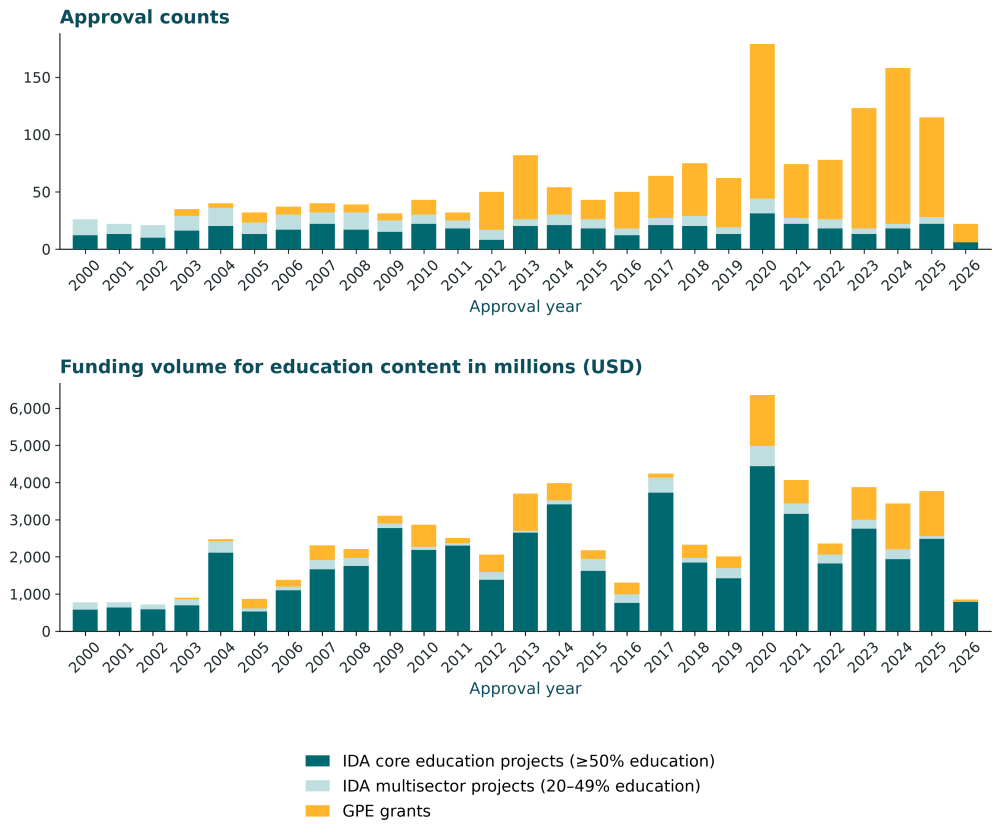
Note: IDA volumes are weighted by each project’s education sector share. GPE grant amounts are education by construction. Projects with no sector disaggregation are excluded.
Countries receiving GPE grants are more likely to attract IDA financing
We test the complementarity between GPE and IDA using an “event study”, estimating the probability that a country receives IDA financing for education in the years leading up to and then immediately after receiving a GPE grant. In the years before getting a GPE grant, the probability that a country receives IDA education financing is flat, and statistically indistinguishable from zero. The likelihood then jumps in the year of the grant (about +7 percentage points) and peaks two years later (about +9 percentage points) before decaying back to zero by the third year (Figure 2).
The relationship does not hold the other way round. Following an approval of an IDA education project, the change in the likelihood of a subsequent GPE grant is essentially zero in every one of the following four years. The only positive coefficient linking IDA to GPE occurs two years before the IDA approval, which is simply the GPE effect viewed from the point of view of the IDA project cycle.
Figure 2. Event studies show GPE grants are followed by IDA finance, but not vice versa
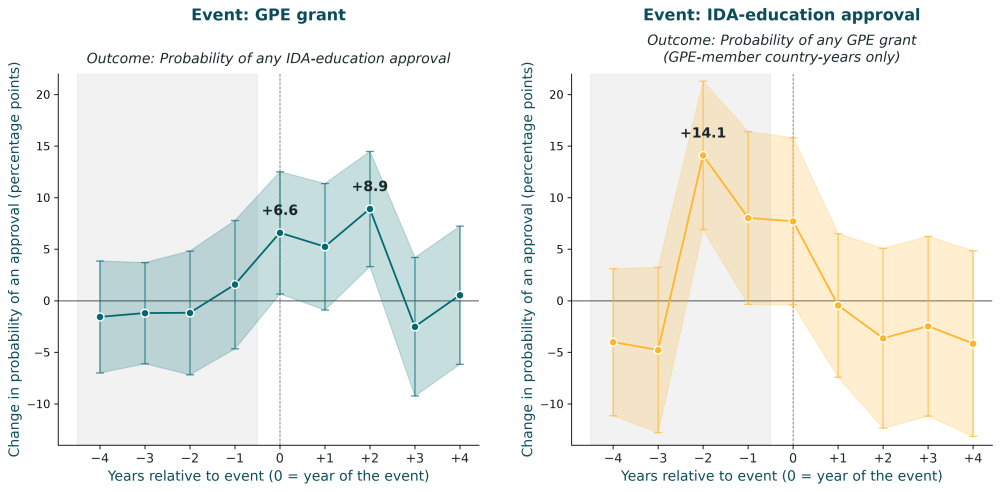
Note: Coefficients are from linear probability models including all leads and lags of the event jointly, with country and period fixed effects and non-education IDA controls. Standard errors are clustered by country and presented by 95 percent confidence intervals.
The link between GPE and IDA financing appears stronger in low-income countries, which make up 37 percent of the sample, compared with 41 percent for lower-middle-income countries and 20 percent for upper-middle-income countries. An IDA education project follows within three years of a GPE grant in about 80 percent of cases, compared with around 65 percent in lower-middle-income countries. But the amount of IDA financing associated with each GPE dollar is smaller in low-income countries at $2.50, compared with $5 in lower-middle-income countries.
The association between GPE grants and IDA lending is concentrated in basic education projects (primary and secondary school), which is exactly GPE's mandate. This should strengthen our confidence in the finding. This pattern also suggests that countries receiving a GPE grant for basic education do not redirect IDA finance elsewhere, such as technical, vocational, or higher education. Further, IDA basic education projects approved in the same years as GPE funding are no smaller, so there is no evidence of substitution on the intensive margin.
The biggest effects come from bigger implementation grants managed by the World Bank
This analysis looks at four types of GPE grants:
- Sector plan development grant to develop a national education plan (capped at $500,000)
- Programme development grant to design the specific programmes (up to $400,000)
- Programme implementation grant the largest grant type, to fund actual delivery
- Multiplier grant to match money a country raises elsewhere, at one GPE dollar for every three from a development bank or bilateral donor, or one for one from a foundation or a company. Each country has a maximum allocation for the Multiplier, ranging from $5 million to $50 million, set by the country’s school-age population.
Breaking down the effect by various GPE grant types shows that different instruments complement IDA financing at different points in the funding cycle. In the year of the grant itself, the two instruments that complement IDA funding for basic education are the programme implementation grant and the multiplier grant (Figure 3). The two smaller preparation grants (the sector plan and programme development grants) show no association in the year of the grant itself, as we would expect (Figure 4). The programme development grant has the strongest predictive power in the immediate term, while the sector plan development grant is associated with subsequent IDA financing throughout the full three-year lag period when managed by non-World Bank agents. Given that both are preparation instruments, these findings suggest that support for education sector planning and programme design may feed into the preparation of subsequent lending operations.
Figure 3. Implementation grants complement IDA in the year of the grant
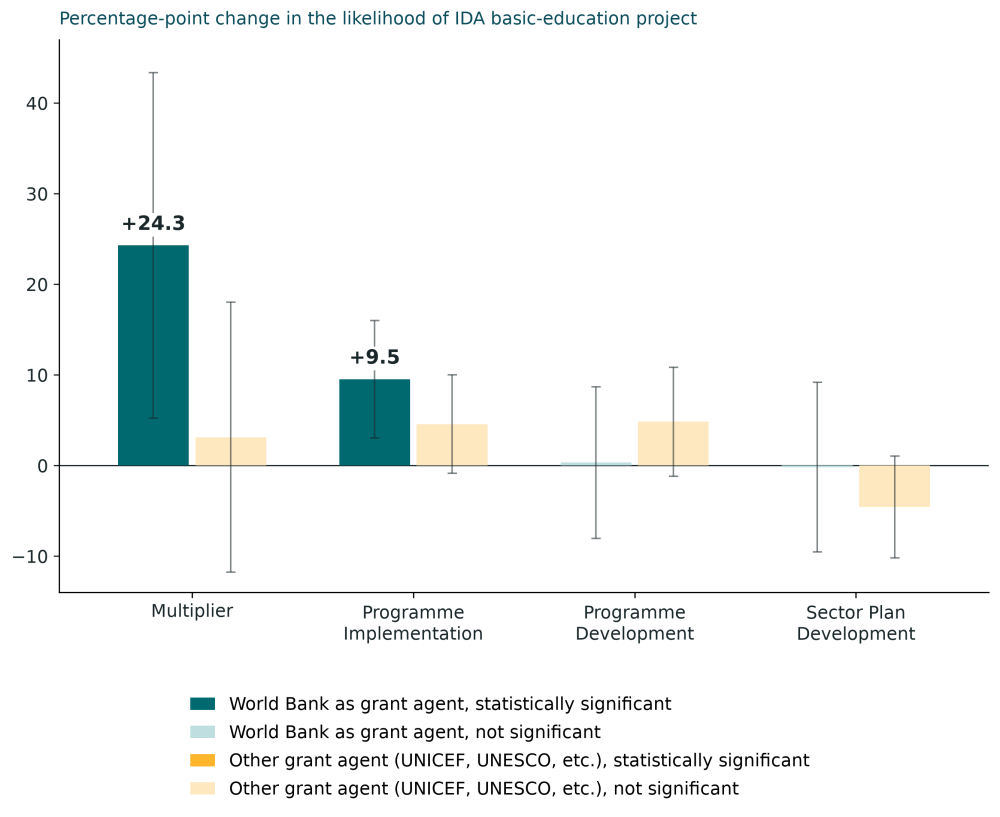
Note: In these specifications, the outcome is narrowed to IDA projects whose content is majority basic education, and the models include country fixed effects.
The association also varies with the grant agent, in ways that align with the purpose of each instrument. For the two implementation grants (multiplier and implementation grants), the contemporaneous association with IDA financing is concentrated in cases where the World Bank itself serves as the grant agent. This highlights the symbiotic institutional relationship between GPE and the World Bank. Similarly, the effects of the programme development grant are driven entirely by grants managed by the World Bank, consistent with the World Bank and client governments seeking preparation funding when an IDA operation is already in the pipeline.
Figure 4. Preparation grants lay the groundwork for future IDA financing
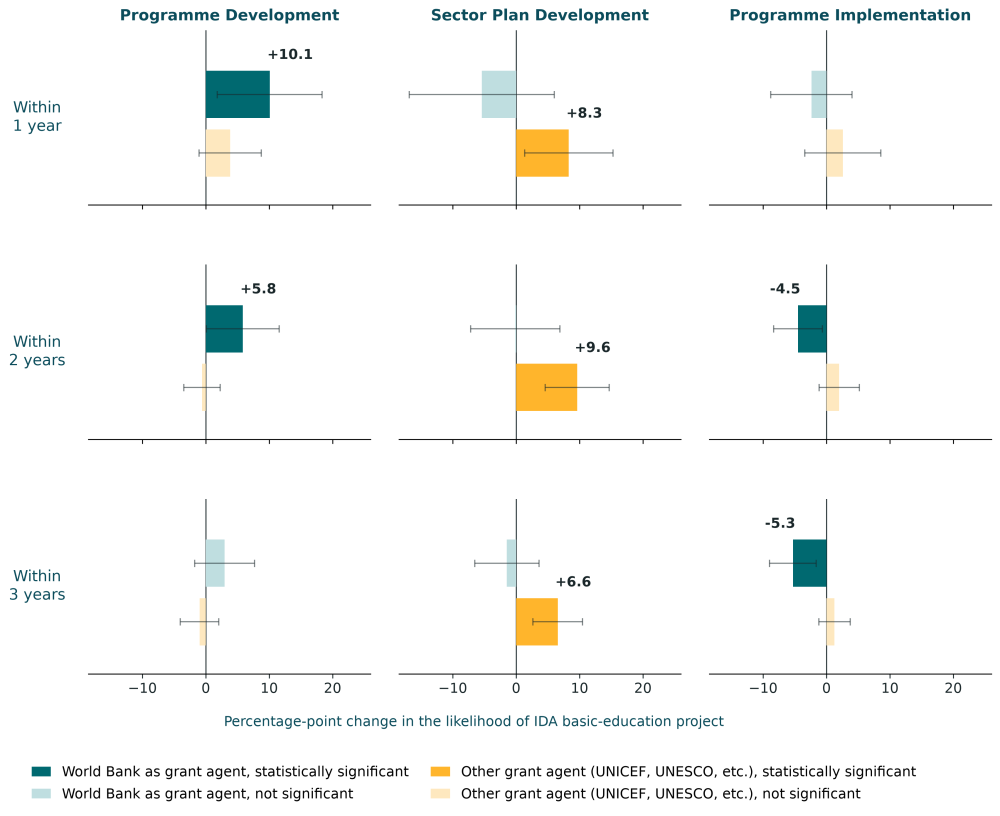
Note: In these specifications, the outcome is narrowed to IDA projects whose content is majority basic education, and the models include country fixed effects.
The pattern is reversed for the sector plan development grant. Here, the association is concentrated among grants managed by other agents, including UNICEF and UNESCO. This suggests that a strong sector plan can help countries secure more IDA financing even without the close institutional relationship between GPE and the World Bank, with the effect appearing specifically for plans developed under other agencies.
Who uses the multiplier grant instrument?
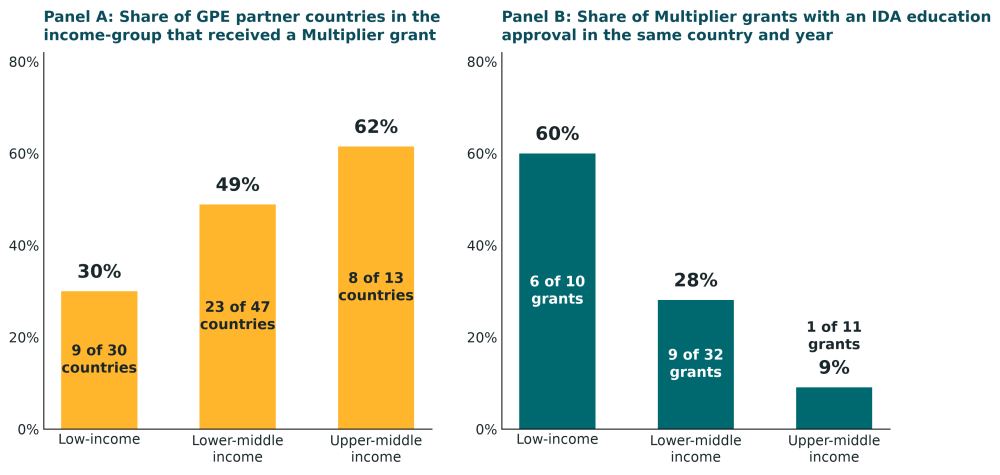
GPE introduced the multiplier grant in 2017 as an explicit recognition of its catalytic role. According to a 2023 independent evaluation, the World Bank has provided around 70 percent of co-financing by volume. Bilateral agencies (14 percent) and private foundations (8 percent) account for the remainder. Although upper-middle-income countries are overrepresented among multiplier recipients, low-income countries are more likely to receive IDA funding matched by the multiplier (Figure 5). Six in ten multiplier grants to low-income countries coincided with an IDA education approval in the same year, compared with fewer than one in ten in upper-middle-income countries, many of which are ineligible for IDA and must secure co-financing elsewhere.
The multiplier grant has been the main entry point into GPE for its newest member countries. The 21 countries that joined since 2020 have engaged almost entirely through small, multiplier grant-led packages totalling roughly $240 million, with little subsequent IDA education financing to date. GPE's expansion into middle-income countries since 2016 coincided with a fall in the share of its funding going to low-income countries, from 79 percent to 59 percent. However, stronger complementarity with IDA financing since 2016, concentrated among low-income countries, may have partly compensated for this shift by helping channel additional IDA resources to those countries.
Figure 5. Upper-middle-income countries are more likely to access the multiplier grant, but it appears to match IDA funding mainly in the poorest countries
Some important caveats are worth mentioning. First, none of this analysis is causal. Countries that receive a GPE grant might be countries that the World Bank was already going to lend to. Second, crowding in other people's money is only one thing to want from GPE. Donors should also care about what that money is buying—are children actually learning more?
Ultimately, schools in low-income countries are criminally underfunded. GPE is one of the best opportunities donors have to target foundational learning in the poorest countries, whilst leveraging government systems and other funders. Donors should pay up, on the proviso that GPE increases its focus on the poorest places and on promoting the best interventions.
Topics
DISCLAIMER & PERMISSIONS
CGD's publications reflect the views of the authors, drawing on prior research and experience in their areas of expertise. CGD is a nonpartisan, independent organization and does not take institutional positions. You may use and disseminate CGD's publications under these conditions.
Thumbnail image by: poco_bw/ Adobe Stock