Recommended

Blog Post
Why the US Should Keep Funding Global Education
Many of the large multilateral funds that finance education in low- and middle-income countries (LMICs) are seeking replenishments over the next year, and several UN education agencies are facing large gaps as a result of US cuts. With reductions in aid budgets, it is unlikely that all education multilaterals will be able to hit their targets. How should donors seek to prioritize among these different calls on their limited budgets? This blog sets out four criteria against which donors can judge and prioritize among the different funds.
What are the funds, and how much are they seeking to raise?
The Global Partnership for Education (GPE)—hosted by the World Bank—provides grants to support LMICs' own education priorities, with assistance from the World Bank in the implementation of project activities. GPE secured US$4.2 billion of its US$5 billion target for the 2021–2025 replenishment and plans to release a new investment case for 2026–2030 later this year.
The World Bank’s International Development Association (IDA) provides subsidized loans to low-income countries and is seeking its 21st replenishment (this is referred to as IDA21). IDA lending (and some grants) covers all sectors with 27 percent going to social services, including education, health and social protection. Donors pledged US$23.7 billion for the IDA21 replenishment—enough to leverage US$100 billion in financing. Pending commitments from the US (where Congress still needs to approve the US administration's request for US$3.2 billion) and the UK(whose initial pledge is currently under review) could threaten the full financing package if significantly reduced.
Education Cannot Wait (ECW) supports education in emergencies and protracted crises. It is part of the United Nations (UN) system (operated under UNICEF's rules with its own governance). ECW is seeking US$1.5 billion for its 2023–2026 replenishment, of which 60 percent has been covered, with the target for 2027–2030 yet to be announced.
Other global funds include the International Finance Facility for Education (IFFEd), a new US$1.5 billion international finance engine established in 2023 that aims to generate US$10 billion of additional funding. IFFEd is expected to be self-sustained for the first five years and will fund its first projects this year, focusing on lower-middle-income countries.
UNICEF (the UN's agency for children) anticipates roughly a 20 percent reduction in funding in 2026, largely as a result of US cuts, while the US administration is reviewing whether it will remain a member of UNESCO (the UN’s education, science and cultural agency). Other countries must decide whether to increase or cut back their funding to these agencies in response.
Finally, bilateral donors have the option to fund education programs directly through their own programs.
With limited aid budgets, how should donors prioritize among these routes to support education?
Criteria for prioritization
In some cases, there are quantitative measures of how well the different multilateral funds do against a criteria. In other cases, it will be more subjective as good data are not available. These are not the first set of principles for assessing multilaterals and aid effectiveness—there’s an alphabet soup of other approaches; GPEDC, MOPAN, CGD’s own QuODA, ATI, UK’s MAR and MDR. Most of these principles, for example, on transparency and country ownership, are sensible, but ultimately focused on process rather than impact. If what you fund can make a greater than 10x difference to the impact you have, it’s unlikely that a better process alone can make that kind of difference. Nevertheless, we take some criteria from the above indices in our criteria below.
Criteria 1: A record of funding the most cost-effective interventions in education
Aid resources will have much more impact if they are spent on programs which have been proven to have high impact per dollar invested. Even among effective programs, some deliver ten times more impact than others for the same money—making cost-effectiveness a particularly important criteria (Figure 1).
The cross-disciplinary Global Education Evidence Advisory Panel summarizes the latest evidence on what the “smart buys” are, when it comes to foundational literacy and numeracy, and increasing enrollment and attendance.
Unfortunately, it is hard to empirically classify what proportion of funding by different agencies is spent on highly cost-effective programs. That’s because most programs include many different components, some of which are cost-effective and some of which are not. And project descriptions are also often too vague to tell exactly what is being funded. Nevertheless, agencies should make their best judgment on which multilateral funds are doing the most evidence-based work. An indicator of this is the extent to which a fund’s guidance documents endorse the science of reading (a mix of phonics and oral language competence) versus discredited reading methods like “whole word” (GEEAP, 2025).
Figure 1. The best programs can deliver 10x more impact on learning outcomes for the same investment
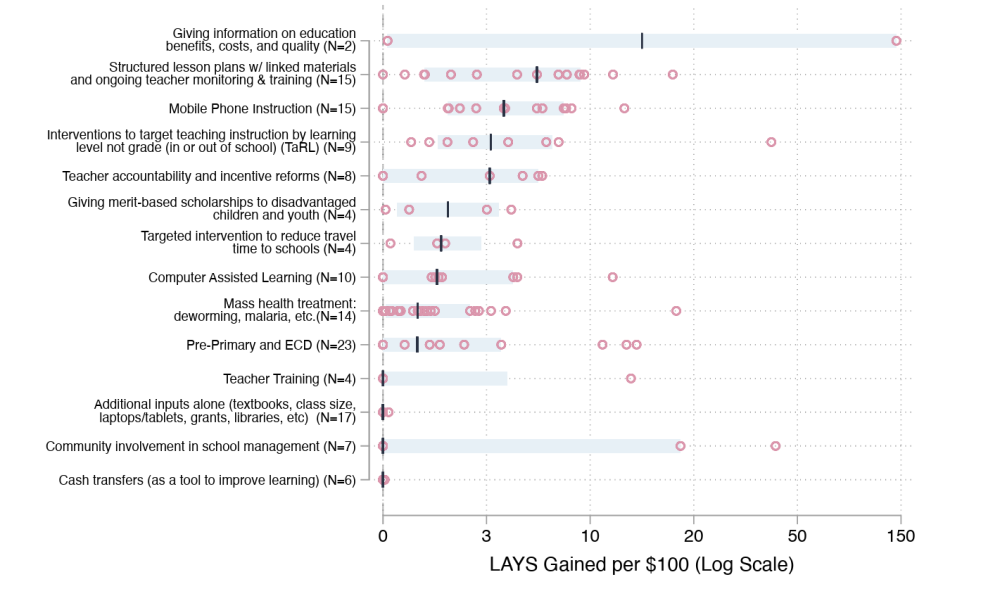
Note: Figure from Angrist, Evans, Filmer, Glennerster, Rogers, and Sabarwal.
Criteria 2: A focus on foundational literacy and numeracy
There are three reasons for donors to prioritize agencies that focus on foundational literacy and numeracy. First, children who do not acquire basic foundational literacy and numeracy skills in early grades (at least 70 percent of children in LMICs) learn less from more advanced curriculum in later years in school. Second, we know much more about how to cost-effectively deliver foundational literacy and numeracy than we do for other types of education (such as vocational training programs). Third, focusing on basic educational skills promotes equity, as it is the most disadvantaged who are at risk of failing to gain literacy and numeracy.
This emphasis should not be interpreted as a dismissal of other important education investments—such as improving teaching quality more broadly, supporting adolescent girls’ education or ensuring school safety. Nor does it imply that literacy and numeracy are the only goals that matter. Rather, the intent is to underscore that foundational learning is a prerequisite for all other learning.
Among the global funds, GPE places a particular focus on basic education (Figure 2). Similarly, USAID spent a high proportion of its funding on basic education, suggesting a big gap in this area with its demise. The high proportion of spending on post-secondary education by many bilaterals is down to programs to sponsor students from LMICs to attend university in the donor country (Japan is the exception as it spends a lot in LMICs themselves).
Figure 2. Multilateral aid and the US put a higher focus on basic education
Note: The figure shows education aid disbursed by period (US$ billions). The figure includes disbursements reported as Official Development Assistance in the OECD Creditor Reporting System and disbursements from the Global Partnership for Education based on their financial reports.
A major difference between IDA and UNICEF and the other agencies mentioned here is that the former fund sectors other than education. For a donor who wants to make sure that their funding goes to education, this could be an issue. However, we have not made this an explicit criteria as funders typically care about more than education.
Criteria 3: Poverty focus
Limited grant funding should go to the poorest countries for whom borrowing is expensive or infeasible. The three large multilateral agencies (IDA, GPE and ECW) are much more focused on the poorest countries than bilaterals (although the Netherlands and the UK have a greater poverty focus than most).
Figure 3 reports the proportion of funding given to countries of different income levels (note that it does not take into account that some agencies provide grants, while others provide loans). ECW has a particularly high concentration of funding going to low-income countries, followed by GPE. The recent start of IFFEd, which targets lower-middle-income countries, should encourage ECW and GPE to put an even greater focus on the poorest countries.
Figure 3. Multilateral education aid is much more poverty-focused than bilateral education aid
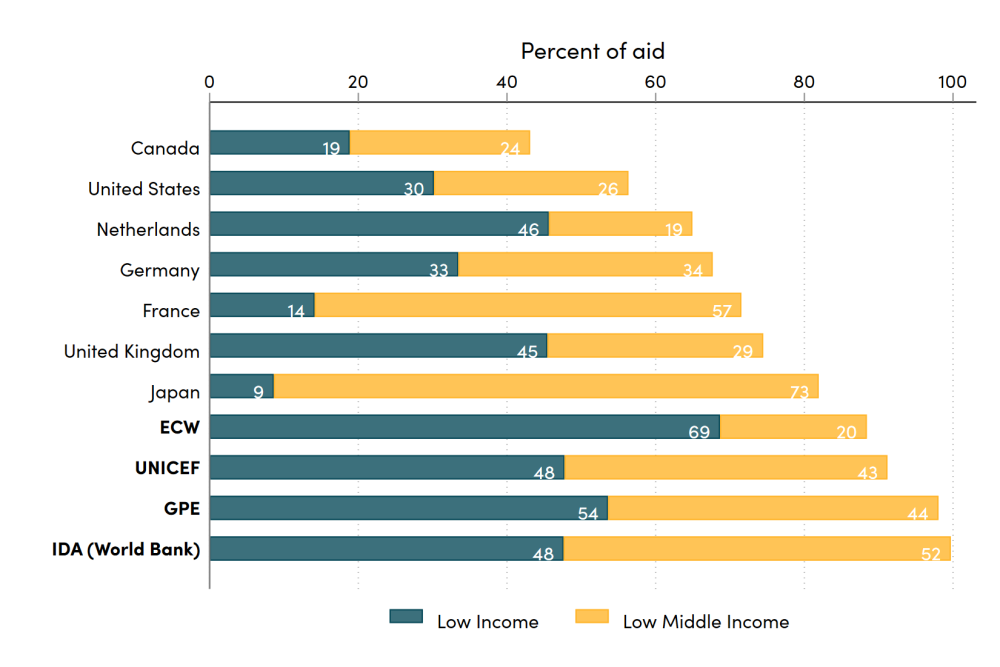
Note: This figure shows the share of aid to education from each donor that goes to low- and lower-middle-income countries. Data for bilateral donors and IDA are from the OECD CRS 2023. Data for GPE is from the average for 2019 - 2025 from their annual report, and for ECW from 2019 - 2026. Figures are based on total funding, unadjusted for the fact that some agencies provide grants while others provide loans. IDA provides more grants to poorer than richer countries, and the proportion of donor subsidy that goes to low-income countries (LICs) is higher than the proportion of funding flowing to them. Similarly, France provides loans while the UK only provides grants, which helps explain why France provides a lower proportion of funding to LICs.
Criteria 4: Maximizing financial and policy leverage
IDA’s model stands out on financial leverage. IDA uses donor contributions to leverage much larger sums through concessional lending and market-based financing—converting US$24 billion in donor contributions to US$100 billion in resources available.
Aid is most effective when it positively influences and leverages much larger domestic government spending. For example, LMIC governments tend to fund teacher salaries, while aid programs typically fund training on specific pedagogies and textbooks and thus influence what government-funded teachers teach. IDA and GPE both work closely with national governments, leveraging their systems. ECW, because it often works where governments do not reach, is less able to leverage government systems. Bilateral aid increasingly does not channel funding through government systems and ranges from funding entirely parallel delivery of education to directly financing supplies or training for government schools.
Country ownership of the programs supported with aid is relevant to policy leverage: if a government does not fully back the program, then it will not implement it well, or may abandon it quickly. However, the best education agencies and programs do not simply agree to fund a government's preferred education program, whatever the quality. For example, purchasing laptops for children is popular with many governments, even though there is a lot of evidence that laptops do not improve learning. The most effective agencies, therefore, are highly influenced by government priorities but use their expertise to nudge them towards more effective delivery of interventions.
While GPE, IDA, ECW, and UNICEF all emphasize country ownership, how they apply this varies. GPE arguably provides the highest level of country ownership, as its operating model is built around this principle, and LMICs have a stronger voice in GPE’s governance. UNICEF’s model tends to be more agency-driven, with implemented programs primarily reflecting UNICEF’s mandate. ECW is a good example of where country ownership fails as a criteria: ECW is needed partly because host countries often do not prioritize the needs of refugee children or children in parts of the country a government does not control.
In sum, two agencies may both fund highly-evidenced strategies (like structured pedagogy). However, if one mainly does so by directly supporting structured pedagogy in a few hundred schools per country, and the other uses its influence to persuade the government to introduce structured pedagogy in all government schools, the latter is likely to have a much larger impact per dollar spent.
Strategic choices to achieve maximum impact
As donors face limited aid budgets and multiple competing funding requests, making strategic choices about where to allocate resources is crucial. The four criteria outlined provide a framework for donors to assess the relative merits of education multilaterals like ECW, GPE, IDA, and UN agencies.
The evidence suggests that donors should prioritize multilateral mechanisms that:
- Direct resources to evidence-based, cost-effective programs—particularly those supporting foundational literacy and numeracy where the impact per dollar can be up to 10 times greater than less effective interventions. Donors should examine whether funds have robust mechanisms to ensure evidence-based programming.
- Focus resources on the poorest countries where financing gaps are largest and alternatives like commercial borrowing are infeasible. The data shows multilaterals generally have a stronger poverty focus than bilateral programs.
- Leverage additional resources and policy influence—both financial leverage (as seen in IDA's model of converting donor contributions into much larger financing packages) and policy leverage that can influence domestic education spending and reforms.
In practical terms, this analysis suggests that IDA offers significant advantages in financial leverage and poverty targeting, while GPE offers a specific focus on basic education. ECW fills a crucial niche in crisis contexts, though with a more limited leverage model. UNICEF, while popular with LMIC governments, tends to be less good at financial and policy leverage, and UNESCO is less poverty-focused. However, given the large variation in the cost-effectiveness of different approaches, we would suggest the most important criteria is how much each agency prioritizes the most cost-effective solutions.
As donors make difficult choices, these principles will help ensure that limited resources achieve maximum impact for children's learning in the countries that need it most.
Strategic investments in evidence-based, poverty-focused, and leveraged multilateral mechanisms offer the best path to addressing the global learning crisis and advancing education opportunity worldwide.
Thank you to Gabriela Smarrelli for helpful inputs to this blog, and to Theodore Mitchell and Yi Ning Wong for their data analysis support.
Topics
DISCLAIMER & PERMISSIONS
CGD's publications reflect the views of the authors, drawing on prior research and experience in their areas of expertise. CGD is a nonpartisan, independent organization and does not take institutional positions. You may use and disseminate CGD's publications under these conditions.
Thumbnail image by: UN Photo/Kibae Park