Recommended
The UK Foreign, Commonwealth and Development Office (FCDO) has been at the forefront of producing evidence on “what works” in development and using it to inform policy. As part of this agenda, FCDO has produced several sectoral documents specifying which types of interventions are likely to be most cost-effective based on a review of evidence— known as “best buys.”
These documents—while imperfect—could be useful to partner countries and other providers; publishing them could itself be a great way to improve systems as the government intends. But at present, FCDO’s best buy documents aren’t publicly available. These documents are too useful to be hidden away as internal documents. FCDO should publish them to allow others to build on them, encourage discussion, and positively influence recipients’ systems as well as other providers.
The birth of the best buy
The Department for International Development (DFID, the FCDO’s predecessor) was a major funder of research and evidence production in global development. By one estimate, it funded (directly or indirectly) 30 percent of published randomized control trials with a development focus, and 70 percent of those in the top five economics journals (a significant chunk of the rest came from the Economic and Social Research Council, also part-funded by UK aid). This research has a practical bent, allowing DFID/FCDO to design more effective interventions and discern between project proposals.
The “best buys” documents are attempts—spearheaded by DFID’s chief economist at the time, Rachel Glennerster (now CGD’s president)—to distil the knowledge generated by academic research into digestible summaries, categorising interventions by how cost-effective they are according to the evidence, and how strong that evidence is. They are part of FCDO’s ongoing effort to improve value for money and ensure that aid achieves maximum impact.
For example, work in the education sector has found that providing information on the value of schooling achieves orders of magnitude more learning-adjusted years of schooling than just providing inputs (for the same expenditure). The former is a great buy, the other a bad buy, according to the Global Education Evidence Advisory Panel report on learning best buys (that began its life as a DFID document).
It is not clear how many best buy documents exist. Business cases that we have reviewed have mentioned documents on humanitarian interventions (published 2018), climate (2019), education (2019), economic development (2019), and governance (2020).
Best buys influence within FCDO
These best buy documents appear to have been influential within DFID/FCDO. Business cases generally contain lengthy discussions of the evidence underpinning the proposed interventions, and since 2018 (when the first one that we are aware of was published) best buy documents are increasingly cited. At the peak in 2023, 43 percent of business cases for new projects referenced a best buys document (the share has since fallen, but there were far fewer newly published business cases in 2024-2025). And this share was far higher for projects above £40 million in value, programmes with costs above this threshold need to be reviewed by the FCDO’s Quality Assurance Unit, and so receive additional scrutiny. Such projects are nearly twice as likely to mention best buys.
Figure 1. Percent of DFID/FCDO business cases mentioning best buys by year
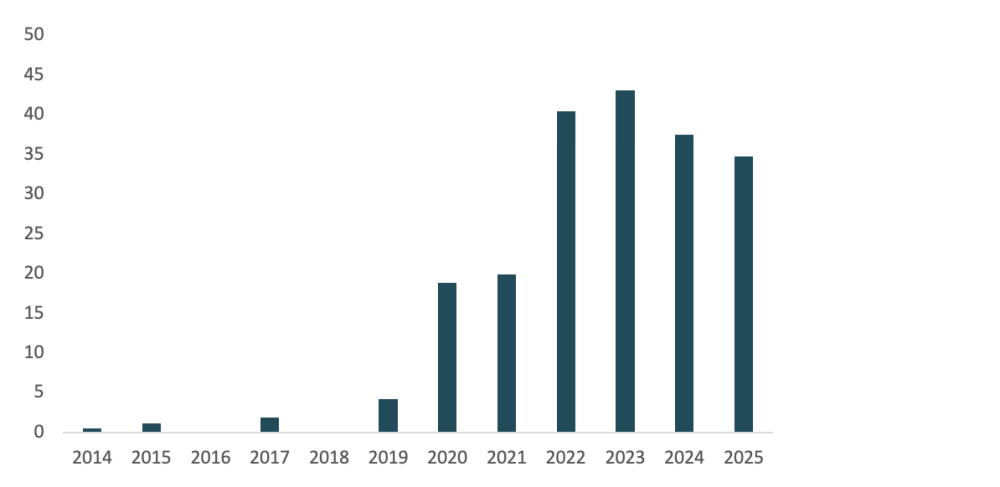
Notes: Addendums to business cases are excluded; years refer to calendar years.
Source: FCDO business cases hosted on IATI
Clearly, additional references in business cases do not necessarily mean that more aid is being spent on best buys. It may be pure signalling: that mentioning the documents makes the business case look more robust by suggesting that the programme officer has considered them. In some cases, business cases mention them only in the context of why an alternative intervention is being funded. For example, the “Transforming Access to Climate Finance” programme notes that the climate best buys paper makes “limited reference” to the intervention in question. But even if not all the interventions are selected à la carte from the best buys documents, the increase in citations suggests that, at the very least, programme officers are confronting the evidence therein.
Best buys influence outside FCDO
While the best buys have played a role in FCDO’s spend; if they were published, they could potentially influence billions of spend in other providers and national governments. This fits with the government’s ambition to move from service provision to system improvement.
This has arguably already happened in the education sector, where the UK collaborated with other aid providers to turn the best buys document into the Global Education Evidence Advisory Panel report, which is now viewed as an authoritative source of cost-effectiveness of learning interventions. In time, this could serve as a model for publishing and enhancing the influence of the remaining best buys: the collaboration with other providers alongside a panel of independent experts lent credibility to the findings. But simply putting what exists in the public domain would be a positive start.
The potential influence and impact of published best buy documents has already been recognised in some FCDO business cases. According to one (for the “Building Resilience, Inclusion and Diversity through Girls’ Education (BRIDGE)” programme), “influencing others to adopt best buys through technical assistance and government level support has been deemed a ‘mega buy’ by the UK.” This was in reference to national governments, but there is no reason to think it does not equally apply to other providers.
Obviously, aid is not provided solely to maximise impact: there are a host of other goals unrelated to averting disability-adjusted life years, increasing learning-adjusted years of schooling, or raising GNI per capita. But having assembled the evidence base in an easily digestible format for policymakers, there is surely little additional cost to sharing, with the potential benefit of influencing at least somebody. There are increasing calls for aid providers to focus on best/smart buys, and so the documents will likely find a ready audience. And this influence isn’t limited to aid. Developing countries could use this evidence in the design of their own systems. Many current FCDO programmes do not implement best buy interventions directly, but promote take-up of well-evidenced interventions. For example, one of the outputs of the “Partnership for Learning for All in Nigerian Education – PLANE” programme is to encourage the use of evidence-based learning approaches, such as teaching at the right level.
Are the best buys the best best buys?
The best buys we have seen are careful and serious reviews of the evidence that would be useful to anyone working in the area—but they rely on interpretation by the authors, and controversy around how projects are assessed may cause reluctance to publish. Collation of interventions into “great buys” and “bad buys” and so on inevitably involves a degree of judgement, and officials may not want that judgement to be exposed to external questioning. Other donors might disagree with the analysis, or at least place emphases differently. This is not necessarily just an attempt to avoid scrutiny: officials may feel strongly about their interpretation of the evidence and be concerned that different interpretations may muddy the waters for otherwise clear recommendations for policymakers.
But this is not a reason for not publishing. On the contrary, where there is controversy around the categorisation of interventions, this should be aired and explored if it is to influence (potentially) billions of pounds of aid spending. Even if best buys documents are imperfect, incomplete or have known shortcomings, publication can still inform debate and enable others to improve the assessments.
An inexpensive route to greater impact
The FCDO (and its predecessor) has done the work. It acknowledges that influencing spending from other actors is a cost-effective way to achieve greater impact. Its role in direct aid spending is greatly diminished, making this indirect impact relatively more important. So while it may trigger uncomfortable discussion as to how great some of the great buys are, there is an overwhelming case for making these documents public. And if these documents are actually influential in aid allocation decisions, there is a public interest rationale for publishing: being open about factors influencing decisions ex-ante would be a welcome step forward in transparency and also in moving to system support, expertise, and local provision.
FCDO should therefore put all of the best buy documents in the public domain, boosting both their transparency and developmental impact beyond their own spending.
Topics
DISCLAIMER & PERMISSIONS
CGD's publications reflect the views of the authors, drawing on prior research and experience in their areas of expertise. CGD is a nonpartisan, independent organization and does not take institutional positions. You may use and disseminate CGD's publications under these conditions.
Thumbnail image by: Adobe Stock Images