Recommended
Between 60 percent and 75 percent of the delay in vaccine deliveries to low- and middle-income countries (LMICs) during Covid-19 can be explained by them signing purchase agreements later than high-income countries. This partly reflects lending restrictions adopted by the multilateral development banks (MDBs) on using MDB financing to purchase vaccines before regulatory approval.
The World Bank is now finalizing a Day Zero Financing Framework that would help make sure that does not happen again. The framework would enable at-risk financing—the use of World Bank financing to buy medical countermeasures before they have received regulatory approval. At-risk financing was one of the five key recommendations of the recent G20 High-Level Independent Panel on Financing Pandemic Preparedness and Response Financing, and was recently endorsed by Gavi.
Here we set out some ideas to help secure agreement among key global health stakeholders, paving the way for Board approval ahead of the World Bank’s Annual Meetings in Bangkok.
1. Promote country ownership
Empowering countries to use their standard borrowing envelopes for at-risk financing should be the basic first step in the Day Zero Financing Framework. Without explicit action in advance to facilitate this, business-as-usual bureaucratic processes that do not reflect the urgency of a pandemic will frustrate countries seeking to make early purchases using their borrowing envelopes. We previously set out some ideas on how to facilitate their use here.
Enabling early use of country envelopes is essential because no other mechanisms can deliver financing at the scale called for by a pandemic. Analysis conducted during Covid-19 suggested that even half the optimal level of investment in vaccines for middle-income countries would cost approximately $60 billion. The IDA and IBRD envelopes are the only vehicles that come anywhere near this scale (IDA and IBRD net commitments in fiscal year 2025 were both approximately $40 billion).
2. Leverage strengths of different players
It would be useful for the World Bank to enable countries to aggregate their orders for medical countermeasures (MCMs) during a pandemic. This would reduce transaction costs, attract suppliers, and help countries obtain better terms.
Doing this effectively requires the World Bank to work together with other global health institutions, drawing on their different strengths.
What should this look like in practice?
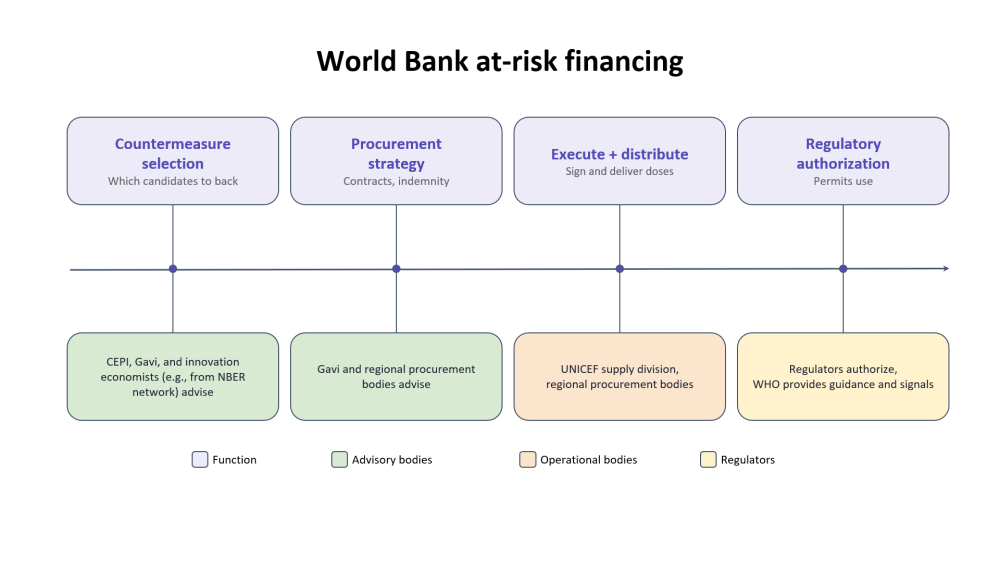
We set out how different institutions would contribute to each function.
Regulatory approval: Regional and domestic regulatory authorities would continue to provide the authorizations that permit the actual use of MCMs following clinical trials. The World Health Organization would retain its role providing advisory signals (including Emergency Use Listing) which domestic and regional regulators can follow.
Medical countermeasure selection for at-risk investment: At-risk financing involves buying medical countermeasures before regulatory approval. This requires determining which countermeasures to bet on by comparing the expected benefit from early investment (the probability of a candidate countermeasure succeeding multiplied by the health and economic benefits of accelerating its availability) to the costs. This is a distinct task from judging whether MCMs work which would remain in the remit of regulatory bodies. These candidate selection decisions should be informed by technical health and economic experts from bodies such as the Coalition for Epidemic Preparedness Innovations and Gavi, and by innovation economists from networks such as the National Bureau of Economic Research. We previously recommended establishing an expert panel in advance for this function. Endorsement from such a panel would also help country officials concerned about political and legal liabilities make at-risk investments.
Procurement strategy: Organizations such as Gavi and PAHO will have experience navigating procurement issues including contract structure and indemnity issues. The newly established African Pooled Procurement Mechanism will also gain such experience over time.
The World Bank should establish an institutional forum to benefit from their expertise. Different global health organizations will also inevitably have different rules governing the procurement and distribution of MCMs. This forum would provide a place for these conflicts to be resolved in relation to at-risk financing. Given the World Bank’s role in providing financing, it would have the final say. The World Bank should also seek economic and commercial expertise on these questions–for example, on how much funding to provide upfront to MCM suppliers.
Executing procurement: Organizations such as the UNICEF Supply Division will have greater experience signing contracts with manufacturers and distributing countermeasures to countries. The World Bank should consider delegating the execution of the procurement strategy to the UNICEF Supply Division, along with regional procurement organizations depending on the nature of the outbreak.
Figure 1. World Bank at-risk financing functions
3. Incentivize early commitments
It is important to incentivize countries to commit at-risk financing early using their own envelopes and funds. Early investment would allow firms to expand manufacturing capacity sooner, accelerating access to MCMs for all. Nonetheless, countries may hold back from proactively investing in MCMs before regulatory approval if they fear it will disadvantage them in accessing free or subsidized countermeasures later.
The World Bank should align incentives for early investment by prioritizing orders from countries that commit earlier. Other global health institutions should commit not to penalize countries that participate early in the World Bank’s at-risk purchasing. In other words, those investing their own money should not get less access to free or subsidized countermeasures than they otherwise would, given their income status.
4. Clarify the role of balance sheet action
A key area of debate is the use of the World Bank’s balance sheet. Key stakeholders would like the World Bank to be able to use its balance sheet to purchase medical countermeasures potentially before client countries have made firm orders. Using the balance sheet in this manner could help ensure rapid coverage for priority groups (e.g., health workers in the poorest countries). But there is a risk of losses on the World Bank’s balance sheet if countermeasures do not receive regulatory approval or the World Bank cannot find customers for them. Ideally this would be mitigated by guarantees and commitments from donors and early client commitments.
However, the potential for residual “naked” risk remains–that is, risk taken on the World Bank’s balance sheet, in advance of country demand, without other backing. This is a concern that could slow progress on this agenda. The World Bank should ensure residual risk remains within the appetite of its major shareholders. This could involve setting prudential thresholds that bound the risk: for example a ceiling on naked risk in relation to the International Bank for Reconstruction and Development’s (IBRD) profits. This would ensure any losses could be covered within a few years. Allocable income averaged approximately $1.5 billion over the last five years. Our rough analysis drawing on Covid-19 estimates suggests $2.5 billion (just under two years’ allocable income) would cover 64 million vaccine courses in expectation (adjusting for a high risk of failure) which could cover 5 percent of the IDA-only population. Alternatively $1.5 billion would be enough to cover 38 million vaccine courses in expectation which could more than cover 34 million key health workers in IDA and IBRD countries. We offer these as ideas—the World Bank will be better placed to propose the appropriate thresholds.
Time to act
The World Bank should secure approval for its framework whilst there is policy momentum. The reality is that there is a 2 percent to 3 percent chance every year that a Covid-19 level outbreak or worse emerges. There’s no time to lose.
Topics
DISCLAIMER & PERMISSIONS
CGD's publications reflect the views of the authors, drawing on prior research and experience in their areas of expertise. CGD is a nonpartisan, independent organization and does not take institutional positions. You may use and disseminate CGD's publications under these conditions.
Thumbnail image by: simanlaci/ Adobe Stock