Recommended

Blog Post
Cheap Toys, Toxic Consequences


Millions of children in low- and middle-income countries attend school near sites known to be contaminated by toxic pollutants such as lead, mercury, arsenic, and pesticides. In a new paper, I show exactly where.
We already knew that lead exposure hurts learning, but it wasn’t clear how schools could help to address this, since lead comes from so many different places. Polluted industrial sites are one such source of exposure, but until recently, they were considered a marginal problem, restricted to isolated hotspots. However, new evidence revealed that these hotspots cause harm over big distances, up to kilometres away, adding up to perhaps a third of the entire health burden.
In a new paper, I present new analysis overlaying spatial data on thousands of polluted sites with data on millions of school locations across 17 low- and middle-income countries (LMICs): India, Bangladesh, Indonesia, Philippines, Colombia, Ghana, Brazil, Armenia, Kenya, Vietnam, Peru, Mongolia, Mexico, Argentina, Kyrgyzstan, Cambodia, and Kazakhstan.
Over 250,000 schools—10 percent of the total—sit within 5 km of a known polluted site. Because the data on contaminated sites is so patchy, this is almost certainly a significant undercount.
Who is most affected?
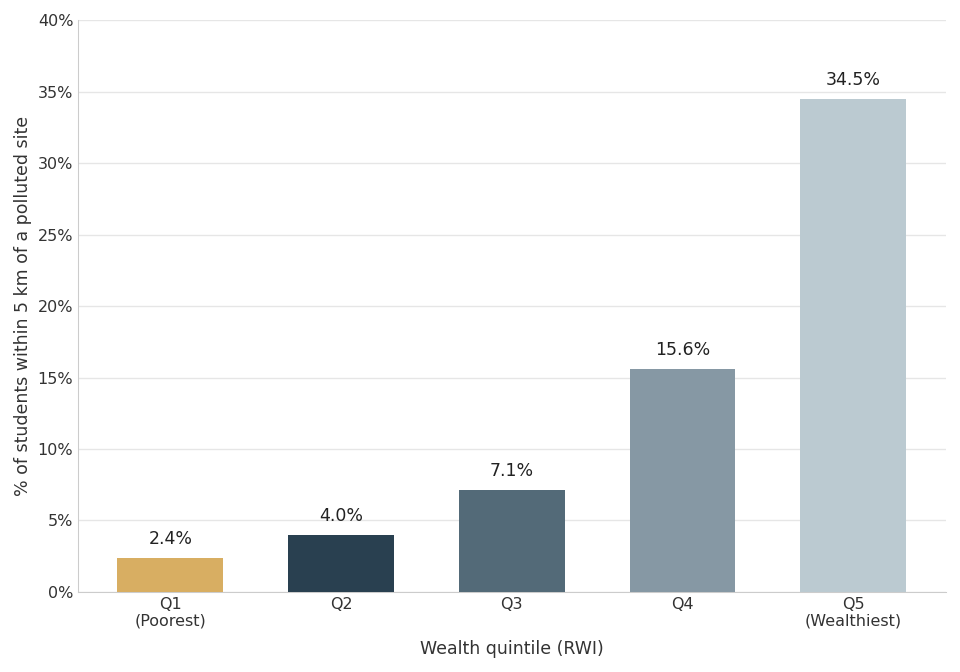
In rich countries, the burden of exposure to pollution is disproportionately borne by poor and non-white students. That pattern is reversed in developing countries, where pollution is concentrated in cities where wealthier people live. As urban schools are also larger than average, the share of students close to a site is higher than the share of schools. In the Philippines, for example, 9 percent of schools are near a polluted site, but those schools have 27 percent of all students. Across the seven countries with school-level enrolment data, over 12 percent of pupils are near a site, or roughly 43 million individuals.
Proximity to documented contaminated sites by wealth quintile
Exposure is near universal in capital cities
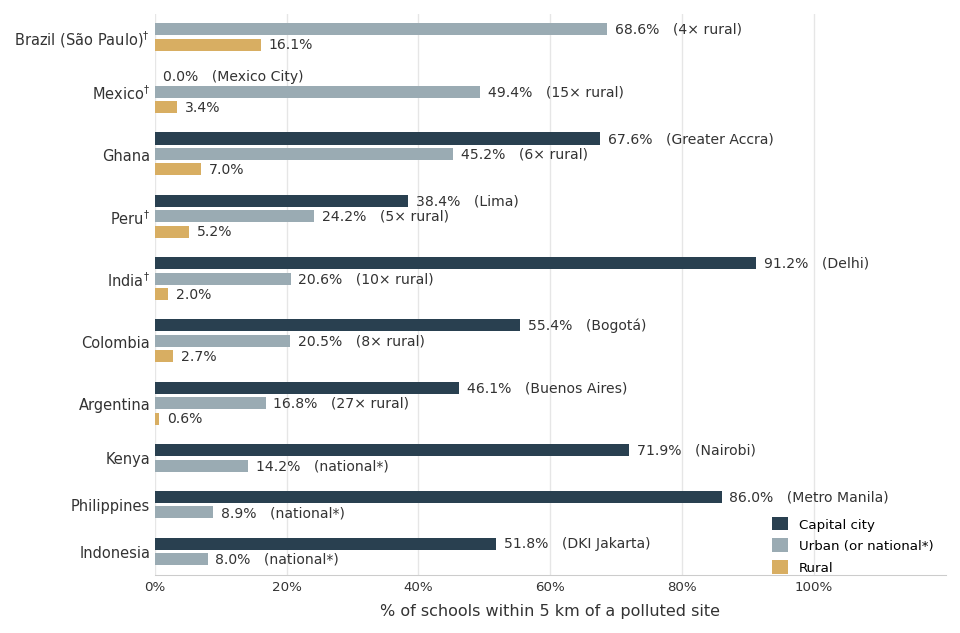
Capital cities concentrate exposure dramatically: nine of the ten capitals have proximity rates well above their national averages, led by NCT Delhi (91%), Metro Manila (86%), Nairobi (72%), Greater Accra (68%), Bogotá (55%), DKI Jakarta (52%),
Buenos Aires (46%), and Lima Metropolitana (38%). Mexico City is the striking exception—the cataloged contaminated sites in Mexico cluster in industrial corridors in Estado de México, Hidalgo, and the Bajío, so essentially no school within Mexico City sits within 5 km of one.
School proximity to documented contaminated sites, by country
Private schools are closer to pollution than public schools
One of the paper's most striking findings is that in all eight countries with data, private schools are more likely than public schools to be located near a polluted site. In Ghana, 41 percent of private schools are near a polluted site, compared to just 18 percent of public schools. The gap is consistent across Argentina, Brazil, India, Indonesia, Kenya, Mexico, and Peru.
When we control for urban location, the raw private-school disadvantage falls by more than half. Economic activity, industry, private schooling, and wealth all concentrate in the same urban cores.
These numbers are almost certainly a floor
Proximity rates vary widely across countries, but this reflects in part incomplete data on both pollution and schools. We can have more confidence in the raw numbers as lower bounds than in prevalence rates.
The Toxic Sites Identification Program (TSIP) database is the best available global inventory of contaminated sites in LMICs, but it is far from complete. One study from Ghana estimates that TSIP captures only around one in eight actual contaminated sites. My search found government registers that are substantially more extensive—for instance, in Brazil, TSIP lists 155 sites for the whole country, while the São Paulo state government registry alone has 1,270.
What this means for policy
Three things follow from these findings:
1. We need better data. The TSIP database is a great resource, but it captures only a fraction of the real picture. Governments and international organizations should invest in more systematic cataloging of contaminated sites.
2. Proximity to polluted sites might be a useful consideration in locating new schools (both public and private). Most LMICs have few regulatory requirements that prevent new schools from opening near industrial zones or known contamination. Five km is a large area, perhaps too large to avoid, but effects are worst within a few hundred metres, so there may be some margin for adjustment.
3. Schools themselves may be able to help mitigate the harms. Doing some low-cost environmental testing around schools might make for a good science project for students, and provide ammunition to push for change. More prosaically, schools in places with contaminated soil should pay particular attention to basic hand hygiene, and educate both students and parents about the risks and how to minimise them.
Schools can’t ultimately fix this problem, but they can help to raise awareness. The teachers’ union played an important role in drawing attention to the lead pollution crisis in Flint, Michigan, in the United States. Perhaps unions can play a role elsewhere.
Topics
DISCLAIMER & PERMISSIONS
CGD's publications reflect the views of the authors, drawing on prior research and experience in their areas of expertise. CGD is a nonpartisan, independent organization and does not take institutional positions. You may use and disseminate CGD's publications under these conditions.
Thumbnail image by: WESTOCK/ Adobe Stock