The Development Assistance Committee (DAC) announced last March that foreign aid from their members shot to a record $106.5 billion in 2005, from $79.5 billion in 2004 and $69.1 billion in 2003. Big debt relief deals for Iraq and Nigeria caused much of the jump. While such debt deals are welcome (and CGD played an important role in the Nigeria one), counting the deals at face value--how many billions in debt are cancelled on paper--greatly overstates their financial worth, in my opinion. Most of the debt written off would probably never have been repaid anyway. (For an economist's analysis, see Daniel Cohen's "HIPC Initiative: True and False Promises".) It can be good to forgive the debts of poor person, but doing so doesn't make her rich.With that is mind, the Net Aid Transfers (NAT) dataset, developed for the aid component of CGD's Commitment to Development Index, adjusts the standard "Net Overseas Development Assistance (ODA)" aid statistics. Results for 2005, made possible by the DAC's December release of final data for that year, find actual transfers of aid at $82.7 billion for 2005, 22% less than the official $106.5 billion figure. Still, that marks a substantial--just more realistic--increase from the 2004 NAT of $74.1 billion. U.S. aid to Iraq and Afghanistan have much to do with that. (See graphs below.)NAT actually embodies two modifications of Net ODA. First, it subtracts out interest recevied from developing countries on outstanding aid loans. Net ODA does not do that because it is a capital flow concept: disbursements of loans and repayment of principal are considered capital flows but interest payments are considered expenses or income, so net ODA is net of principal repayments only. This accounting convention makes sense for private investors, but does it matter whether a $1 million debt service check from the government of Ghana to the government of the United States says "interest" or "principal" in the memo field? Netting out both particularly affects Japan, which received $2.1 billion in interest from poorer countries in 2005.The second change is to take out debt relief. In fact, the jump in net ODA, what DAC's Richard Carey called a "debt bubble", is cancellation of old non-aid loans. When the World Bank makes a low-interest, $10 million loan to Nicaragua, that counts as aid when disbursed, so counting it as aid again when cancelled wouldn't make sense, and DAC does not do it. But many loans are not considered aid when disbursed, either because they are not for development but, say, to help foreigners buy the donors' goods (export credits); or because the interest rates are too high, such as with the near-commerical loans of the World Bank's International Bank for Reconstruction and Development arm. These are the sorts of loans that languished for years on the balance sheets of Nigeria and Iraq, and whose cancellation boosted Net ODA.The technical paper for the CDI's aid component details the calculations. The NAT dataset breaks out the numbers by donor, by recipient, and by donor-recipient pair, from the 1960s to 2005. Expect Net ODA to plunge in the years ahead after the "debt bubble" pops, while NAT holds steady--unless the U.S. withdraws from Iraq.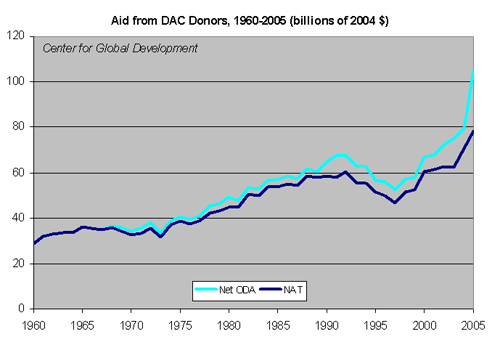

Topics
DISCLAIMER & PERMISSIONS
CGD's publications reflect the views of the authors, drawing on prior research and experience in their areas of expertise. CGD is a nonpartisan, independent organization and does not take institutional positions. You may use and disseminate CGD's publications under these conditions.