Recommended

Blog Post
How Are Countries Thinking About Violence Against Children?
Blog Post
How Are Countries Thinking About Violence Against Children?
In November 2024, the first Global Ministerial Conference on Ending Violence Against Children brought together representatives from more than 100 countries. One of its key outputs was a pledging platform, where governments and organizations set out commitments to prevent and respond to violence against children (we wrote about this here).
Over the past year, countries have reported on actions taken to address violence against children through the pledging platform. Ahead of the second Global Ministerial Conference in Manila, we review these progress reports to understand what countries are doing through their education systems and where further efforts are needed.
We find that more countries have pledged to make schools safe since 2024, with nearly three in eight countries worldwide making pledges related to preventing and responding to violence in and around schools. Of the 73 countries making these pledges, 55 reported on ongoing actions. Reported actions have focused mainly on prevention and response programs, alongside efforts to introduce new legislation and guidelines, particularly on corporal punishment. Yet many of these actions are still at the implementation stage, so we know less about their effectiveness. Strengthening data systems has received less attention, limiting countries’ ability to understand whether violence is trending upward or downward and whether policies to curb it are effective.
1. Between 2024 and 2026, more countries pledged to strengthen how education systems prevent and respond to violence in and around schools
At the first ministerial gathering, 101 countries pledged to address violence against children, making a total of 389 pledges. Since then, the number of pledges has increased to 471, with nine additional countries joining the platform, bringing the total to 110.
We find that the largest number of pledges (79)—not to be confused with actions already taken—focused on response and support services, including actions to identify, report, manage, and address cases of violence against children. Pledges on legal and policy frameworks (71) were the second most common. Actions within these and other categories play an important role in helping keep children safe, including in schools. However, they do not necessarily target education systems directly and, on their own, cannot guarantee changes in how schools prevent and respond to violence.
Pledges specifically aimed at strengthening violence prevention and response efforts within and through education systems fall under the “Safe and Enabling Environments” category. The number of countries with pledges in this category has increased from 44 in 2024 to 53 in 2026, of which 32 are low- and middle-income countries (Figure 1). When we also include pledges under other categories that explicitly refer to actions related to education systems, the total number of countries with education-related pledges increases to 73.
Figure 1. Country pledges across time by income group and region
2. Half of pledging countries report actions to address violence in and around schools, with most describing ongoing initiatives
Seventy-five of the 110 countries that made pledges submitted a progress report ahead of the second Global Ministerial Conference. While some countries described progress that directly corresponds to the original pledge, this was not always the case. We therefore examine the types of actions countries reported under each category, rather than assessing whether individual pledges had been fulfilled.
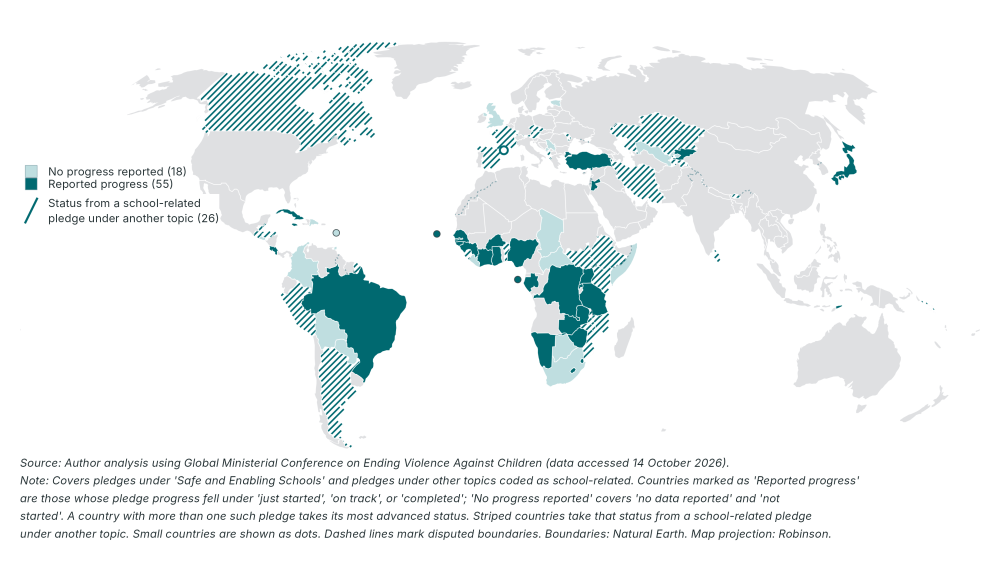
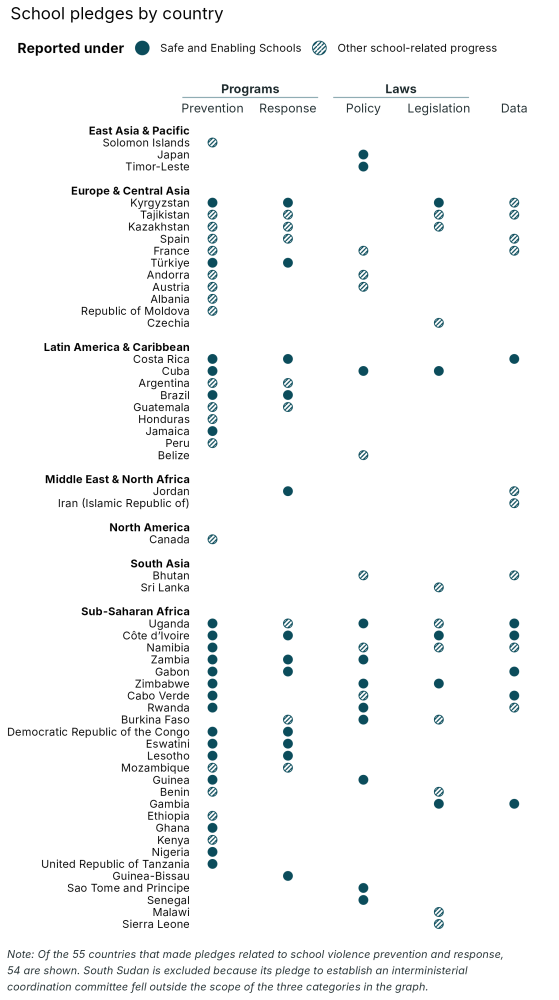
When looking at the progress reported under the “Safe and Enabling Schools” category, as well as in other categories with explicit references to actions related to education systems, we find that 55 countries reported progress related to education systems (Figure 2). Of these, 29 reported under the “Safe and Enabling Schools” category, and 26 additional countries reported actions to prevent violence in and around schools under other categories.
Of the 55 countries, 13 were low-income countries and 35 were middle-income countries (20 lower-middle-income and 15 upper-middle-income). Only six were high-income countries, suggesting lower participation among high-income countries in pledging and reporting on violence prevention, even though violence in and around schools remains prevalent in these settings: in OECD countries, around 20 percent of children report experiencing bullying.
Reported actions look different across countries, and the majority describe ongoing initiatives. Across the 55 countries, 28 reported actions related to enacting national legislation, guidelines, and strategies; 38 reported programs to prevent and respond to violence in and around schools; and 15 reported efforts to strengthen data systems. Moreover, the level of detail provided in the progress reports also varied: only 28 countries attached a budget to their pledge.
Figure 2. Country pledge progress on safe and enabling schools
3. Laws and policies are advancing, but implementation and enforcement remain critical
Fifteen countries reported progress in advancing laws, including legislation on corporal punishment bans and mandatory reporting laws (Figure 3). Cuba, for example, enacted the 2025 Code on Childhood, Adolescence, and Youth, which reaffirmed and prohibited corporal punishment in all settings, explicitly banning corporal punishment in schools for the first time. In Czechia, an amendment to the Civil Code explicitly prohibiting corporal punishment in all settings took effect in January 2026. Other countries reported progress toward legal reform. The Gambia, for example, reported developing a national roadmap prohibiting corporal punishment.
Eighteen countries reported publishing new national guidelines, such as teacher codes of conduct or curriculum development. Zambia’s Ministry of Education developed a National Safe School Manual for learners and education personnel, along with child safeguarding guidelines for schools. In Kyrgyzstan, curriculum standards are being revised to integrate issues related to violence against children, including online sexual exploitation, cybersecurity, and life skills, into relevant subjects.
Laws, national guidelines, and regulations are essential to signal that violence in schools is unacceptable and to set clear standards for how schools should act. Yet causal evidence of their impact remains scarce. Descriptive evidence on corporal punishment bans suggests the effects of bans can be mixed, particularly when weakly enforced and not complemented with actions to shift the norms that sustain violence. Evidence from the US on antibullying laws shows that their effectiveness was lower in states with weaker enforcement. Programmatic actions, discussed next, can help translate these regulations into behavioral change.
Figure 3. Country-level progress types
4. Prevention and response programs include actions that have been shown to work in some contexts
Thirty-three countries, more than half of those reporting education-related progress, described actions related to violence prevention programs (Figure 3). Examples include positive-discipline training for teachers and activities to strengthen students’ social and emotional skills and self-regulation. Thirteen countries also reported implementing or plans to implement awareness initiatives or campaigns, such as distributing pamphlets or organizing events that engage the broader community.
Evidence suggests that some of these approaches can reduce violence, though their effectiveness varies. In El Salvador, for example, an after-school program that strengthened social skills, impulse control, and conflict management reduced reports of student misbehavior and improved learning. In Uganda, the Good School Toolkit, which sought to change school culture and promote positive discipline, reduced teacher-to-student physical violence by 42 percent. Evidence on the impact of awareness campaigns on violence reduction is more limited. While these strategies can support advocacy and knowledge building, they don’t always translate into violence reductions. In the US, for example, a program focused on raising awareness of sexual harassment improved students’ attitudes but did not reduce victimization. Experiences in other fields—including radio and television shows and campaigns that influenced health-related behaviors in Burkina Faso, Nigeria, and Brazil—suggest that well-designed mass-media approaches may have potential. Whether similar approaches can reduce violence in and around schools remains to be tested.
Twenty countries reported actions related to strengthening violence reporting and response systems in schools. Uganda and Lesotho, for example, established child helplines and messaging services to facilitate reporting. Brazil reported on a “School That Protects” program, which trains education professionals in violence prevention and emergency response planning and supports school networks. Mozambique reported actions to strengthen reporting, response and referral processes for school-related violence prevention through training to students and teachers.
These systems are an essential complement to prevention: children need safe, accessible ways to disclose violence and receive appropriate support. Evidence from specific contexts points to the benefits of these investments. For example, in Mozambique, an intervention called Está na Hora de Agir (It’s Time to Act), implemented in 2021 in coordination with the government, trained students on how to seek support and teachers on how to manage cases of violence, and reduced teacher-perpetrated violence against girls by around 67 percent. (The country's current efforts may be building on this earlier experience.)
5. Efforts to strengthen data systems and data-informed decision-making are lagging
Data (as we have highlighted before) are crucial to understanding whether violence is reducing over time and to making evidence-informed policy decisions. Yet only 15 countries reported progress in strengthening data systems among the 55 countries reporting school-related actions.
The reported actions include conducting national surveys, which measure the prevalence of violence, and creating monitoring systems, which record violence cases and responses. In Iran, multiple ministries jointly developed a set of child-rights indicators, including indicators on preventing violence against children, to lay the groundwork for more systematic data monitoring. Jordan launched a digital case management platform to coordinate responses to family violence and has rolled it out across different settings, including 60 schools.
Building data systems is challenging. It requires careful decisions about what data to collect and how, strong safeguards to protect children, and sustained investment. Experiences from different countries show it is possible. In Latin America, for example, Colombia and Peru have built systems to record and monitor cases of violence, which have helped signal the scale of the problem and the need to invest in improving school systems to prevent violence. In Kenya, the Violence Against Children Survey found declines in sexual, physical, and emotional violence between 2010 and 2019, with some progress attributed to public health interventions introduced after the first survey.
Three priorities for the road ahead
The progress reports show that countries are taking steps to make schools safer: 55 of the 110 countries that made pledges reported education-related actions. (This is not a complete picture of national efforts, since countries that did not make pledges may also be working to prevent violence in schools.) The pledging platform has provided an important opportunity for countries to share their experiences and learn from one another. As ministers gather in Manila for the second Global Ministerial Conference, the next phase must move beyond commitments and reported activities toward sustained implementation, stronger accountability, and a clearer understanding of impact.
Looking ahead, we would like to see more progress in three areas:
- Reinforce coordinated, sustained action across sectors. Education, health, social protection, and justice actors need to work more closely together, with schools connected to the wider services children need. Relatedly, education systems should not be seen as separate from the broader response, but as a key entry point for addressing violence against children in and beyond school settings.
- Strengthen data systems and evidence on what works, where, and how. As much as we need to learn from what countries are implementing, we need to understand the challenges, costs, implementation lessons, and evidence of results. Stronger data systems and a stronger culture of monitoring and evaluation are central to this effort: they can help countries monitor trends, assess whether programs are working, and improve responses when children report violence.
- Strengthen connections and collaboration across governments and with civil society and researchers. More opportunities are needed for governments to exchange experiences and learn from one another, as well as to build stronger connections with civil society organizations, practitioners, and researchers working to prevent violence against children. These connections can support implementation, generate evidence, and help sustain momentum for further action.
Many thanks to David Evans and Sally Zweimueller for feedback on this post.
Tune in to the second Global Ministerial Conference on Ending Violence against Children to watch the session co-hosted by CGD, UNICEF, the Safe Schools Secretariat, and the Coalition for Good Schools on data and evidence for action. Check the full conference program to discover other exciting sessions and events you can join online, even if you are unable to attend the conference in person.
Note: Analysis for 2024 pledges is computed from original commitment documents accessed November 21, 2024. Data from 2026 were downloaded on October 14, 2026. This means that our analysis does not include new progress reports submitted by countries after October 14 and total counts might differ with those in the pledges platform. Pledge counts are derived by unique country-topic combinations for temporal comparability.
Topics
DISCLAIMER & PERMISSIONS
CGD's publications reflect the views of the authors, drawing on prior research and experience in their areas of expertise. CGD is a nonpartisan, independent organization and does not take institutional positions. You may use and disseminate CGD's publications under these conditions.
Thumbnail image by: JuanSt/ Adobe Stock