Global aid is entering a period of retrenchment. After a decade of expansion, budget announcements for 2025 point to cuts across major donors, driven by fiscal tightening and competing domestic and international priorities. For education, this squeeze compounds an earlier trend: even as overall aid grew by more than US$100 billion since 2014, only a small share went to education. Basic education, heavily reliant on a few donors, is particularly vulnerable.
Yet these shifts may not be permanent. Crisis-related aid currently absorbs around half of all aid, but it may not dominate indefinitely. When fiscal space begins to open, sectors able to demonstrate effectiveness and readiness to scale will be well placed to attract resources.
In this piece, Susannah Hares and Jack Rossiter analyze the trajectory of education aid, the risks of further retrenchment, and how the sector can prepare to position itself for future opportunities. This is the fourth of CGD’s biennial updates on global education aid finance—you can read the previous updates from 2023, 2021 and 2019 here.
David Evans
Director, Global Education and Child Well-Being Program and Senior Fellow
Center for Global Development
Let’s start with some maths. Which is the larger fraction: A. or B. ?
That, in short, is the story of education aid over the past two decades. It has risen by US$4 billion in each decade, yet its share of overall aid has shrunk sharply as portfolios have shifted, as we explain in a new report. In the decade running up to 2014, total aid grew by US$34 billion and education captured a sizable share of that. Since 2014, total aid has grown by US$118 billion, but education has captured only a fragment of that increase (Figure 1).
The current driver is clear: crises, especially the war in Ukraine, have absorbed almost 80 percent of new aid resources. Like health and agriculture, education is steadily losing ground and risks being forgotten altogether by some donors.
Figure 1. There was 118 billion more aid in 2023 compared to 2014. This is where it went.
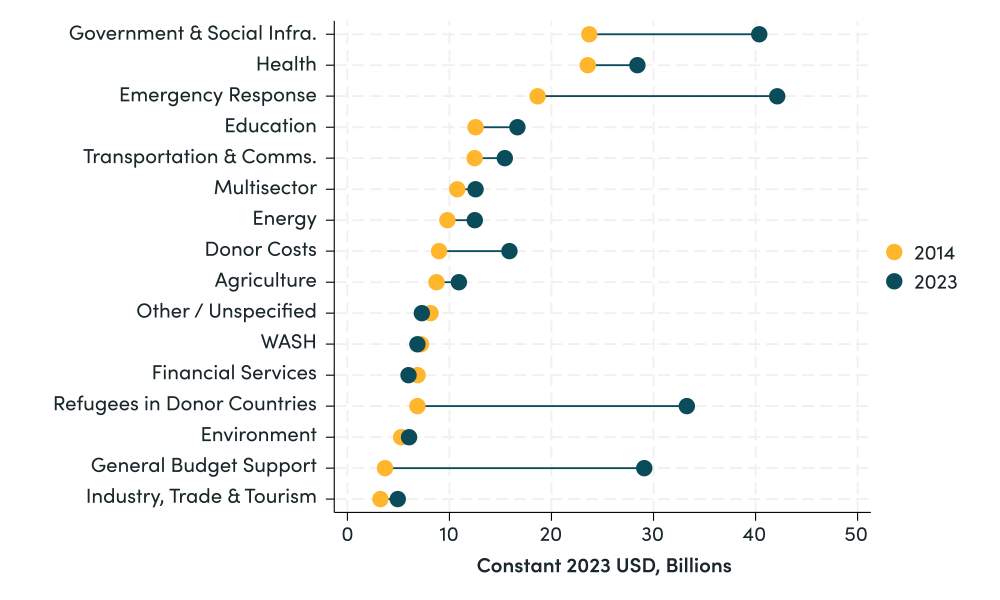
Source: OECD DAC CRS database for given years. Notes: disbursed volumes of aid, by sector. Gold dot represents total aid to each sector in 2014 and teal dot in 2023.
This change matters for two reasons. First, international education aid has played a catalytic role in many systems, financing important interventions like early-grade literacy, girls’ schooling and the prevention of violence. Second, aid is on track to fall further. Budget announcements and medium-term expenditure plans from major donors suggest that overall aid may contract by 9-17 percent this year. Projections show education aid falling back toward mid-2010s levels, even in moderate scenarios, with sharper declines if some bilateral donors withdraw from basic education altogether (as some, like the UK and the US, have indicated this is a real possibility).
Figure 2. Aid to education is projected to fall to at least 2016 levels
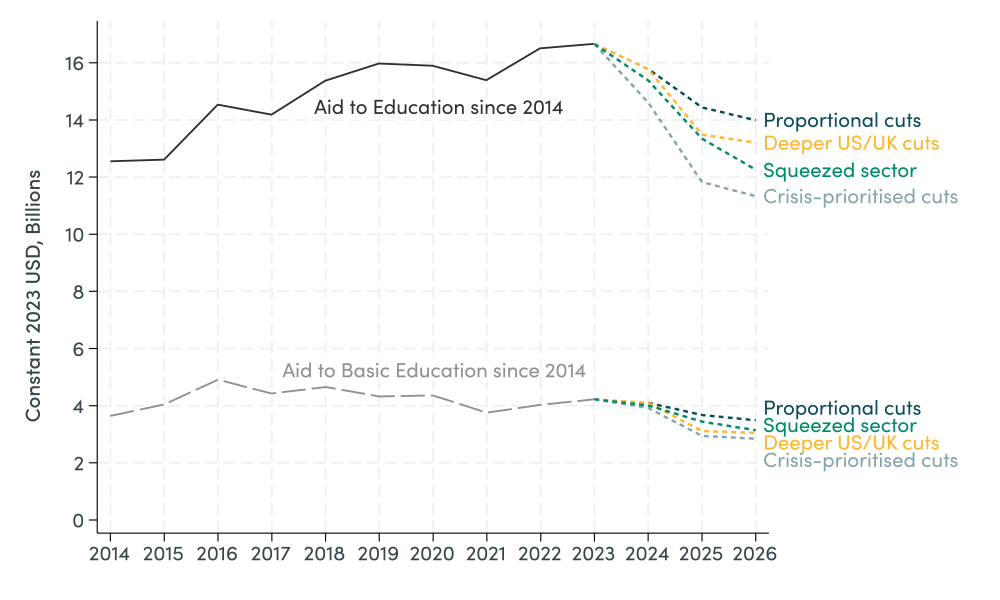
Source: OECD CRS (2014 to 2023 values); authors’ calculations for 2024 to 2026 based on scenario assumptions in the report. Notes: we model four scenarios (1) ‘Proportional cuts’: donors reduce aid according to policy-stated cuts, uniformly across sectors; (2) ‘Deeper US/UK cuts’: baseline plus US exits education sector and UK halves its education allocation; (3) ‘Squeezed sector’: education’s share of aid continues to fall in line with historical trend; and (4) ‘Crisis-prioritised cuts’: crisis sectors are protected at current levels and others including education are cut more. These four scenarios, their assumptions, and how they are constructed is explained in the report in full.
Basic education squeezed the hardest
Aggregate figures also mask important changes within the education sector itself. The composition of aid has shifted in ways that leave basic education particularly exposed. A decade ago, one-third of education aid went to primary and lower-secondary education. By 2023, that share had fallen to one-quarter. In the same period, allocations to post-secondary education rose steadily, now reaching nearly 40 percent of the total.
Much of this growth reflects ‘imputed’ tuition costs: an accounting practice possible only in countries where governments cover tuition, under which the value of study by students from developing countries (e.g. a Ugandan studying in Germany) is counted as aid. These costs now account for roughly one-fifth of all education aid. While they may be an effective tool in development cooperation, they do not directly expand or improve school systems in recipient countries.
Figure 3. Changing donor composition is driving shifts in sub-sector allocations
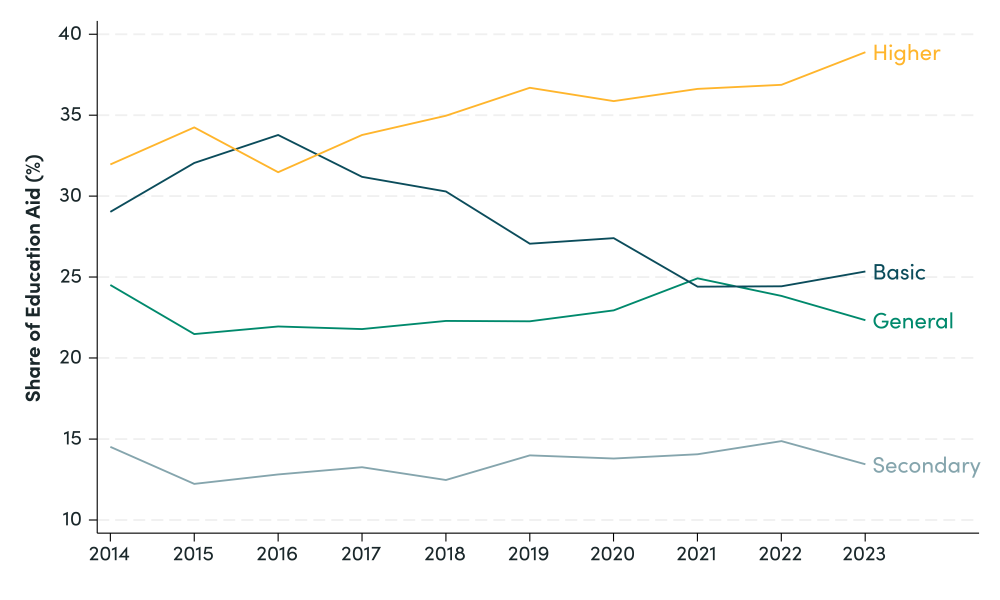
Source: OECD CRS database for given years. Notes: shows change in sub-sector shares of aid disbursed in each year. Following OECD classifications, Basic includes lower-secondary and Higher includes imputed costs of students studying in donor countries.
The donor landscape compounds this vulnerability. Nearly half of all global education aid comes from five actors: Germany, the International Development Association (IDA), France, the United States, and EU institutions. Their portfolios vary considerably. Germany and France emphasise post-secondary support, with a heavy emphasis on imputed tuition costs, while the United States and United Kingdom have historically directed a majority of their allocations to basic education. This concentration means that retrenchment by one or two donors has disproportionate effects. A total withdrawal by the United States, for instance, would reduce global basic education aid by almost US$1 billion annually.
For some countries, these shifts carry immediate implications. On average, aid constitutes less than 10 percent of education spending in low- and middle-income countries. But in highly aid-reliant systems such as Liberia, Malawi and South Sudan, external support accounts for 20–40 percent of education budgets. In Liberia, a single donor’s retrenchment scheduled for 2025 would cut nearly US$100 million in multi-year education programmes, including literacy and numeracy initiatives. In Malawi, nationwide projects financed by external partners, such as a US$74 million early-grade reading programme and a US$150 million system reform initiative, are at risk if donors scale back. In both cases, reductions would not simply slow progress; they would reshape what governments can deliver at the most basic level.
Figure 4. In 2026, many countries will get tens of millions less aid than in 2023
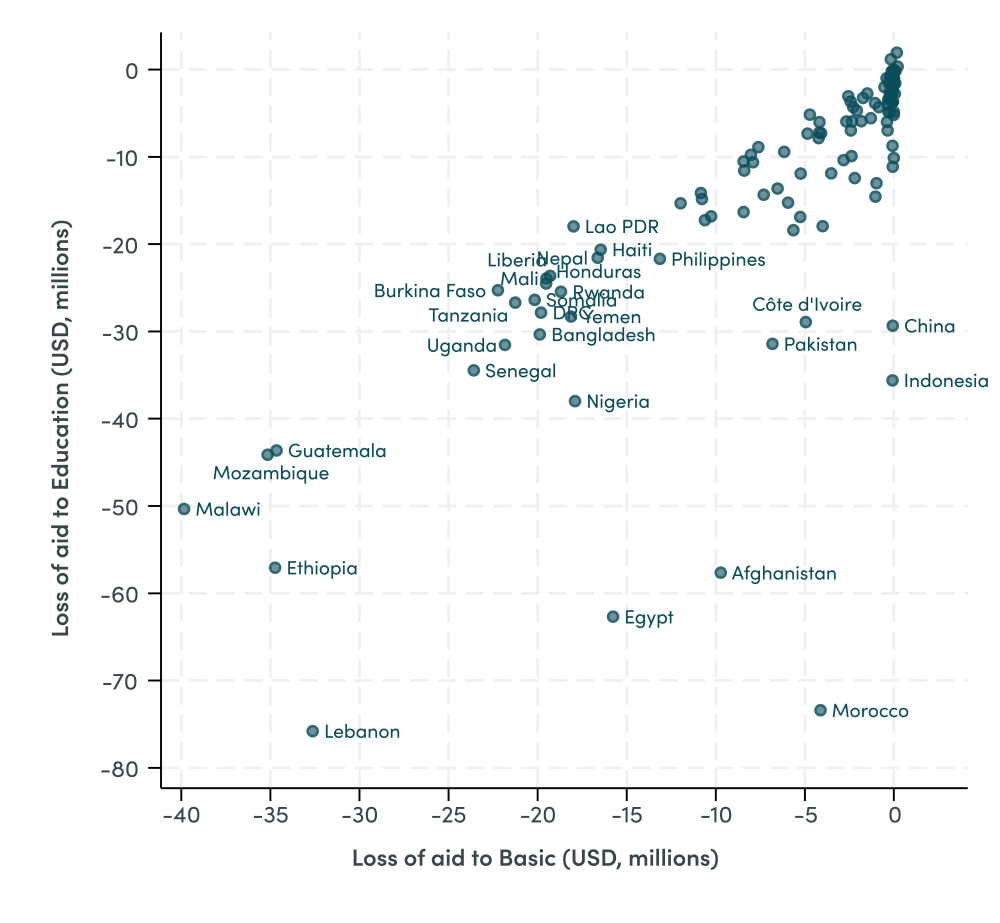
Source: OECD CRS; authors’ projections under the “Deeper US & UK Cuts” scenario. Notes: shows the change in aid received by each country in 2026 compared to 2023. See report for full notes and explanation of each scenario and its projection.
What can be done to cushion the impact of education aid cuts?
Although overall fiscal space for aid is tightening, several options exist to mitigate the impact of cuts on basic education.
First, strategic rebalancing within existing portfolios. Donors with large allocations to post-secondary education could redirect a modest share toward primary schooling. Even a 10-15 percent reallocation from scholarship-heavy portfolios could free several hundred million dollars per year for evidence-based foundational learning programmes. While politically complex, as imputed scholarship costs are not “money” that can easily be reallocated, this form of rebalancing would align better with countries’ objectives to improve basic education, including foundational learning and girls schooling.
Second, engage mid-sized donors. Countries such as Canada, Norway and South Korea together provide more basic education aid than any G7 donor apart from the United States. If each increased their support by 10–15 percent, the sector would gain an additional US$100–150 million annually. These contributions would not offset large-scale cuts, but they would reduce concentration risk and, importantly, broaden the coalition of supporters who invest in evidence-based foundational learning programmes.
Third, preserve the commitments of major donors. Advocacy that focuses on maintaining, rather than expanding, existing levels of basic education funding can have outsized returns. For example, preventing a single cut by the United States or United Kingdom safeguards more financing for primary education than could be generated by many smaller increases elsewhere.
Fourth, strengthen multilateral channels. IDA now delivers about one-quarter of all basic education aid worldwide, and the Global Partnership for Education and Education Cannot Wait also direct substantial resources to foundational learning. These funds can act as stabilisers when bilateral programmes are reduced, and when bilateral agencies are stripped of expertise. With GPE’s replenishment approaching, and its leadership considering how to sharpen priorities, there is an opportunity to ensure that the most effective education interventions for children, those that deliver measurable improvements in learning and wider life outcomes, remain at the centre of country grants and reporting.
Fifth, getting ready now for more investment in the future. The role of multilaterals also points directly to the sector’s longer-term readiness. Crisis-linked categories currently absorb about half of all aid, roughly US$150 billion. These allocations will remain essential in the near term, but they are not permanent. If refugee, humanitarian, and conflict-related expenditures fall back even part-way toward pre-crisis levels, tens of billions of dollars could be reallocated. Capturing a larger share of that future space will require education actors to present a strong investment case, backed by evidence of effectiveness, costs, and long-term impact on health and economic prosperity.
To seize such opportunities, multilateral funds in particular will need to demonstrate the capacity to scale quickly and deliver results beyond disbursement. They are praised for strong country leadership and for targeting resources toward low-income countries and foundational skills. But to be positioned to attract major resources when fiscal conditions ease, they will need to do much more: supporting countries during programme design to use quality evidence, and during delivery to assess whether their funding improves learning and other education outcomes, and for whom.
Protecting education in a period of aid retrenchment
The trajectory of global education aid is downward in the short term. The contraction reflects structural changes in the aid system, not simply shifts within education. But the impact will be uneven: basic education, which relies heavily on a small set of donors, is especially vulnerable. For countries such as Liberia, Ethiopia and Malawi, cuts could translate directly into stalled reforms for girls schooling or universal secondary education, and abandoned literacy and numeracy programmes.
Mitigation is possible. Modest reallocations within existing portfolios, increased commitments from mid-sized donors, and stronger multilateral channels can reduce the scale of losses. At the same time, we suggest the sector must take a longer-term view, preparing to capture resources when crisis-related spending diminishes. This kind of readiness, backed by strong evidence and delivery capacity, will determine whether education regains priority in the global aid agenda. The question is not only how much aid education receives now, but whether the sector can do the groundwork now to position itself to secure future resources, and translate them into outcomes for children.
Topics
DISCLAIMER & PERMISSIONS
CGD's publications reflect the views of the authors, drawing on prior research and experience in their areas of expertise. CGD is a nonpartisan, independent organization and does not take institutional positions. You may use and disseminate CGD's publications under these conditions.
Thumbnail image by: Oleksandr/ Adobe Stock