Recommended
Event
Annual Bank Conference on Development Economics 2025
HYBRID
July 22, 2025 8:00—2:30 PM ETAt this year’s Annual Bank Conference on Development Economics, Markus had the privilege of moderating a panel titled “How can Development Economics Meet the Moment? Practice, Research, and Teaching in a Time of Unilateralism and Polycrisis.” In preparing for this panel, we put together a bunch of data that indicates the volume (rate) of research on sub-Saharan Africa remains low (albeit improved), the (immediate) relevance is generally missing, and representation is still lacking.
1. Rates: How often Africa appears in top journals
A study published in 2013 by Jishnu Das (one of our panelists) and coauthors reports that, from 1985 to 2005, only 34 empirical economic papers published in the top five economic journals focused on a sub-Saharan African country. We found that there has been progress since then: Searching the top-five economic journals for papers focused on the five most populous countries (Nigeria, Ethiopia, DRC, Tanzania, South Africa) or the region as a whole yields 38 empirical articles over the last 10 years, so an increase over Das et. al. However, these still represent a very small number of the total articles published, as shown below.
Empirical economic research papers focused on sub-Saharan Africa as a share of total journal publications (2015-2025)
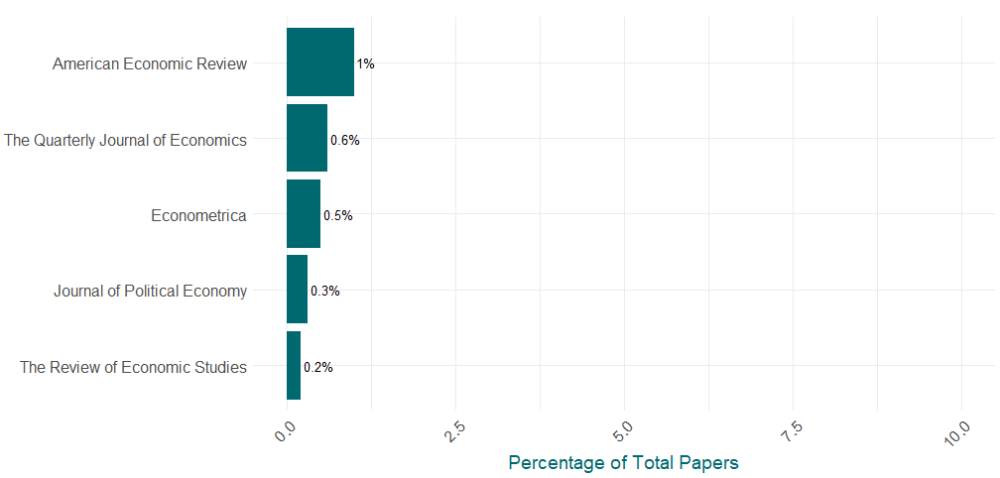
Source: top 5 economic journals browsers* (2015–2025) and authors’ analysis
* with search terms: #Sub-Saharan Africa, #Nigeria, #Ethiopia, #DRC, #Tanzania, #South Africa
2. Relevance: Whose questions are we asking?
As the panelists noted, even rigorous studies often reflect external academic incentives rather than local policy needs. The debates dominating ministries, parliaments, and communities across Africa rarely shape the articles that make it into journal pages.
We informally surveyed a range of advisors to leaders on the continent about what their main policy concerns are. Their list was (in no particular order):
- Job creation and youth employment
- Macroeconomic stability, debt management, and revenue mobilization
- Diversifying the economy, value addition, and structural transformation
- Energy access and infrastructure (roads, water, railways)
- Governance, institutional stability, and security
- Food security
- Human capital and education
- Private sector development
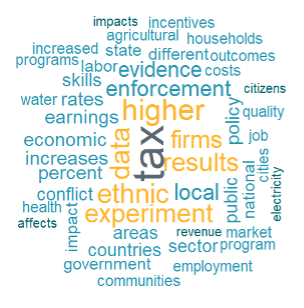
As pointed out by panelist Oriana Bandeira during the discussion, not all research must (or even should) answer immediate policy needs. But one might expect that at least some of the empirical economic research on poor countries would align with these concerns on the ground. The following word cloud comes from a text analysis on title and abstracts of the 38 empirical papers we identified in our exercise, showing little overlap with the list above.
Most frequent terms in titles and abstracts from papers focusing on sub-Saharan Africa published in the top-five journals (2015-2025)
Oriana raised whether we were asking relevant questions (when pursuing basic research) and alluded to the fact that this could be hampered by the lack of African representation in our coauthors. In her words, “in many cases, we [foreign researchers] are not even conscious that there is a possibility that things work differently than they do in the country we live.”
We now turn to the third “R”—representation.
3. Representation: Who is doing this research?
Even when African countries are studied, the work is largely produced by researchers based outside the continent, or outside of any developing country. Author affiliation data from our sample of 62 recent articles (including empirical, theoretical, and regional papers) indicates that just 5.2 percent of the authors publishing on sub-Saharan African are affiliated with an African institution.
Institutional Affiliation of Authors by Country
| Country | Number of Authors | Share (%) |
|---|---|---|
| USA | 94 | 54.0 |
| UK | 28 | 16.1 |
| Canada | 7 | 4.0 |
| France | 5 | 2.9 |
| Switzerland | 5 | 2.9 |
| Germany | 4 | 2.3 |
| Italy | 3 | 1.7 |
| Other African Countries | 9 | 5.2 |
| Other Developed Countries | 12 | 6.9 |
| Other Developing Countries | 3 | 1.7 |
| Not mentioned | 4 | 2.3 |
| TOTAL | 174 | 100.0 |
Source: top 5 economic journals browsers* (2015–2025) and authors’ analysis
* with search terms: #Sub-Saharan Africa, #Nigeria, #Ethiopia, #DRC, #Tanzania, #South Africa
Knowing that affiliation might be misleading giving how often authors from the developing world conduct research on their original countries or continents from institutions located in developed countries, we analyzed authors’ personal websites in search of identifying their origins. We found that roughly 10.3 percent of the authors were born or received their undergraduate education in an African country.
Leonard Wantchekon, another of our panelists, pointed out an “agency gap” that is evident in the absence of African scholars in decision-making (editorial) roles at top journals. For instance, the Journal of Development Economics has never had an African editor—a structural barrier that poses a critical question about the origin of the epistemological authority of these editorial boards. In his words, “in this globalized world, it should be possible to create high-level, top-quality institutions in the continent, where all you need to do, perhaps, is to be mobile. To go three or two months somewhere to get connected to what is happening elsewhere.”
From diagnosis to action
The data leaves little doubt: the field faces a triple challenge when it comes to sub-Saharan Africa:
- The geography of research is still incomplete: as much as the interest in sub-Saharan Africa grew during the last decades, large parts of it remain understudied.
- The representation gap persists: African scholars are rarely in positions to set the research agenda.
- The questions we ask often diverge from the questions policymakers on the ground need to answer and/or may be constrained in their choice or their approach by the absence of African researchers.
Closing these gaps will require deliberate choices and ultimately a systematic approach. However, panelists proposed a set of concrete starting points:
- Diversifying editorial boards to include African scholars and amplify their role in setting priorities. Journals like World Development have begun appointing more Africa-based editors, showing that representation can shift when it’s a stated priority (and maybe a different notion of epistemological authority).
- Investing in high-level, Africa-based research institutions to build and retain talent locally. Initiatives such as the African Economic Research Consortium have built long-term capacity by funding local PhDs and research programs. The African School of Economics (which Leonard founded) provides another example of how this can be homegrown.
- Structuring partnerships for leadership and frameworks that ensure local researchers steer the agenda rather than only execute it. Jishnu had a good example of this in practice.
As Leonard put it, “if it’s possible in India and Latin America, it should be possible in Africa too. We need to work on developing local capacity, not just to get by, but to compete globally […] I am not going to be asking an American Ivy League university to be training the best African economists. For sure they will contribute, but African universities have to be the ones doing that, and it is not nearly as difficult as we think.”
The goal is not simply more research about Africa. It is to support the conditions for Africans to tell their own economic story, and for that story to shape both global scholarship and local policy.
Topics
DISCLAIMER & PERMISSIONS
CGD's publications reflect the views of the authors, drawing on prior research and experience in their areas of expertise. CGD is a nonpartisan, independent organization and does not take institutional positions. You may use and disseminate CGD's publications under these conditions.