Recommended

Blog Post
A Lead-Free Future: Finally On Its Way?

Blog Post
What We’re Learning about Lead
Solar energy is a central plank of the green energy revolution, with widespread adoption in high-income countries and low- and middle-income countries (LMICs) alike. In LMICs, these technologies—and off-grid solar systems, in particular—are favored by individuals and development partners for their apparent win-win-win: rapid and low-capital deployment, lower CO2 emissions, and cheap(er) electricity generation. But off-grid solar requires battery storage—and in LMICs, that still largely means lead-acid. While there’s nothing inherently dangerous about lead-acid batteries, their unsafe disposal and recycling—which is unfortunately common in LMICs—can drive severe environmental lead contamination, poisoning workers and surrounding communities.
In a new policy paper, we investigate the role of lead-acid batteries in the off-grid solar revolution taking place across sub-Saharan Africa. We sought to answer two simple questions: first, to what extent are lead-acid batteries from off-grid solar contributing to regional lead poisoning? And second, what exactly can funders, international institutions, and national governments do to promote a truly “green” roll-out of off-grid solar? The short answer is “quite a bit”—but the longer answer is more complicated.
Off-grid solar can help solve sub-Saharan Africa’s energy crisis
Expanding electricity access to sub-Saharan Africa is a high-priority development goal for governments, donors, multilateral development banks, and citizens. Most prominently, the World Bank, the African Development Bank (AfDB), and other partners are now aligned behind Mission 300. This is an ambitious initiative to increase the region’s low access rate via new connections for 300 million additional people by 2030 (Figure 1). Off-grid solar is expected to play an important role in this effort. Experts estimate that off-grid solar would be the least-cost method of electrification for about 55 percent of unelectrified households, and Mission 300 anticipates that almost half of new connections will be provided via off-grid systems.
The off-grid solar market in sub-Saharan Africa is largely unregulated
The market for off-grid solar technologies in sub-Saharan Africa is diverse and hard to characterize with any level of certainty. There is a two-way split between the “regulated” and “unregulated” sectors. The regulated market is broadly defined by several (largely overlapping) standards and certifications that ensure minimum quality; almost all regulated products use (more expensive) lithium-ion batteries, and we believe they make up a little less than a third of overall off-grid solar volumes. The remaining ~70 percent are unregulated—which means we have almost no real data on the market composition and characteristics. From anecdotal and case reports, our best understanding of the unregulated market suggests it consists mostly of component-based (versus plug-and-play) systems, relies heavily on imported Chinese components, and uses primarily lead-acid batteries instead of alternative chemistries.
The picture varies significantly by country. For example, upwards of 97 percent of Rwanda’s off-grid solar market is regulated; customers can use pay-as-you-go (PAYG) financing schemes to afford the higher up-front costs, and in turn benefit from a warranty, higher-quality, and longer-lasting battery. In neighboring Tanzania, however, only about 28 to 40 percent of the off-grid solar market is regulated.
In sub-Saharan Africa, most ULAB recycling is unsafe
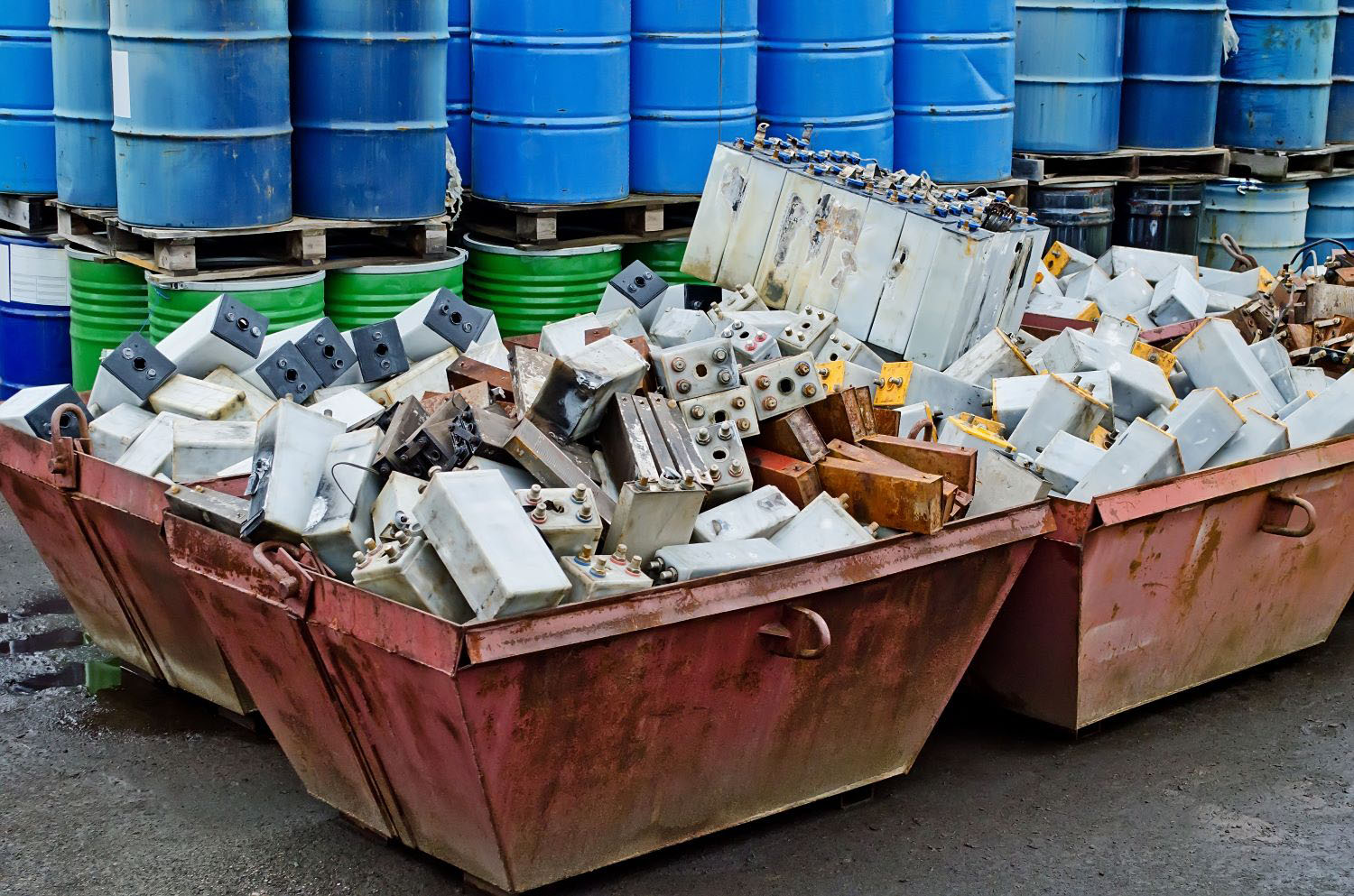
When lead-acid batteries are spent, they are collected via an informal network and fed to recyclers. The majority of ULAB recycling in sub-Saharan Africa is highly polluting. In the most dangerous circumstances, recycling of ULABs occurs in suburban backyards by untrained workers without any personal protective equipment, which can leach up to 50 percent of recoverable lead into the environment. More commonly, lead is recycled in formal, large-scale but substandard industrial facilities—with somewhat higher lead recovery rates, but still unacceptable losses to environmental contamination.
Unsafe ULAB recycling is a major driver of regional lead exposure, which in turn is a severe and wide-ranging threat to health and development. Lead is a dangerous neurotoxin disproportionally affecting children. It is linked to cardiovascular disease, stunted cognitive development, coma, seizures, paralysis, and even death in extreme cases. In sub-Saharan Africa, an estimated four in ten children have blood lead levels above 5 µg/dL, the level at which the World Health Organization recommends clinical intervention. New research from Crawfurd et al. suggest that a substantial amount of this poisoning comes from the unsafe recycling of ULABs.
Off-grid solar may be responsible for up to half of sub-Saharan Africa’s lead-acid battery waste
In our findings, we necessarily rely quite a bit on scattered fieldwork, anecdotes, and estimates; there’s simply not sufficient data on these topics to come to high-confidence conclusions generalized across the region. Nevertheless, to put the scope and scale of the problem into context, we attempted to estimate the contribution of off-grid solar to overall ULAB waste. We find that off-grid solar products could be contributing between 13 to 47 percent of all ULAB waste in sub-Saharan Africa (Table 2). We think the real number likely falls in the upper half of that range—but again, it is hard to say with any certainty.
So what can we do about it?
We find that the World Bank and other development partners almost exclusively purchase off-grid solar systems from the regulated market—which mostly uses lithium-ion batteries. That means that development partners are not directly driving significant ULAB waste from off-grid solar—but they do have a role to play in fixing the problem.
While we’d have loved to find a magic bullet economic or policy tool, regulatory solutions that severely penalize lead pollution offer a more cost-effective and sustainable path forward. There is no simple shortcut here, but instead a need for long-term investment (including from development partners) in increasing governmental and citizen awareness of lead’s dangers, strengthening regulatory frameworks, and building and deploying enforcement capacity. Mission 300 is an excellent opportunity for the World Bank and other development partners to get this issue on the agenda with partner governments—and deliver on the full promise of green off-grid solar energy access.
Topics
DISCLAIMER & PERMISSIONS
CGD's publications reflect the views of the authors, drawing on prior research and experience in their areas of expertise. CGD is a nonpartisan, independent organization and does not take institutional positions. You may use and disseminate CGD's publications under these conditions.
Thumbnail image by: International Monetary Fund/ Flickr