Recommended
WORKING PAPER
Mass Media and Contraception Use
Blog Post
Reproductive Rights and Women’s Economic Empowerment

In our obsession with new technologies (drones, TikTok, artificial intelligence), it’s all too easy to forget the power of old-school technology like radio. From talk radio in the US to small community radio stations in Burkina Faso, billions listen regularly. Across Africa, it is the main source of news after friends and family.
The power of this simple, cheap technology to change behavior and political accountability has been demonstrated across the globe. In Brazil, local radio coverage of audits of local government led voters to turn out corrupt politicians (areas where audits were published before elections saw a fall in votes for corrupt politicians, but only in areas with local radio stations). In Sierra Leone, where most people vote based on ethnicity, access to local radio stations (which covered local politics) led people to cross party lines and vote for politicians they thought were good, ignoring ethnicity. In Burkina Faso, a radio campaign increased practices associated with higher child survival. As with other technologies, this power is not always used for good: villages in Rwanda that could receive the signal of Radio Television Libre des Mille Collines saw higher violence during the genocide.
In a new paper, Victor Pouliquen, Joanna Murray, and I show that in Burkina Faso, where not all households can afford a radio, simply having access to a radio changed behavior in profound ways. A family planning campaign run by Development Media International (DMI) on the radio successfully combatted misinformation, increased the use of contraception, and reduced unwanted pregnancies.
To test the impact of standard radio programming and the family planning campaign, we ran a randomized controlled trial with DMI covering 5.1 million people in Burkina Faso. Because national radio in Burkina Faso is in French and most people don't speak French, most listen to local community radio stations broadcasting in the local language (which differs by area). DMI contacted 16 radio stations, all of which agreed to participate, and we randomly picked 8 to air the campaign (Figure 1). After surveying women in both treatment and control radio station areas, we randomly chose some without radios in their households to receive wind-up radios that did not need batteries. A chance of winning a lottery at the end meant most (95 percent) kept their radios throughout the study.
Figure 1. Research design: A two-level randomized experiment
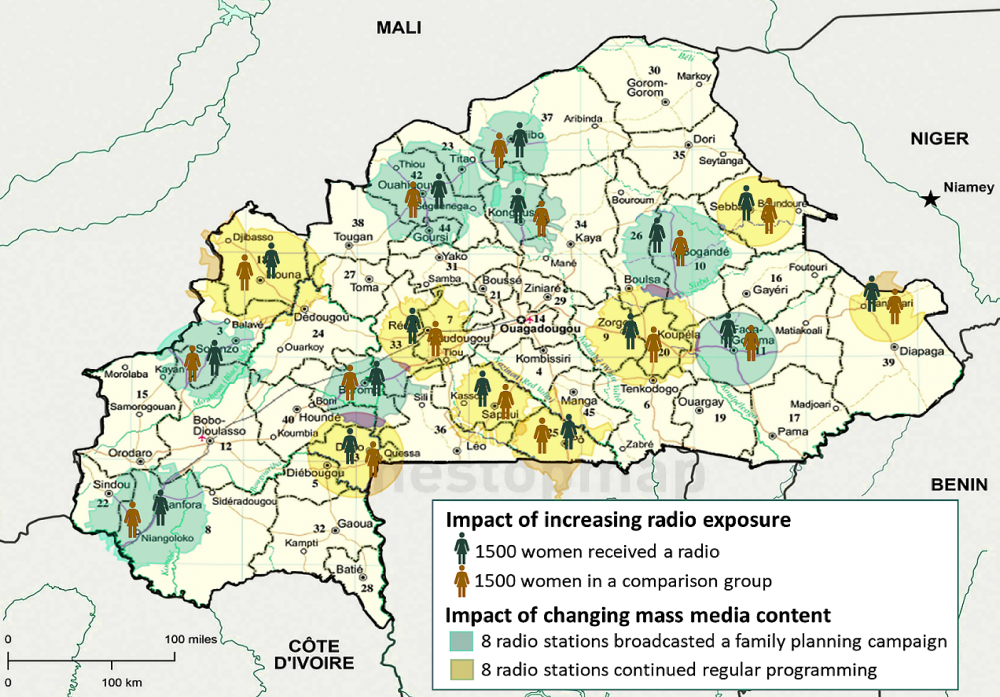
Note: Broadcasting areas of the 16 local radio stations included in the study.
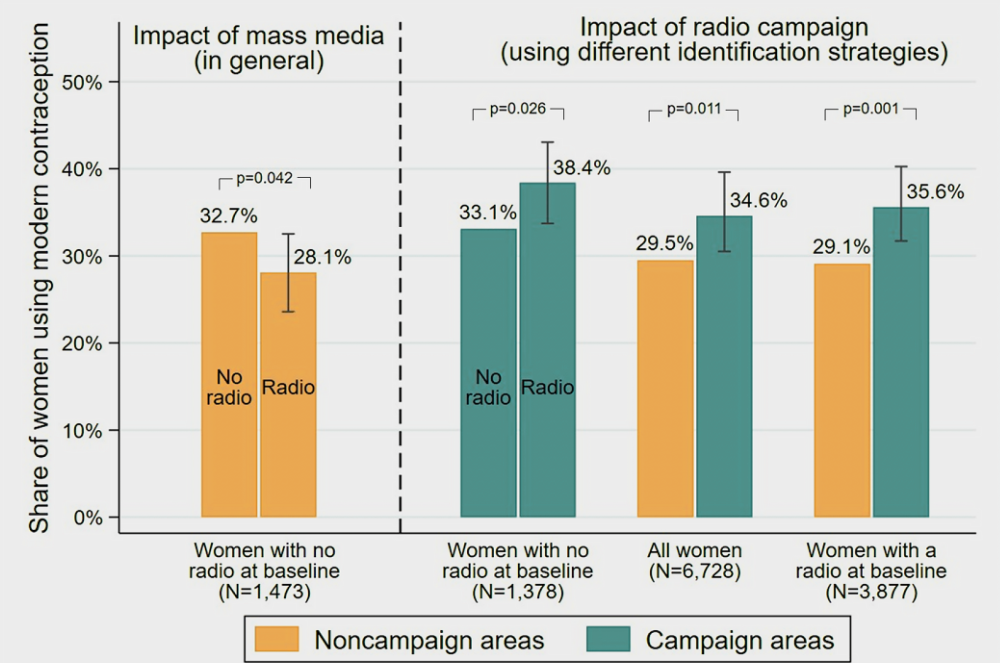
Women who received radios in control areas (i.e., listened to normal community radio) reduced their use of contraception by 4.6 percent. This is in contrast to conventional wisdom about the impact of the arrival of mass media, and previous mass media studies. While women did hear international news and government family planning messages on their radios, they also heard call-in shows reflecting the views of society around them (where the typical woman does not use contraception). Thus, both our study and previous studies found that listeners tend to adopt the behavior of other listeners. As we explain in our paper, this is contrary to a popular theory that mass media inevitably reduces fertility by reducing the importance of family and clan. All these studies suggest that mass media can profoundly change personal decisions like using contraception.
The radio campaign by DMI explained the different types of contraception and addressed misinformation—for example, the belief that contraception can make you permanently sterile. The campaign increased contraception use both among women who already had a radio by 6.5 percentage points and among those given a radio in campaign areas by 5.3 percentage points. Women who had wanted to avoid pregnancy at the outset responded most strongly, and women in areas where the campaign aired reported higher life satisfaction (by 0.25 standard deviations). Feeling in control of your own fertility makes you happier!
Figure 2. Impact on modern contraception prevalence rate (mCPR)
Radio campaigns are very cheap compared to other types of outreach, even intensive and highly professional campaigns like DMI’s. The cost per additional couple using contraception was US$39 per woman per year. When DMI scaled up the program to the whole country, the cost per additional couple using contraception was US$7 per woman per year.
Radio is also particularly effective at reaching communities affected by conflict. Parts of Burkina Faso were already in conflict when we ran our final survey (we had to interview women by phone but got similar results). Conflict has worsened since our study, but DMI continues to get its programming out. To learn about their other campaigns, see www.developmentmedia.net.
Don’t underestimate the power of radio!
Topics
DISCLAIMER & PERMISSIONS
CGD's publications reflect the views of the authors, drawing on prior research and experience in their areas of expertise. CGD is a nonpartisan, independent organization and does not take institutional positions. You may use and disseminate CGD's publications under these conditions.
Thumbnail image by: World Bank Photo Collection/ Flickr