Recommended
Dalia Is Still Here (Dalia sigue aquí) is an 11-minute animated film directed by Nuria Menchaca. It recounts, visually and heartbreakingly, the tale of eight-year-old Dalia as she searches for her father in Mexico.
Source: Still image from the short film Dalia Is Still Here / Dalia sigue aquí
Disappearances in Mexico are sadly, strikingly common. Each year, tens of thousands of people go missing (Figure 1)—and those official numbers are likely underestimates. Nearly one in three haven’t been located. The rise in disappearances in recent years is mostly attributed to the drug trafficking industry and the battle against it. In her book, researcher Lene Guercke lists a wide range of documented causes: human trafficking, forced recruitment into criminal organizations, and secretly disposing of the deceased, among others.
Figure 1. New disappearance records per year in Mexico, by current status
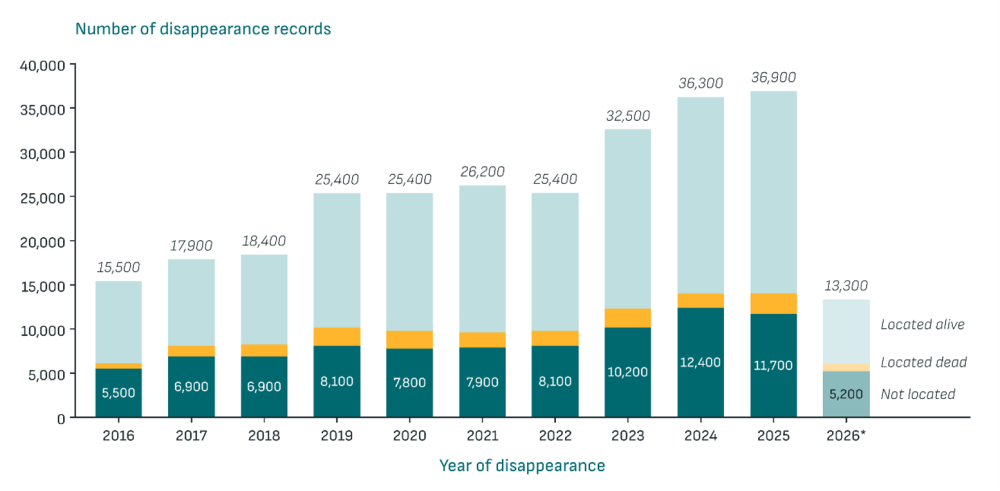
Source: Approximate calculations drawn from Data Cívica’s cumulative figure, drawing on RNPDNO data (a national registry of disappeared persons). * Data extend only through mid-August 2026, so 2026 is incomplete.
There are studies from around the world—Armenia, Burundi, Eritrea, Guatemala, Mexico, Nigeria, Peru, Rwanda, Vietnam, among many others—that demonstrate that growing up in the context of violence adversely affects children’s outcomes. (Evidence from Nigeria shows that even children in the generation after the one directly affected by conflict are less likely to survive or to get an education.) There are many other studies that show the adverse impact of losing a parent—in Indonesia, Kenya, and South Africa, for example. The impacts are clear, consistent, and adverse. Conflict is bad for children. Losing a parent is bad for children.
Quantitative studies on the impact of growing up in conflict or losing a parent usually focus on outcomes that are easily measured in large surveys, like years of education achieved or malnutrition. They are less likely to measure impacts on areas like socioemotional skills, emotional health, and quality of relationships. The evidence we do have on these less consistently evaluated outcomes suggests that these areas are negatively affected as well.
In the case of disappearances, some adults are found, as the figure above shows. While we lack quantitative evidence on the impact of losing a parent and not knowing if you’ll find them again, qualitative interviews with adult relatives of disappeared persons in Mexico indicate severe emotional distress, manifesting in suicidal thinking, anxiety, irritability, and more. (Relatives of people who disappeared during the Pinochet dictatorship in Chile report similar challenges.) Mexican scholars have referred to this phenomenon as cuerpo ausente (absent body), where families remain in unresolved grief, with likely ripple effects throughout their lives.
Menchaca’s short film seeks to capture the emotional cost of losing a parent. While that loss will likely manifest in lost years of education and worse health outcomes, it also pervades a whole life. Whatever price tag we assign in our heads to the impact of conflict on the well-being of the next generation, based on our quantitative studies of impact—it’s too low. And in a world where many philanthropic dollars are allocated based on some estimate of return on investments (at least among the philanthropists I speak with), building in the costs we’re not accustomed to quantifying is crucial.
Many thanks to Sergio Cárdenas Denham, Ana Teresa Del Toro Mijares, and Sally Zweimueller for feedback on this post.
Use of generative artificial intelligence: I used AI to convert cumulative data to year-on-year data and generate the figure visualizing those data. I also used it to supplement my own knowledge of the literature and to check whether anything I wrote remained unclear.
Topics
DISCLAIMER & PERMISSIONS
CGD's publications reflect the views of the authors, drawing on prior research and experience in their areas of expertise. CGD is a nonpartisan, independent organization and does not take institutional positions. You may use and disseminate CGD's publications under these conditions.
Thumbnail image by: annanahabed/ Adobe Stock