Recommended
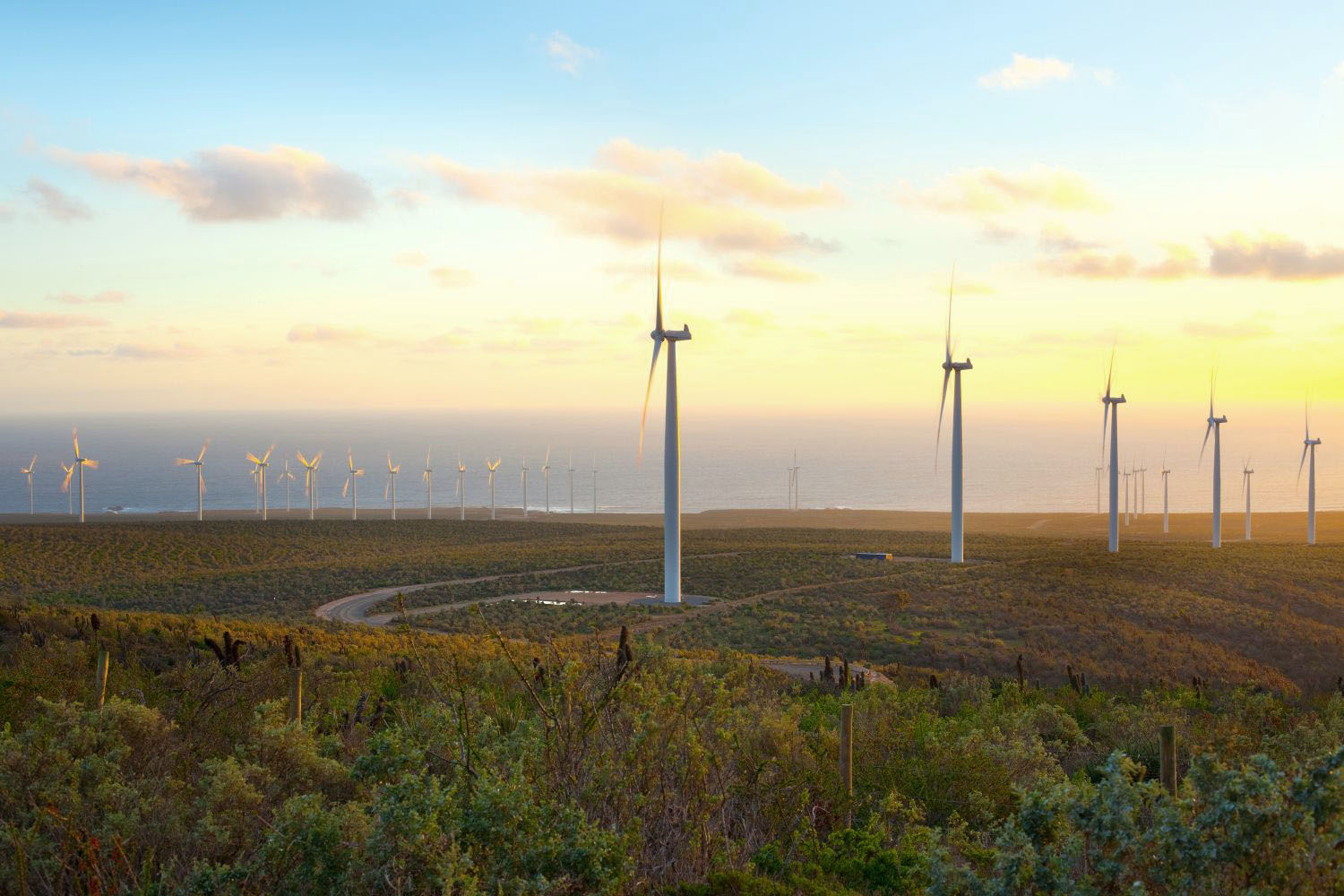
Investors point to regulatory uncertainty, infrastructure gaps, and financing constraints as key barriers to scaling renewable energy in the region.
Highlights
- Market demand and profitability drive investors’ technology choices, far outweighing environmental considerations and government incentives.
- Yet commercial viability alone is not enough: predictable rules, efficient permitting and long-term stability also matter, as highlighted by a recent IDB-CGD study that asked investors directly what stands in their way.
- To address these challenges, governments and multilateral development banks can help unlock investment by improving regulations, strengthening infrastructure and expanding access to long-term financing.
Latin America and the Caribbean have optimal natural conditions for renewable energy. The region enjoys some of the world’s highest levels of solar irradiation, vast wind corridors, abundant biomass, and significant hydropower potential. Why, then, has investment in renewable energy infrastructure not kept pace with that potential or with the region’s development needs?
According to estimates from the Inter-American Development Bank (IDB), the region will need approximately $2.2 trillion by 2030 to expand and maintain the infrastructure required to meet its development goals, including about US$550 billion for the energy sector. However, current investment flows remain well below this level, creating a major financing gap. Bridging that gap will require a significant increase in private capital, alongside stronger efforts to create the conditions that attract renewable energy investment at scale.
To understand what is holding back private investment, a new report from CGD and the IDB, Investor Perceptions of Barriers to Renewable Energy Investment in Latin America and the Caribbean, takes a direct approach: it asks investors themselves. Rather than inferring investment barriers from aggregate indicators or realized investment flows, the report surveys firms and associations that develop, finance and build renewable energy projects.
The survey gathered responses from firms and associations operating in Argentina, Brazil, Chile, Colombia, Costa Rica, Ecuador, Guatemala, Mexico, Peru and Spain. Respondents include senior officials from these organizations, so the findings reflect the views of experienced market participants directly involved in renewable energy investment.
Profitability, not good intentions, drives investment
A key finding of the report is that renewable energy investment in the region is, above all, a business decision. Indeed, market demand and profitability are the leading factors behind investors’ technology choices, cited as the top driver by more than twice as many respondents as government incentives and policy reliability.
Meanwhile, only 14.3 percent of respondents rank environmental impact and sustainability as the most important factor. In short, scaling renewable energy in the region will depend primarily on commercial viability.
Investors are pragmatic about technology, too. Solar energy is by far the most popular option, followed by energy storage, while clean hydrogen attracts little interest despite the global attention it receives. Brazil stands out in biofuels, Chile in storage and wind, and Mexico in solar. Respondents stress, however, that a country’s attractiveness lasts only as long as its rules, auction calendars and permitting remain predictable.
The main obstacles are regulatory, not technical
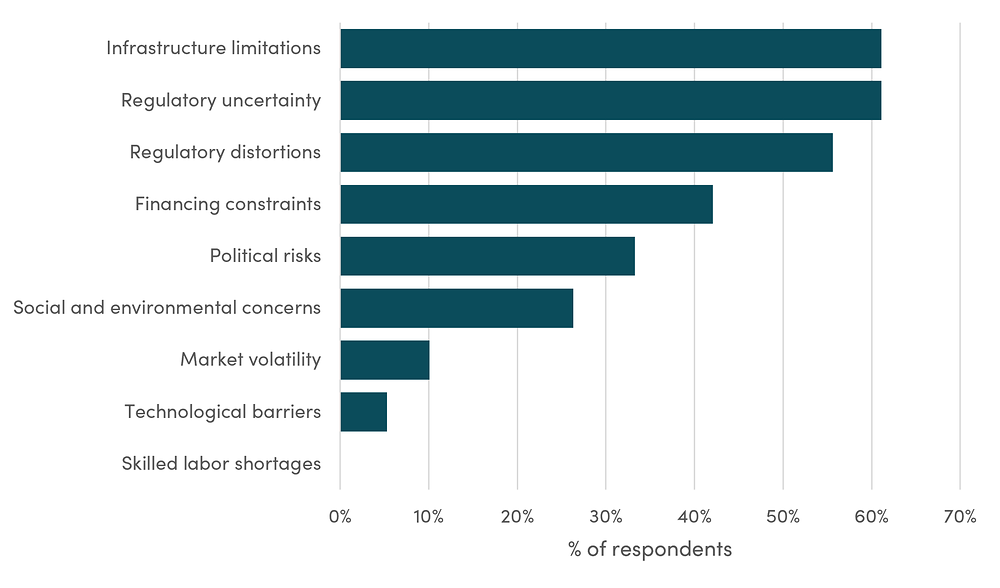
When asked about the biggest challenges, respondents point first to infrastructure limitations and regulatory uncertainty, followed closely by regulatory distortions (Figure 1). For these investors, technology is not the problem. Very few cite technological barriers, and no respondent identifies skilled labor shortages as a key obstacle. Political risks, meanwhile, are cited by only about one-third of investors, perhaps because experienced firms have learned to navigate the region’s political environment.
Figure 1. Top perceived challenges to investing in renewable energy
Source: Cavallo et al., Investor Perceptions of Barriers to Renewable Energy Investment in Latin America and the Caribbean.
The verdict on regulation is striking. Only 4.5 percent of respondents believe current regulations strongly encourage renewable energy investment, and 36.4 percent say they somewhat encourage it. Almost half (45.5 percent) say regulations somewhat discourage it.
Yet investors do not complain about a lack of rules or overly strict standards. Rather, they describe a gap between rules on paper and their application in practice: lengthy permitting cycles, unclear approval sequencing, and discretionary interpretation by authorities. Even after securing financing, insufficient transmission capacity can hold projects back.
Why financing remains a challenge
Financing matters, but the problem is less the availability of capital than its cost and maturity. Indeed, access to financing and difficulty obtaining long-term bank loans top the list of financial barriers, with respondents pointing to high interest rates and a scarcity of loans that match the long life of infrastructure assets.
Projects rely mostly on private equity and bank loans, with multilateral development banks (MDBs) also playing a significant role. By contrast, green bonds, public-private partnerships, and government subsidies are used far less, suggesting these markets remain shallow.
Multilateral banks as partners, not simply sources of capital
Investors see a central role for MDBs. No respondent rated that role as limited or nonexistent, and 85.7 percent consider it important or critical. Importantly, investors do not see MDBs simply as sources of additional capital. Policy advocacy and regulatory support rank alongside financial support as the most valuable forms of engagement, consistent with the importance investors place on regulatory and institutional constraints. Investors' top priority for MDBs is to expand financial instruments tailored to renewable energy, followed by stronger partnerships with local governments and private investors.
What can be done to unlock renewable energy investment?
For national governments, the report’s first recommendation is to prioritize regulatory implementation: reduce administrative bottlenecks, streamline permit sequencing, set clear timelines, and improve coordination across agencies. Energy policy also needs to be anchored in predictable frameworks, as investors cite stability horizons of 15 to 20 years as critical for capital-intensive projects. These efforts also include improving transmission infrastructure and ensuring transparent auctions with clear timelines and evaluation criteria, all part of the same agenda: making viable projects easier to execute.
For MDBs, the report recommends addressing financing constraints by scaling up instruments that provide longer-term financing, guarantees and risk sharing, including blended finance facilities that reduce first-loss risk for private investors. MDBs can also help deepen local capital markets by supporting the development of local-currency bond markets and other longer-term financing instruments.
At the same time, they can use policy dialogue and technical assistance to help governments simplify regulation, particularly permitting. This combination of financing and policy engagement is consistent with what investors say they value most.
For institutional investors and the private sector, the report suggests treating regulatory risk as a manageable constraint rather than a disqualifying one. To that end, knowledge-sharing platforms, stronger sector associations, and joint investment with established sponsors could help lower entry barriers and broaden the investor base.
An execution challenge as much as a financing one
The message from investors is remarkably consistent: renewable energy investment in Latin America and the Caribbean is commercially driven, technology is not a major obstacle, and a shortage of capital is far from the only constraint. Rather, much of the challenge lies in execution: unpredictable regulation, slow permitting, weak coordination, and costly, short-term financing continue to hold back investment.
Ultimately, turning the region’s extraordinary renewable energy potential into investment at scale will require as much attention to institutional capacity and regulatory predictability as to the availability of financial instruments.
For more information, see the full report, Investor Perceptions of Barriers to Renewable Energy Investment in Latin America and the Caribbean.
This blog post was prepared in collaboration with Eduardo Cavallo and Cristina Querubin. It has also been published on the Inter-American Development Bank (IDB) website.
Topics
DISCLAIMER & PERMISSIONS
CGD's publications reflect the views of the authors, drawing on prior research and experience in their areas of expertise. CGD is a nonpartisan, independent organization and does not take institutional positions. You may use and disseminate CGD's publications under these conditions.