Recommended
Economic policy is often described as technocratic, insulated from politics, and driven by expertise. Yet the people entrusted with steering macroeconomic policy—finance ministers, central bank leaders, and senior economic planners—are appointed through deeply political processes. Who gets these positions matters not only for representation, but also for how economic policy is framed and implemented. We analyze data on senior economic advisers in Latin America and the Caribbean (LAC) from 1961 to 2020 and find a striking and persistent gender gap at the very top of economic decision-making across the region.
A new look at economic leadership
We analyzed a dataset covering senior economic advisers across the region, including finance ministers or equivalent (e.g., ministers in economic and financial planning) and central bank presidents or equivalent (e.g., central bank governors). Spanning almost six decades (1961–2020), the data allow us to track both who is appointed and how the composition of economic leadership has—or has not—changed over time.
The original data is the Index of Economic Advisers from Goes and Kaplan (2024) and Kaplan (2018), which we supplement with additional data collection. The original series is incomplete for two sub-periods. The first period, 1961–2014, was assembled for the 2018 study and includes Belize but excludes Guyana and Suriname. The second period, 1996–2020, was collected for the 2024 study and includes Guyana and Suriname but excludes Belize. We collected additional data to fill in the gap for Belize up to 2020. For the analysis discussed below, we focus on the longest consistent span—1961–2020—excluding Guyana and Suriname. Lastly, we collect information on the gender of advisers in the dataset.
A key feature of the dataset is information on advisers’ training. We classify advisers as having a technocratic orientation if they hold an advanced graduate degree in mainstream economics. This proxy captures whether appointees are drawn from the professional economics pipeline that is often viewed as conferring technical legitimacy in macroeconomic policymaking.
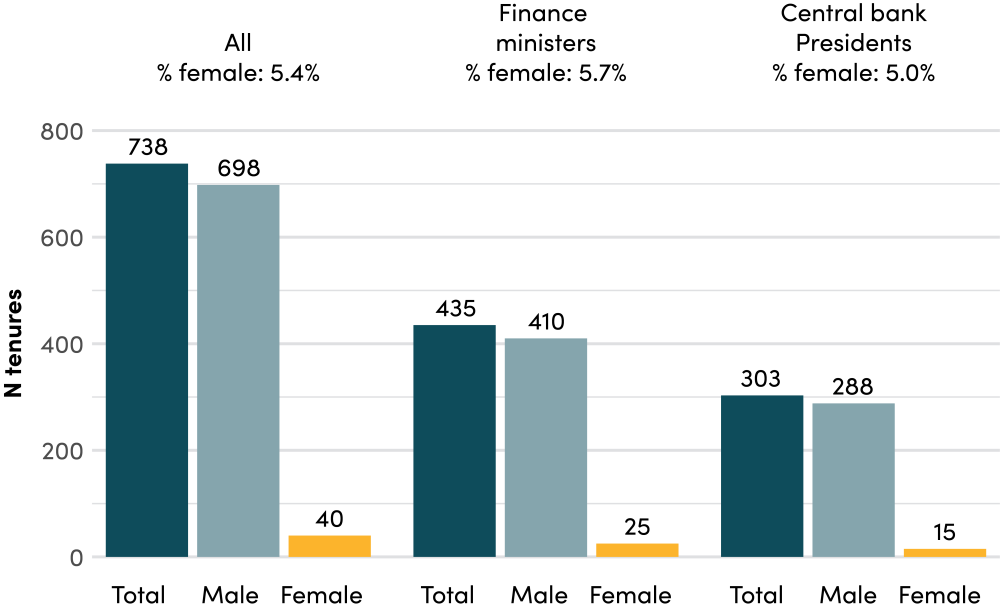
Our final dataset is a balanced sample of senior economic advisers from 23 countries, including Argentina, Brazil, Chile, Colombia, Mexico, Peru, and Venezuela, among others. The data covers a total of 738 tenures of 647 economic advisers.
An overwhelmingly male domain
The headline finding is stark: until very recently, top economic leadership in LAC was an all-male club. From the beginning of the sample through 1988, 100 percent of all appointed economic advisers were men.
Over the period from 1961 to 2020, just over 5 percent of senior economic adviser tenures were women. This is true for both economic advisers appointed as finance ministers and as central bank presidents.
Figure 1. Tenures of senior economic advisers by type and gender (1961-2020)
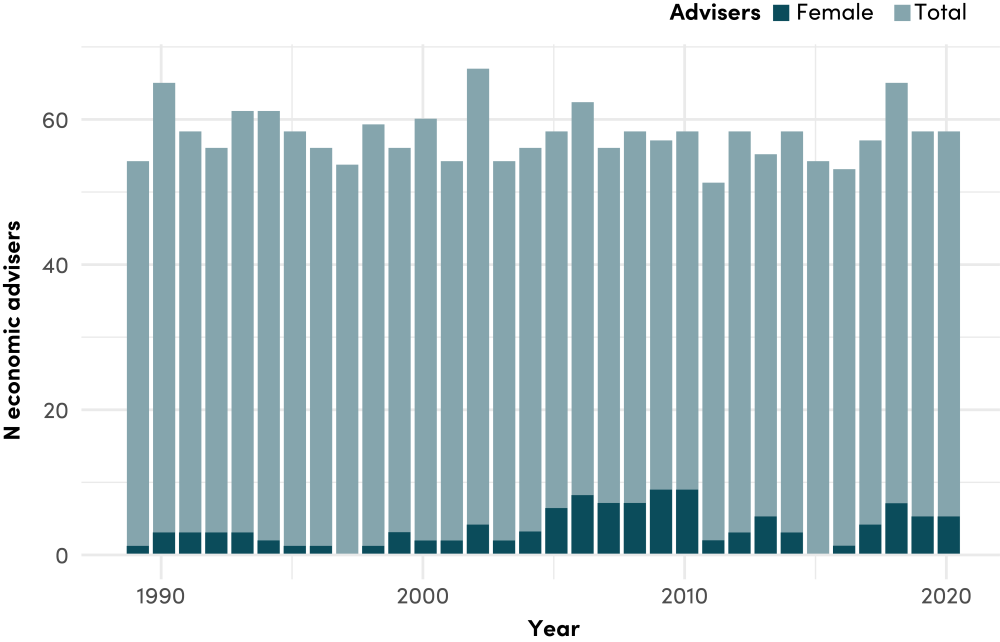
The first female economic adviser appears in the data only in 1989—nearly three decades after the start of the sample. Progress since then has been slow. From 1989 onward, 92.5 percent of all appointed economic advisers are still male. In other words, even after women finally gained some access to these positions, they have remained rare exceptions rather than the norm.
Figure 2. Number of senior economic advisers in term by year since 1989
This pattern is striking given the broader progress in gender equality in the region. Women’s labor force participation in the region has been steadily increasing, from just 20 percent in the 1960s to between 50 percent and 70 percent more recently. Educational outcomes are also high, with women averaging higher completion rates in tertiary and secondary education than men (see: 2022 UNESCO report; 2023 IDB report). Within economics, women hold 39 percent of master’s degrees and 33 percent of PhDs in economics in the region. Even in the academic profession—sometimes viewed as the core pipeline into technocratic roles—women account for roughly 35 percent of assistant professors and 24 percent of full professors of economics in Latin America. This suggests that the near absence of senior economic advisors cannot be explained by a shortage of women trained in advanced economics.
Cross-country differences—and similarities
The scarcity of women in senior economic roles is remarkably widespread across the region. The most common outcome is zero. Even after 1989, the modal country in the region had not appointed a single female economic adviser by 2020. Seven countries—Bolivia, Chile, Colombia, Jamaica, Mexico, Nicaragua, and Panama—fall into this category, having appointed only men to top economic posts over more than three decades. Notably, there have been some promising advances since 2020, the final year of our dataset. Both Chile and Mexico have since appointed women to central bank leadership, with the appointments of Victoria Rodriguez Ceja and Rosanna Costa as governors of the Bank of Mexico and the Central Bank of Chile, respectively, in 2022.
Figure 3. Distribution of share of female appointed economic advisers in LAC countries between 1961-2020
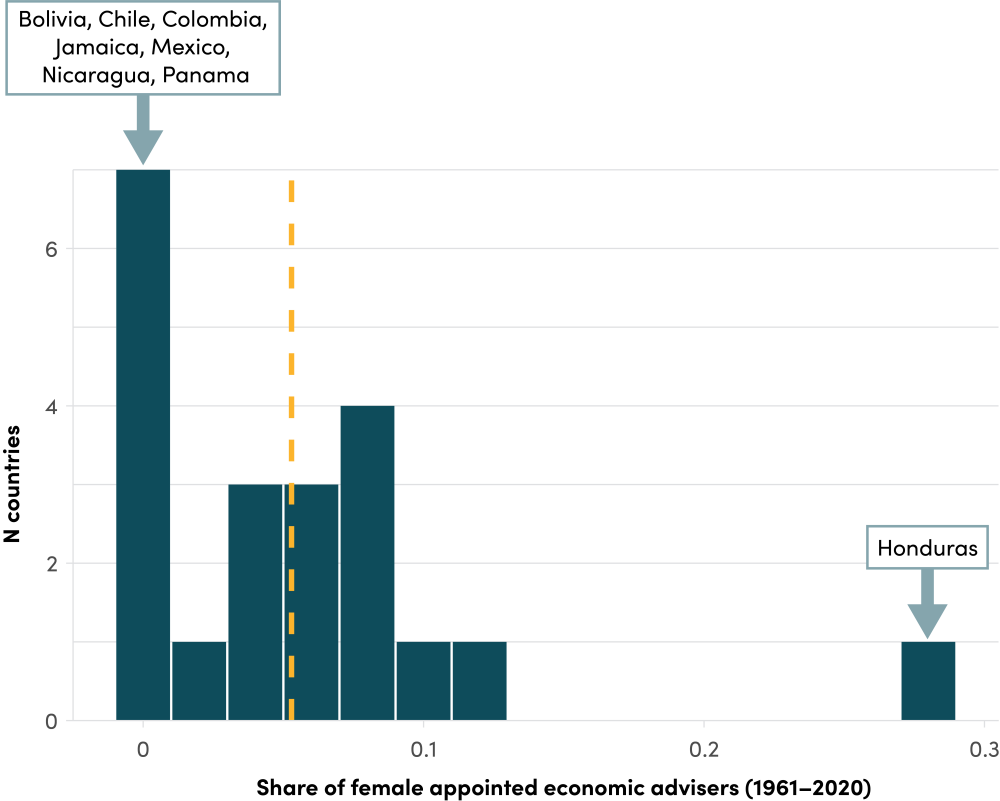
Over the period 1961-2020, women account for an average of just 5.3 percent of all economic advisers appointed within a given country. Even at the upper end of the distribution, representation remains limited. Honduras has the highest share, with women making up 28.6 percent of its economic advisers (6 out of 21 appointments). While notable relative to regional norms, even this “best case” still reflects a large gender imbalance.
Women who make it are more likely to be technocrats
An intriguing finding emerges when we look at the training these leaders received. Among the small group of women who do reach senior economic positions, 75 percent have a technocratic profile–i.e., have training in mainstream economics–compared to 54 percent of men.
This pattern is consistent with a phenomenon observed across elite professions: women often face higher barriers to entry and may need stronger formal credentials to be considered for the same roles as men. While men may be appointed on the basis of political networks, party loyalty, or broader administrative experience, women appear more likely to be selected when they can signal technical expertise to an extent that cannot be overlooked or dismissed.
The implication is double-edged. On the one hand, women who are appointed may bring strong technical skills to economic leadership. On the other hand, the higher credential bar suggests that gender bias may shape not only whether women are appointed, but also which women are deemed acceptable candidates.
Table 1. Gender breakdown of senior economic advisers in LAC by career experience and education
| Category | Male | Female | ||
|---|---|---|---|---|
| Number | Share | Number | Share | |
| All individuals | 613 | 94.7% | 34 | 5.3% |
| Served in both roles, i.e., central bank president and finance minister (% of category total) | 32 | 5.2% | 3 | 8.8% |
| Served multiple tenures (% of category total) | 76 | 12.4% | 5 | 14.7% |
| Technocrat (% of category total)* | 298 | 54.0% | 24 | 75.0% |
| Educated in the US (% of category total) | 191 | 31.2% | 12 | 35.3% |
*Note: 584 observations due to incomplete data on economic advisers’ educational background
No clear upward trend
One might expect that representation would steadily improve over time, particularly in the 2000s and 2010s. Yet time trends offer little evidence of sustained progress. When we examine the share of female economic advisers relative to the total number serving in a given year, representation fluctuates at very low levels.
Perhaps most strikingly, in 2015 there were zero female economic advisers in office across the sample. More than 25 years after the first woman was appointed, it was still possible for an entire region to have no women at the helm of economic policy.
How does this compare to the private sector?
The scarcity of women in public-sector economic leadership mirrors patterns observed in the private sector. World Bank and IFC research on senior management in Latin America and the Caribbean finds that, across nine major stock markets, women represent only 14 percent of board members. More broadly, the share of women in management positions is low, with only 20 percent of firms in the private sector having a female top manager. While these figures are higher than the share of women among senior economic advisers, it still reflects substantial underrepresentation in positions of economic power.
Taken together, these findings point to a broader gender gap in economic leadership and one that spans public and private institutions.
Looking ahead
Economic ministers shape fiscal policy, monetary frameworks, debt negotiations, and responses to crises. Their decisions affect growth, inequality, and the distribution of opportunity. A leadership cadre that draws from only half of the population risks missing perspectives that could inform better policy design.
Documenting the gender gap is only a first step. Future research should explore whether the presence of women in senior economic roles affects policy priorities, crisis management, or public trust. Equally important is understanding what institutional reforms, talent management best practices, or professional networks might help broaden women’s access to these positions.
For now, the message from six decades of data is clear. Despite incremental change, senior economic policymaking in Latin America and the Caribbean remains a man’s world. The data also show that time alone won’t close that gap—it will require intentional efforts to rethink how economic leadership is identified and appointed.
With thanks to M. Caridad Araujo, Kelsey Harris, and Liliana Rojas-Suarez for helpful feedback.
Topics
DISCLAIMER & PERMISSIONS
CGD's publications reflect the views of the authors, drawing on prior research and experience in their areas of expertise. CGD is a nonpartisan, independent organization and does not take institutional positions. You may use and disseminate CGD's publications under these conditions.