Recommended

Project
Advancing Women in IFI Leadership
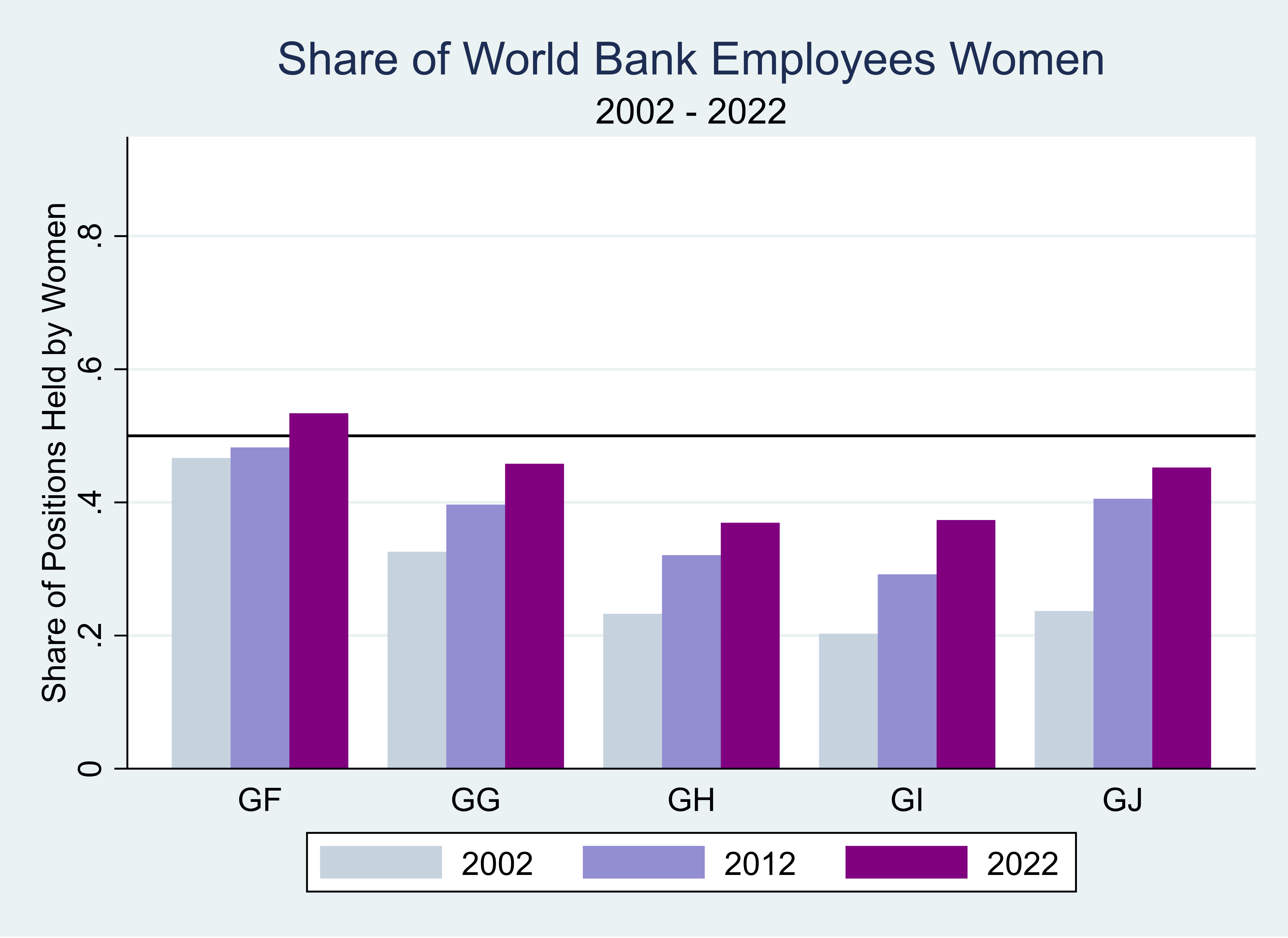
The international financial institutions (IFIs)—the World Bank, the IMF, the Inter-American Development Bank (IDB), and their peers—have long said that gender equality is central to development. Yet CGD research shows a persistent blind spot within these institutions: women are being hired into technical roles at near-parity, but they are not being promoted into leadership at the same rate. This gap is not a diversity headline; it is a governance, effectiveness, and human resources problem that deserves continued, careful tracking and remedial action.
CGD research has previously documented this pattern across a set of IFIs and finds that recruitment pipelines look much more gender equal than leadership rosters. For several IFIs, we find that women are hired into technical and junior professional roles at roughly equal rates to men, but the share of women falls off substantially as you climb the ladder into senior technical, managerial, and executive jobs. That disparity cannot be explained away as a supply problem inside these organizations: the talent is being hired. The problem is what happens after the initial hire.
Why meritocracy and women’s leadership matter
If women are qualified enough to be hired into technical grades, meritocratic HR systems should ensure they have equal opportunities to advance. That requires transparent promotion criteria, a consistent use of objective performance metrics, structured leadership pipelines (i.e. mentoring, sponsorship, rotational experiences), and routine assessments of promotion outcomes by gender and grade. Without these systemic safeguards, parity in the technical grades can become a superficial achievement while real decision-making power remains concentrated in homogeneous leadership.
The stakes go beyond internal fairness. Research also shows that bureaucratic representation—the presence of women in supervisory and authoritative roles—shapes how development organizations operate. This work shows that when women supervise projects, hold positions of authority, and are present among coworkers, mainstreaming of gender across World Bank projects is of a higher quality. Similarly, a study looking at data from 28 donor countries over the period 1965 to 2011 demonstrates that greater female representation in legislatures increases foreign aid and reallocates aid in favor of social investments in education and health. Other work has also found a positive correlation between women’s overall wellbeing and the share of women in parliament across 50 African countries (this last study does not report causal trends).
Research on political and institutional leadership more broadly highlights why gender diversity at the top matters. Much of the most rigorous evidence on this topic comes from India because of the lottery-based system it uses to implement a quota for female representation at the village council level. Using this setup to estimate the causal impacts of female leaders, Chattopadhyay and Duflo’s seminal work on village councils in India showed that women leaders invest differently, prioritizing public investments in water quality and access, as well as other infrastructure. Qualitative research on local governance in India similarly documents how women’s representation in village councils not only shifts resource allocation but also reshapes deliberation, voice, and accountability within communities. New work has shown that greater female political representation improves air quality in India, further underscoring the broader welfare impacts of women’s leadership. Together, this evidence demonstrates that gender diversity in leadership is not symbolic—it changes institutional priorities and performance.
In short, who leads matters for what institutions do. If women are underrepresented in leadership, MDBs risk weaker attention to gender in policy design, weaker outcomes for beneficiaries who are women and, potentially, less robust investments in health, education, and other social sectors. These investments are critical for ensuring sustainable economic growth.
A second key reason to keep monitoring is that CGD research has shown that periods of rapid institutional change typically coincide with backsliding on gender parity. Changes like reorganizations, leadership turnover, or other fast transitions that are unrelated to gender diversity can erode the steady gains women have made in the workforce—sometimes quickly. That makes the current moment particularly risky; the potential for backsliding is real. Global shocks, shifting governance arrangements, or internal restructurings at the IMF, World Bank, and regional MDBs could produce the bureaucratic churn that has, in the past, undermined promotion pipelines for women.
What we need to prevent backsliding
Tracking helps us catch early warning signs and respond before a temporary disruption calcifies into a permanent setback. To effectively do this, we need three levels of information:
- Basic disaggregated data like the gender breakdown by grade/job family, promotion rates, time-to-promotion, and attrition patterns;
- Process indicators like the number of women shortlisted for promotion, use of external versus internal hiring for senior slots, and incidence of merit-based selection panels; and
- Qualitative signals like exit interview findings, staff perceptions of fairness, and whether sponsorship/mentorship programs translate into real promotions.
Regular public reporting on such indicators gives stakeholders—member states, civil society, and internal staff—the data to hold these institutions accountable.
Tracking progress towards parity, ensuring transparency, and proactively implementing safeguards will ensure that MDBs can live up to their commitments at home and in the field. Yet, tracking alone is not enough. It must be paired with reforms to make promotion systems demonstrably meritocratic: transparent audit trails for promotion decisions, mandatory gender balance on selection panels, leadership development targeted at mid-career women, and safeguards against backsliding during restructuring (for example, temporary hiring freezes should not become an inadvertent way of losing women from leadership pipelines).
Human resources staff at the IFIs have a powerful role to play during this time of prospective reform by both making data accessible and using the data to inform internal change. We have seen where this has been impactful in the past with the progress towards closing the gender pay gap at the World Bank.
CGD’s next phase of work
To address the ongoing risk of backsliding and support sustained action at the MDBs to prioritize women’s leadership, CGD has launched a new phase of our work on this topic. In the months ahead, we will be collecting and analyzing new disaggregated data from the IFIs to demonstrate the measurable benefits of women in leadership roles. Our focus is on identifying what works, what doesn’t work, and where change is most needed to strengthen women’s trajectories in these institutions.
To ensure this effort is grounded in both data and lived experience, we have convened an advisory group of senior leaders with deep ties to the IFIs. This group will review emerging evidence, suggest approaches to address new challenges, and help shape targeted recommendations aimed at catalyzing meaningful institutional change. Through CGD’s research and engagement alongside our advisory group, CGD will continue to support IFI efforts to ensure that women are recruited and promoted on merit, ensuring that IFI leadership reflects the needs and priorities of the people they serve.
In the end, meritocracy is not a zero-sum game. When employees feel valued and are treated fairly, they are more likely to thrive, and that collective success strengthens institutions, expands opportunities, and fuels impact. For MDBs, this progress is especially vital: their mandate is to help support sustainable economic development, and their effectiveness depends—in no small measure—on their management of the talent and leadership within. MDBs cannot champion women’s leadership in client countries while falling short in their own leadership ranks. And at a time when global aid budgets are increasingly constrained, they also cannot afford to leave potential untapped. They must demonstrate the progress they champion and not only hire the best candidates but also nurture all of their talent in ways that allow every individual to reach their fullest potential. Doing so ensures that they can deliver on their promises — with leadership that is representative, effective, and truly committed to serving the global public good.
DISCLAIMER & PERMISSIONS
CGD's publications reflect the views of the authors, drawing on prior research and experience in their areas of expertise. CGD is a nonpartisan, independent organization and does not take institutional positions. You may use and disseminate CGD's publications under these conditions.
Thumbnail image by: IMF/Flickr