Recommended



Artificial intelligence (AI)-powered development interventions are growing, with over 100 global health and 150 education AI projects delivering direct services in low- and middle-income countries (LMICs). While most such projects are currently pilots, governments may eventually look to scale effective applications within public systems. These digital services could be distributed through government-hosted “app stores” or gateways.
Such concepts aren’t new—since the early 2000s, countries from the US to India have offered e-government portals as one-stop shops for identity, benefits, and taxes. However, many portals are underused; a 2023 survey found only 23 percent of US respondents regularly use e-government services, with satisfaction 20 percent lower than private-sector equivalents. This blog post explores how generative AI can improve citizen access to digital public services by transforming e-government portals.
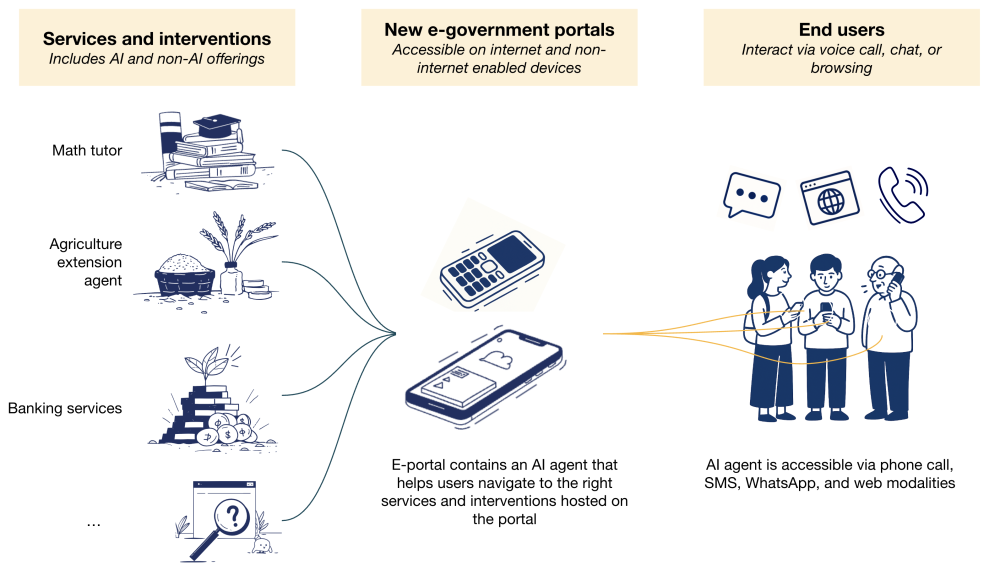
Image 1 describes an AI powered government portal that can help users navigate to the appropriate intervention or service, which may itself be AI-powered. It functions like an “app store”, but with an AI-powered agent that helps users navigate to the right services.
While some of the technologies discussed in this blog are not yet ready for deployment at large scales and for sensitive tasks, AI’s rapid pace of advancements make it worth examining their potential now. Eventually, governments may use AI agents or assistants to help users navigate a multitude of services, accessible via smartphones or feature phones, even without internet connectivity. For example, a pregnant mother might call a helpline in her native dialect, where an AI agent identifies her need for nutritional support and connects her directly to an AI nutrition coach via call or SMS. Another user entering the workforce might interact with the agent over WhatsApp and be directed to a service that helps him open a bank account. These experiences could be similar to interacting with a human caseworker and accessible through the same entry point, as opposed to fragmented and niche helplines for differing use cases. While a previous CGD blog post outlined theoretical benefits of such personalized services, the next section focuses on practical design principles and implementation questions.
Design principle: Simplify discovery and set high standards for ecosystem partners
The current generation of e-government portals face two problems: (i) They host too many services and are not navigable, and (ii) the services hosted may be low quality and not effective.
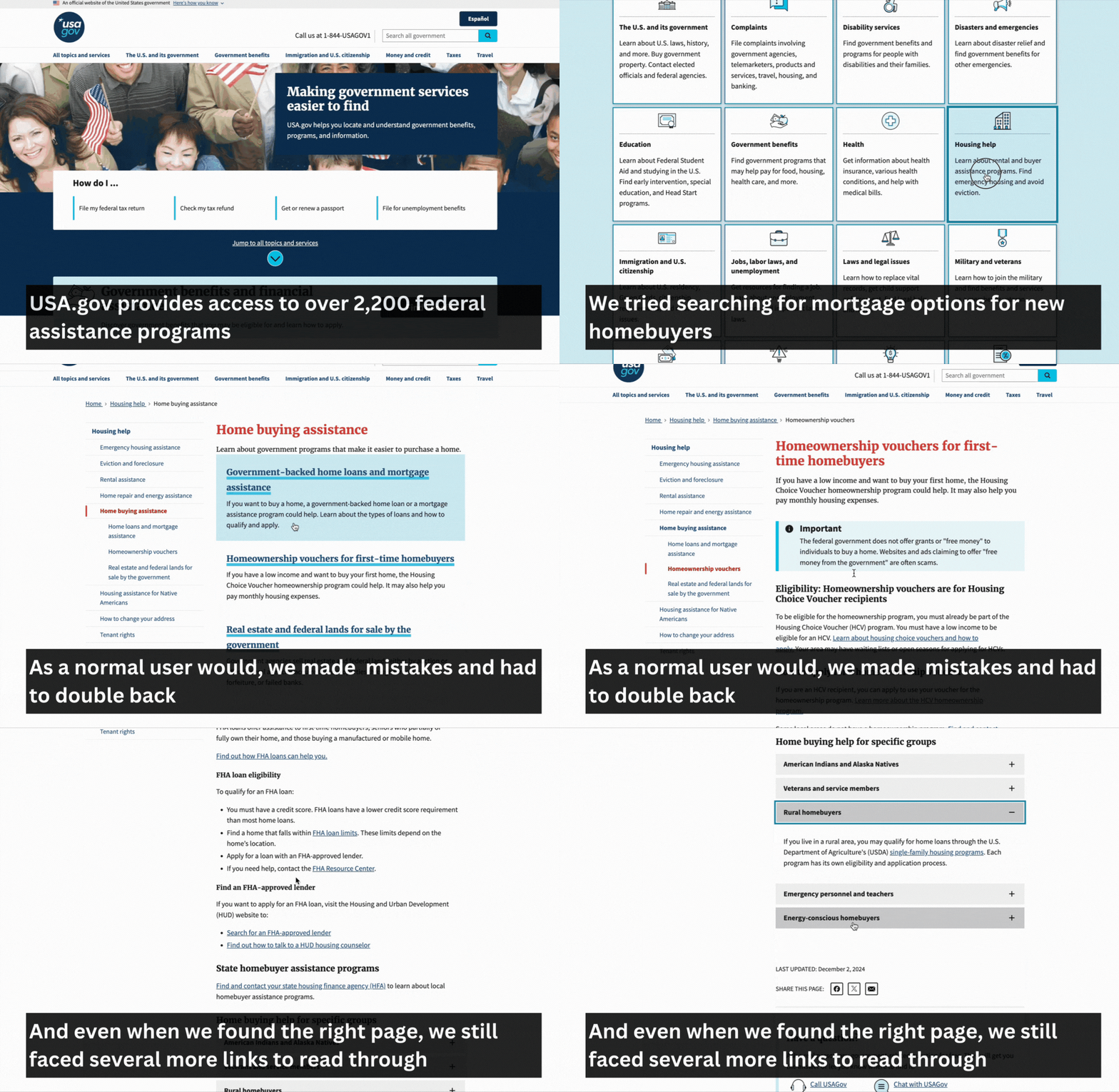
Source: USA.gov, April 2025
For example, USA.gov’s homepage currently lists numerous services, placing navigation entirely on users. A new homebuyer seeking mortgage options must click through multiple pages and scroll through lists to find links relevant to overlapping demographics, from “veterans” to “energy-conscious homebuyers.”
Clunky, difficult websites erode public trust; governments could emulate technology companies to better retain user attention. Rather than requiring users to open and review dozens of tabs to find the right fit, the site could simplify navigation by chatting with the user to determine needs, and generating personalized results summarizing available services and their suitability.
On top of being hard to navigate, e-portals of the past spoke a narrow set of languages and required stable internet connections and a certain level of technological literacy. Generative AI has the potential to make human-computer interaction so intuitive that technological literacy could be less of a barrier. Navigating digital services could become as simple as having a conversation. Further, these interactions could occur on low- or no-data voice and SMS channels, expanding digital service access to regions where the internet remains scarce. However, access to services is moot if users don’t feel understood—AI models are only as good as the data they are trained on, and many languages remain under-resourced. Some countries are making large investments to build AI that speaks the language of their people. For instance, India’s Bhashini initiative has been creating foundational models in Indian languages with applications in real-time translations and multimodal service delivery.
In addition to improving user experience, governments should act as gatekeepers for digital services, at minimum allowing only those services onto e-portals that meet strict standards for safety, harm prevention, and data security—similar to app store policies by Apple and Android. They should protect users from predatory practices, such as by excluding payday lenders or high-interest microcredit firms. Or they can adopt an even higher bar by exclusively listing interventions that have been proven effective through rigorous evaluations, thereby enhancing the digital gateway’s potential for positive development outcomes.
Open question: What architectural choices best support widespread adoption, sovereignty, and privacy?
Governments must also make important architectural decisions about the set-up and management of such a citizen service gateway. For instance, should it be designed as a protocol or a platform? A platform is a centrally managed interface that provides citizens direct access to various services. Estonia’s Bürokratt, for instance, offers a virtual AI assistant for tasks like filing complaints or renewing IDs by connecting to multiple government databases and APIs. Although centrally managed, platforms can still host third-party applications—similar to Apple’s App Store—where multiple external developers provide alternative apps for the same function.
Unlike a centrally managed platform, a protocol consists of open standards that allow multiple independent systems to interoperate without a single entity controlling the user experience. India Stack has many protocols, which for example comprise open, interoperable components (digital ID, payments, data-sharing) that serve as common rails for banks, companies, and government agencies. Adopting a protocol approach means that rather than accessing services through one government-controlled platform, multiple companies and government agencies can build their own “one-stop shop” applications that connect users to various specialized services.
There are pros and cons to each approach and this blog post won’t do them justice. However, it is worth mentioning that a strategic reason to choose protocols is to harness scale and innovation through private partnerships. By offering common digital protocols, governments can let banks, startups, and others create their own citizen gateways, host applications they select, and extend those services to millions of users, while leaving space for continued diversification of services through competition. In contrast, a government-run platform’s usage growth depends on citizens adopting a single interface. However, it lacks the market-driven multiplication of user interfaces—scalability comes from the government’s ability to onboard services to the platform, rather than from many independent apps reaching different user segments.
On the other hand, a platform-approach gives the government greater direct control over service offerings, user experience, and data management. This can be strategically important for ensuring only impactful programs are offered to citizens. Adopting the platform strategy means the state can enforce uniform service standards and quickly implement changes across the board. A protocol’s decentralization may mean governance is exerted through standards and regulations rather than direct operation.
Whether designed as a protocol or platform, e-portals providing services across education, health, and finance must handle sensitive data carefully. Privacy is crucial: should data from an agricultural AI app be accessible to a financial services app if it influences decisions like loan terms? For instance, spending on farm inputs might signal borrower risk and the farmer might object to data sharing if it leads to unfavorable loan terms. Data protection and consent-based frameworks will be key. Additionally, platforms must address data and model sovereignty. Powerful foundational AI models are primarily hosted in the cloud by a few countries, yet national laws often restrict citizen data from leaving national borders or cloud processing. To manage this, some companies have started offering open-weight models that operate locally, while others and certain governments are developing their own sovereign models.
Accessing public services could be simpler, but their design choices are complex—start exploring now
Generative AI has the potential to greatly enhance government e-portals and the services they host. Beyond the introduction of generative AI, there are fundamental architecture choices that can affect important factors, such as adoption, privacy, and technology sovereignty. While greater improvement in AI technology is needed to achieve what is described in this blog post, given the pace of development in AI applications, governments may want to start exploring how they can transform certain cumbersome e-portals and underutilized services. With intentional, contextually grounded choices, AI can help governments close long-standing service gaps—not just for those who are digitally connected today, but for everyone.
Topics
DISCLAIMER & PERMISSIONS
CGD's publications reflect the views of the authors, drawing on prior research and experience in their areas of expertise. CGD is a nonpartisan, independent organization and does not take institutional positions. You may use and disseminate CGD's publications under these conditions.