Recommended
As major donor countries roll back international development commitments, the youngest children in the poorest places are likely to be hit the hardest.
Early childhood development (ECD) already makes up only a small share of total official development assistance (ODA). As donors cut budgets, many developing countries—facing limited resources and competing priorities—may struggle to fill the gap. And many of the countries that will be the worst impacted by shrinking aid flows were already investing too little, too late on children.
Still, there are reasons for optimism. Some low-income countries are allocating a higher share of their limited child-focused budgets to early childhood than their income levels would predict.
At the same time, multilateral development banks—most notably the World Bank—are scaling up investments in early childhood education (ECE), responding to growing demand and delivery capacity in low- and middle-income countries.
This blog explores country-level investment in early childhood, the role of concessional finance, and what governments and donors can do to close the gap and build on emerging momentum.
Too little, too late
UNICEF, Columbia University, and the University of York’s report, Too Little, Too Late, offers a sobering diagnosis: public spending on children is not just insufficient, but mistimed. Around the world, government spending overwhelmingly arrives too late in life, failing to reach children during their most formative years, when returns to investment are highest.
Using data from 84 countries, the report finds that in low-income settings, cumulative public spending per child up to age 18 adds up to an average of just US$2,300 in PPP terms (adjusting for differences in prices and cost of living). A meagre 6.7 percent of that is spent in the first six years of life. In lower middle-income countries, the share rises only slightly to 8.2 percent. In contrast, high-income countries invest more than US$195,000 per child, and nearly 27 percent of that comes during the early years.
In order to measure how fairly governments allocate money to young children, the report introduces the Early Childhood Parity Score (ECPS). This score compares the share of spending on children under six with how large a share of the child population they make up—showing whether young children are getting their fair share of funding based on their numbers. Most countries fall far short of parity: the median ECPS is 0.5, meaning young children receive only half as much as they would if budgets were allocated proportionally by age. Only a small number of countries meet or exceed parity.
Which countries are beating the odds?
Predictably, richer countries tend to frontload investments in early childhood. They have stronger fiscal capacity, mature welfare systems, and political incentives to support family-friendly policies. But there are some low-income countries—such as Benin, Niger, and Nepal—who are allocating a larger share of their total child investment to early childhood than their income levels would predict (Figure 1). This is likely the result of deliberate policy choice.
Figure 1: Early Childhood Commitment Gaps
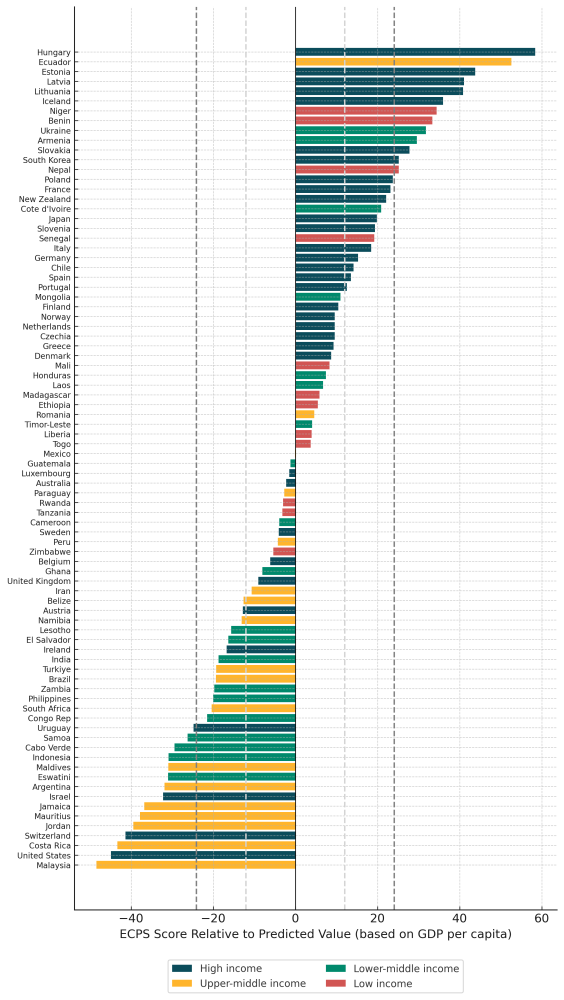
Note: The relative scores are the residuals from a linear regression of each country's ECPS on the log of per-capita income in 2015. The dashed vertical lines indicate half and one full standard deviation from the mean of the residual distribution.
In contrast, many upper-middle-income countries like Malaysia and Costa Rica, underperform relative to their economic capacity. Even some high-income countries, like the United States, trail behind their peers, suggesting that the issue is policy inaction rather than a lack of resources.
The fact that many low-income countries spend a larger-than-expected share of their child-focused budgets on early childhood is an encouraging sign. It suggests that a base of political will and policy innovation that could be built upon—even in the most resource-constrained environments.
Leveraging concessional finance for early childhood investment
In some low-income countries, the strong domestic effort to prioritise early childhood—spending more than their income levels would predict—is mirrored in how they partner with international funders. Our analysis of World Bank education lending over the past 25 years shows that ECE is becoming a key area where country demand and the Bank’s delivery capacity align. Dr. Luis Benveniste, Global Lead for Education at the World Bank recently highlighted at a CGD event that a quarter of the Bank’s education portfolio is now focused on early education.
As shown in Figure 2, countries tend to borrow for ECE more as they expand access to primary education. A common pattern is for governments to first borrow to expand primary education, and only later shift attention to early childhood programs. This sequencing suggests a policy learning curve: as countries experience the limitations of focusing solely on primary education, they begin to recognize the foundational importance of early childhood investment.
Figure 2: Early childhood education has emerged as the sweet spot for World Bank education lending
A. On the demand side, as net primary enrollment rises, countries become more likely to borrow for ECE
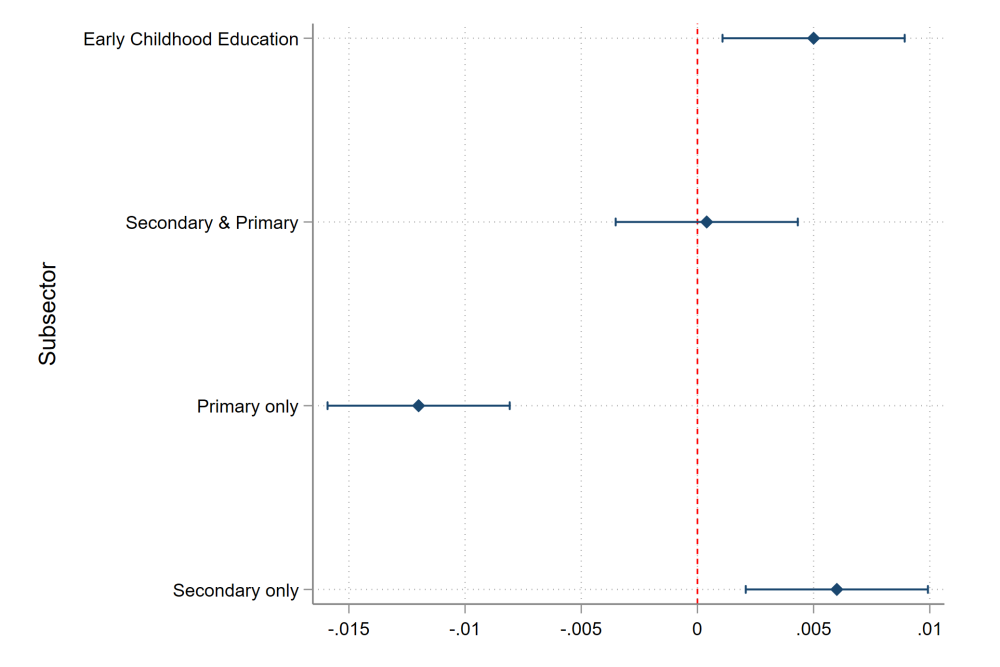
B. On the supply side, ECE projects outperform other education subsectors in World Bank ratings
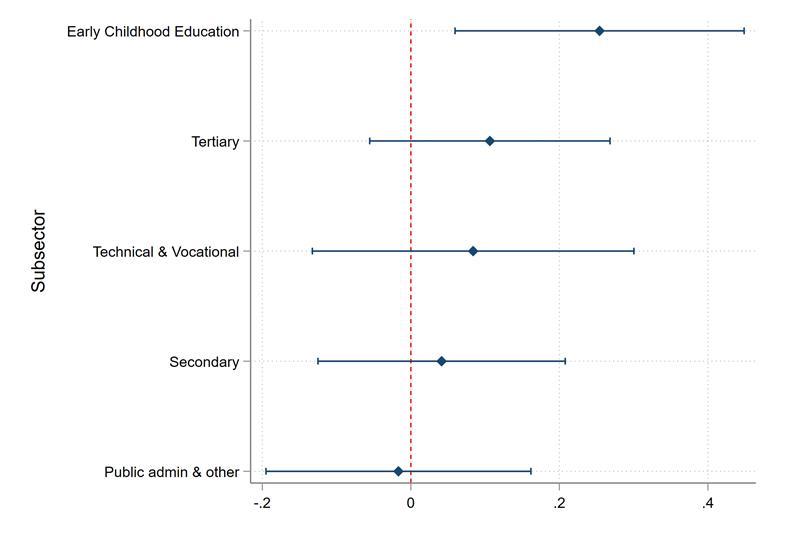
Note: Panel A shows marginal effects of a 1 percentage point increase in primary enrollment on borrowing probability for each subsector (N = 395 projects, Years: 1990-2021). Panel B shows marginal effects of subsector focus on project success ratings (N = 229 projects, Years 1998-2022).
Importantly, the Bank has demonstrated relatively strong performance in implementing ECE projects. Internal assessments give ECE projects high ratings for both efficacy and efficiency. In fact, among the various education sub-sectors, ECE is the only one where projects are significantly more likely to be rated successful compared to primary education projects.
While this analysis focuses only on the education dimension of early childhood development, it underscores the potential of concessional finance from multilateral development banks (MDBs) both to complement domestic resources in countries already showing policy commitment but constrained by limited fiscal space—and to catalyze domestic investment where that commitment is not yet evident.
What this means for policymakers and donors
Based on the evidence presented above, we propose the following recommendations for how national governments and international funders can protect and enhance early childhood investment in the face of tightening budgets:
Reprioritize early childhood in national budgets: The early years receive the least investment despite delivering the greatest long-term returns. Budget reforms that explicitly track and prioritize spending on children under six could help shift this imbalance, especially in countries already signaling a commitment to the early years.
Use international finance as a catalyst: MDBs and other donors can amplify impact by targeting countries that are showing effort but face budget constraints and drive domestic spending in countries where early childhood policy is not yet a priority.
Prioritize a portfolio of early childhood policies: Current investments in areas such as ECE can be a gateway to a broader portfolio of early childhood investments, including universal child benefits (which UNICEF considers the “foundational policy for children”) and parental leave.
Learn from relative overachievers: Countries that are “beating the odds” should be studied more closely. Their experience can offer practical lessons for delivering better outcomes with fewer resources.
Topics
DISCLAIMER & PERMISSIONS
CGD's publications reflect the views of the authors, drawing on prior research and experience in their areas of expertise. CGD is a nonpartisan, independent organization and does not take institutional positions. You may use and disseminate CGD's publications under these conditions.
Thumbnail image by: Dennis/ Adobe Stock