Recommended
Blog Post
The Foreign Assistance Contracting Cliff
Blog Post
A Million Lives at Risk?
The process of procuring goods and services to deliver US development assistance remains shut down. June 17th marked 259 days into the 2025 fiscal year. At an equal daily rate, you’d expect cumulative new obligations across the US government at that point to be running at about 70 percent of the total for last year. But new obligations at USAID are running at 30 percent of last year—less than half the expected rate. It’s a sign of the collapse in the foreign assistance machinery that is having a particularly damaging effect on lifesaving assistance.
Obligations are legal commitments by the government to pay for goods or services delivered (strictly “a series of actions”) under contracts and grants. There has been an almost-complete freeze in new USAID obligations since the inauguration. Those obligations reached a total of around $9 billion in January and have stayed at about $9 billion ever since. That’s 30 percent of the total for last fiscal year.
The number of award issuances (the number of new contracts and grants) is so far running at 17 percent of last year. And again nearly all of those new awards predate the Trump administration. The pattern is little better at the State Department, where award obligations are currently at 32 percent of last year’s total, and the number of new awards is at 41 percent of last year’s total.
Fig 1. USAID and State Department new obligations FY2024 (full year) and FY2025 (through June 17) $m
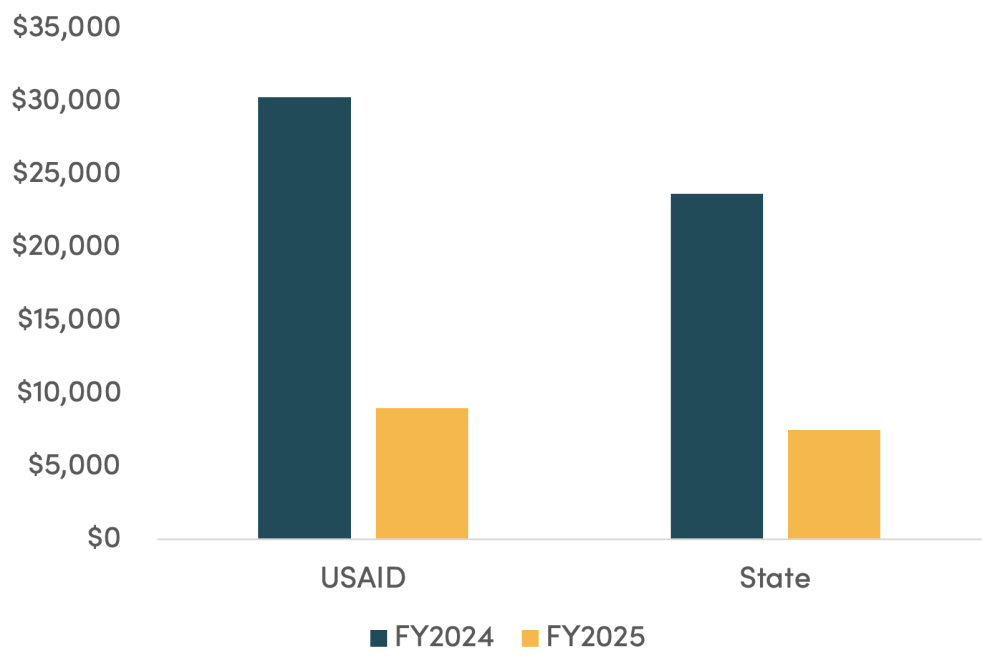
Data for USAID FY24 FY25 State FY24 FY25
This problem extends to lifesaving assistance—indeed the picture is, if anything, even worse. USAID’s humanitarian assistance bureau is currently down 92 percent on new obligations compared to last year. USAID’s global health bureau is down 93 percent. (The one exception amongst large USAID bureaus involves support for Ukraine through the Eastern Europe regional bureau—but again these were obligations made under the Biden administration). And once again it isn’t just at USAID. The State Department’s Population and Refugees and International Organization accounts have also seen an obligations collapse so far this year, by 71 percent and 84 percent respectively compared to (full year) FY 2024.
Fig 2. Selected bureaus: New foreign assistance obligations FY2024 (full year) and FY2025 (through June 17) $m
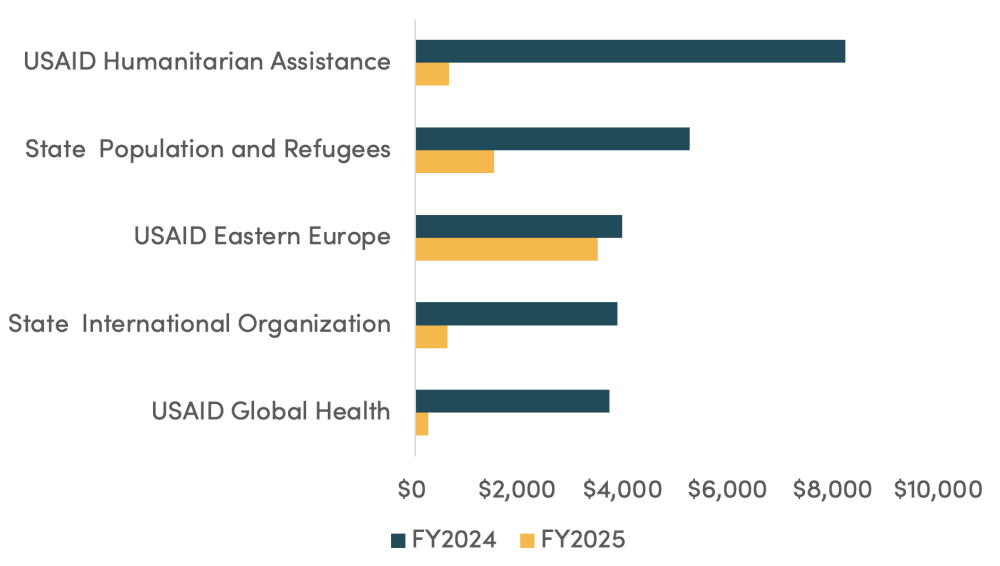
USAID data for FY24 FY25 State data for FY24 FY25.
The picture regarding spending also remains grim. Treasury data suggests outlays for FY25 were at $10 billion on January 1st (three months into the fiscal year)—so running a little above $3 billion a month. As of June 17th, they were still below $16 billion—so they’ve been running at about $1 billion a month since January. 144 days after the start of the “90 day pause” on US foreign assistance, the assistance system was still completely stalled. While there is less sign of the pause in State Department spending, there is also no sign it is picking up USAID’s slack. State Department outlays between January 1st and June 18th this year, at $7.6 billion, were $2 billion lower than this time last year.
US foreign assistance draws from a pool of finance refreshed by a stream of obligations. The stream has been dry for nearly six months, and the worsening drought will kill many thousands.
Topics
DISCLAIMER & PERMISSIONS
CGD's publications reflect the views of the authors, drawing on prior research and experience in their areas of expertise. CGD is a nonpartisan, independent organization and does not take institutional positions. You may use and disseminate CGD's publications under these conditions.
Thumbnail image by: USAID/ Flickr