Recommended

Blog Post
Unpacking the US’s New Global Health Strategy
Last week, the State Department released the first PEPFAR dataset on Spotlight since it picked up the program. The data cover the period July through September, 2025. PEPFAR provided antiretroviral therapy (ART) for 20.6 million people living with HIV in more than 50 countries, which is comparable to FY2024. The administration has framed this stability as a success story. But a closer look suggests a more complicated picture.
“Stable” is another word for foregone progress
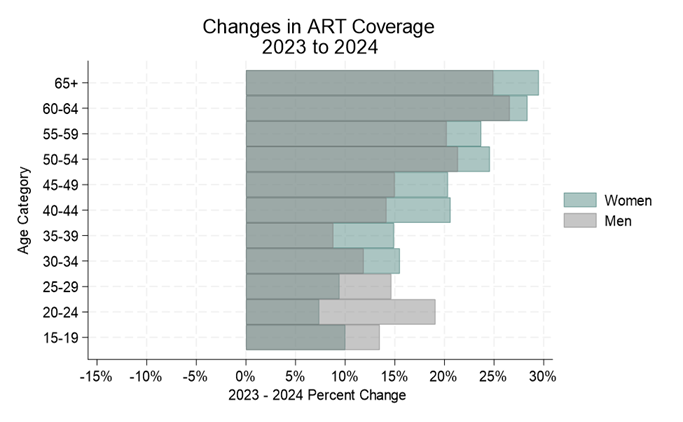
Yes, the new data do not show a catastrophic decline. But “stable” is disappointing compared to the program’s performance the year before: between FY2023 and FY2024, PEPFAR saw treatment growth of 5 percent to 30 percent across ages 12 through 65 and above, for both men and women.
Figure 1. Changes in PEPFAR-supported antiretroviral therapy coverage, 2023–2024
The testing pipeline is collapsing
Testing dropped from 21.9 million people in Q4 2024 to 17.2 million in Q4 2025; unsurprisingly, new diagnoses fell from 385,000 to 307,000. Because PEPFAR-supported ART coverage is a cumulative stock—people already on treatment—the 20.6 million figure can hold steady even as the pipeline feeding it weakens.
To be clear, this decline did not begin in 2025. COVID-19 disrupted HIV testing infrastructure and it has never fully recovered. The remaining undiagnosed population is also increasingly concentrated among key populations—men who have sex with men, sex workers, people who inject drugs—who require active outreach to be reached and account for a growing share of new infections globally.
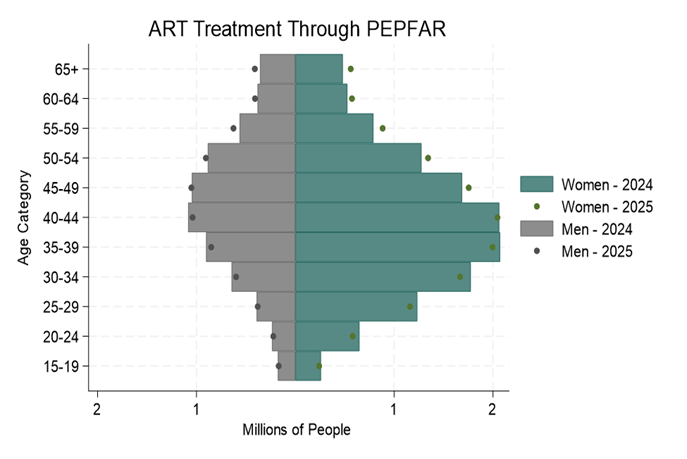
Driven by the shifting nature of the epidemic—a shift in relative burden to older age groups and the younger infected populations being harder to reach— the demographic breakdown in the new data suggests the losses are not evenly distributed—with younger cohorts showing actual declines in coverage while older cohorts hold steady or grow in coverage—a pattern we will examine in a forthcoming blog post.
The cancellation of funding for programs serving these key populations will likely accelerate this trend. This shift also matters for the program's long-term impact. If PEPFAR is increasingly spending less on outreach to adolescents and young adults, itis leaving public health impact—measured as disability-adjusted life years (DALYs)—on the table.
Figure 2. Antiretroviral therapy through PEPFAR has increased among older adults and fallen among reproductive age adults
Geographic changes
Most countries saw some change in PEPFAR-supported ART coverage; roughly a third witnessed a decline. Although many of these were small in relative terms, South Africa recorded a reduction of approximately 95,000 people, and Zambia and Malawi saw ART coverage decline by over 40,000 each.
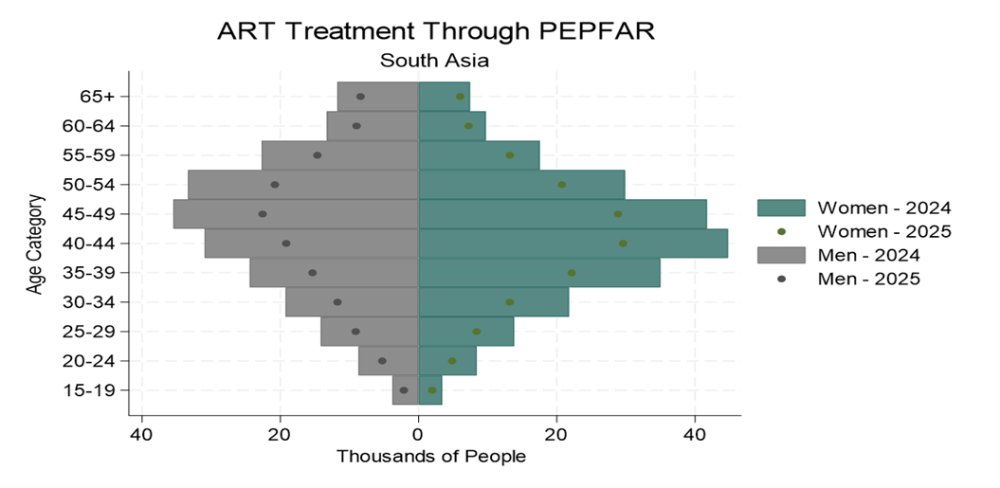
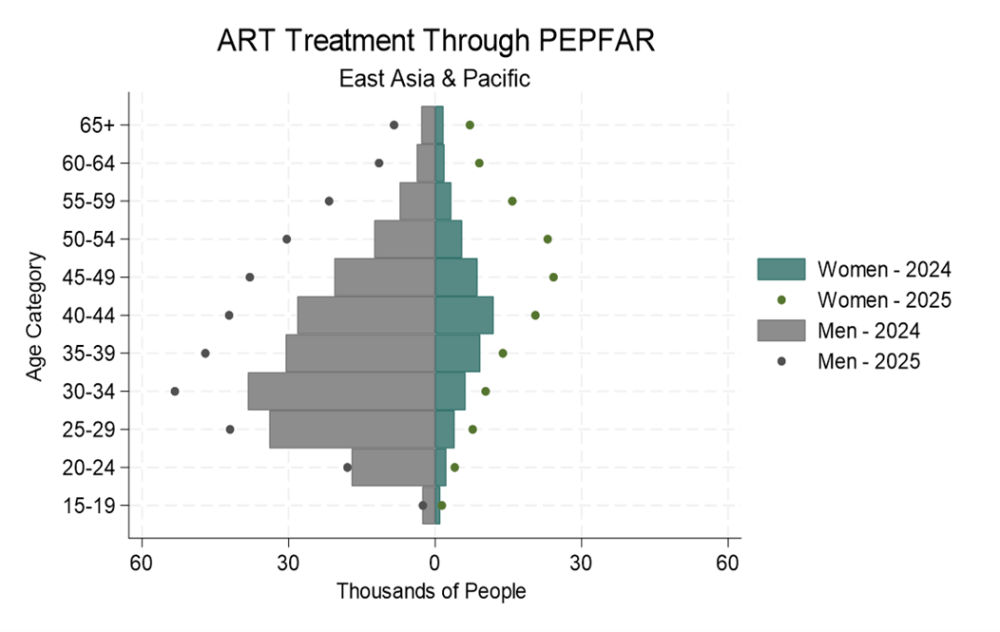
And while PEPFAR is a small actor in Asia, India and Thailand saw large relative decreases and increases in ART coverage respectively.
Figure 3a and Figure 3b. PEPFAR-supported antiretroviral therapy treatment through PEPFAR in Asia
| 
|
What we need to see
Because these ART numbers are a cumulative stock—measuring how many people are currently on treatment at a given point in time—a single quarter's snapshot is limited basis for assessing program trajectory. The fact that very limited data have been released, with earlier quarters excluded due to reporting disruptions, makes it impossible to assess how coverage evolved over the course of the year. The calls for the release of the full FY2025 dataset stand. Full, timely data is the foundation of PEPFAR's accountability to patients, partner countries, and taxpayers.
With thanks to Charles Kenny and Jocilyn Estes for comments.
Topics
DISCLAIMER & PERMISSIONS
CGD's publications reflect the views of the authors, drawing on prior research and experience in their areas of expertise. CGD is a nonpartisan, independent organization and does not take institutional positions. You may use and disseminate CGD's publications under these conditions.
Thumbnail image by: USAID/ Flickr