Development assistance for health is declining rapidly, and public healthcare supply chains are facing urgent shortfalls in resources. Governments are moving to increase domestic financing of their healthcare supply chains. Yet the financing of supply chains is a neglected policy area, and one where countries face significant challenges. Too often, financing is slow, unpredictable, fragmented, inflexible, dependent on donors, and inefficient. As a result, populations suffer from limited and unreliable access to essential medicines and diagnostics. The neglect is partly due to the reality that health financing and supply chain policymakers work in institutional and disciplinary silos, are backed by different global health agencies and donors, and lack a common understanding or language to develop robust national policies.
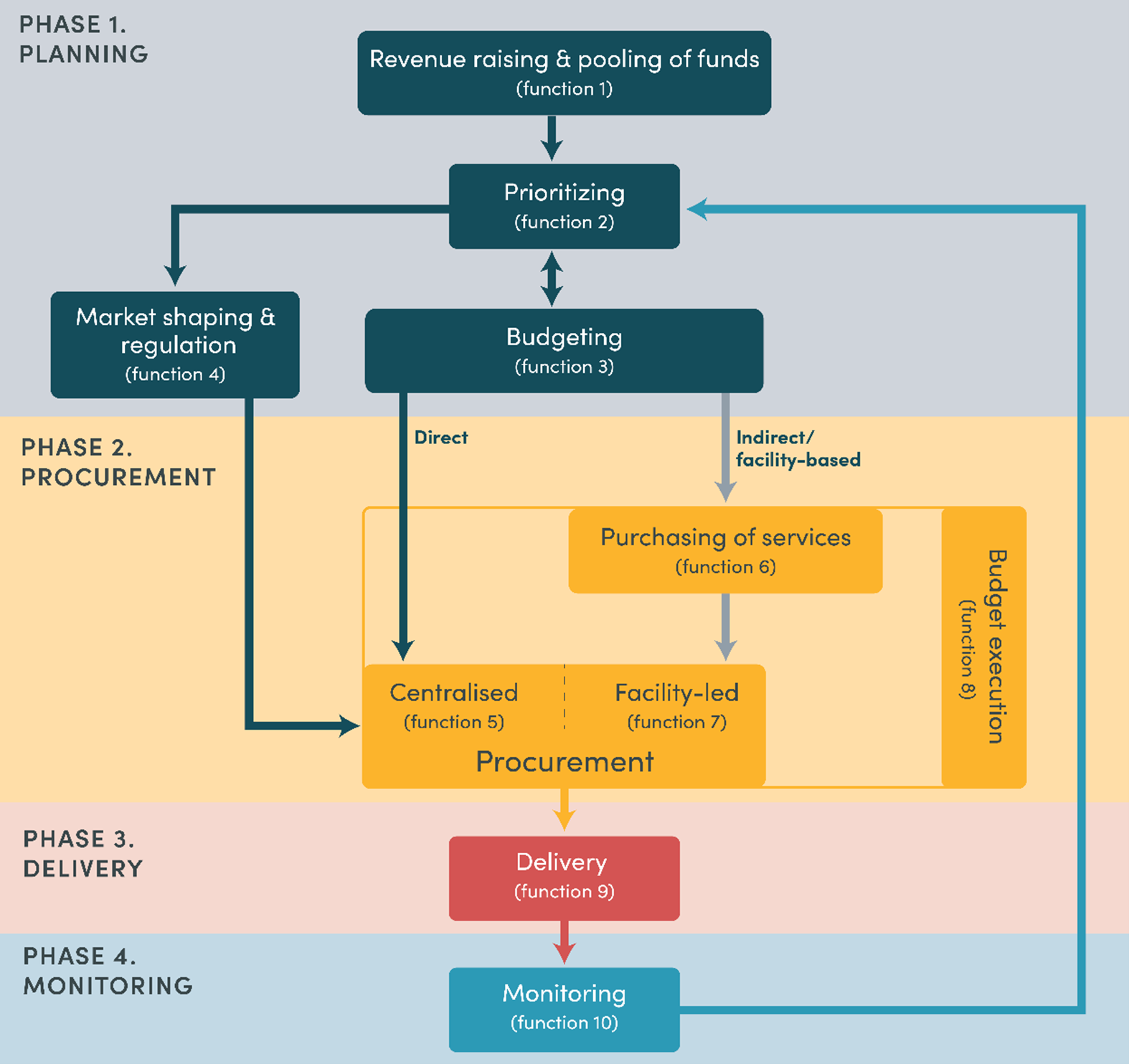
Following a review of prior theoretical work and case studies, and engagement with policymakers and experts, this CGD Policy Paper proposes a novel conceptual framework that integrates the functions and policy domains of the two fields. It defines financing of supply chains as “the policies and practices necessary to provide financial resources to the supply chain, and ensure their optimal use, in order to achieve health system goals.” The framework articulates integrated sectoral governance as a prerequisite for success and then details 10 distinct functions across four phases of the supply chain: planning, procurement, delivery, and monitoring. First, countries must plan the financing of supply chains, including raising funds, setting priorities, budgeting, and regulating markets. Second, countries must finance procurement and effectively execute procurement budgets, including both “direct” procurement by higher-level budget holders and “indirect” procurement carried out by healthcare facilities. Third, countries must finance an effective delivery system that ensures efficient warehousing and the timely last-mile distribution of commodities to healthcare facilities. Finally, robust monitoring is needed to enable data-informed decision making, including setting the priorities for future cycles.
This framework is intended to provide a new way of thinking about supply chains. In time, we hope this will lead to a new community of practice, countries strengthening their policies and sharing their experience, and better global guidance.