Recommended
Blog Post
The Human Cost of Cholera
Blog Post
How Many Lives Does US Foreign Aid Save?
Blog Post
Unpacking the US’s New Global Health Strategy
The United States—long the world’s largest provider of lifesaving assistance and the largest humanitarian donor to many countries, especially in sub-Saharan Africa—saw a sharp reversal in early 2025. The US administration imposed a temporary funding freeze, cancelled most assistance awards, and closed USAID. Although lifesaving programs were nominally exempt, the protections were partial and largely ineffective: many lifesaving awards were cancelled and the definition of “lifesaving” excluded activities that prevented morbidity and mortality (e.g., water, sanitation, and hygiene—WASH—and sexual and reproductive health). While recent evidence suggests that global health funding has resumed near previous levels, there have been no significant new humanitarian awards since January.
To date, current estimates of the impacts of the US cuts and disruption (including analysis by CGD staff) rely on modeling mortality increases. In this blog, we use data on reported cholera deaths and US spending responses to provide real-world evidence of potential impact. We report on two linked datasets that we constructed to analyze the changes in both cholera incidence and the US government’s foreign aid disbursement in Africa between January 2023 and June 2025.
What we did
We scraped and processed Africa CDC’s Epidemic Intelligence Reports, which feature cumulative country-level totals for multiple diseases. Cholera—a persistent public health threat in sub-Saharan Africa and one of the most consistently reported—is a notable example. We focused on countries with recent outbreaks where there has been US WASH assistance.
We also extracted award-level data from usaspending.gov for fiscal years 2023 to 2025. These data cover USAID, Department of State, and Centers for Disease Control obligations in 10 cholera-affected countries. Using text analysis and manual verification, we identified 219 WASH-related awards for which we estimated monthly obligations and outlays by averaging across the reported life of the award. Merging the health and aid datasets at the country-month level, we created a panel capturing cholera cases, deaths, case fatality ratios, and estimated aid disbursement (including cancelled spending after January 2025).
What we found
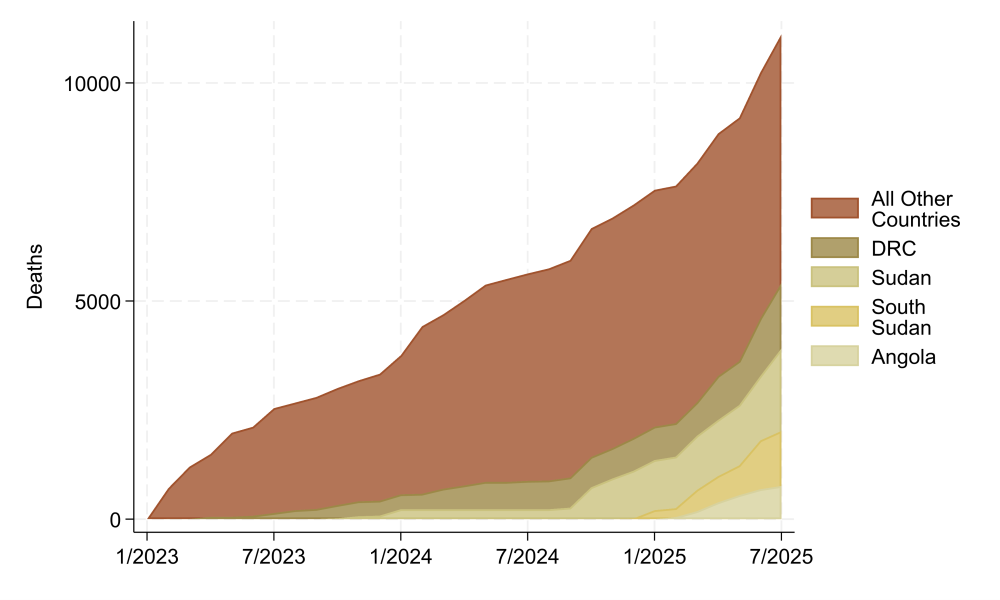
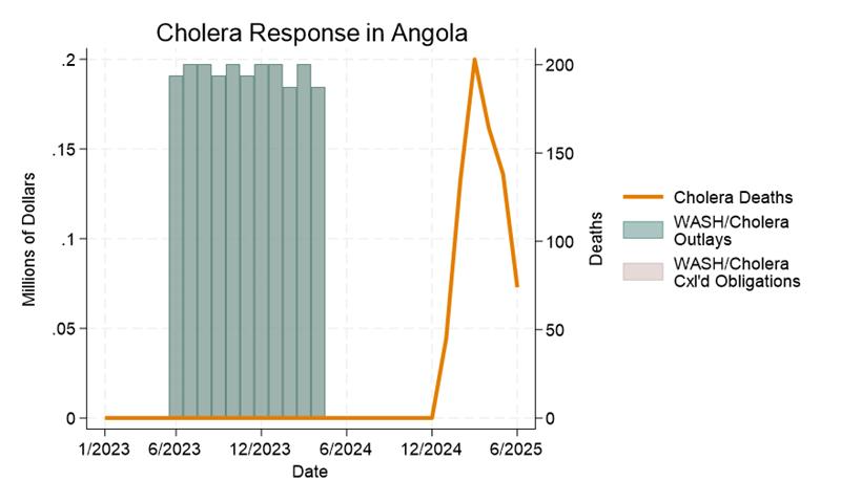
The data show elevated cholera mortality across Africa in 2025 relative to prior years, with Angola, the Democratic Republic of Congo (DRC), Sudan, and South Sudan accounting for 3,296 of the 3,561 deaths reported through the start of July.
Figure 1. Cumulative cholera deaths tracked by Africa CDC
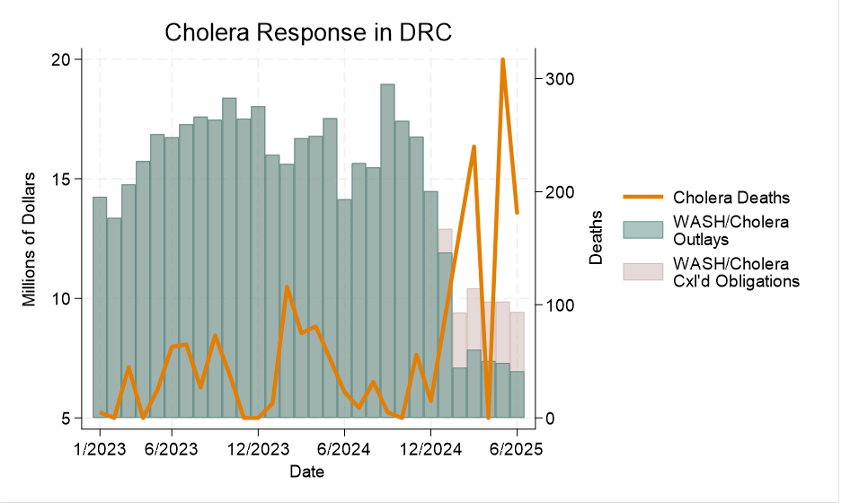
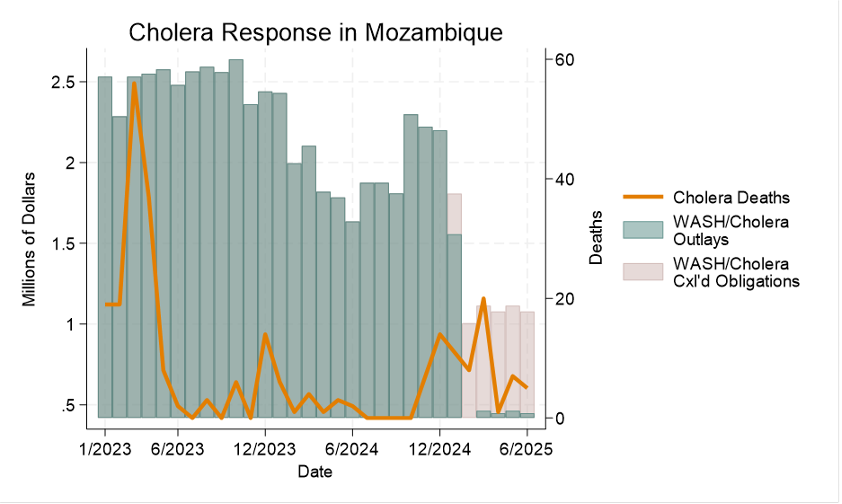
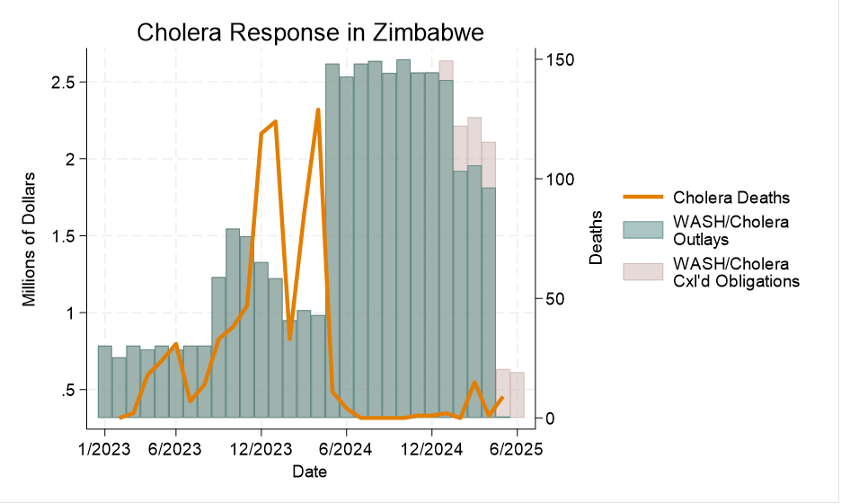
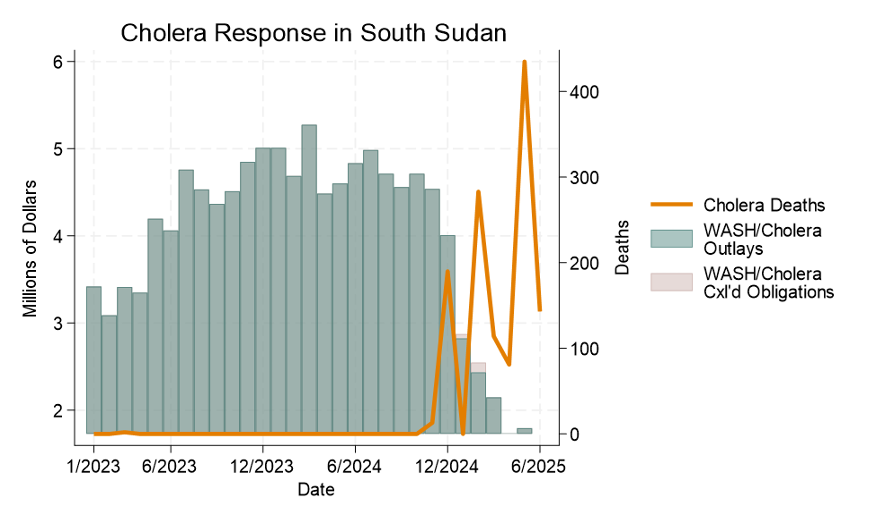
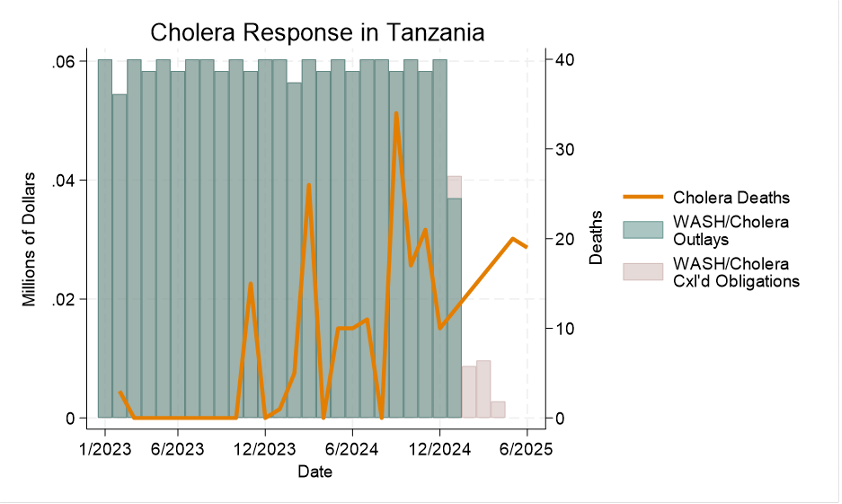
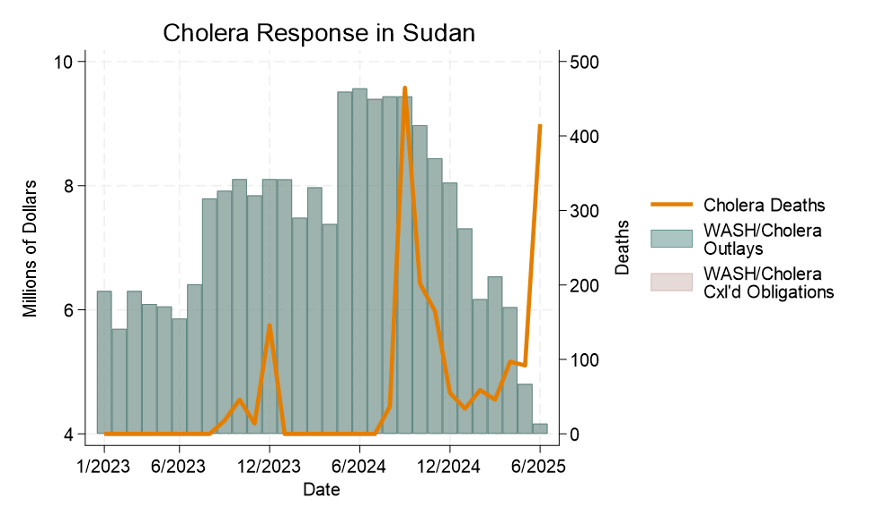
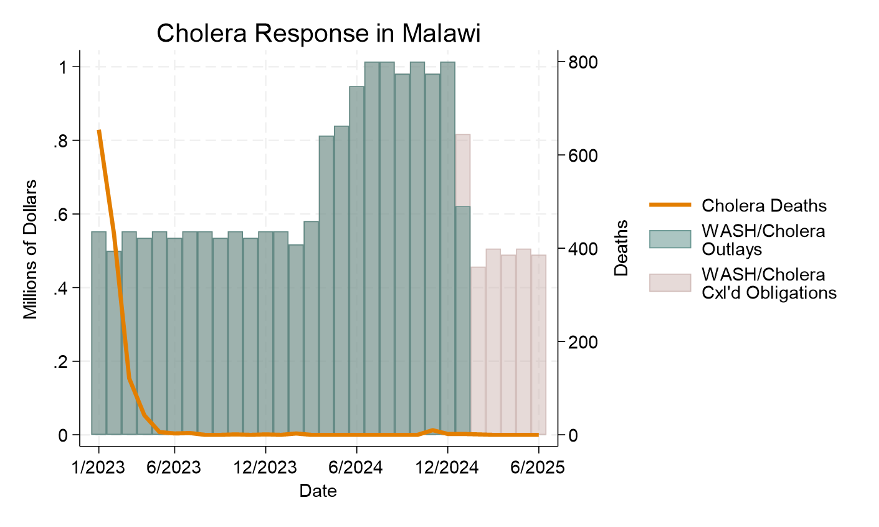
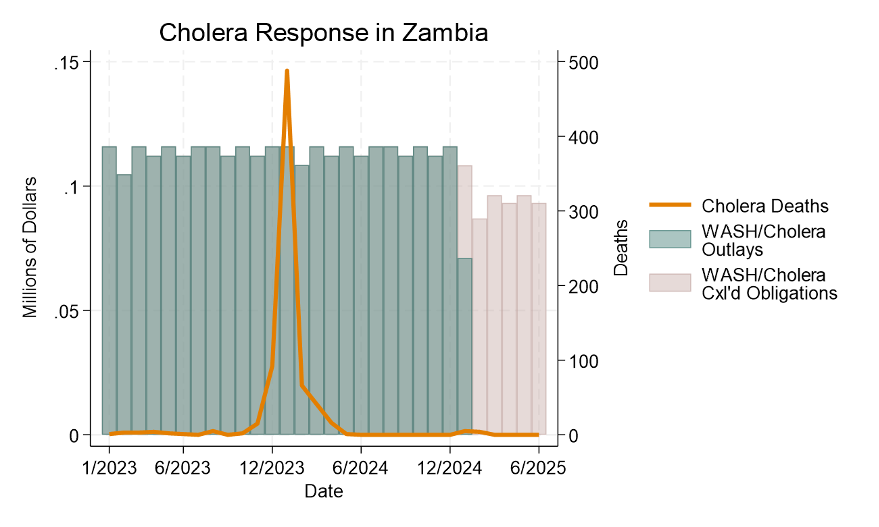
The data (Figure 2) also highlight the role that US foreign assistance has often played in responding to cholera outbreaks across sub-Saharan Africa over the past two years. Admittedly the long-term picture is sometimes more complicated. For instance, in Malawi and Zambia, aid flows do not appear to map as directly onto cholera trends. This reflects both reporting gaps and the fact that US programs often pursued broader objectives beyond immediate outbreak response. But in many instances, the data point to US assistance responding to a cholera outbreak. Take Zimbabwe, where aid disbursements climbed during peaks in cholera mortality—albeit with a delay—and Sudan, where US funding rose through late-2024 before gradually tapering as death counts fell. Mozambique showed a similar relationship: after Cyclone Freddy in 2023, displacement caused cholera to spread, and US projects expanded in the months after.
Today, that logic appears to have been broken. The current outbreak, one of the most severe in years, is not being met with additional aid but instead with reductions. The 2025 data (to August) shows 22 WASH-related contracts cancelled outright as well as a sharp contraction in projected commitments and an absence of new awards.
Figure 2 . Cholera deaths and USAID and CDC spending by country, January 2023-August 2025
| 
|
| 
|
| 
|
| 
|
|
A cholera crisis amid aid cuts
In Sudan, South Sudan, and DRC, years of conflict and displacement have weakened health systems and forced people into overcrowded refugee camps and other temporary settings, fueling recurrent and deadly cholera outbreaks. US assistance has contracted at precisely the moment when rising cholera cases require immediate medical response as well as sustained and intensified investments in clean water and sanitation infrastructure. For global health security, this is not just an abdication of leadership—it is a losing gamble with people’s lives.
Topics
DISCLAIMER & PERMISSIONS
CGD's publications reflect the views of the authors, drawing on prior research and experience in their areas of expertise. CGD is a nonpartisan, independent organization and does not take institutional positions. You may use and disseminate CGD's publications under these conditions.
Thumbnail image by: Africa/ Adobe Stock