Recommended
CGD NOTE
Sanctions on Venezuela Aren't Driving Migration to the US Border
Ecuador’s sharp rise in violent crime has coincided with a major influx of Venezuelan migrants, fueling a public narrative that blames migrants for the country’s deteriorating security. This policy note challenges that view using five years of official detention data disaggregated by nationality and migratory status. It finds that Venezuelans are consistently underrepresented in crime statistics—accounting for only 1.3 percent of detentions in 2024 despite comprising over 2.5 percent of the population—and are far less likely to be formally detained after apprehension. Most crimes involving Venezuelans are non-violent and economically motivated, with a large majority committed by individuals lacking regular legal status. While Venezuelan detainees are more likely to be found carrying weapons, geographic analysis of homicide data reveals that the provinces hit hardest by gang-related violence are not those with the highest concentration of homicides committed by Venezuelan migrant detainees. These findings suggest that migrant-related offenses are largely disconnected from Ecuador’s structural security crisis. To devise and design all immigration policy solely through the lens of crime—particularly as part of broader efforts to combat gangs—is misguided and likely to be ineffective. Instead, policy should focus on migrant regularization, economic inclusion, and evidence-based public communication.
Introduction
Ecuador is navigating two overlapping crises: a dramatic surge in violent crime and one of the region’s largest inflows of displaced Venezuelans. Since 2018, the number of Venezuelans in the country has jumped from just over 72,000 to more than 440,000 by 2024—around 2.5 percent of Ecuador’s population. Over the same period, Ecuador’s homicide rate has tripled, rising from 13.7 per 100,000 in 2021 to nearly 43 per 100,000 by 2023. The coincidence of these trends has fueled public anxiety and political rhetoric suggesting that Venezuelan migrants are, partially or entirely, to blame for rising crime. High-profile incidents—such as isolated murders involving Venezuelan suspects—have received extensive media coverage and, in some cases, provoked xenophobic backlashes.
This note interrogates that narrative using detailed national data on police detentions (2019–2025), disaggregated by nationality and migratory status. The results point clearly in the opposite direction: Venezuelans account for registered detentions that are well below their population share. In 2024, for example, only about 1.3 percent of all detainees were Venezuelan, despite census data suggesting they made up more than double that share at the national level. Moreover, Venezuelans are significantly less likely to be formally detained once apprehended: only 10–15 percent of Venezuelan apprehensions result in detention, compared to 35–40 percent for Ecuadorians, throughout the years, suggesting that many incidents involving Venezuelans are minor or administrative in nature.
This pattern holds across the country. A subnational analysis of detention data by province shows that in most parts of Ecuador, Venezuelans are detained at rates below their share of the local population. The few provinces where Venezuelans appear overrepresented in detentions—such as Carchi or Azuay—tend to have small overall populations, high police presence, or border-control dynamics that might inflate numbers through minor infractions rather than serious crimes. By contrast, in provinces with the largest Venezuelan communities, like Pichincha and Guayas, detention shares roughly track or fall below population shares. Taken together, these spatial patterns reinforce that Venezuelan migrants are not a major driver of crime even at the local level, and that apparent “hot spots” often reflect enforcement intensity or visibility rather than elevated criminal activity.
This does not mean Venezuelans are uninvolved in crime altogether. The data reveal that when crimes by migrants occur, they are far more likely to be crimes against property (e.g., theft, robbery), drug-related offenses, or “crimes against the state” (e.g., immigration infractions). For instance, over 40 percent of crimes involving Venezuelans are property-related, compared to just 26 percent for the general population.
Crucially, most crimes involving Venezuelans are committed by individuals with irregular status. Between 2021 and 2025, the share of detained Venezuelans with regular migratory status never exceeded 12 percent, with most falling into undocumented and ambiguous (including unknown status) categories. This pattern aligns with broader research: exclusion from legal residency and formal employment increases both vulnerability to victimization and involvement in survival-driven crime.
At the same time, almost 10 percent of Venezuelan detainees are found carrying weapons, more than four times the rate among Ecuadorians. This suggests a worrying pattern, since it means that their offenses, even if often minor ones, can involve the threat—or perception—of violence.
Given this concerning pattern of weapon involvement, it becomes essential to determine whether these incidents are part of a broader violent dynamic. To investigate this, I focus on violent crimes—and in particular, on homicides, which are harder to manipulate than other crime categories that may be shaped by enforcement biases or media sensationalism. Unlike lesser offenses, homicides typically leave a body, a crime scene, and often a weapon—making them subject to automatic investigative procedures and much harder to underreport or misclassify.
Focusing on data of detainees because of homicides, this paper asks: Is there evidence supporting the idea that Venezuelan migrants are participating in the country’s surge in gang-related killings, or are their offenses distinct and largely separate from the structural violence that has gripped Ecuador in recent years? I find little evidence of Venezuelans being part of gang-related violence when looking at the geographic distribution of these crimes. In particular, from 2019 to 2024, the highest homicide rates—over 60 per 100,000—were found in provinces like Guayas, Esmeraldas, and Manabí, all hotbeds of organized criminal activity. Yet Venezuelan involvement in homicides in these provinces is negligible. In fact, provinces with higher shares of Venezuelan-linked homicides are generally places with low overall homicide rates, suggesting that migrant-related violence operates through different mechanisms than gang warfare.
Taken together, I argue, these findings call for a strategic policy response grounded in evidence, not fear. Anti-migrant crackdowns that conflate mobility with criminality are unlikely to reduce crime and risk further marginalizing an already vulnerable population. Instead, Ecuador should double down on regularization efforts, remove barriers to labor market participation, and focus policing on the actual drivers of violence: the transnational drug-trafficking networks and mega-gangs operating across the country. Finally, shifting public perception will be key. Combating xenophobia and misinformation through evidence-based communication is essential to ensure that migration policy serves Ecuador’s security and social cohesion, rather than undermining them.
Data sources
This report draws mainly on multiple official data sources from Ecuador that are anonymized and publicly available:
- Police Detention Records (2019–2025): Microdata on apprehensions and detentions was obtained from Ecuador’s Interior Ministry website, covering the years 2019 through April 2025, accessible via Ecuador’s national open data portal. The dataset includes individual-level information on nationality, migratory status, geographic location, and legal classification (apprehended vs. detained).
- 2022 Population Census: Population figures—including the number of Venezuelan nationals residing in Ecuador—were sourced from the 2022 Census of Population and Housing (Censo de Población y Vivienda 2022), conducted by the National Institute of Statistics and Censuses (INEC). Data by province and nationality were used to compute population shares and estimate proportional detention rates.
National trends
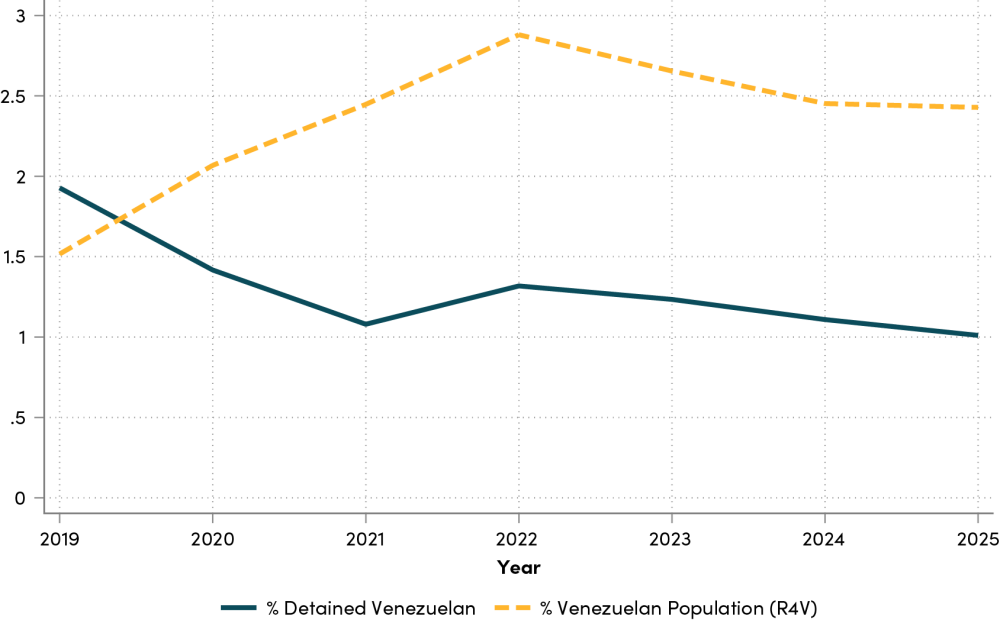
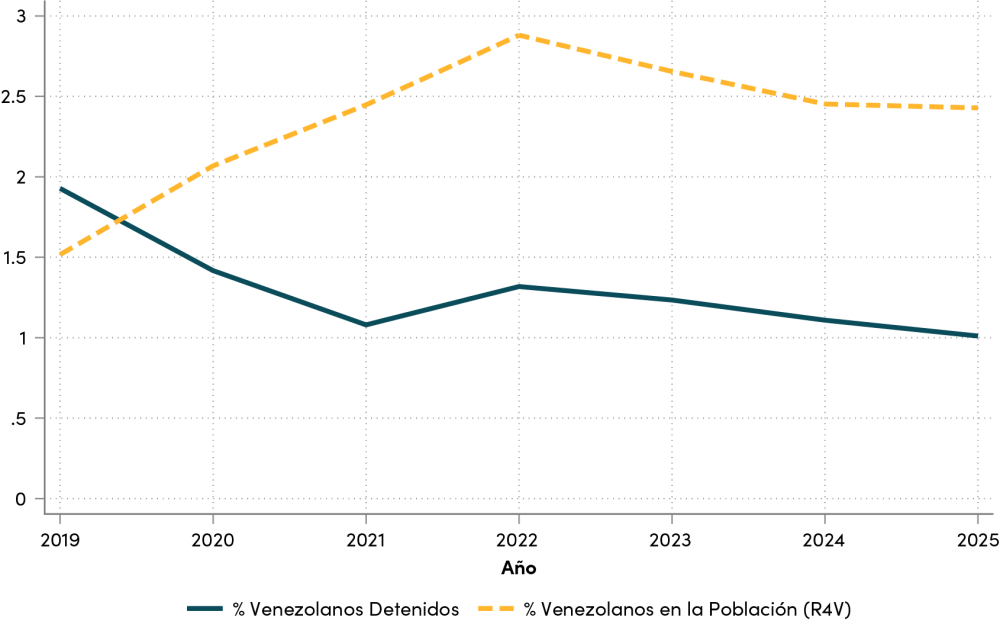
National-level data consistently show that Venezuelan migrants do not commit crimes at disproportionate rates. As illustrated in Figure 1, from 2019 through 2025, the percentage of all detainees in Ecuador who are Venezuelan hovered around 1 percent to 1.5 percent per year. For contrast, the figure also plots the share of Venezuelans in the population on a yearly basis, drawing on data from R4V (using mid-year figures). Overall, the share of crimes committed by Venezuelans fluctuates slightly but generally tracks below the Venezuelan share of the population. Simply put, the evidence does not support claims that Venezuelan immigrants are driving crime in Ecuador.
Figure 1. Share of Venezuelans among persons detained by police, Ecuador (2019–2025)
Source: Datos Abiertos, Government of Ecuador; R4V Data
This finding aligns with studies from other Latin American countries that host Venezuelan refugees. For instance, research covering Colombia, Peru, and Chile in 2019 found that Venezuelan immigrants commit substantially fewer crimes than natives relative to their population share. Ecuador appears to fit this regional pattern: migrants are, overall, at least as law-abiding as the host population.
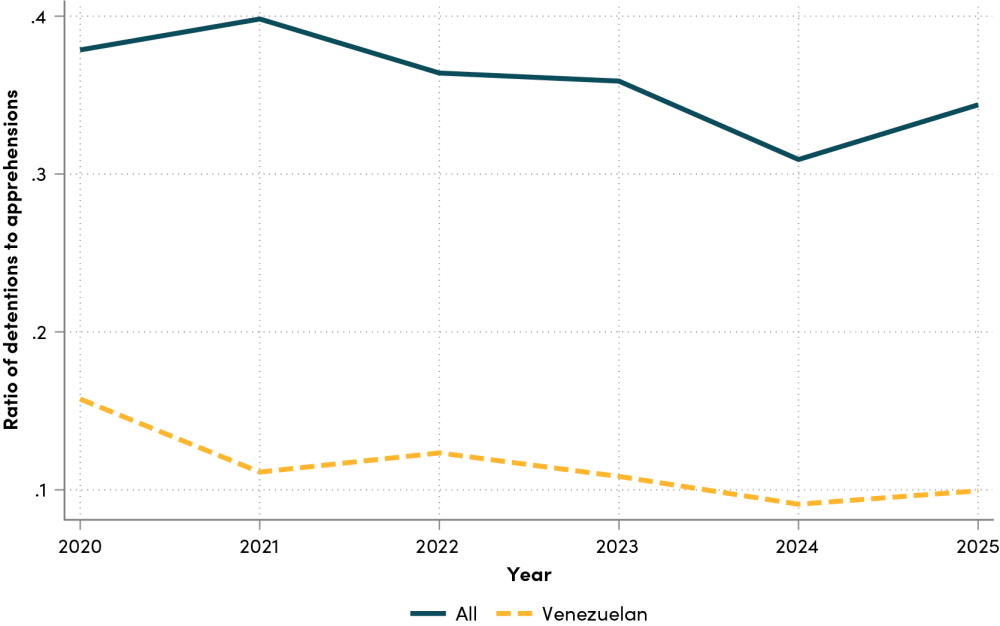
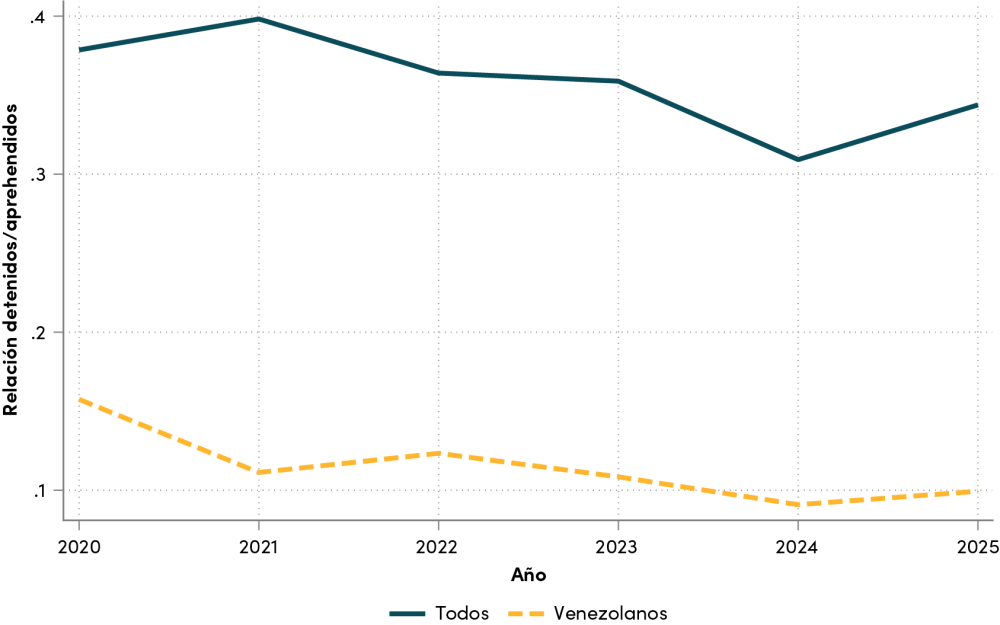
The broader climate of suspicion and the public discourse that frames migrants as a threat may be shaping enforcement outcomes in more subtle ways. These dynamics appear to surface in the data. As shown in Figure 2, the ratio of individuals detained to those apprehended is significantly lower for Venezuelans than for the overall population—consistently around 10 percent to 15 percent, compared to 35 percent to 40 percent nationally. This suggests that many of the apprehensions involving Venezuelans do not lead to formal detention, likely because the offenses are less serious, unsubstantiated, or administrative in nature.
In this light, one possible interpretation is that some enforcement actions may reflect an overly aggressive posture toward migrants, influenced by political or societal pressures rather than actual threat levels. While not codified in policy, these practices risk reinforcing stigma and misallocating resources. The data serve as a reminder that poorly grounded narratives can have real operational consequences, and that durable security solutions require a clear distinction between immigration and crime control.
Figure 2. Detention-to-apprehension ratio by year: Venezuelans vs. total population
Source: Datos Abiertos, Government of Ecuador.
Subnational variation in Venezuelan crime involvement
National averages can conceal local variations. In a few provinces, authorities and the public have reported concerns about migrant crime, sometimes due to specific incidents or higher migrant concentrations. To further understand patterns in Venezuelan involvement in crime, I examine subnational variation across Ecuador’s provinces using three complementary indicators. These maps present annual averages from 2019 to 2025 to smooth year-to-year fluctuations and highlight consistent geographic trends.
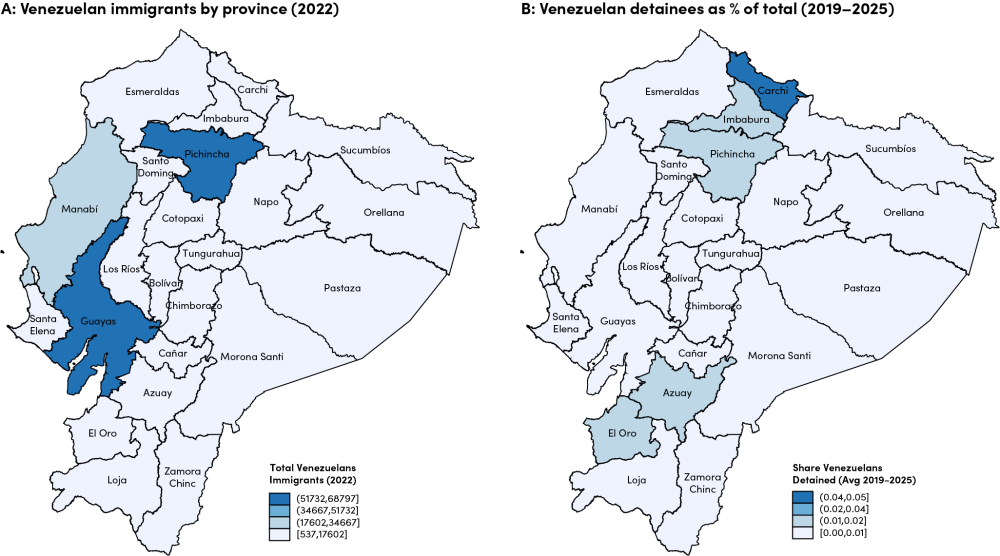
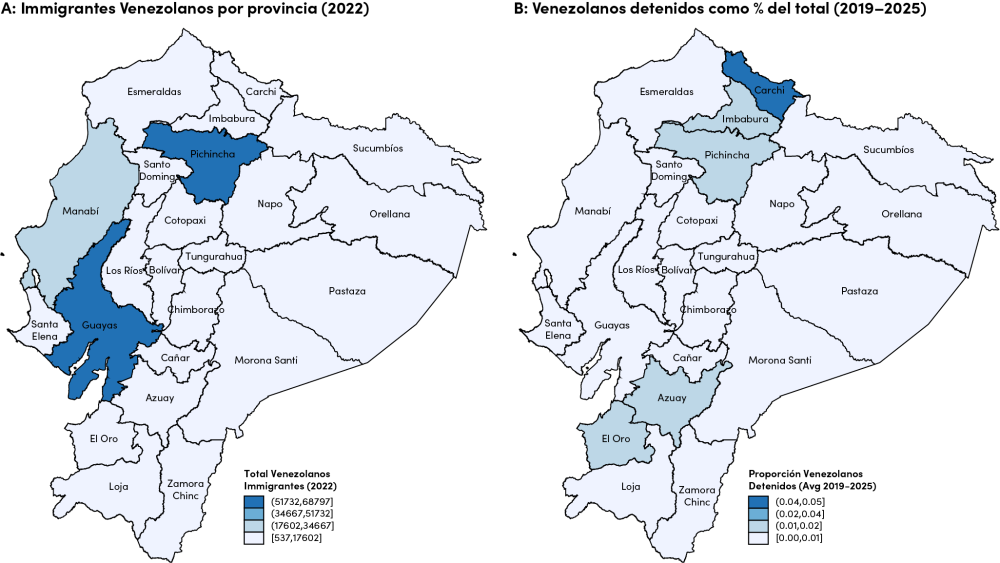
Figure 3a presents the geographic distribution of Venezuelan immigrants residing in Ecuador in 2022, based on census data (to the best of my knowledge, this is the most recent data estimating the Venezuelan population at the subnational level). Unsurprisingly, the highest concentrations are found in the country’s two largest urban provinces—Pichincha and Guayas—as well as in Manabí, which also hosts a sizable Venezuelan population. These provinces are major economic hubs that offer more employment opportunities and access to services, making them natural destinations for migrant settlement.
By contrast, Figure 3b represents the share of total provincial detentions involving Venezuelans, averaged over 2019–2025. Here, besides Pichincha, provinces like Carchi, Imbabura, Azuay, and El Oro stand out, despite having comparatively smaller Venezuelan populations. This mismatch suggests that in certain border or transit provinces, Venezuelans may be disproportionately represented in detention statistics, possibly due to heightened police presence, migration controls, or greater visibility in smaller localities.
Taken together, these maps caution against drawing conclusions based solely on detention shares. Provinces with large migrant communities do not show correspondingly high detention rates, and provinces with high detention shares often host relatively few Venezuelans. This reinforces the argument that enforcement patterns may reflect visibility, policing intensity, or administrative dynamics more than actual criminal behavior. It also underscores the need for nuanced, proportional policy responses tailored to local contexts rather than sweeping national narratives.
Figure 3. Geographic distributions of Venezuelan population and Venezuelan detainees
Source: Datos Abiertos, Government of Ecuador; INEC 2022 Census.
It is important to emphasize, however, that a higher share of detentions involving Venezuelans in certain provinces does not in itself indicate a meaningful crime problem. These shares must be interpreted relative to the size of the local Venezuelan population. For instance, provinces like Carchi or Azuay may show elevated detention shares simply because their overall population is small and the migrant presence is more visible or more frequently policed.
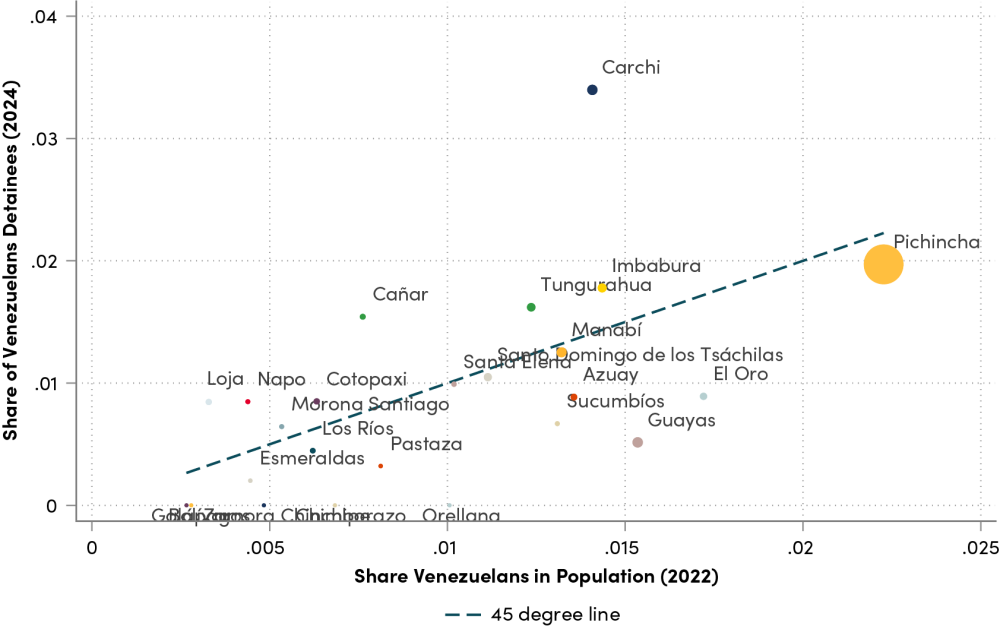
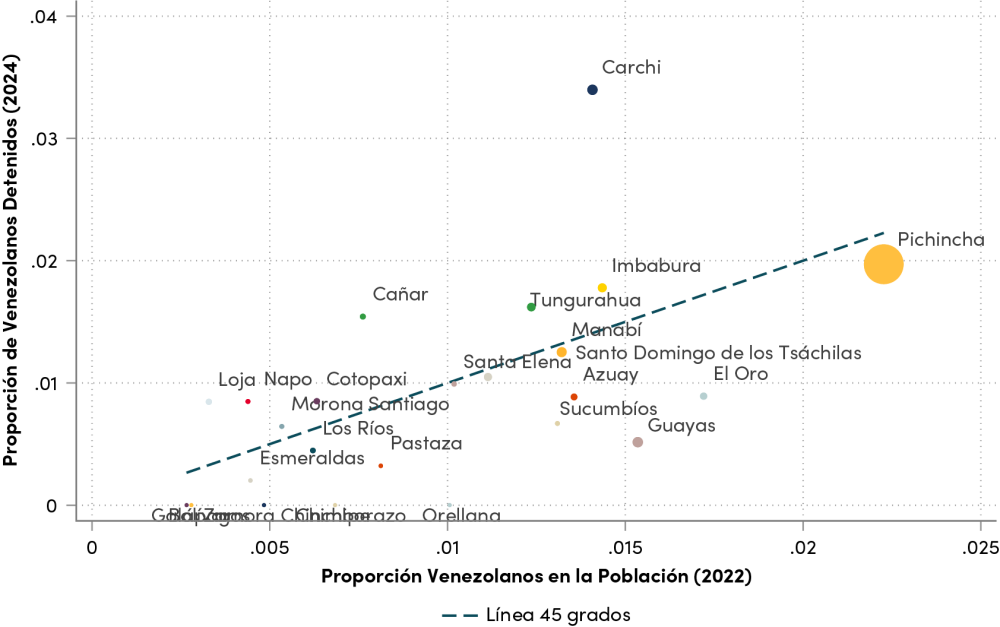
To address this, Figure 4 presents a localized version of the national-level analysis introduced above. It plots the share of detainees in 2024 (the last year for which crime data is available for the totality of the year) who are Venezuelan against their share of the local population in each province, using 2022 Census data. Note that using the 2022 Census is likely an undercount given that the 2022 census reports only 231,686 Venezuelans in Ecuador for that year as compared to R4V, which places the figure closer to 500,000. Under that conservative comparison point, the dashed 45-degree line represents parity—points along this line indicate provinces where Venezuelans are detained in proportion to their presence in the population. Crucially, the size of each bubble reflects the total number of crimes committed by Venezuelans in that province.
Figure 4. Venezuelan population share vs. detention share by province
Source: Datos Abiertos, Government of Ecuador; INEC 2022 Census.
Note: Marker size is proportional to total number of Venezuelan detainees by province.
The figure shows clearly that most provinces fall below the parity line. This indicates that Venezuelans are generally detained at lower rates than would be expected based on their demographic footprint. Pichincha, the province with the largest number of reported crimes committed by Venezuelans, lies close to the parity line, showing a nearly proportional relationship between crime and population. Most localities above the parity line, as shown by the size of the bubbles, represent a negligible number of crimes by Venezuelans. In other words, even in provinces where Venezuelans appear overrepresented in detention data, the underlying crime numbers are low.
One notable outlier, however, is Carchi, a northern border province. Carchi’s data point sits way above the line, indicating that Venezuelans form a higher share of detentions than of the local population. This is consistent with Figure 3 and is likely tied to Carchi’s border location and enforcement dynamics. Carchi sees large transient migrant flows and intensive immigration policing; many Venezuelans detained there may be picked up for immigration infractions or minor offenses related to border crossing and survival strategies. Even so, the absolute numbers are very small. Apart from Carchi, only a handful of provinces show modest overrepresentation. In several provinces (e.g., Morona Santiago, Napo, Galápagos), no Venezuelan detentions were recorded in the latest data—despite migrants residing there.
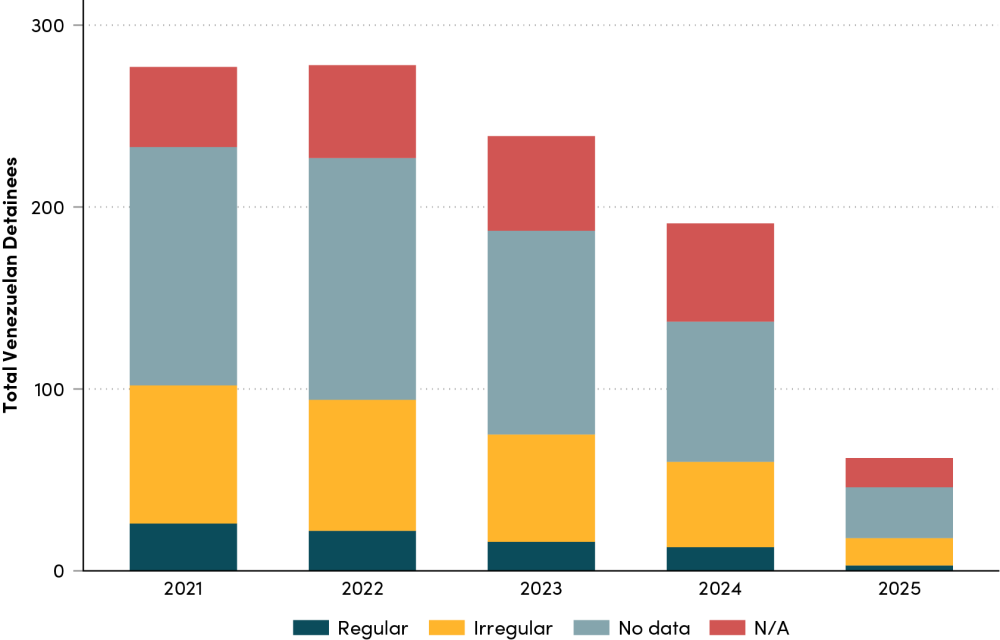
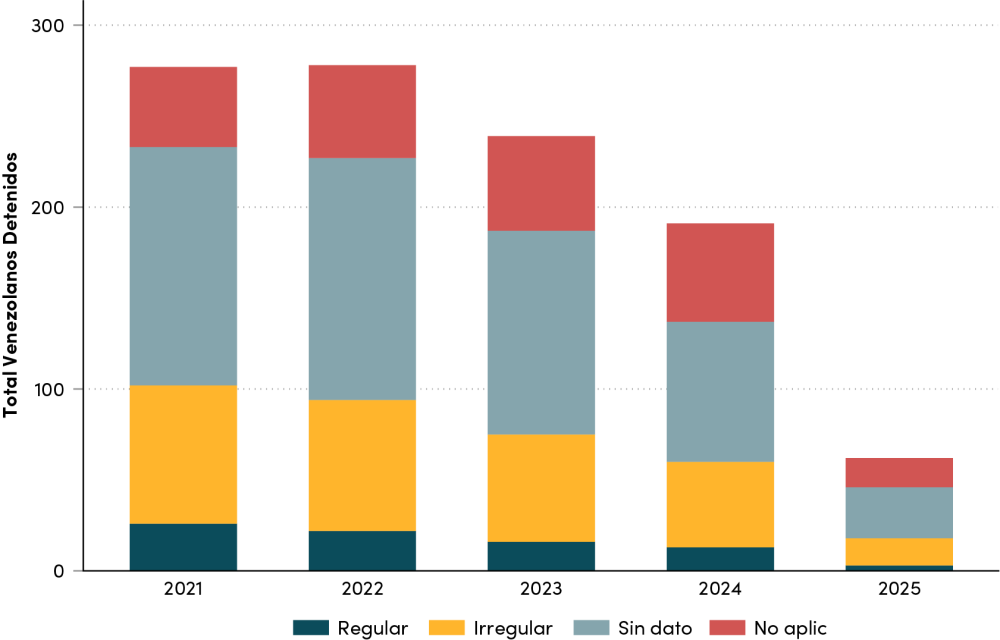
An important question these data allow us to inquire about is to what extent the legal status of these immigrants is associated with crime as measured by detention data. Figure 5 illustrates the total number of Venezuelan detainees from 2021 to 2025, categorized by whether individuals were in regular status or irregular status (or whether there is no data to categorize them), as reported in the detainee data. It is striking that only a small fraction of detainees held regular migration status, and that this proportion has remained stable—and low—over time, never exceeding 12 percent and averaging about 7 percent over the years. Most detained individuals are recorded as being in irregular status or fall under ambiguous administrative categories, suggesting gaps in legal documentation and enforcement practices.
This pattern aligns with findings from other contexts showing that granting legal residency to undocumented migrants led to sizable reductions in crime, especially for economically motivated offenses. The Ecuadorian data points in the same direction and allows us to hypothesize that irregular status is not just a bureaucratic label, but rather a structural risk factor. Migrants without legal recognition are more likely to live in precarious conditions, face barriers to employment, and become either targets of police action or participants in survival-driven offenses. Accordingly, regularization should not be viewed merely as a migration management tool but as a critical crime prevention strategy that enhances public safety, not only based on this evidence but on the wider literature that has analyzed these patterns.
Figure 5. Venezuelan nationals detainees by migratory status
Source: Datos Abiertos, Government of Ecuador
Common crime or gang violence?
While the overall propensity for crime among Venezuelan migrants in Ecuador is low, understanding the nature of the crimes that do occur is critical not only for accurate diagnosis, but also for designing effective policy responses—particularly given the rise in structural gang violence in recent years. Are the relatively few crimes involving Venezuelans primarily linked to the broader dynamics of organized crime, or are they better understood as isolated incidents of common criminality?
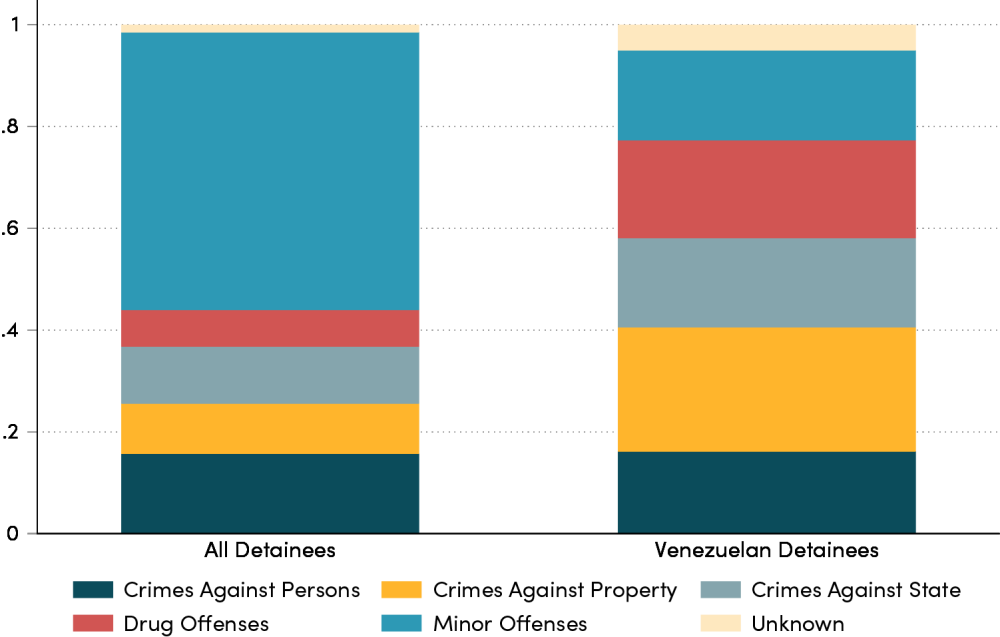
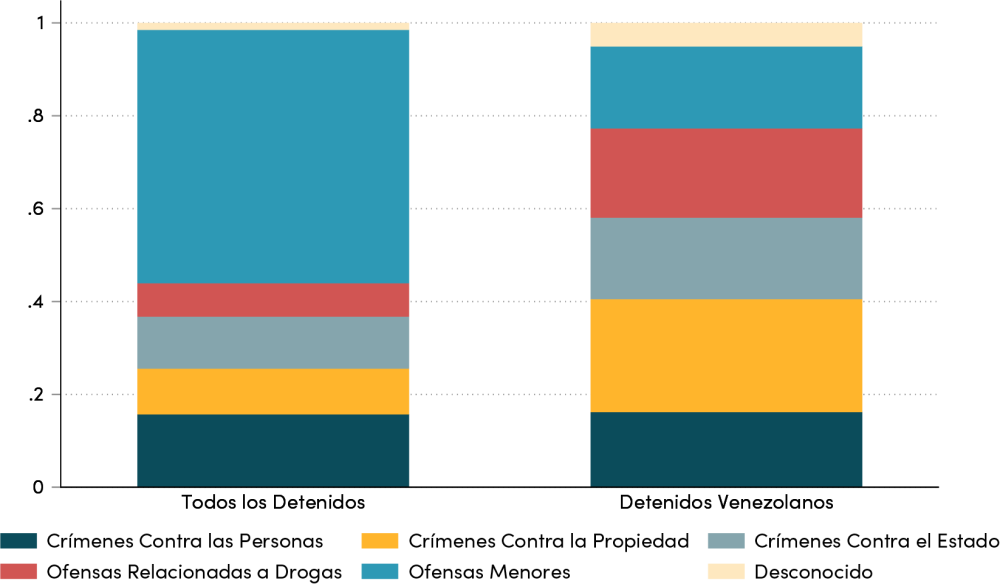
Figure 6 breaks down the composition of crimes by category, comparing the distribution of offenses committed by Venezuelan detainees and the overall population. The categories include crimes against persons (such as assault or homicide), crimes against property (such as robbery or theft), drug-related offenses, crimes against the state (including immigration or documentation infractions), minor offenses (typically administrative or low-severity), and unknown classifications.[1]
Several notable patterns emerge. Venezuelans are significantly more represented in crimes against property, crimes against the state, and drug offenses—categories often associated with economic precarity and legal vulnerability. Together, these account for a much larger share of total crimes committed by Venezuelans than by non-Venezuelans. This contrasts sharply with the general population, where minor offenses dominate the criminal composition. The share of minor infractions among non-Venezuelans is nearly half, compared to less than a quarter for Venezuelans.
Figure 6. Reported type of crimes by detainees, Venezuelan vs. overall population
Source: Datos Abiertos, Government of Ecuador
It is also interesting to note the elevated share of “crimes against the state” by Venezuelan detainees, which could reflect the criminalization of migratory or documentation-related offenses, which may be administrative in nature but still appear in criminal records.
This pattern reinforces the importance of distinguishing between types of criminal behavior and their underlying causes. While Venezuelans are not more likely to commit crimes overall, when they do, their offenses often stem, one can hypothesize, from structural exclusion rather than organized criminal intent, it seems.
However, the data also reveals a concerning reality. Figure 7 plots the share of detentions involving edged weapons (such as knives) and firearms, broken down by nationality (with the omitted variable being “no weapon”). Overall, for Venezuelans, nearly 10 percent of detentions involved some form of weapon, with roughly 4.4 percent involving edged weapons and 5.5 percent involving firearms. For the overall population (non-Venezuelans), less than 2.5 percent of all detentions involved the use of a weapon, with just under 1 percent involving edged weapons and around 1.4 percent involving firearms. This means that although Venezuelans account for a small number of total crimes in Ecuador, those crimes are disproportionately more likely to involve the threat of violence—or at least the presence of a weapon.
Figure 7. Reported use of weapons by detainees, Venezuelan vs. overall population

Source: Datos Abiertos, Government of Ecuador
Interpreting these patterns requires nuance. One possibility is that Venezuelan migrants—particularly those with irregular status (and thus excluded from formal labor markets and potentially better conditions)—are more vulnerable to participating in petty or opportunistic crimes that can escalate when weapons are present. Alternatively, police and judicial actors may respond more aggressively when weapons are involved, which could increase the likelihood of detention in such cases. Regardless of the mechanism, the elevated share of weapon-related offenses among Venezuelans warrants attention.
In the context of Ecuador, this observation raises an important policy and analytical question: does this greater prevalence of weapon use suggest a link between Venezuelan migrants and Ecuador’s broader structural crime problem—namely, organized criminal violence? Or are these cases better understood as isolated acts of common crime, not tied to the country’s gang dynamics?
In fact, recent reports have surfaced of Venezuelan-led criminal groups—most notably cells of the Tren de Aragua, a transnational gang originating in Venezuela—operating in Ecuador and engaging in extortion, contract killings, and kidnappings. At the same time, domestic mega-gangs—such as Los Choneros, Los Lobos, and their affiliates—have surfaced in the medias those driving the rise in crime as they are vying for control of drug routes in coordination with Mexican and Colombian cartels.
To probe these questions, we focus on homicides. Unlike other criminal offenses—which may be subject to underreporting, misclassification, or selective enforcement—homicides are much harder to ignore or manipulate in official records. A body, a weapon, and a crime scene are tangible and often trigger automatic investigative procedures. As a result, homicide records provide a more accurate lens through which to assess the presence and nature of violence, including whether migrants are playing any identifiable role in the rise of lethal organized crime.
In fact, there was a dramatic rise in homicide rates in Ecuador beginning around 2021, climbing from under 10 homicides per 100,000 to nearly 45 by 2023—a stark indication of the country’s escalating security crisis. This broader surge in violence coincides with the emergence of powerful domestic and transnational criminal organizations and marks a major shift in Ecuador’s public safety environment.
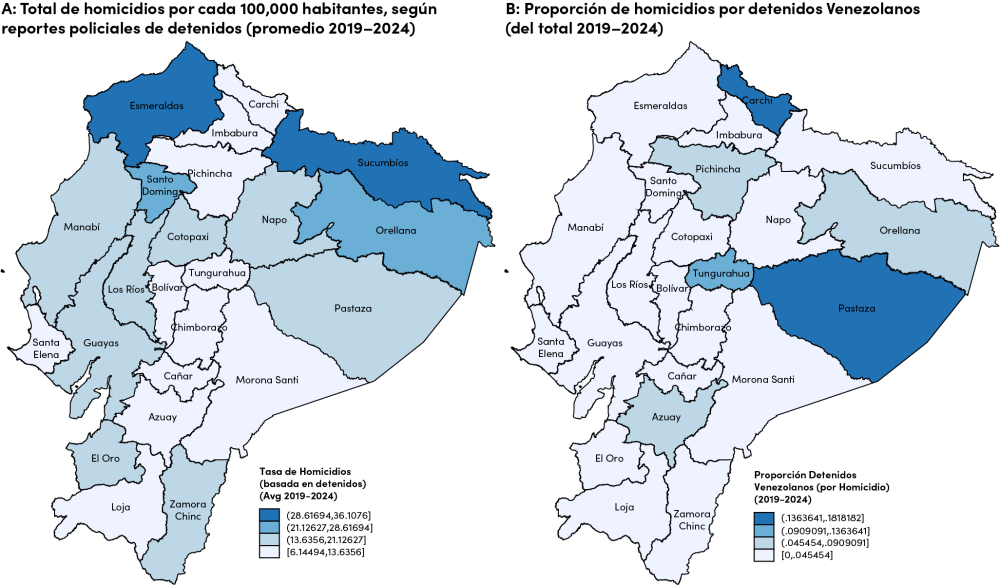
For this analysis, I still rely on detainee data but limit the sample to crimes categorized as homicides. While there is a stand-alone dataset on homicides provided by the Ecuadorian authorities, this one does not include the nationality of the suspect, and therefore we cannot use it to understand the patterns of homicides by Venezuelan immigrants. Figure 9 compares two important spatial dynamics of homicide in Ecuador between 2019 and 2024, based on detainee data. The map in Panel (a) displays the total number of homicide detentions per 100,000 people by province for the same period (on average). The epicenters of Ecuador’s organized crime crisis—Guayas, Manabí, Esmeraldas, Los Ríos, and El Oro—show some of the highest total homicide counts. In contrast, Panel (b) shows the share of homicides in each province committed by Venezuelans (from the total of all homicides between 2019 and 2024). A striking pattern emerges: the provinces with the highest homicide rates overall are not the ones where Venezuelans are significantly involved. Provinces where Venezuelans make up a larger share of total homicides are not the focal points of the structural violence crisis.
This spatial mismatch provides strong supporting evidence that Venezuelans are not embedded in the core dynamics of Ecuador’s organized criminal conflict. Their involvement in homicides, while real in certain localities, appears to stem from separate mechanisms. Together, these maps underscore the need for policy to differentiate between common crime and structural violence, and to avoid conflating migrant involvement in crime with the country’s broader security breakdown. Tailored, evidence-based interventions—centered on integration and protection—are more likely to succeed than security responses built on misperception.
Figure 8. Geographical distribution of homicides in Ecuador (2019-2024)

Source: Datos Abiertos, Government of Ecuador; INEC 2022 Census.
Conclusion and policy implications
The evidence demonstrates that Venezuelan migrants are not driving the overall increase in crime rates in Ecuador. National and province-level data consistently show that Venezuelans commit crimes at a lower rate than their representation in the population would suggest.
However, this analysis does highlight an important nuance: although Venezuelans commit relatively fewer crimes, when they do offend, these crimes tend to be somewhat more violent or severe. Yet, crucially, the data strongly indicate that this violence is not systematically connected to organized crime or Ecuador’s gang crisis.
Given these insights, the Ecuadorian government’s policy response should be strategic and nuanced. Broad punitive measures against migrants, such as intensified policing or immigration crackdowns, could be misplaced and counterproductive. Such policies risk stigmatizing migrants further and pushing vulnerable groups deeper into precarious and possibly illicit survival strategies. Instead, a more effective and evidence-based approach would prioritize social integration measures, reducing the root vulnerabilities that underlie migrant involvement in crime.
Enhancing integration and economic inclusion
Central to mitigating crime involving Venezuelan migrants is improving their access to formal employment and legal residency. As shown in the data, irregular migratory status significantly increases vulnerability to crime involvement, particularly through exposure to economic precarity and exclusion. The government should therefore enhance and expand its migrant regularization programs, making them more accessible, affordable, and responsive. International donors and civil society can provide crucial support here, supplementing government resources and expertise, especially in creating scalable integration programs that offer clear pathways to formal employment.
Differentiating enforcement strategies
It is essential that law enforcement policies clearly differentiate between migrant-related common crimes and the organized violence stemming from gang activities. The battle against the rise of crime in Ecuador should remain focused on dismantling organized criminal structures primarily responsible for Ecuador’s high homicide rates, where immigrants seem not to be playing a significant role. Of course, immigrant crime should also be addressed by authorities, but it requires a different strategy since the data suggest motivation for this criminal activity is essentially different. In this sense, law enforcement should address individual criminal behaviors without alienating entire migrant communities.
Combating misinformation and xenophobia
Public perceptions significantly shape both policy responses and social integration outcomes. Therefore, actively addressing misinformation and xenophobic narratives about Venezuelan migrants should be an integral component of Ecuador’s policy strategy. Public awareness campaigns, proactive government messaging, and collaboration with media and civil society organizations are essential tools for reinforcing evidence-based narratives about migration and crime. These efforts should underscore that rather than posing a security threat, migrants can and do contribute positively to Ecuador’s economy and society.
In sum, adopting these nuanced, evidence-informed policy measures will enable Ecuador to enhance public safety while promoting social cohesion. By treating Venezuelan migrants as partners in community-building rather than as security threats, Ecuador can leverage migration as a strength, aligning policy actions with humanitarian values and practical security considerations.
[1] The categorization of crime types into broader categories was supported by generative artificial intelligence, drawing on the descriptions provided in the original dataset. Full documentation of the classification process is available upon request.
El fuerte aumento de la criminalidad violenta en Ecuador ha coincidido con una importante afluencia de migrantes venezolanos, alimentando una narrativa pública que culpa a los migrantes por el deterioro de la seguridad en el país. Esta nota de política cuestiona esa visión utilizando cinco años de datos oficiales de detenciones desagregados por nacionalidad y estatus migratorio. Encuentra que los venezolanos están sistemáticamente sobrerrepresentados en las estadísticas de población pero subrepresentados en las cifras delictivas—representaron solo el 1,3 por ciento de las detenciones en 2024, a pesar de constituir más del 2,5 por ciento de la población—y tienen muchas menos probabilidades de ser formalmente detenidos tras ser aprehendidos. La mayoría de los delitos que involucran a venezolanos no son violentos y tienen motivaciones económicas, siendo en su gran mayoría cometidos por personas sin estatus legal regular. Si bien los detenidos venezolanos tienen mayor probabilidad de portar armas, el análisis geográfico de los datos de homicidios revela que las provincias más afectadas por la violencia relacionada con pandillas no son aquellas con mayor concentración de homicidios cometidos por migrantes venezolanos. Estos hallazgos sugieren que los delitos vinculados a migrantes están en gran medida desconectados de la crisis estructural de seguridad que atraviesa Ecuador. Idear y diseñar toda la política migratoria únicamente desde la óptica del crimen—en particular como parte de esfuerzos más amplios para combatir a las pandillas—es desacertado y probablemente ineficaz. En su lugar, la política debería centrarse en la regularización de los migrantes, la inclusión económica y la comunicación pública basada en evidencia.
Introducción
Ecuador atraviesa dos crisis superpuestas: un aumento dramático de la criminalidad violenta y una de las mayores oleadas de desplazados venezolanos en la región. Desde 2018, el número de venezolanos en el país ha pasado de poco más de 72,000 a más de 440,000 en 2024—alrededor del 2,5 por ciento de la población ecuatoriana. En el mismo período, la tasa de homicidios en Ecuador se ha triplicado, pasando de 13,7 por cada 100,000 habitantes en 2021 a casi 43 por cada 100,000 en 2023. La coincidencia de estas tendencias ha alimentado la ansiedad pública y un discurso político que sugiere que los migrantes venezolanos son, en parte o en su totalidad, responsables del aumento del crimen. Incidentes de alto perfil—como homicidios aislados que involucran a sospechosos venezolanos—han recibido amplia cobertura mediática y, en algunos casos, han provocado reacciones xenófobas.
Esta nota cuestiona esa narrativa utilizando datos nacionales detallados sobre detenciones policiales (2019–2025), desagregados por nacionalidad y estatus migratorio. Los resultados apuntan claramente en la dirección opuesta: los venezolanos representan una proporción de las detenciones muy por debajo de su participación en la población. En 2024, por ejemplo, solo alrededor del 1,3 por ciento de todos los detenidos eran venezolanos, a pesar de que los datos censales indican que su proporción en la población era más del doble que esa figura. Además, los venezolanos tienen muchas menos probabilidades de ser formalmente detenidos tras ser aprehendidos: solo entre el 10 y el 15 por ciento de las aprehensiones de venezolanos resultan en detención, frente al 35–40 por ciento para ecuatorianos, lo que sugiere que muchos de los incidentes que involucran a venezolanos son de carácter menor o administrativo.
Este patrón se repite en todo el país. Un análisis subnacional de los datos de detención por provincia muestra que en la mayoría de las regiones de Ecuador, los venezolanos son detenidos a tasas inferiores a su proporción en la población local. Las pocas provincias donde los venezolanos parecen estar sobrerrepresentados en las detenciones—como Carchi o Azuay—suelen tener poblaciones pequeñas, alta presencia policial o dinámicas fronterizas que podrían inflar las cifras a través de infracciones menores más que delitos graves. En cambio, en provincias con las mayores comunidades venezolanas, como Pichincha y Guayas, las tasas de detención siguen o están por debajo de su proporción en la población. En conjunto, estos patrones espaciales refuerzan la idea de que los migrantes venezolanos no son un motor principal del crimen, ni siquiera a nivel local, y que los supuestos “puntos calientes” a menudo reflejan la intensidad de la vigilancia o la visibilidad, más que una actividad delictiva elevada.
Esto no significa que los venezolanos no estén involucrados en delitos en absoluto. Los datos muestran que cuando ocurren delitos cometidos por migrantes, es mucho más probable que sean delitos contra la propiedad (como hurto o robo), delitos relacionados con drogas o “delitos contra el Estado” (como infracciones migratorias). Por ejemplo, más del 40 por ciento de los delitos que involucran a venezolanos están relacionados con la propiedad, en comparación con solo el 26 por ciento en la población general.
De forma crucial, la mayoría de los delitos que involucran a venezolanos son cometidos por personas con estatus migratorio irregular. Entre 2021 y 2025, la proporción de venezolanos detenidos con estatus regular nunca superó el 12 por ciento, siendo la mayoría clasificados como indocumentados o con estatus ambiguo (incluido el desconocido). Este patrón se alinea con investigaciones más amplias: la exclusión de la residencia legal y del empleo formal aumenta tanto la vulnerabilidad a la victimización como la participación en delitos impulsados por la supervivencia.
Al mismo tiempo, casi el 10 por ciento de los detenidos venezolanos portaban armas, una proporción más de cuatro veces superior a la de los ecuatorianos. Esto sugiere un patrón preocupante, ya que indica que sus delitos, aunque a menudo sean menores, pueden implicar una amenaza—o al menos la percepción—de violencia.
Dado este patrón inquietante relacionado con el porte de armas, se vuelve esencial determinar si estos incidentes forman parte de una dinámica violenta más amplia. Para investigarlo, me enfoco en los delitos violentos—y en particular, en los homicidios, que son más difíciles de manipular que otras categorías delictivas susceptibles a sesgos de aplicación de la ley o al sensacionalismo mediático. A diferencia de las infracciones menores, los homicidios suelen dejar un cuerpo, una escena del crimen y con frecuencia un arma—lo que los somete a procedimientos automáticos de investigación y los hace mucho más difíciles de subreportar o clasificar erróneamente.
Concentrándome en los datos de detenidos por homicidios, este análisis plantea la siguiente pregunta: ¿Existe evidencia que respalde la idea de que los migrantes venezolanos están participando en el aumento de asesinatos vinculados a pandillas en el país, o sus delitos son distintos y están en gran medida separados de la violencia estructural que ha golpeado a Ecuador en los últimos años? Encuentro poca evidencia de que los venezolanos formen parte de la violencia relacionada con pandillas al observar la distribución geográfica de estos crímenes. En particular, entre 2019 y 2024, las tasas de homicidios más altas—más de 60 por cada 100,000 habitantes—se encontraron en provincias como Guayas, Esmeraldas y Manabí, todas focos de actividad criminal organizada. Sin embargo, la participación venezolana en homicidios en estas provincias es insignificante. De hecho, las provincias con mayores proporciones de homicidios vinculados a venezolanos suelen ser lugares con bajas tasas generales de homicidios, lo que sugiere que la violencia relacionada con migrantes opera a través de mecanismos distintos al conflicto de pandillas.
En conjunto, sostengo que estos hallazgos exigen una respuesta de política estratégica basada en la evidencia, no en el miedo. Las redadas antimigrantes que confunden movilidad con criminalidad probablemente no reduzcan el crimen y corren el riesgo de marginar aún más a una población ya vulnerable. En su lugar, Ecuador debería redoblar los esfuerzos de regularización, eliminar barreras para la participación en el mercado laboral y enfocar la acción policial en los verdaderos motores de la violencia: las redes transnacionales de narcotráfico y las mega-pandillas que operan en todo el país. Por último, cambiar la percepción pública será clave. Combatir la xenofobia y la desinformación mediante una comunicación basada en evidencia es esencial para garantizar que la política migratoria contribuya a la seguridad y cohesión social de Ecuador, en lugar de socavarlas.
Fuentes de datos
Este informe se basa principalmente en múltiples fuentes de datos oficiales de Ecuador que están anonimizadas y disponibles públicamente:
- Registros de detenciones policiales (2019–2025): Se obtuvieron microdatos sobre aprehensiones y detenciones del sitio web del Ministerio del Interior de Ecuador, cubriendo los años 2019 hasta abril de 2025, accesibles a través del portal nacional de datos abiertos. El conjunto de datos incluye información a nivel individual sobre nacionalidad, estatus migratorio, ubicación geográfica y clasificación legal (aprehendido vs. detenido).
- Censo de Población de 2022: Las cifras poblacionales—incluyendo el número de ciudadanos venezolanos residentes en Ecuador—fueron tomadas del Censo de Población y Vivienda 2022, realizado por el Instituto Nacional de Estadística y Censos (INEC). Los datos por provincia y nacionalidad se utilizaron para calcular la proporción poblacional y estimar las tasas de detención proporcional.
Tendencias nacionales
Los datos a nivel nacional muestran de manera consistente que los migrantes venezolanos no cometen delitos a tasas desproporcionadas. Como se ilustra en la Figura 1, entre 2019 y 2025, el porcentaje de todos los detenidos en Ecuador que son venezolanos se mantuvo entre el 1 % y el 1,5 % por año. Como punto de comparación, la figura también muestra la proporción de venezolanos en la población para cada año, utilizando datos de R4V (con cifras de mitad de año). En general, la proporción de delitos cometidos por venezolanos fluctúa levemente, pero en términos generales se mantiene por debajo de su proporción en la población. En pocas palabras, la evidencia no respalda la afirmación de que los inmigrantes venezolanos estén impulsando el crimen en Ecuador.
Figura 1. Proporción de venezolanos entre las personas detenidas por la policía, Ecuador (2019–2025)
Fuente: Datos Abiertos, Gobierno de Ecuador; R4V
Este hallazgo coincide con datos de otros países de América Latina donde viven inmigrantes y refugiados venezolanos. Por ejemplo, una investigación que abarca Colombia, Perú y Chile en 2019 encontró que los inmigrantes venezolanos cometen significativamente menos delitos que los nacionales en relación con su proporción en la población. Ecuador parece ajustarse a este patrón regional: los migrantes, en general, son al menos tan respetuosos de la ley como la población local.
El clima general de sospecha y el discurso público que presenta a los migrantes como una amenaza podrían estar influyendo en los resultados de las acciones policiales de manera más sutil. Estas dinámicas parecen reflejarse en los datos. Como se muestra en la Figura 2, la proporción de personas detenidas con respecto a las aprehendidas es significativamente menor para los venezolanos que para la población en general—constantemente entre el 10 % y el 15 %, en comparación con un 35 % a 40 % a nivel nacional. Esto sugiere que muchas de las aprehensiones que involucran a venezolanos no derivan en una detención formal, probablemente porque las infracciones son menos graves, no están fundamentadas o son de carácter administrativo.
Desde esta perspectiva, una posible interpretación es que algunas acciones de aplicación de la ley podrían reflejar una postura excesivamente agresiva hacia los migrantes, influenciada por presiones políticas o sociales más que por niveles reales de amenaza. Aunque estas prácticas no estén formalizadas en políticas públicas, corren el riesgo de reforzar estigmas y desviar recursos de manera ineficiente. Los datos recuerdan que las narrativas infundadas pueden tener consecuencias operativas reales, y que las soluciones de seguridad sostenibles requieren una distinción clara entre control migratorio y control del crimen.
Figura 2. Proporción de detenidos sobre aprehendidos por año: venezolanos vs. población total
Fuente: Datos Abiertos, Gobierno de Ecuador.
Variación subnacional en la participación delictiva de venezolanos
Los promedios nacionales pueden ocultar variaciones locales. En algunas provincias, las autoridades y la ciudadanía han expresado preocupación por delitos cometidos por migrantes, a veces debido a incidentes específicos o a una mayor concentración de migrantes. Para comprender mejor los patrones de participación de venezolanos en actividades delictivas, analizo la variación subnacional en las provincias de Ecuador utilizando tres indicadores complementarios. Estos mapas presentan promedios anuales entre 2019 y 2025 para suavizar las fluctuaciones de un año a otro y destacar tendencias geográficas consistentes.
La Figura 3a muestra la distribución geográfica de los inmigrantes venezolanos residentes en Ecuador en 2022, con base en datos censales (hasta donde tengo conocimiento, estos son los datos más recientes que estiman la población venezolana a nivel subnacional). Como era de esperarse, las concentraciones más altas se encuentran en las dos principales provincias urbanas del país—Pichincha y Guayas—además de Manabí, que también alberga una población venezolana considerable. Estas provincias son centros económicos importantes que ofrecen mayores oportunidades de empleo y acceso a servicios, lo que las convierte en destinos naturales para el asentamiento migrante.
En contraste, la Figura 3b representa la proporción de detenciones provinciales totales que involucran a venezolanos, promediada entre 2019 y 2025. Aquí, además de Pichincha, destacan provincias como Carchi, Imbabura, Azuay y El Oro, a pesar de tener poblaciones venezolanas comparativamente más pequeñas. Esta discrepancia sugiere que, en ciertas provincias fronterizas o de tránsito, los venezolanos pueden estar sobrerrepresentados en las estadísticas de detenciones, posiblemente debido a una mayor presencia policial, controles migratorios o mayor visibilidad en localidades más pequeñas.
En conjunto, estos mapas invitan a tener cautela al sacar conclusiones basadas únicamente en las proporciones de detención. Las provincias con grandes comunidades migrantes no presentan tasas de detención correspondientemente altas, y las provincias con altas proporciones de detenciones suelen albergar relativamente pocos venezolanos. Esto refuerza el argumento de que los patrones de aplicación de la ley pueden reflejar visibilidad, intensidad policial o dinámicas administrativas más que un comportamiento delictivo real. También subraya la necesidad de respuestas de política pública matizadas y proporcionales, adaptadas a contextos locales, en lugar de recurrir a narrativas nacionales generalizadas.
Figura 3. Distribuciones geográficas de Venezolanos detenidos y Venezolanos en la población
Source: Datos Abiertos, Gobierno de Ecuador; Censo 2022, INEC.
Es importante enfatizar, sin embargo, que una mayor proporción de detenciones de venezolanos en ciertas provincias no indica por sí sola un problema delictivo significativo. Estas proporciones deben interpretarse en relación con el tamaño de la población venezolana local. Por ejemplo, provincias como Carchi o Azuay pueden mostrar proporciones elevadas de detenciones simplemente porque su población total es pequeña y la presencia migrante es más visible o más frecuentemente vigilada.
Para abordar esto, la Figura 4 presenta una versión localizada del análisis a nivel nacional introducido anteriormente. Se grafica la proporción de detenidos en 2024 (el último año con datos completos sobre criminalidad) que son venezolanos frente a su proporción en la población local en cada provincia, utilizando datos del Censo 2022. Cabe señalar que es probable que el Censo 2022 subestime la cifra, ya que reporta solo 231,686 venezolanos en Ecuador para ese año, mientras que R4V estima la cifra más cerca de los 500,000. Bajo ese punto de comparación conservador, la línea punteada de 45 grados representa la paridad—los puntos sobre esta línea indican provincias donde los venezolanos son detenidos en proporción a su presencia en la población. De manera crucial, el tamaño de cada burbuja refleja el número total de delitos cometidos por venezolanos en esa provincia.
Figura 4. Proporción de Venezolanos en la población versus proporción de Venezolanos detenidos, por provincia
Fuente: Datos Abiertos, Gobierno de Ecuador; Censo 2022, INEC.
Nota: El tamaño del marcador es proporcional al número total de detenidos venezolanos por provincia.
La figura muestra claramente que la mayoría de las provincias se ubican por debajo de la línea de paridad. Esto indica que los venezolanos, en general, son detenidos a tasas más bajas de lo que cabría esperar según su peso demográfico. Pichincha, la provincia con el mayor número de delitos reportados cometidos por venezolanos, se encuentra cerca de la línea de paridad, lo que refleja una relación casi proporcional entre delitos y población. La mayoría de las localidades que aparecen por encima de la línea de paridad, como lo indica el tamaño de las burbujas, representan un número insignificante de delitos cometidos por venezolanos. En otras palabras, incluso en las provincias donde los venezolanos parecen estar sobrerrepresentados en los datos de detenciones, los números absolutos de delitos son bajos.
Sin embargo, hay una excepción notable: Carchi, una provincia fronteriza al norte. El punto de datos de Carchi se sitúa muy por encima de la línea, lo que indica que los venezolanos representan una proporción mayor de las detenciones que de la población local. Esto coincide con la Figura 3 y probablemente esté relacionado con la ubicación fronteriza de Carchi y las dinámicas de control migratorio. Carchi experimenta flujos migratorios transitorios importantes y una vigilancia migratoria intensiva; muchos de los venezolanos detenidos allí pueden haber sido aprehendidos por infracciones migratorias o delitos menores relacionados con el cruce de fronteras y estrategias de supervivencia. Aun así, los números absolutos son muy bajos. Aparte de Carchi, solo un puñado de provincias muestra una sobrerrepresentación moderada. En varias provincias (por ejemplo, Morona Santiago, Napo, Galápagos), no se registraron detenciones de venezolanos en los datos más recientes, a pesar de que hay migrantes viviendo allí.
Una pregunta importante que estos datos permiten plantear es hasta qué punto el estatus legal de estos inmigrantes está asociado con su participación en actividades delictivas, según lo reflejado en los datos de detenciones. La Figura 5 ilustra el número total de venezolanos detenidos entre 2021 y 2025, clasificados según si tenían estatus migratorio regular, irregular o no especificado, tal como lo reportan los datos de detenciones. Llama la atención que solo una pequeña fracción de los detenidos contaba con estatus migratorio regular, y que esta proporción se ha mantenido estable—y baja—a lo largo del tiempo, sin superar nunca el 12 por ciento y con un promedio cercano al 7 por ciento en esos años. La mayoría de los detenidos están registrados con estatus migratorio irregular o bajo categorías administrativas ambiguas, lo que sugiere vacíos en la documentación legal y en las prácticas de control.
Este patrón es consistente con hallazgos de otros contextos que muestran que otorgar residencia legal a migrantes indocumentados conduce a reducciones significativas en el crimen, especialmente en delitos motivados por razones económicas. Los datos ecuatorianos apuntan en la misma dirección y permiten formular la hipótesis de que el estatus irregular no es solo una etiqueta burocrática, sino un factor estructural de riesgo. Los migrantes sin reconocimiento legal tienen más probabilidades de vivir en condiciones precarias, enfrentar barreras para acceder al empleo y convertirse en blanco de acciones policiales o en participantes de delitos motivados por la supervivencia. En consecuencia, la regularización no debe verse únicamente como una herramienta de gestión migratoria, sino como una estrategia clave de prevención del delito que mejora la seguridad pública, no solo con base en esta evidencia, sino también en la literatura más amplia que ha analizado estos patrones.
Figura 5. Venezolanos detenidos, por estatus migratorio
Fuente: Datos Abiertos, Gobierno de Ecuador
¿Delincuencia común o violencia de pandillas?
Aunque la propensión general al delito entre los migrantes venezolanos en Ecuador es baja, comprender la naturaleza de los delitos que sí ocurren es fundamental, no solo para un diagnóstico preciso, sino también para diseñar respuestas de política efectivas—particularmente dado el aumento de la violencia estructural relacionada con pandillas en los últimos años. ¿Los pocos delitos que involucran a venezolanos están principalmente vinculados a las dinámicas más amplias del crimen organizado, o se entienden mejor como incidentes aislados de delincuencia común?
La Figura 6 desglosa la composición de los delitos por categoría, comparando la distribución de los delitos cometidos por detenidos venezolanos con la de la población general. Las categorías incluyen delitos contra las personas (como agresión u homicidio), delitos contra la propiedad (como robo o hurto), delitos relacionados con drogas, delitos contra el Estado (incluyendo infracciones migratorias o de documentación), delitos menores (típicamente administrativos o de baja gravedad) y clasificaciones desconocidas.[1]
Surgen varios patrones llamativos. Los venezolanos están significativamente más representados en delitos contra la propiedad, delitos contra el Estado y delitos relacionados con drogas—categorías que a menudo están asociadas con la precariedad económica y la vulnerabilidad legal. En conjunto, estas representan una proporción mucho mayor del total de delitos cometidos por venezolanos que por no venezolanos. Esto contrasta marcadamente con la población general, donde los delitos menores dominan la composición delictiva. La proporción de infracciones menores entre los no venezolanos es de casi la mitad, en comparación con menos de una cuarta parte entre los venezolanos.
Figura 6. Tipo de crímenes por detenidos, Venezolanos versus población general
Fuente: Datos Abiertos, Gobierno de Ecuador
También resulta interesante observar la alta proporción de “delitos contra el Estado” cometidos por detenidos venezolanos, lo cual podría reflejar la criminalización de infracciones migratorias o relacionadas con documentación, que pueden ser de naturaleza administrativa pero que aun así figuran en los registros penales.
Este patrón refuerza la importancia de distinguir entre los tipos de comportamiento delictivo y sus causas subyacentes. Aunque los venezolanos no tienen una mayor probabilidad de cometer delitos en general, cuando lo hacen, sus infracciones parecen derivarse—puede hipotetizarse—de la exclusión estructural más que de una intención criminal organizada.
Sin embargo, los datos también revelan una realidad preocupante. La Figura 7 muestra la proporción de detenciones que involucraron armas blancas (como cuchillos) y armas de fuego, desglosadas por nacionalidad (siendo la categoría omitida “sin arma”). En términos generales, para los venezolanos, casi el 10 % de las detenciones involucraron algún tipo de arma, con aproximadamente un 4,4 % involucrando armas blancas y un 5,5 % armas de fuego. Para la población general (no venezolana), menos del 2,5 % de todas las detenciones involucraron el uso de un arma, con menos del 1 % involucrando armas blancas y alrededor del 1,4 % armas de fuego. Esto significa que, aunque los venezolanos representan un número reducido del total de delitos en Ecuador, esos delitos son desproporcionadamente más propensos a implicar la amenaza de violencia—o al menos la presencia de un arma.
Figura 7. Uso reportado de armas por detenidos, Venezolanos versus población general

Fuente: Datos Abiertos, Gobierno de Ecuador
Interpretar estos patrones requiere matices. Una posibilidad es que los migrantes venezolanos—particularmente aquellos con estatus migratorio irregular (y por tanto excluidos del mercado laboral formal y de condiciones más estables)—sean más vulnerables a participar en delitos menores u oportunistas que pueden escalar cuando hay armas involucradas. Alternativamente, es posible que las autoridades policiales y judiciales respondan de manera más agresiva cuando hay armas presentes, lo que podría aumentar la probabilidad de detención en esos casos. Independientemente del mecanismo, la alta proporción de delitos relacionados con armas entre los venezolanos merece atención.
En el contexto ecuatoriano, esta observación plantea una pregunta importante desde el punto de vista analítico y de política pública: ¿esta mayor prevalencia en el uso de armas sugiere un vínculo entre los migrantes venezolanos y el problema estructural de la criminalidad en Ecuador—es decir, la violencia criminal organizada? ¿O estos casos se entienden mejor como actos aislados de delincuencia común, sin conexión con las dinámicas de las pandillas en el país?
De hecho, han surgido informes recientes sobre grupos delictivos liderados por venezolanos—en particular células del Tren de Aragua, una banda transnacional originaria de Venezuela—que operan en Ecuador y participan en extorsión, sicariato y secuestros. Al mismo tiempo, mega-pandillas nacionales—como Los Choneros, Los Lobos y sus aliados—han sido señaladas por los medios como las responsables del aumento de la criminalidad, en su lucha por el control de rutas del narcotráfico en coordinación con carteles mexicanos y colombianos.
Para explorar estas preguntas, nos enfocamos en los homicidios. A diferencia de otros delitos—que pueden estar sujetos a subregistro, errores de clasificación o aplicación selectiva—los homicidios son mucho más difíciles de ignorar o manipular en los registros oficiales. Un cuerpo, un arma y una escena del crimen son evidencias tangibles que suelen activar procedimientos automáticos de investigación. Como resultado, los registros de homicidios ofrecen una mirada más precisa para evaluar la presencia y naturaleza de la violencia, incluyendo si los migrantes están desempeñando algún papel identificable en el aumento del crimen organizado letal.
De hecho, Ecuador experimentó un aumento dramático en las tasas de homicidio a partir de 2021, pasando de menos de 10 homicidios por cada 100,000 habitantes a casi 45 en 2023—una clara señal del agravamiento de la crisis de seguridad en el país. Este aumento generalizado de la violencia coincide con la aparición de organizaciones criminales nacionales y transnacionales poderosas, y marca un cambio profundo en el entorno de seguridad pública del país.
Para este análisis, seguimos utilizando los datos de detenidos, pero limitamos la muestra a los delitos clasificados como homicidios. Aunque las autoridades ecuatorianas cuentan con un conjunto de datos independiente sobre homicidios, este no incluye la nacionalidad del sospechoso, por lo que no se puede utilizar para entender los patrones de homicidios cometidos por inmigrantes venezolanos. La Figura 9 compara dos dinámicas espaciales importantes del homicidio en Ecuador entre 2019 y 2024, basándose en datos de detenciones. El mapa del Panel (a) muestra el número total de detenciones por homicidio por cada 100,000 personas, por provincia, en promedio durante ese período. Los epicentros de la crisis del crimen organizado en Ecuador—Guayas, Manabí, Esmeraldas, Los Ríos y El Oro—presentan algunos de los recuentos más altos de homicidios. En contraste, el Panel (b) muestra la proporción de homicidios en cada provincia cometidos por venezolanos (del total de homicidios entre 2019 y 2024). Surge un patrón revelador: las provincias con las tasas más altas de homicidio en general no son aquellas donde los venezolanos tienen una participación significativa. Las provincias donde los venezolanos representan una mayor proporción de homicidios totales no son el foco de la crisis de violencia estructural.
Este desajuste espacial proporciona evidencia sólida de que los venezolanos no están insertos en las dinámicas centrales del conflicto criminal organizado en Ecuador. Su participación en homicidios, aunque real en ciertas localidades, parece originarse en mecanismos distintos. En conjunto, estos mapas subrayan la necesidad de que las políticas públicas diferencien entre delincuencia común y violencia estructural, y eviten confundir la participación migrante en delitos con el colapso generalizado de la seguridad en el país. Intervenciones específicas y basadas en evidencia—centradas en la integración y la protección—tienen más probabilidades de éxito que respuestas de seguridad fundamentadas en percepciones erróneas.
Figura 8. Distribución Geográfica de Homicidios en Ecuador (2019-2024)
Fuente: Datos Abiertos, Gobierno de Ecuador; Censo 2022, INEC.
Conclusión e implicaciones de política
La evidencia demuestra que los migrantes venezolanos no están impulsando el aumento general de las tasas de criminalidad en Ecuador. Los datos, tanto a nivel nacional como provincial, muestran de manera consistente que los venezolanos cometen delitos a una tasa inferior a la que sugeriría su representación en la población.
Sin embargo, este análisis sí resalta un matiz importante: aunque los venezolanos cometen relativamente menos delitos, cuando lo hacen, estos tienden a ser algo más violentos o graves. No obstante, y esto es crucial, los datos indican claramente que esta violencia no está sistemáticamente vinculada al crimen organizado ni a la crisis de pandillas que atraviesa Ecuador.
A la luz de estos hallazgos, la respuesta del gobierno ecuatoriano debe ser estratégica y matizada. Medidas punitivas generalizadas contra los migrantes, como una vigilancia policial intensificada o redadas migratorias, podrían estar mal dirigidas y ser contraproducentes. Este tipo de políticas corre el riesgo de estigmatizar aún más a los migrantes y de empujar a grupos vulnerables hacia condiciones más precarias y, posiblemente, hacia estrategias de supervivencia ilícitas. En cambio, un enfoque más efectivo y basado en evidencia priorizaría medidas de integración social, reduciendo las vulnerabilidades estructurales que subyacen a la participación migrante en el crimen.
Mejorar la integración y la inclusión económica
Un elemento central para mitigar el crimen que involucra a migrantes venezolanos es mejorar su acceso al empleo formal y a la residencia legal. Como muestran los datos, el estatus migratorio irregular aumenta significativamente la vulnerabilidad a involucrarse en actividades delictivas, particularmente a través de la exposición a la precariedad económica y la exclusión. Por lo tanto, el gobierno debería fortalecer y ampliar sus programas de regularización migratoria, haciéndolos más accesibles, asequibles y receptivos. Los donantes internacionales y la sociedad civil pueden desempeñar un papel clave en este esfuerzo, complementando los recursos y capacidades del gobierno, especialmente en la creación de programas de integración escalables que ofrezcan caminos claros hacia el empleo formal.
Diferenciar estrategias de aplicación de la ley
Es esencial que las políticas de seguridad diferencien claramente entre delitos comunes cometidos por migrantes y la violencia organizada proveniente de actividades de pandillas. La lucha contra el aumento del crimen en Ecuador debe mantenerse enfocada en desmantelar las estructuras criminales organizadas que son en gran parte responsables de las altas tasas de homicidio en el país, donde los inmigrantes no parecen desempeñar un papel significativo. Por supuesto, los delitos cometidos por inmigrantes también deben ser abordados por las autoridades, pero requieren una estrategia distinta, ya que los datos sugieren que la motivación detrás de estas actividades delictivas es esencialmente diferente. En este sentido, la respuesta de las fuerzas del orden debe centrarse en los comportamientos individuales sin criminalizar o alienar a comunidades migrantes enteras.
Combatir la desinformación y la xenofobia
La percepción pública influye significativamente tanto en las respuestas de política como en los resultados de la integración social. Por lo tanto, abordar activamente la desinformación y las narrativas xenófobas sobre los migrantes venezolanos debe ser un componente fundamental de la estrategia de política migratoria de Ecuador. Las campañas de concientización pública, los mensajes proactivos del gobierno y la colaboración con los medios de comunicación y las organizaciones de la sociedad civil son herramientas esenciales para reforzar narrativas basadas en evidencia sobre migración y crimen. Estos esfuerzos deben subrayar que, lejos de representar una amenaza para la seguridad, los migrantes pueden y de hecho contribuyen positivamente a la economía y la sociedad ecuatorianas.
En resumen, adoptar estas medidas de política matizadas y basadas en evidencia permitirá a Ecuador mejorar su seguridad pública al tiempo que promueve la cohesión social. Al tratar a los migrantes venezolanos como socios en la construcción de comunidades, y no como amenazas a la seguridad, Ecuador puede aprovechar la migración como una fortaleza, alineando sus acciones de política con valores humanitarios y consideraciones prácticas de seguridad.
[1] La categorización de los tipos de delito en categorías más amplias fue asistida por inteligencia artificial generativa, basándose en las descripciones provistas en el conjunto de datos original. La documentación completa del proceso de clasificación está disponible a solicitud.
Topics
CITATION
Bahar, Dany. 2025. Data Against Fear: What the Numbers Say About Venezuelan Migrants and Crime in Ecuador. Center for Global Development.DISCLAIMER & PERMISSIONS
CGD's publications reflect the views of the authors, drawing on prior research and experience in their areas of expertise. CGD is a nonpartisan, independent organization and does not take institutional positions. You may use and disseminate CGD's publications under these conditions.
Thumbnail image by: UNICEF Ecuador