Recommended
Project

CGD NOTE
A New Compact for Health Financing
This past weekend, 15 countries launched their National Health Compacts at the UHC (Universal Health Coverage) High-level Forum 2025, in partnership with the World Bank. The compacts represent high-level government support for a five-year sectoral plan. They take a valuable health systems approach, as well as open a window to resolve common criticisms in development assistance for health, such as fragmented financing, weak coordination, and parallel structures that bypass national systems. But in their current design, they are essentially one-way agreements: governments commit to reforms, while donors face no clearly articulated responsibilities, no expectations on how they channel funds, and no mutual accountability for changing their own behaviour.
If they are to be real compacts, they must become two-way deals. That means defining roles and responsibilities for donors, not just governments. This includes agreements on financing modalities and alignment behind a national plan, as we have articulated in our “New Compact” proposal. Donors, global health initiatives, and other multilateral development banks (MDBs) must now get behind the National Health Compacts, and help transform them from promising frameworks into shared, two-way agreements that finance more effective and coordinated health services.
The National Health Compacts are great—as domestic health sector plans…
Of the 15 countries that the World Bank has partnered with, National Health Compacts have, so far, been published for nine. According to the Bank’s Health Works initiative, the compacts intend to “serve as a strategic roadmap to align resources across domestic and external sources, including the private sector, galvanize political leadership, and promote accountability for delivering results” with a strong focus on digitally enabled primary care.
But what are they are in practice? From the examples and documentation available, National Health Compacts are, at best, government-owned, five-year, high-level plans for the health sector. They are similar to National Health Strategies supported by the World Health Organization over many decades. They have many strengths: high-level government support, a structured health system strengthening approach, clarity of funding and technical assistance needs, and better national coordination of stakeholders. The health system goals and reforms articulated in the compacts offer a common reference point for engaging development partners, civil society, and the private sector around a single, nationally led framework. By proposing shared targets and a joint monitoring approach, they have the potential build trust between different actors in the health system.
…But a “Compact” needs to be a two-way street
Herein lies the rub: the term “compact” means a multi-party agreement. For example, the original IHP+/UHC2030 Compacts are “a negotiated agreement between a government and development partners.” The National Health Compacts are, however, almost entirely inward-looking, framed around domestic government commitments and internal coordination, with no clear counterparty on the other side. That means that there are no corresponding, enforceable responsibilities for external financing partners like the World Bank and other donors, and little specificity on how external financing should interact with domestic systems.
This is striking for an initiative led by the World Bank—itself a major financing institution, which will presumably use the compacts to inform design of its own investments. And while an exclusively domestic focus may be appropriate in upper-middle-income countries like Mexico, where health services are overwhelmingly financed by domestic governments, it’s a major and striking omission for all low-income and many low- and middle-income countries, which still rely on external health financing to provide basic health services.
Ideally, country commitments should be met with corresponding donor pledges for more effective financing modalities: for example, aid provided on‑budget, clear expectations for the use of country systems, and plans to align vertical or off‑budget funds with the national approach. As is, the compacts leave unaddressed some of the core problems that they should be aiming to solve: aid volatility, parallel delivery channels, and weak protection of core services when donor funding shifts—as we saw with the significant aid cuts in 2025.
This focus on government commitments may be defended by the Bank as representing government ownership. In practice, however, it risks weakening real government ownership of the overall health system, because donors remain largely free to continue with fragmented projects or off‑budget support while still “signing on” to the compact in name.
Are the Compacts just repackaged donor funding requests?
What is remarkable is that 15 countries—during a moment of health financing crisis—took considerable time and effort to develop these compacts, and followed Bank-set deadlines and guidance, despite already having national plans and strategies. Why would they do this? For countries, the clearest additional advantage of the National Health Compacts is surely the potential to get World Bank funding and technical assistance. For example, Nigeria’s 2023 Health Compact (the prototype for the National Health Compacts) was followed by a $500 million IDA loan and $70 million Global Financing Facility grant, with disbursements directly contingent on delivering the Compact.
Viewed in this cynical light, the National Health Compacts appear less like a compact, and more like public funding requests to donors (or to the Bank) for funds. The published compacts include a direct request for funding from international partners. However, no new money appears to be promised by the Bank (or their funders) for the compacts, so this will presumably be drawn from existing allocations, as well as a MOU with Gavi and Global Fund. The flip side of this is that non-National Health Compact countries would presumably have to get less funding. But how this can happen is unclear, given IDA, Gavi and Global Fund allocations are unlikely to be substantially influenced by the compacts.
Transforming the National Health Compacts into two-way “New Compacts”
The National Health Compacts offer great potential if they can transform into genuine two-way deals with donors. Over the past two years CGD, in partnership with the Africa Centers for Disease Control and Prevention, has developed an idea that can assist with this: the “New Compact,” grounded on three core pillars: locally-led, evidence-informed priority-setting; domestic-first resource allocation, and consolidated supplementary aid.
Figure 1. Three pillars of the New Compact for Global Health Financing
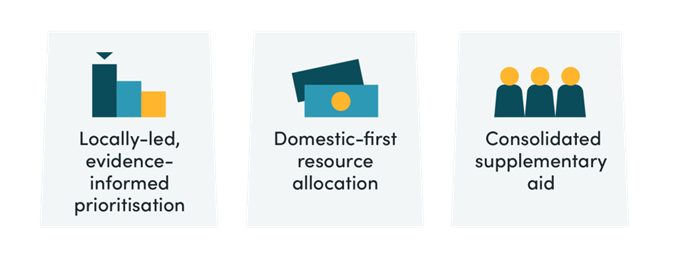
Each of the three pillars of the New Compact could improve the National Health Compacts in three corresponding ways:
- First, National Health Compacts could kick off an explicit, formal priority‑setting process that defines a core benefits package and ranks services based on evidence of value for money and equity impact. This package would cover both donor and domestic financing. This would shift compacts from broad reform narratives towards a more concrete articulation of “which services, for whom, and in what sequence,” with the compact serving as the binding vehicle through which donors agree to back those nationally set priorities.
- Second, National Health Compacts would need to spell out clearly how governments will fund the highest priority services from domestic budgets before aid is allocated. In practice, this would mean embedding domestic spending commitments by programme or service tier inside the Compact. This would reassure donors that their contributions are topping up, rather than displacing, domestic financing.
- Third, National Health Compacts would need to define how external finance is pooled, channelled, and coordinated. This could include stronger expectations that partners provide support on‑budget or in closely coordinated pools. It could also include explicit mapping of each donor’s role against the nationally prioritised package, and a mutual accountability framework that tracks not only government reforms but also whether donor behaviour—earmarking, parallel systems, etc—is changing in line with the Compact.
A “New Compact” approach would enable the National Health Compacts to become a truly two-way compact. It would put governments in the driving seat of both domestic and donor funding. It would set out explicit and reciprocal commitments for donors, and a shared framework for monitoring whether external funds genuinely back the government’s plan rather than substitute for it.
Three steps to achieve genuine two-way compacts
Two-way National Health Compacts, following New Compact principles, could serve as a framework to guide all donors in development assistance for health—not just the World Bank. This would take three steps:
- Low- and middle-income governments, with Bank support, should convene donors in-country to discuss how they will align behind the compacts, and agree a roadmap to more formal donor agreements such as sector-wide approaches underpinned with New Compact principles. This will take time and careful negotiation.
- Gavi, the Global Financing Facility, the Global Fund, and MDBs should build compacts into their approach at the national level. This may mean joining sector-wide approaches and on-budget or pooled funding, if this is requested by governments; jointly setting priorities; and carrying out joint transition planning. It will also require improved “collaborative co-financing” between MDBs.
- At the global level, Gavi, the Global Financing Facility, the Global Fund, and the World Bank should build compacts into their policies, transition plans, and even staff promotion incentives, and ensure grants and loans align. This will require a shift from simple results delivery, and their boards must actively promote this. An independent observatory should be developed for monitoring progress on agreements, to ensure mutual accountability.
If the National Health Compacts can pivot to becoming a genuine deal with donors, they could become a powerful tool to transform the global health architecture and deliver on countries vision for their health system.
Thanks to Rachel Bonnifield for feedback on this blog.
Topics
DISCLAIMER & PERMISSIONS
CGD's publications reflect the views of the authors, drawing on prior research and experience in their areas of expertise. CGD is a nonpartisan, independent organization and does not take institutional positions. You may use and disseminate CGD's publications under these conditions.
Thumbnail image by: Delmaine Donson/peopleimages.com/ Adobe Stock