Recommended
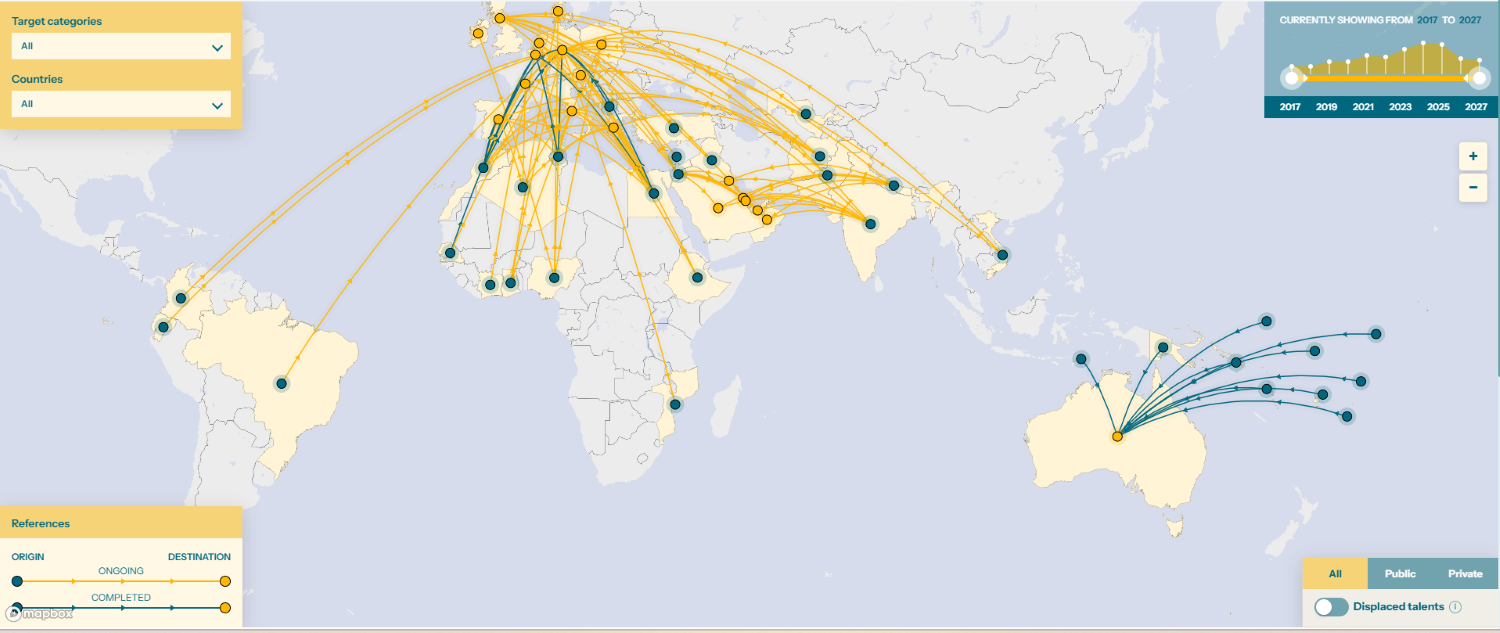

Last week, we released the latest edition of BCG’s semi-annual report on the state of Global Talent Mobility. The headline finding is a decline in the number of globally mobile highly-skilled students and employees.
For the first time since 2020, the cross-border movement of highly-skilled professionals is declining, down 8.5 percent year on year as of August 31, 2025, or roughly 220,000 fewer people on the move out of a tracked pool of 214 million. About 2.4 million highly skilled individuals still changed countries, but the direction of travel, and the balance of winners and losers, have shifted.
The report draws on a dataset from Revelio Labs, which sources and de-biases data from LinkedIn, as well as other online sources. With a cutoff of August 31, 2025, it’s currently the best near-real-time global snapshot of high-skilled people, covering all individuals with university-level education (Bachelor or higher), including those still studying, across more than 200 origin and destination countries.
A slowdown with high stakes
Openness to global talent and national prosperity tend to move together (Alesina et al., 2016). Based on data from ASPI, we see that countries that lead in talent for one of the 44 technologies of the future the think tank tracks are 17 times more likely to lead in that technology. Meanwhile, recent BCG studies find that firms with more globally mobile leaders generate about 1 percentage point more shareholder value per year.
Despite this, the mobility of highly skilled talent is slowing. Tighter migration rules in Canada and the UK, softer hiring conditions, and economic uncertainty have all played a part. In short, competition for talent has not diminished, but it is concentrating in fewer places.
Old hubs are stalling, new hubs are rising
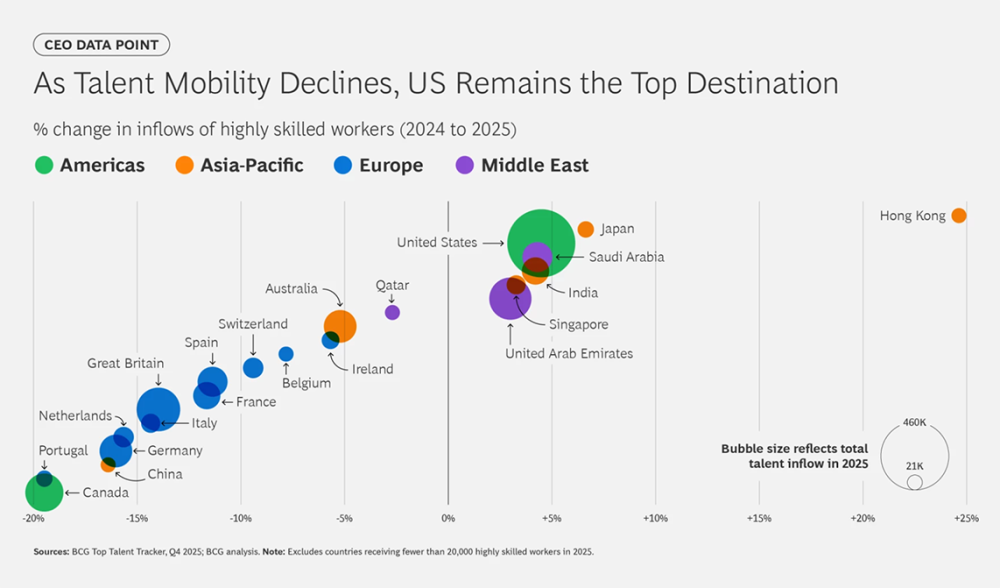
The data suggests a new pecking order of global destinations, with the US still on top in terms of market share among globally mobile highly skilled workers, among science, technology, engineering, and mathematics (STEM) workers, and also among artificial intelligence (AI) workers.
- Highly skilled talent. The US strengthens its dominant position, gaining 2.4 points of global inflow share. Several European economies, along with Canada and the UK, post declines. The US, the UAE, and parts of Asia register gains.
- STEM talent. The US remains first, but the UAE has moved into second place, overtaking Canada and the UK. The UAE’s inflow share rises by 2 points, while Canada’s drops by 2.5 and the UK’s by 1.6.
- AI talent. Mobility in AI stands apart. It rises a lot compared to 2024, fuelled by the rapid expansion of the AI-skilled workforce (which complicates year-over-year comparisons). The US widens its lead, and the UAE gains 3 points of inflow share, placing it among the most dynamic destinations for AI specialists.
The result is a world where the US and a handful of Gulf economies are becoming high-attraction, high-retention hubs, while many European countries are gradually losing market share, in large part due to sluggish employment growth.
Path forward
In order to foster economic growth, countries will need to assemble fully fledged global talent-attraction ecosystems, pairing fast visas and lean administration with proactive efforts to headhunt the best and brightest. Yet many remain stuck at visa reform or red tape—or question the benefits of highly skilled immigration.
That may soon change. Over the coming years, we expect to see the first national talent-attraction agencies emerge, with mandates not only for regulatory reform and place branding but for real recruiting muscle. In parallel, the most forward-thinking governments are now piloting public talent investment funds (TFs), designed to offer financial incentives to select highly skilled newcomers. The business case for those funds is compelling: a modestly funded TF attracting 1,000 skilled workers a year could become self-funding in less than two years, and generate hundreds of millions in net fiscal value within four years (BCG, 2024)
In short, attracting top global talent will stop being a side project and start being a core economic and strategic priority. Nations that build integrated, finance-backed talent ecosystems—combining visa ease, administrative agility, active recruiting, and performance-oriented incentives—are likely to position themselves for sustained economic growth and innovation.
For developing countries, there’s a different challenge: they must find ways to economically benefit from global talent flows even though they are often facing a net talent loss (or, in other words, are net talent exporters). This makes it essential for them not just to retain local talent but to strategically seed and mobilize their diasporas as bridges into new industries and ideas (Bahar & Rapoport, 2018). Currently, very few countries treat these flows strategically, missing the opportunity to build global learning networks rather than merely competing for inflows.
It’s time for countries to treat the attraction and retention of highly skilled talent as a core policy lever for growth, global competitiveness, and fiscal resilience.
Disclosure: Johann Harnoss is a partner at Boston Consulting Group (BCG), and a fellow at BCG’s think tank, the BCG Henderson Institute. BCG publishes the State of Global Talent Mobility report referenced in this post.
Topics
DISCLAIMER & PERMISSIONS
CGD's publications reflect the views of the authors, drawing on prior research and experience in their areas of expertise. CGD is a nonpartisan, independent organization and does not take institutional positions. You may use and disseminate CGD's publications under these conditions.
Thumbnail image by: Elenathewise/Adobe Stock