Recommended



Discussion of the US–Mexico–Canada Agreement (USMCA) usually centers on tariffs, rules of origin, and manufacturing content requirements. What’s underappreciated is what the agreement says about people. Since the original NAFTA agreement came into force, a streamlined pathway has existed for professionals from Canada and Mexico to work in the US through the TN visa. The program carried over into USMCA largely unchanged: no caps, minimal bureaucracy, and almost no political controversy. Yet the TN visa remains remarkably underutilized relative to the scale of the labor market challenges the US now faces.
The TN visa allows citizens of Canada and Mexico to work in the United States in a defined list of professional occupations. Unlike the H-1B, the TN visa has no annual cap, no lottery, and no years-long backlog. It does not require congressional action to expand. Employers who can identify qualified Canadian or Mexican professionals in TN-listed occupations can hire them quickly and with minimal bureaucratic friction. The visa is renewable indefinitely, and the process is familiar to firms that operate across North American borders.
The list of TN-eligible professions covers more than 60 occupation titles, spanning engineering, nursing, accounting, law, architecture, the sciences, teaching at the university level, social work, pharmacy, dentistry, veterinary medicine, and many more. When mapped to the Bureau of Labor Statistics’ Standard Occupational Classification system, these professions correspond to approximately 147 distinct occupation codes—covering nearly 13.7 million workers in the US economy as of 2024.
Here is an important insight: The TN visa is not a peripheral feature of USMCA—it is one of its most practical mechanisms. The occupations it covers align closely with the sectors where the US economy faces the most acute labor market pressures. And because the TN program already exists within the legal framework of USMCA, it offers a way to ease these pressures without requiring new legislation, new caps, or politically fraught immigration debates in Congress.
According to projections from the Bureau of Labor Statistics, the US economy will face nearly 190 million job openings over the next decade—a number that reflects not only new job creation but the enormous volume of retirements and occupational transitions expected as the workforce turns over. These openings are not concentrated in peripheral occupations. They are heavily clustered in essential, high-skill fields: nursing, engineering, data and business analysis, physical and occupational therapy, university-level teaching, accounting, and a broad set of scientific and technical professions. Many of these roles require long and specialized training pipelines, and the domestic supply of workers is struggling to keep pace with both demographic pressures and rapid technological change.
A recent report by the Bipartisan Policy Center (BCP), developed in collaboration with economists at the Burning Glass Institute (BGI), highlights the severity of these gaps. The report constructs a labor market pressure index that ranks occupations according to several indicators of strain—including projected job growth, vacancy durations, employer difficulty filling roles, and demographic risks from an aging workforce. Occupations in healthcare, engineering, business, and STEM consistently appear near the top of the list, underscoring the depth of the challenge ahead.
The figure below plots the BPC-BGI’s labor market pressure index against projected job growth for all occupations requiring a college degree. Comparing TN-eligible to non-eligible occupations reveals a clear pattern. TN-eligible occupations score substantially higher on the pressure index, with an average of 0.61 compared to 0.42 for non-eligible occupations (a statistically significant difference). Moreover, two-thirds of TN-eligible occupations score above the median pressure level, compared to just over one-third of other college occupations. Average projected employment growth is slightly higher for TN-eligible occupations: 6.4 percent versus 5.6 percent (though this difference is not statistically distinguishable from zero). Where TN occupations stand apart more sharply is in their exposure to retirement-driven replacement demand: the share of current workers aged 55 and above averages 26 percent in TN-eligible fields, compared to 23 percent in other college occupations. These are also occupations that disproportionately require professional certification or licensure (38 versus 29 percent) and are less amenable to remote work—meaning the positions need to be filled by qualified workers who are physically present.
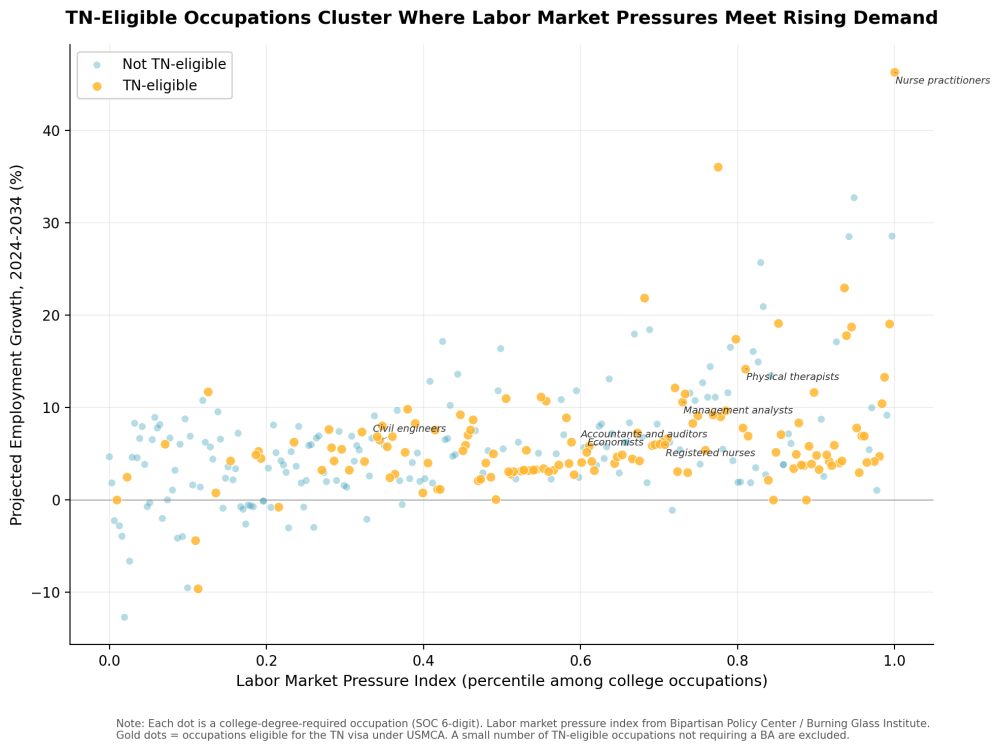
Note: Each dot represents a college-degree-required six-digit occupation, plotted by its labor market pressure index score and its projected job-growth rate between 2024 and 2033. Gold dots denote occupations eligible for the TN visa under USMCA; blue dots denote occupations not eligible. A small number of TN-eligible occupations that do not require a BA under BLS classifications are excluded; their omission does not affect the overall pattern.
The table below lists the 15 TN-eligible occupations with the highest labor market pressure index scores. Nurse practitioners—which can qualify under the TN “Registered Nurse” category—rank at the very top of the entire national index. Healthcare, dental, and psychological professions dominate the list.
| Rank | Occupation | Pressure Index | Proj. Growth (%) |
|---|---|---|---|
| 1 | Nurse Practitioners | 1.000 | 46.3 |
| 2 | Veterinarians | 0.998 | 19.0 |
| 3 | Clinical And Counseling Psychologists | 0.993 | 13.3 |
| 4 | Dentists, General | 0.991 | 4.8 |
| 5 | Oral And Maxillofacial Surgeons | 0.986 | 4.2 |
| 6 | Nurse Anesthetists | 0.985 | 10.4 |
| 7 | Orthodontists | 0.982 | 4.1 |
| 8 | Psychiatrists | 0.980 | 7.8 |
| 9 | Neurologists | 0.979 | 6.9 |
| 10 | Dermatologists | 0.978 | 6.9 |
| 11 | Dentists, All Other Specialists | 0.975 | 3.0 |
| 12 | Physicians, Pathologists | 0.973 | 5.9 |
| 13 | Surgeons, All Other | 0.972 | 4.2 |
| 14 | Ophthalmologists, Except Pediatric | 0.970 | 4.0 |
| 15 | Health Specialties Teachers, Postsecondary | 0.968 | 18.8 |
Mexican and Canadian workers are already in these occupations
Data from the 2024 American Community Survey reveal that approximately 234,000 workers born in Mexico or Canada are already employed in TN-eligible occupations in the US. While survey data do not allow us to identify which of these individuals hold TN visas specifically, the numbers illustrate that professional labor flows between the three countries are real and ongoing.
The patterns differ by country of origin. Nearly 14 percent of all employed Canadian-born workers in the US are in TN-eligible occupations, compared to about 8 percent of the overall workforce. Canadians are especially present in fields like economics, actuarial science, veterinary medicine, and management consulting. Mexican-born workers, by contrast, are more concentrated in the broader labor market: about 2.2 percent of employed Mexican-born workers are in TN-eligible occupations, but this reflects the overall occupational distribution rather than any absence of professional talent. Mexico graduates large numbers of engineers, nurses, accountants, and other professionals each year, suggesting significant untapped potential for professional flows under the TN program.
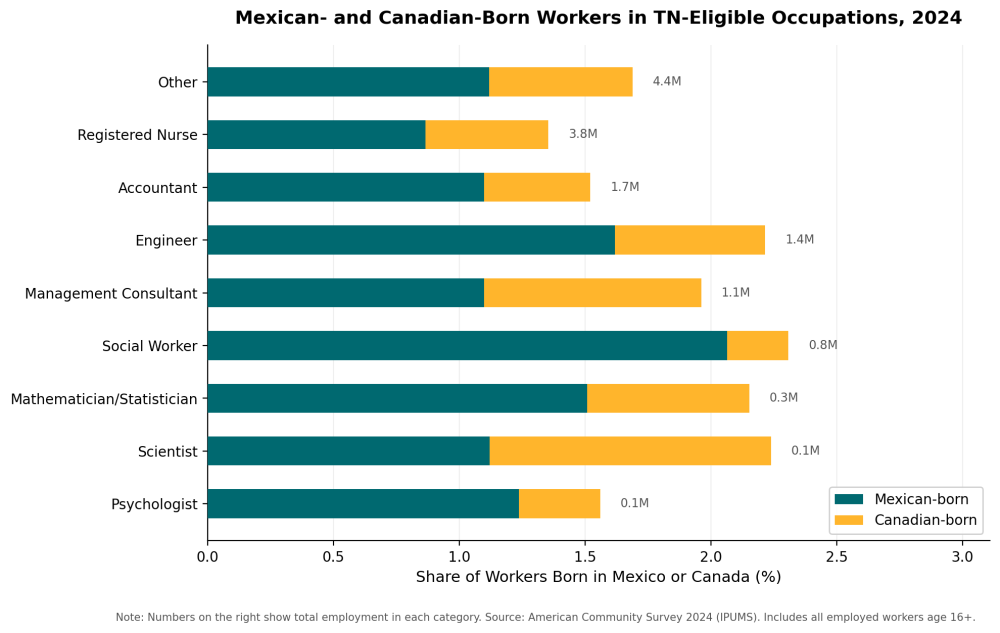
Note: Numbers on the right show total employment in each broad TN-eligible category. Source: American Community Survey 2024 (IPUMS). Includes all employed workers age 16+.
More broadly, foreign-born workers already constitute a significant share of employment in TN-eligible occupations—between 9 and 22 percent depending on the field. Engineering, accounting, and management consulting each have foreign-born shares around 20 percent. This underscores a basic fact: these sectors already depend on immigrant labor. The question is not whether international talent will play a role in staffing them, but whether the channels for that talent are efficient, legal, and well-managed.
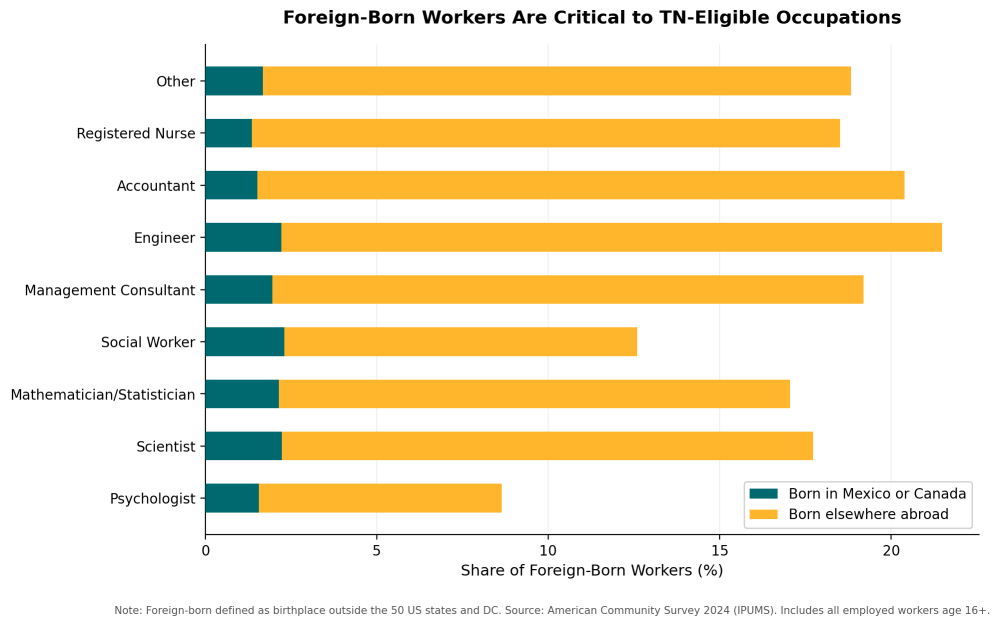
Note: Foreign-born defined as birthplace outside the 50 US states and DC. Source: American Community Survey 2024 (IPUMS).
Growing the North American Pie
The value of the TN visa extends beyond filling vacancies in the US labor market. It is also an instrument for strengthening North America’s collective position in the global economy—which is, ultimately, the purpose of USMCA. The challenges shaping competitiveness today—from the semiconductor supply chain to clean energy to biomedical innovation—are fundamentally about the capacity of firms to mobilize highly skilled workers. North America’s competitive advantage will depend not only on supply chains and trade rules, but also on the ease with which engineers, scientists, analysts, and health professionals can move and collaborate across borders.
This is not about competition between the US, Mexico, and Canada. It is about all three economies working together to increase the size of North America’s share in global markets. When a Canadian engineer helps design a product manufactured in the US and exported worldwide, or when a Mexican-trained nurse fills a critical vacancy in an American hospital, the gains accrue to the region as a whole. Europe and Asia already have internal labor-mobility structures that make it easier for firms to adjust staffing across borders. USMCA gives North America a comparable tool—but one that remains underused.
President Trump has made reducing the US trade deficit a central policy objective. While economists debate the merits of the trade deficit as a standalone measure of economic health—since it reflects factors like capital flows and domestic demand as much as trade policy—there is little disagreement that strengthening the productive capacity of North American industries would help. Enabling smoother professional mobility in the occupations where demand is rising directly supports that goal: it allows US firms to staff up, produce more, and compete more effectively against European and Asian rivals. A stronger, better-staffed North American manufacturing and services base is one of the most direct paths to a more favorable trade position for the region.
In an era when immigration has become one of the most symbolically charged issues in American politics, the TN visa offers something unusual: a legal channel for professional workers that already exists, already works, and generates virtually no political controversy. It does not require Congress to pass new legislation. It does not involve a lottery or multi-year waiting lists. It does not displace existing workers in low-skill sectors, nor does it create the kind of large-scale migration flows that tend to dominate public debate.
Even voices that are broadly skeptical of expanding immigration often recognize the need for more workers in engineering, technology, healthcare, and manufacturing. President Trump himself has said on multiple occasions that the US needs more, not less, immigration in certain sectors. The TN visa is precisely the kind of targeted, skills-based channel that matches that stated preference: it brings in professionals with verified qualifications in occupations where American employers cannot find enough workers domestically.
Because the TN visa is embedded in the USMCA treaty framework, the upcoming 2026 review presents a natural opportunity to modernize the program. This does not require reopening divisive political debates about immigration caps or green-card backlogs. It simply means updating an existing, well-functioning mechanism to better reflect current labor market realities. Concretely, this could involve updating the occupation list to include emerging fields, aligning professional credentialing standards across the three countries, and building mechanisms for the list to respond more dynamically to labor-market signals.
The data presented here make the case straightforward. TN-eligible occupations account for a large and growing share of projected labor demand. They overlap heavily with the occupations where labor market pressures are most intense. And there is already a pipeline of Mexican and Canadian professionals working in these fields. Strengthening the TN program is not a radical policy proposal—it is an incremental improvement to a tool that North America already has, one that serves the interests of all three countries and the competitiveness of the region as a whole.
Note: This blog was edited with assistance from AI and reviewed by the authors and a human editor before publication.
Topics
DISCLAIMER & PERMISSIONS
CGD's publications reflect the views of the authors, drawing on prior research and experience in their areas of expertise. CGD is a nonpartisan, independent organization and does not take institutional positions. You may use and disseminate CGD's publications under these conditions.
Thumbnail image by: Taiga/ Adobe Stock