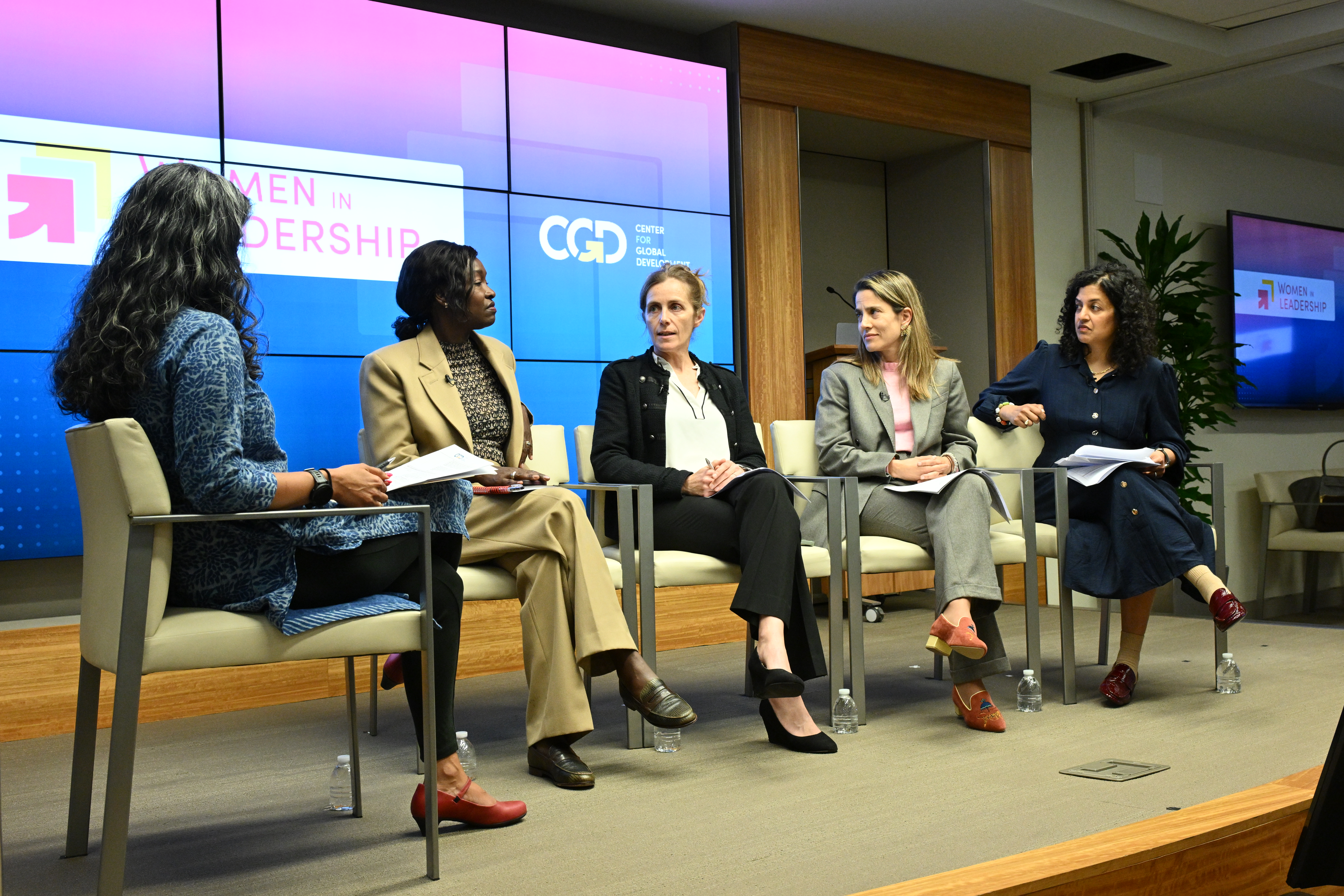
[00:00:00] Kelsey Harris: Good morning, everyone, and welcome. After many months of planning, it is a real pleasure to have you all here at CGD for our first annual Women in Leadership Conference. My name is Kelsey Harris, and I'm the Assistant Director of the Gender Equality and Inclusion Program here at CGD. I have had the privilege of working closely with Senior Fellow Eeshani Kandpal and the broader team on both the research and the policy engagement behind this portfolio, as well as on bringing this conference together today. At CGD, we work to reduce global poverty and improve lives through research that informs better policy. Within the Gender Equality and Inclusion Program, our work focuses on how policy choices, from financing to care systems to institutional governance, shape women's opportunities and economic outcomes. Today's conference sits squarely in that tradition. Today we will be talking about who holds decision-making power, why that matters, where the barriers remain, and what institutions can do differently to support women's professional trajectories. Over the past several years, CGD has been examining women's leadership at the international financial institutions, institutions like the World Bank, the IMF, and the regional development banks that help shape global development priorities, allocate hundreds of billions of dollars in financing, and influence policy choices in low- and middle-income countries. Who leads these institutions matters because leadership shapes what is prioritized, what gets funded, and what change is possible. Leadership matters for internal governance. It matters for external credibility. And it matters because the people making decisions about development finance, economic policy, and institutional priorities shape outcomes far beyond their own organizations. In a few minutes, Eeshani will share an overview of CGD's research in this area, including our updated quantitative findings, as well as a preview of some qualitative research now underway. So, I will not steal her thunder by getting into the specifics right now. But the broad story is this. Women are entering these institutions with the skills and the credentials to lead. The issue is institutional systems not being built to recognize that talent, to advance it, to sustain it at the top. That is why our conversation today is not just about representation. It's about whether leadership pathways are fair, transparent, and genuinely meritocratic. And it's about whether organizations that advise others on inclusive growth and promote jobs for women are willing to apply that same standard to themselves. We're also meeting at a moment when talking about gender equality has been more politically challenging. Some may see that as a reason to step back from efforts to advance women's leadership. We see it as a reason to be even more disciplined, to lead with the evidence, to keep the conversation grounded in institutional effectiveness, and to continue asking what real progress requires. That is why we are here today. The goal of this conference is not just to document the problem. We want to move forward with answers. So today, we hope to leave you with three things. First, a clear understanding of what the latest evidence tells us about the benefits of women's leadership for institutions, for policy, and for broader development outcomes. Second, a sharper view of the barriers that continue to shape women's leadership trajectories, including the formal and informal systems that determine who rises. And third, a better sense of what can be done by IFIs, by shareholders, by researchers, by funders, and by the broader policy community to move from commitment to action. As you've seen, we have a packed agenda today and an exceptional group of researchers, policymakers, and institutional leaders who are here. Throughout the day, you can scan the QR code that will show up on the screen for the full agenda, including speaker names and bios. The day is designed to move from evidence to barriers and then to solutions. We're going to start with why women's leadership matters, and then we'll look at regional evidence, some institutional barriers, and what actually works. We will end with the policy question that should follow all of this research. What now? What can we actually do to address these barriers? And because this is a full day, we're also going to make sure that you're fed and fully caffeinated. Coffee and snack breaks will be throughout the day. We'll have lunch around midday, and then we'll have a drinks reception at the end of the program. So please do stay with us for the final policy panel and reception. Just a few quick logistics before we begin. In respect of our speakers, please make sure your phone is silenced. If you're looking for the restroom, it's outside the conference center and to the right. And we encourage you to join the conversation today on social media. You know, please follow CGD. If you do post, make sure to tag us to help us get this discussion outside of this room. And before I turn it over, I also want to recognize Co-Impact, whose support has made this work possible and whose partnerships have helped us to stay focused not just on the research outputs, but on institutional change. It is now my pleasure to introduce Yasmin Madan, Senior Director for Strategic Partnerships at Co-Impact. Yasmin leads Co-Impact's work on strategic partnerships, philanthropic engagement, and cross-portfolio collaboration in support of systems change across health, education, economic opportunity, gender equality, and women's leadership. Yasmin brings more than two decades of experience across philanthropy and international development and she has worked with philanthropies, multilaterals, public and private sector actors, governments, and locally rooted organizations across Africa and Asia. Her work examines how institutions, financing, and decision-making structures shape access, representation, and whose voices influence policy priorities. Yasmin, thank you for joining us.
[00:06:44] Yasmin Madan: Pleasure to be here. Thank you for including me. Good morning, everyone. It's such a pleasure to be here and I'm really sad I can't be there in person, but unfortunately travel plans have got in the way. Co-Impact is, as Kelsey said, has the privilege of supporting this work because as we were designing our gender fund, we realized how critical women's leadership was to it. So, I'll begin with a few numbers and I realize, again, the audience is sitting on a lot more data, but when we looked at India, just as a starting point, 40% of economic PhD students are women and yet less than 15% of department heads are women. So another statistic, India, women are entering the Indian statistical service at about parity, but no woman has ever been a secretary of statistics or a registrar general in India. So an institution that decides what data gets collected, how national progress is measured, has never had a woman at the top of the system. But this is not just India, we know that in Nigeria, women make up nearly half the workforce in major commercial banks,but hold less than 30% of senior executive leadership roles. And globally, as CGD's research will show us, no major financial institution has reached gender parity. And what's worse is there's been backsliding over the last two years. So at the IMF now, women hold less than 24% of senior leadership roles. And at the World Bank, women's representation in expanded leadership has gone back from 37% to below 30% in the last two years. And the reason I brought up country level and global data is because they actually mirror each other. So, I know the conversation sometimes is a lot at the global level, but whether these are universities in India, banking systems in Nigeria, or major global multilateral development banks, women are entering in meaningful numbers, but where economic power is concerned and where influence concentrates, that's where the numbers start disappearing. So pipeline exists, power does not. And again, we know why this matters, but it's good to say it out that economics is not abstract. As Kelsey was saying, economic institutions are shaping budgets, policies about taxation, labor markets, allocation of resources for public services, social protection. But whether these institutions are public or private, what they're actually doing is taking realities into consideration and policy. But when that reality consideration is incomplete, then the burdens are invisible. So if you have global and country level institutions that are shaping these decisions and they lack diversity and lived experience, then they lack full understanding of what is actually reality. We also support the International Budget Partnership, and Priyanka Samy recently wrote this piece about fiscal justice and feminist perspective. And she says that power actually tends to hide behind numbers, macroeconomic decisions, because they are presented as these neutral inevitabilities. But what she reminds us is fiscal policy determines who's counted, who's resourced, who's protected, and then who's left to navigate precarity. So what's neutral economic decision making is actually gender blind. And as Kelsey was saying, the consequences are so clear. Care work is invisible, unpaid, informal labor markets are ignored. When there's pressure on fiscal space, women are absorbing these costs first and foremost. So what is presented as marginal issues are actually majority concerns. And women's leadership is shaping, or lack of it, is then unable to shape economic power. But I also, and Eeshani and I recently discussed this briefly, but given the audience in the room, I do want to say this explicitly. I don't think we should make this case instrumentally only, in terms of stronger growth, better institutional performance, or better economic outcomes. All of these matter, but there's an intrinsic issue of power, legitimacy, and justice here. Women shouldn't have to continually prove their economic value to belong in these institutions, shaping national or global priorities in everyday life. Men don't. And so exclusion weakens economic decision itself, and leadership remains narrow. Dimensions of economic life are poorly understood, underprioritized, invisible. And so that brings me to Co-Impact's approach. Why are we investing in women's leadership, and how are we going about it? And one of the most important lessons we learned, and I know it will be part of the whole discussion you'll have through the day, is that the problem isn't capability. We cannot put the onus of change on women alone. Exclusion and discrimination is baked into the design of these institutions, opaque promotion policies, biased evaluation structures, informal networks, unequal access to visibility and sponsorship. Policies, practices, mindsets are deciding who advances and who doesn't. So when we're investing in women's leadership, whether that's in India, whether Nigeria, or Kenya, globally, we are actually looking at institutional change. Because women are less likely to get high-profile assignments, publication opportunities, research collaborations, advisory roles, but actually are picking up a disproportionate share of teaching, administrative work. And so institutions are shaping professional credibility through journals, conferences, boards, appointments, and continue reproducing the same patterns of leadership. So instead of fixing women to navigate exclusionary structures, what we are doing through our portfolio of women's leadership at Co-Impact is looking at when the exclusion is structural, the solutions must be structural. So for us, it's institutional change. And we are focusing on three interconnected institutions, what we call critical. These are directly shaping economic policy, resource allocation, whether that's a ministry of finance, a central bank, a multilateral development bank, international financial institutions. These are the critical institutions. The second is pipeline. Who enters, who advances? That happens in academic institutions, universities, economic departments, research institutes. And the third is ecosystem, where there is visibility, influence, networking, credibility, like professional associations, advisory boards, think tanks, all of these. So for us, all three institutions matter, because this is where expertise becomes visible, influence is shaped, and then decision-making is shaped accordingly. So we are trying to focus on these conditions of success, what we call. And that brings me to the CGD partnership, which we are, again, such a privilege to be part of this, what we call a movement, because systemic change, and CGD, through the day you'll have this discussion, evidence, transparency, accountability, and public pressure is a really nice set of ingredients for the recipe for change. And CGD's work, and Eeshani will speak to this, has been making visible patterns across these institutions. So what was previously normalized or obscured or even ignored, now we have data. And now we have data to show us the fragility of this, right? So when institutions themselves haven't changed, then progress depends on leadership, but then when that transitions, then we have dramatic fluctuations. We have individual champions rather than institutional norms, because inclusion isn't embedded structurally. And again, for me, this convening matters. It's more than a research conversation, clearly. It's about this field coming together, because institutions determine realities, but those realities have to be all realities, not just a few. So thank you for including me, and I wish I was there in person to meet and engage with everybody, but really grateful for our partnership.
[00:14:53] Kelsey Harris: Thank you, Yasmin, for your support and for sharing more about how Co-Impact is investing in women's leadership. We're thrilled to be part of this movement and just happy for all of the work ahead. I would now like to introduce Eeshani Kandpal. Eeshani is a senior fellow on the Gender Equality and Inclusion team and the research manager here at CGD. She has been leading this work on women's leadership at CGD since its inception in 2022. Eeshani joined CGD from the World Bank, and her research spans beyond this topic to social protection, nutrition, maternal health, just to name a few. And throughout her career, supporting the next generation of economists and researchers has been a very important priority for her. At CGD, she's been pushing for more inclusive policies and serving as a mentor to associate staff. And she's also been working on this more broadly through organizations like the International Health Economics Association. However, before turning to her, we are also going to hear briefly from CGD's president, Rachel Glennerster, who unfortunately could not be here with us today. She's going to share some personal reflections on why we need to continue to focus on this issue.
[00:16:07] Rachel Glennerster: I'm sorry I can't be there in person today, but I wanted to provide some brief thoughts on why it matters to have women in senior roles in governments and at the IFIs and what we can do about it. Today you will see new CGD data on how rare it remains for women to hold any ministerial position, and in particular, the most influential portfolios like Minister of Finance. Early in my career at the IMF, I was fortunate enough to see in action one of the most impressive African female ministers of finance, LuÍsa Dias Diogo, who went on to be Prime Minister of Mozambique. Not only was she a brilliant economist, ushering in reforms that led to rapid growth and debt relief, she was a powerful figure across the continent, pushing, for example, for free sexual and reproductive health services for women. Personally, she dominated the room, was on top of all the data, and always thought about the impact of policies on the poor. You will hear about the importance of role models later today, but Luísa Diogo has been one of my role models throughout my career. You will also hear about the barriers that still hold women back, because understanding the barriers helps us to fix them. A very practical barrier that I faced at the IMF was that working on a borrowing country, ideally one in the middle of a crisis, was important for your career. But pregnant women and those with very young kids, I found, could not cope with the intense travel schedule. The reason I could be on the IMF mission to Mozambique and work with Luísa Diogo was that an innovative solution was found. I worked full-time, but I job-shared the country, and thus the travel part, with another mother. It's possible to change things. You will hear more and less anecdotal analysis on how research at CGD and elsewhere is documenting the problem and surfacing solutions, pay transparency, role models, targeted HR interventions. And we're seeing some positive response from this work. Our data and analysis directly informed the IDB's board declaration on gender equity, one of the few concrete governance-level commitments any MDB has made on this agenda. Other IFIs should act, because IFIs, important in their own right, are an important stepping stone to ministries of finance and heads of state. Work by the Bretton Woods Project found that 20% of ministers of finance of borrowing countries had worked for either the World Bank or the IMF prior to their appointment, just like Minister Diogo had.
[00:19:08] Eeshani Kandpal: Thank you, Rachel, and thank you all. Thank you for being here. This is, you know, some of you are familiar faces. I look around, and it's just so heartwarming that we are still here in times that are different from the last time I saw you up on this, from up on this stage, on this topic. If I could have my slides up, please. As Kelsey kindly introduced me, I am a senior fellow here. My name is Eeshani Kandpal. I lead our Women in Leadership work program, which is focused on working with the international financial institutions to try and understand both the trends there and also understand sort of what's going on in the world today and what's going to happen in the future. I'm going to talk about the impact of this program, how it's going to impact women's lives there, and also understand sort of what the implications are for the broader development effectiveness agenda. While we wait for my slides to come up, let me give you a little bit of a preview of what I'm going to tell you about. So I'm going to do three things today. First, I'm going to tell you what we found so far. The picture of women's representation in leadership roles at the international financial institutions, we gathered about 20 years of staffing data from seven major IFIs. So the three in town, the World Bank, the IMF, the Inter-American Development Bank, the Asian Development Bank, the EBRD, the EIB, and the African Development Bank. We're not able to include the African Development Bank in our analysis because they only share the numerator with us, which is the number of women, not the denominator, which is the total number of staff. And we were never able to, unfortunately, get the denominator. So in the data and analysis I show you, it'll be the six, the World Bank, the IMF, the IDB, the ADB, EBRD, and the EIB. So that's sort of descriptive of 20 years of trends. These are fairly aggregated data. We're on the outside. We're not able to get sort of granular staff-level data. So this is just gender by grade over that period. But the trends, as you will see, and I hope you'll agree, are fairly informative. Then we did an update on senior leadership. So at this point, the IFIs are not consistently able to or willing to share even the sort of aggregated data. Some have, but others haven't. So for sort of consistency and comparability reasons, we scrape publicly available data on senior leadership. And that's what I will show you for the end of last year. And Yasmin sort of shared the headline finding, which is that we find some backsliding at a couple of the IFIs in our data set, but also some pretty robust progress at the more regional development banks. And then last but not the least, I'll describe the qualitative work that we have, which is being led by Catherine Weaver from the University of Texas, Austin, and Monica Biradavolu of Qual Analytics. We are still waiting on my slides, which is not something that I had planned on. But we will get there. This is better to do this with me than with our external speakers to figure out what the glitch is. And then I'll sort of end with where we see this work going. But while I'm up here, I also want to make a plug for the qualitative study. The qualitative study is in its early stages at this point. And if you are interested, please do reach out to Drs. Weaver and Biradavolu. Sort of they're in their snowball sampling stage. So those of you who are researchers and are worried that I'm asking you to reach out, this is the early stage, formative stage. We will have more representative work underway later. OK. So with that, I do want to note that this work that I'm going to present is done with Brian Webster, some of it with Charles Kenney, of course, with Kelsey. And then the qualitative work, as I said, is led by Monica Biradavolu and Kate Weaver.
[00:23:23] Eeshani Kandpal: So, you know, Rachel and Yasmin and Kelsey gave us a sort of a compelling summary of why this work matters. But they also told us that where we are today is that women's representation in leadership and senior management in particular at the international financial institutions is far from the norm at this point. Only three of the major IFIs have ever had a female head, and they are the IMF, the EBRD, and the EIB. And yet, as Kelsey and Yasmin noted, these IFIs do have a lot of say in the lives of women and girls in low- and middle-income countries. They channel hundreds of billions of dollars in development finance, and they shape economic policy across low- and middle-income countries. I gave you what I'm going to do today, so I'm just going to jump straight into what we find. So in 2023, when we put together this 20 years of staffing data, going into that exercise, my prior, and as Kelsey said, I'd just come here from the World Bank at the time, was that there wasn't much of a representation problem, that there were cultural issues, that there were issues of once you got into leadership, how you were treated, legitimacy with which you were greeted. But that in general, it seemed to me just based on the part of the World Bank that I inhabited, that we were not going to find significant underrepresentation. So imagine my shock, and Yasmin noted the importance of actually looking at the data for myself even. Only a third of all IFI managers were women as of late 2023, and there has been little net progress since 2010 in senior leadership. We also found that politically appointed positions, so obviously the heads but also the executive directors who sit on the boards of these institutions, are even further from parity, between 20% and 25% than the technocratic managerial cadres. We also found an issue of exactly the thing that Yasmin described with the Indian Statistical Service, this clogged pipeline and broken trajectory, that many IFIs are at parity. In fact, the World Bank, from the beginning of our sample, which goes back to 2000, has been at parity in the entry technical grade. But then the clogged pipeline starts with the first promotion itself. So going from economist to senior economist, women are less likely to be promoted than they're available in the grade below. And that holds true until the very top, but then we're talking about a very small number for the World Bank, which is by far the largest institution, about 30 to 40 individuals. And there we do have parity or close to parity, and then that will slide back. Sorry, parity with the grade below, not parity in absolute terms. So that bottleneck starts with the first promotion itself. And most distressingly, going into last year, the thing that on this work program kept me up at night was that we found that the share of women drops in these labor forces during any period of secular change. So this can be the IMF contracted significantly after the Great Recession of 2008. The EIB expanded rapidly starting in 2014 when their board expanded their mandate. And the World Bank's Jim Kim reform of 2012 to 2015. And the share of women takes years up to a decade sometimes to recover to the pre-shock trends. These are, as I said, these were secular events that we had evaluated as of 2023, and yet we were finding this pattern. And so last year and all the pushback that started, that is DEI specific, really had us concerned about what we would find. So what has happened in the last year? An update that we did, again, this is the publicly scraped data. So we can't really tell you the pipeline story here. But at the very top, you will see that the three regional banks, four regional banks rather, the ADB, the EBRD, the EIB, and the IDB have built on where they were. So that's the light gray is in 2023. That's the last data we had reported. And then in the black are the, let me see. I don't think my, does that work? Yes, OK. So the black is 2025, the publicly scraped data. And so you'll see that for the regional banks, they're all going up. But for these two over here, the World Bank and the IMF, which are large and influential, we see the opposite trend, which is that they're worse off than they were. And pretty dramatic drop-offs compared to two years back. Now, of course, an important caveat, this is senior leadership. This is a small number of observations total. Still, the trends are, they're meaningful. And in the absence of more granular data, we can only look at these and worry. OK. But not all is doom and gloom. We can compare, for example, the recruitment of junior economists into the World Bank and the IMF from publicly reported from edge certification data, for instance, and compare that to the share of women in that year's new econ PhDs in the US. And we find that HR actions, lo and behold, actually make a difference. Both institutions have recruited an increasing share of women into those entry technical grades, and they match or even outstrip the share of women that are new econ PhD graduates for that year. And that should not be surprising. I mean, these are fantastic jobs in many ways, right? These are highly paid jobs. These are prestigious jobs in the research departments of these institutions. You have a lot of freedom to do your work, as I can attest personally. So it should not be surprising that they're able to do this, but it also takes intentionality. And we see that here. So the slide off at the top should not be viewed as sort of inevitable and something that we cannot do anything about, that we just sort of throw up our hands at. And again, of course, that pipeline does not translate into leadership role. So here are the six institutions in our data, the complete data set. And you'll see that all but the ADB have a bit of a drop off in that last two-year period. Sorry, the ADB and the IDB. So in this next phase of work for us, we're interested in starting to understand and unpack these trends using quantitative data where we can. And we are working in close partnership with a couple of the IFIs. We're hopeful that we'll be able to get some more quantitative data out of them and some more learnings to unpack these trends. But we also think that documenting the lived experiences and understanding them systematically is really important. And I'll give you a personal example here very quickly, which is that of mans-slation So this is fairly common experience that you're in a meeting room and you say something. It doesn't really seem to register. And then a man repeats it. Maybe a couple of minutes later, I heard that laugh. A man repeats it and everybody sits back and says, yes, of course. And as Jim said, maybe Eeshani had said it five minutes back, but it didn't land. The first time that happens is what happens to all of us is I think we take back that we are not effective communicators. And so what's important about the qualitative work is that it helps us tease these trends out. And that's when we realize that it's not us, it's them. Because it can be me. Maybe I'm a terrible communicator. But it's not all of us. We are not all 50% of the world's population, just inherently terrible communicators. That's not how it works. I'm sorry to say. So we think it's very important to start documenting these sorts of barriers that we face that are soft, but that are sort of death by a thousand paper cuts, if you will. And equally, the things that women have done, the strategies they've used, both institutional and personal, to overcome the barriers that they have faced. So some of the preliminary findings, as I said, this is sort of in the toehold stage at the moment. So these are very preliminary. But we are finding, Drs. Biradavolu and Weaver are finding that women start in the back foot. That they're under-placed at entry. They're out-negotiated on salary. And they're shut out of insider networks. I don't want to call out the out-negotiated on salary and under-placed at entry, because there is some evidence that conditional on graded entry, the World Bank's gender pay gap has decreased dramatically. Again, that shows that HR actions can be meaningful. That was not an accident that the pay gap closed over time. And yet, that analysis, the underlying assumption is conditional on graded entry. This is work done by Clément Joubert and Jishnu Das. And here we're finding in the qualitative work that that assumption might actually be a pretty heroic one. And we need to think about how we start loosening that assumption, relaxing that assumption a bit to really understand what the gender pay gap is. And also, just as a woman who worked at an IFI for about 12 years, I will say that 5% of an IFI's salary over 30 years of a career is a lot of money to leave on the table just because you're a woman. So there's that. The qualitative work is also finding that the path to management runs through access to visible influential portfolios. Exactly the sort of thing that Rachel alluded to. And that is not gender neutral. Exactly the story that she used to highlight that. The leadership track is also driven by rotations, by field postings, by stretch assignments. Again, I'll simply point to Rachel's remarks as explaining what this is about. Performance reviews, as we'll see later today, can be biased. Plus, many of these institutions have a cap on the total number of top performance scores that they're allowed to sort of each manager is allowed to hand out, meaning that sort of every judgment call can compound. And the networks and mentors, of course, help. But the access is far from equal. And there can be bias there as well. So in terms of our research, we plan to continue doing our annual data update to the best of our ability, working with the IFIs with more granular data where possible. Want to keep building our analysis of the mechanisms behind these trends, the specific HR interventions that move the needle on specific parts of the bottleneck. And then in terms of influence, you know, obviously convenings like this are a key part of what we do. We are co-hosting the World Bank's Women in Leadership Conference in September 2026 in London, which is led by Ana Maria Munoz-Boudet, who's in the back, and will be presenting later today. We're also going to be convening likely a closed-door event at the IMF and World Bank's annual meetings in October. We do host regular roundtables with executive directors of all the IFIs, and we're building towards board-level commitments at all of the peer institutions following that IDB model that Rachel spotlighted. We do ask the IFIs to share your data. If you are IFI staff, lobby for that. Ask your staff association to share anonymized aggregated data. What we're asking for is not beyond the pale. They approved it. They gave it to us in late 2023. Boards and shareholders. It is really important for the progressive shareholders to step in and not step back, to embed gender criteria, especially into presidential and director searches. And then to funders and other partners, you know, stay the course, please. As Yasmin argued, this is a long game, but the evidence base for why we need to stay the course is compelling. And so with that, let me just lead you to the rest of the program, which is that, you know, the data show that the IFI pipeline is there, that the pipeline of econ PhDs is there, that whatever the leadership pipeline needs to be, that there are talented, capable, ambitious women there. What is missing is that pathway from pipeline to power. And if anything, the gap is getting wider. Two of the largest IFIs. There's also the retrenchment in the pipeline. There's also the retrenchment in the private sector. We heard about Deloitte and Zoom pulling back their parental leave policies recently. So that gap is getting wider. These are all institutions that still play a very large role in determining what is possible for women and girls. And we will hear wide ranging evidence today on why and how to get past these barriers and what institutional champions can do. And then as Kelsey said, we'll end with what's next for policy. Thank you for being here. It is really personally moving to see all of you here still in 2026. Thank you.
[00:36:33] Kelsey Harris: Thank you, Eeshani, for summarizing all of that research so concisely and giving us that preview of what's to come. And for those of you less familiar with our work, I would point you to the CGD web page. We have a landing page for this work. And you can take a look at all of our past research, our blogs, policy commentary, and recordings of past events. This one will be on there after today. Now I'm very excited to move into our research sessions. The first session is going to dive deeper into the empirical case for women's leadership, how it affects policy choices, project implementation, and institutional performance. And I would like to invite our session moderator, Gaurav Chiplunkar, Assistant Professor from the University of Virginia to come to the stage to introduce the panel and provide opening remarks.
SESSION I: THE BENEFITS OF WOMEN IN LEADERSHIP (9:20–10:35 AM)
[00:37:36] Gaurav Chiplunkar: Okay. Good morning. Wonderful to be here. Thank you, Kelsey. Thank you, Eeshani, for having me moderate this extremely interesting session and also opening the day. Like Eeshani, I will wait on my slides for a minute. Oh, great. Thank you. So I'm not going to make a new point over and above what Eeshani, Rachel, and Yasmin have already said in the morning, but just wanted to provide a little bit more data from some of the work I have done, some of the work that I'm always interested in. And so unless you have been living under a rock, or probably you're not on Twitter, which is fair nowadays, you've probably seen this tweet by Geeta Gopinath about the meeting between the US and China and not a woman on the table. And so if you extend this logic a little bit more, I just pulled up some data from the World Bank to look at how does this vary across countries and across the distribution of low-income, middle-income, and high-income countries. So what I'm really showing you here are essentially two lines. They are a ratio. On the top is the ratio of women in X. Let's take X as senior management, junior management, so on and so forth. As a fraction of the women in the US, as a fraction of women in some other occupation, Y. So this could be, for example, labor force participation. So if this ratio is 1, it basically means conditional on participating in the labor force. For example, the probability that women go into managerial roles between men and women are equal. So that ratio equals 1 would mean that. If it is less than 1, that would mean women are underrepresented mostly in these kinds of jobs. And so what I'm doing is just basically, it's not rigorous research in the sense of, I won't be able to give you causal estimates. That's why we are here for the next eight hours. But this is just to show you some patterns that I found very interesting. And so if you look at this line, the blue line basically tells you what is the probability that women become managers or get into managerial roles conditional on working in the labor force. And you see this upward sloping line that kind of flattens out for middle and high-income countries. Now, why is it important to think more about two things that I hopefully want to stress about? One is context. So is this really the fact that you are looking at a composition of countries across the entire income distribution so you can't really compare something in Bangladesh with something in Pakistan with something in Egypt with something in Mexico? So context matters. And second is how much of this is a growth story in the sense of as these countries get richer in terms of economic development, do these things change in these countries? So there's a composition story and there is a time trend with growth kind of a story. So effectively what you see here, for example, just to break down this pattern a little bit more, if you look at this upward sloping line there, you could go back home happy because women are more likely to get into managerial roles as countries develop. But there's a slight nuance. The thing that is driving this is what labor demand and labor supply. So it's important to break it down in terms of like, is this a labor supply problem or a labor demand problem? So the reason, for example, that this line is upward sloping some of that is coming from the fact that female labor force participation actually dips in middle income countries. So the denominator basically shrinking, which is why this ratio is equaling one as opposed to managerial role, which is increasing as you become rich in these countries. Similarly, the flattening out that you see there is again driven by the numerator and the denominator. So in many of these middle to high income countries, female labor force participation actually picks up again, which means the denominator is actually going up. But there is, and the managerial, the probability of becoming a manager kind of flattens out. So the point I want to make is basically trying to decompose not only context with trends, but also look at labor demand versus labor supply kind of stories that can help differentiate and really pull about what sound very promising trends. If you look at top managers, so the red line now is showing you conditional on being in a managerial role in a firm. What is the probability that women actually become top managers, right? They start leading these firms. And that's a secular decline. And that goes back to some of the stuff that Eeshani was showing us earlier, which is trying to understand the pipeline of getting women not only to work, but also where in work do they go. For example, I have this paper with Tatjana Kleinberg from the World Bank where we put together data across 50 countries, 50, 100 countries actually, 50 years. And we really try and show, economics has been obsessed with structural transformation and moving people out of agriculture, but no one's really looked at, for whatever weird reason, the gender component of this, right? And so what we basically show is that while countries are moving out of agriculture into manufacturing and services, that is a very gendered story to how they're moving across occupations on the job ladder. For example, like the managerial gaps between men and women still continue to persist in some sectors, as opposed to just moving people out of farms and into firms as one would see. So again, looking at this entire pipeline becomes extremely important. And then breaking this into, again, supply versus demand kind of both gains as well as barriers as we'll talk about today. And then, as I'd said, these differences mask patterns, not only across countries, because as we know, norms matters, your starting points matter, but also within countries over time. So for example, if you actually just put country fixed effects and run these regressions, which is, I'm just comparing the same country as it grows over time, how does this relationship change? What you basically find, for example, is that the blue line that flattens out, it actually just keeps on growing up, right? So there is a standard, there's a positive relationship. So the flattening out that you see in the raw data is basically coming from the composition of countries that we're studying, as opposed to the within country over time kind of relationship. And lastly, before I start introducing the wonderful panel that we have here, I just also wanted to go back to what Eeshani was showing us, which is women in leadership roles as policymakers, as Rachel also alluded to in her remarks. Again, using the World Bank data, looking at the proportion of women who are in the black line, which is in just parliament as policymakers, and then the red line showing you the fraction of women who are in ministerial positions in the government. And so you can see essentially two things. One is that the gap between parliament and ministerial positions is slightly higher in low and middle income countries. So you see that divergence between the black and the red line, which goes back to what Rachel was saying, which is that you might get people elected as policymakers, but giving them portfolios in managerial positions and ministerial roles is a different story, as opposed to getting them into parliament itself. What you can see is, there is this flattening slash slight dip, but then it starts going up, right? Which means women are more represented in policymaking roles as countries get richer. But that happens around, in real terms, around USD 8,000, right? Which is, if you think of the countries, it's Brazil, Mexico, we are not talking of sub-Saharan Africa, we are not talking of most countries in South Asia and Southeast Asia. So really when it starts going up is when countries start crossing the threshold of about USD 8,000 in real terms. And then really where these gaps also start diminishing is over 25,000 US dollars, right? In terms of per capita income of those countries, is when the gaps really, the lines start converging over each other. So I think there's a different conversation to be had, and then I'll introduce the wonderful panels that we have around understanding both supply, demand, barriers, gains. It's a complicated story to unpack, but I think really treading across all of these things together and comprehensively, I think is just way more important than looking at one piece in isolation. And again, that's all we are going to do the rest of the day, so I'm really excited to see how the discussion shape. With that, let me introduce, hopefully Oriana is online, if not, it'll be interesting, but hopefully she's there. So this panel, we will talk more about women in leadership roles and the benefits of having women in leadership roles. And so let me introduce the four speakers. We have Oriana Bandiera, who is the Sir Anthony Atkinson Chair and Professor of Economics at the London School of Economics. She obviously needs very little introduction in this audience, but let me attempt to do so. Her research is well-known in the field of labor and development, with a focus on monetary incentives, social relationships, and how they interact and shape individual choices. How this in turn shapes labor markets, the allocation of talent and living standards. She's a distinguished academic who has led many important initiatives in the field, but most notably stickered at LSE, and now the Gender Growth and Labor Markets in Low-Income Countries Initiative. She has been a recipient of numerous awards. I'll only name three. Carlo Alberto Medal, which is awarded to the Italian economist under the age of 40 for outstanding research contributions to economics. The Yrjö Jahnsson Award. I've got the pronunciation of it wrong, but that's what Google told me, for outstanding contribution to economics in Europe. And the Istvan Boza Prize for research and development economics among others. She's an honorary foreign member of the AEA, past president of the European Economic Association, the British Academy, Econometric Society, CEPER, REDD, so on and so on. I could go on and on, but I welcome Oriana. Thank you so much for being here and joining us. I'm just going to introduce all four, and then so that I don't interrupt in between the flow of the discussions. Next, we have Apurva Bamezai, who recently completed her postdoctoral fellowship at the Kellogg Institute at Notre Dame. And she'll be joining Ashoka University as an assistant professor in political science this fall. She holds a PhD in political science from UPenn, where she was affiliated with the Center for Advanced Study of India and the Penn Development Research Initiative. Her research examines political selection, bureaucracy, and public goods provision with a regional focus on India. And her current agenda is centered around political entry in rural governments, ongoing projects that relate to local electoral politics, peer networks, and effectiveness of gender quotas. She employs both quantitative and qualitative methods, and her research has been supported by a whole set of initiatives like J-PAL, IGC, UPenn, so on and so forth.
[00:48:25] Gaurav Chiplunkar: Next, we have Henrietta Asiamah, who is a research economist at Statistics Canada and is also a World Bank Africa fellow. She has experience in economic research, teaching policy garnered from working at the World Bank, the African Women Development Fund in Ghana, and various Canadian policy organizations. Her research focuses, which has been widely published in leading academic journals, focuses on development economics, especially around foreign aid on women's empowerment in sub-Saharan Africa, the measurement of childhood chronic poverty, and long-term consequences of childhood poverty and future life prospects. She holds a PhD from the University of Guelph in Canada, and her undergrad degree is from the University of Ghana.
[00:49:10] Gaurav Chiplunkar: And last but not least, Louise Paul Delvaux is a research economist at the World Bank's Development Research Group and holds a PhD from Harvard. She studies labor markets in low and middle-income settings and policies that reduce gender disparities in income and employment. Her research really spans a whole range of topics, but some of her recent work studies how minimum wage differentially affects men and women in Morocco, the role of managers in parental leave take-up, group-based lending for women in rural India, and legal rights for widows in Egypt. And so a common thread across these projects is to try and understand how institutions, norms, and policies can interact to determine women's outcomes in various roles. So a warm welcome to all our panelists, and without further ado, let us get Oriana's thoughts. And so Oriana will be talking about ungendering the economy. Oriana, over to you.
[00:50:08] Oriana Bandiera: Thank you. Hi, everybody. I'm sorry I can't be there with you. I would have liked to, but at least we saved some fuel, which seems to be quite short in supply. So let's see if I can do this. Should have learned by now, but Zoom has decided to update itself, so everything is in a different place now, as always. So you should be seeing the slides. Let me get them from... Sorry, guys. Now you can read my email. Where's it gone? No, I guess you don't see it. So it was working perfectly before, but of course now... Let's try again. No? Okay, cool. That's better. We will get them, don't worry.
[[00:51:13] Oriana Bandiera: You see the big screen? All blue?
[00:51:15] Gaurav Chiplunkar: Yep. I don't know if you can hear me, Oriana, but yes.
[00:51:19] Oriana Bandiera: So thank you. Thank you so much for introducing me and for having me here. Let's be quick, because I know that we have exactly 10 minutes. So the business case for women. This is what I was asked to talk about. And there are three types of arguments that we can make for this. The most common argument is the one on the intensive margin, which is here. The first on the top right box. And what is the argument? That's a very simple argument. It goes with the following logic. If women participate in the labor force, there is more labor. You plug in some estimates from growth models and you have more growth and more GDP for everybody. That's a very simple argument. Then there are more sophisticated arguments that look at the misallocation of talent, which is more pertinent to the women in leadership. So for instance, this goes. The first one is a macro-estimate. It's a famous paper by Chang-Tai Hsieh and co-authors, where they look at, it's probably one of my favorite lines, opening lines of a paper. It goes like, in 1960, 90% of doctors were white men in the US. By 2010, that share was only 60%. So they go and estimate a macro-model and they come up with a number which is between 20 and 40%. The preferred estimate is about 25%. So it's 25% of US growth in the last 40 years is explained by allowing women and black people to enter the professions. I have a recent paper where we use personnel data from a large multinational, where we have data on 100,000 people in over 100 countries. And we use the difference in labor force participation as a proxy for the barriers that women face in these countries. And we see that the higher the barrier, of course, the more qualified and the more able the women are. So this is the same company. When they hire in India, where the labor force participation is very low, they hire men and a woman for the same role at the same pay level. Within four years, the woman has been promoted and has a much more responsible role than the men. Right? So there are productivity gains left unexplored. So it's very easy to make the business case for women. And this has been known for quite a while. So the question is, why are we here today? Why are we still here if there is such a good case for women for engendering the economy, basically? And I think the answer to this lies in the fact that we are asking the wrong question. That is, we are making the business case for women to do the job of men. And we're not asking whether men can do the job of women. That's partly due to our definition of work, which only defines market work. Market work. Because what do women do all day? Well, if you look in this graph, it's a scatterplot by country. This is the latest news data from the OECD. And here we see paid work and unpaid work for women and men. And you see the first graph, the one on the left, every country is below the diagonal. Sorry, every country is below the diagonal, meaning that men do a lot more paid work. And in the left hand side, in the right hand side graph is the other way around. That we know. So women do unpaid work. Now, that's where it gets interesting. If you want to know what the opportunity cost or the shadow price of work, you compare it with leisure. Because in the standard labour supply model, the cost of work is leisure. Foregone leisure. And these graphs, again, are cross country scatterplots. And they're almost identical. But if you look at them, there is differences. So I didn't just do the same graph twice. But the slope is nearly the same. This tells you how paid work trades off with leisure. And how unpaid work trades off with leisure. So basically, paid work and unpaid work are the same for women. This is paid work for women and men. Men in red. Same story. But then, if you go and look at the relationship between unpaid work and leisure, for men, it's upwards sloping. So that means that when men, in countries where men do more care work, they get more leisure in return. Well, they don't have any return because these are all correlations. But it's quite interesting to see that unpaid work is unpaid only for women. It's also interesting to know that they seem to be, in the correlation, in the cross-section, of course, a price for paid work. For unpaid work, sorry. Which is the amount of leisure that men, which live in countries where they do more unpaid work, get. So if we go back to the business case for women, what are we left with? With the extensive margin story upon which most estimates are based, doesn't hold any water. Because that story only works if you assume that the labour supply increases in the economy. But if women do an equal amount of unpaid work, once they move into the labour force, that labour supply decreases by the same amount as the increase in the labour force. So the net effect is zero. So the benefit from gender neutrality really only comes from reallocation. So the other type of evidence, misallocation evidence, still holds under the assumption that the distribution of talent for market work and homework is the same across genders. If you make that regularity assumption, then those results go through. But the key thing is that the key assumption that is never made explicit is that for every new female engineer, we need one more male homemaker or carer. And currently we do a lot of work and a lot of policy on the former, that is getting women into STEM. And we do hardly any work on the latter, that is getting men into social care. Now this becomes increasingly important in the face of the fact that low-skilled jobs are taken by robots and machines. So there is a collapse in the demand for low-skilled jobs that typically men do, and a massive rise due to the ageing population, among other things, in the type of jobs that women do. And yet men do not apply for these jobs. Now, in the face of 3 million papers on why women do not do men's job, there is only one paper that looks at why men don't do women's job. And I'm going to tell you about that because that was one of my students who did it a couple of years ago. But before doing that, so this we already discussed largely, that most initiatives bring women to men's jobs, and the division matters because work outside the home counts and work inside the home does not. And if you look at it like this, this is the paper that I wanted to tell you about. Why don't the men do women's pink-collar work? Well, what Alexia does in this paper, she embeds a field experiment in a national program in the UK for recruiting social workers. And she tests different hypotheses for why men don't want to do it. The first is that this is not a man's job. So she changes the photos in the ads, she puts men or women. The second, which is super interesting and turns out to be the explanation, is that people think it's a non-competitive job. And so she changes the information how difficult it is to do well in this job. When she changes that, she gets a lot more applicants who are men, and the quality goes up for both women and men. Retention also increases. So it's a win-win. We need a lot more papers like this that makes us understand why men don't want to do the jobs of women, and especially to value the caring sectors and also the unpaid sector in the home. Now, if we don't know that, we can push as much as you want. We cannot have a country made only of engineers. And I think we're within the 10 minutes.
[01:01:58] Gaurav Chiplunkar: Thank you, Oriana. Can I now call Purva to tell us more about women leaders and local democracies in India?
[01:02:13] Apurva Bamezai: Thanks, everyone, for being here. And thank you to CGD for inviting me. Today's conference framing is the clogged pipeline to leadership in global institutions. I want to take us somewhere very different to women leaders in local democracy in India and argue that some of what we see there speaks to a more general question about where and how that pipeline actually clogs. The corresponding topic is women leaders. The corresponding tier, I guess, to the IFIs we at least set the agenda with might be parliaments, and we're going to hear more about that in the next presentation. But I'm going to take us several steps down to village council governments in India. The setting obviously looks very different from ours here. The insights, though, I'll argue, have structural parallels. So the share of women, as we all know, in elected office has been rising across the world, and India has been at the center of that transformation. In the early 1990s, India ran one of the largest experiments in democracy in human history, introducing more than 250,000 village councils with elected village heads and reserving specific seats for women and other marginalized groups. And over two million women currently hold these positions. There is, of course, again, this room knows a large literature that documents how women in power have affected the governance outcomes. We know gender quotas have brought gains in descriptive representation, changes in policy priorities, changes in how women are perceived. Some studies, like the well-known Chattopadhyay Duflo paper, find positive effects. Others have found muted or null effects. But what I want to argue today is that we need to shift our analytical lens to ask a different question. Before studying the policy consequences of women in office, we should first ask a more fundamental question. Do elected women actually get to assume the role of political leaders, at least in this context? And there are some election campaign posters on the right that you might suggest. Often the answer is no. Patriarchal norms mean that often it's a male relative and specifically a spouse that ends up governing. So the framework I'll use defines local governance as a set of routinized practices essential to performing the role of an elected representative. And I want to focus on three of them today. First, accessibility. Can the elected woman actually be reached directly by her constituents and bureaucrats? If not, if that can't happen, the representation channel in politics is broken. Second, visibility. Do citizens know that she is the one in power? Again, symbolic representation requires that the symbol be seen and actually recognized. And third is presence, right? So is she physically present in the administrative spaces where decisions get negotiated? Local governance often happens face-to-face in meetings with the state. So all three, accessibility, visibility, and presence, I argue, are the infrastructure of governance and are also the preconditions for any sort of downstream impact of women that we might want to see in elected positions. So just very quickly, the setting. Like I said, village council governments in two states actually in India, Bihar and Maharashtra, highlighted. I mean, there are squares around them. Together, representing populations of roughly 250 million out of over 900 million rural Indians. I focus on two tiers and I'll go, I mean, I'm happy to answer questions later. The lower tier ward member representing about 1,000 citizens and the village council head representing about 10,000. And of course, these are very, I mean, the point to take away is that these are very hyper-local elected leaders. So very quickly, there are three data sources that I'm drawing on, but again, they come from a wide array of sources in the sense that we're like repeated surveys, et cetera. So we have phone surveys of elected representatives, in-person surveys of citizens, and direct observation of meeting attendance. Crucially, these are all observed behaviors, no sort of cell reports right now, which mitigates somewhat the social desirability bias that we obviously want to avoid. The analysis here is really just a descriptive comparison of unreserved seats versus female reserved seats, and because almost all the women in this context are actually in reserved seats, that is effectively a men versus women comparison. Okay, so now the results very quickly. So the first metric is accessibility. So what we did was we ran a governance-related phone survey with about 3,000 elected representatives across these two states. And the simple question really was, when we call, who actually answers questions about governance, okay? So basically, we asked for the person who is most familiar with the day-to-day running of the elected office. In unreserved seats, as you can see, which are mostly held by men, 87% of leaders answer the survey themselves. They are clearly sort of the de facto leaders on the ground. In female reserved seats, that number is just 10%. The plot here is for Bihar, which is the majority of our sample, but this also replicates in the state of Maharashtra. The absolute gender gap there is also 45 percentage points, less than the 77 here, but the smaller magnitude is kind of consistent with its higher development setting and weaker patriarchal constraints. When the elected woman is not the one answering this governance survey, then who is? Yeah, so no surprises here. It's her husband, 78% of the time, and her son, another 15%. So before we really even get to what these women do once in office, we have to kind of confront the fact that for the most part, they cannot be reached at all. The household is gatekeeping access to the elected representative, but it was also clear that she may not really be the one in charge. Okay, so quickly on the second metric, visibility, and this I mean through the eyes of the citizens. So we surveyed roughly 1,000 citizens in person in Bihar and asked an open-ended question, who is your elected representative? And we're basically asking for the name, right? And this was for both tiers of elected reps that I just talked to you about. In unreserved seats, citizens correctly name their leader 90% of the time. So if you're a man, basically recognition by name is pretty much universal. In female reserve seats, the woman is named only about 44% of the time.
[01:09:24] Apurva Bamezai: In case maybe you're wondering, well, perhaps women identify women leaders at higher rates. Unfortunately, that's not what we find. They sort of name the female elected rep at pretty much the same rate. This is not some kind of a gender knowledge gap among voters. It is a gap in the woman's public presence as leader and recognition by her constituents. Again, who do citizens name if not the elected woman? They usually name a male relative. And most often that's the husband, or they'll identify the woman as someone's wife or daughter-in-law and so on. Okay, and finally, I want to show you the third metric of presence. So here what you're seeing is basically attendances at official district level meetings, exactly the kind of in-person engagement with the state where a lot of the stuff of governance really happens. So this actually draws on a larger study with about 2,400 ward members conducted in partnership with the government of Bihar, where we directly observed who showed up to these meetings. Again, in reserve seats, elected leaders attend alone. So like by themselves, 45% of the time. In female reserve seats, women attend alone or by themselves only 6% of the time. And for the most part, they attend with a companion or they're entirely substituted. So again, think of all the sort of patriarchal norms and constraints around mobility, et cetera, that really do sort of constrain women from actually showing up. So the woman is the elected representative, but it is not her presence that the state is registering. And what happens with this absence, it also leaves women under-informed, under-equipped, and also like bureaucrats come to expect male substitution, right? So that keeps reinforcing some kind of a figurehead perception. So again, this is not a surprise. Over 75% of the cases, when women are accompanied by someone or completely replaced by someone, it is mostly her husband again. Okay, so to now quickly summarize, I want to basically, using just this description, show you that across all these three dimensions, we see a consistent pattern of patriarchal constraints continuing to manifest to a large extent. Women remain harder to reach because of household gatekeeping. Citizens do not identify their leaders by name. Women are rarely even physically present in administrative spaces, let alone actually have a voice. I mean, these measures are correlated, so we find that if a woman is not accessible, she's typically also not visible, also not present in these higher bureaucratic offices. So the takeaway really is this, that women do enter office, but constraints rooted in economic scarcity and patriarchal norms shape who actually does the governing. And this gender task landscape that was also referred to in Oriana's presentation is sort of operationalized within the household, even for political labor, so to speak. So what does this all mean? Oh, sorry, last thing I want to say is, of course, unlocking these constraints could substantially amplify the transformative potential of women in politics. And again, I know the panel is on benefits off, but I feel like the way I want you to understand is that to actually get to the point where we really get the value that we can from women in positions of leadership, there's a lot that is still left to be done. So very quickly, I want to end with what this all means. For research, I think we need to really sort of move beyond the average treatment effect of women leaders as something that we want to study, and basically study the inter-household dynamics of political power in particular. Like a lot of us have focused on how household labor gets distributed, and Oriana's presentation set that up very well. But again, in politics, what is it that women do and men do in positions of power is something to think about. And while the household is not the unit of analysis in IFIS that we're discussing, the broader point that constraints on women's authority operate downstream, or formal selection into these institutions sort of generalizes. So we need to better understand the mediators between descriptive representation, so women actually holding office, and substantive representation so that they actually start to shape outcomes. That sort of means tracing how some of these routine governance practices map onto downstream outcomes, and understanding which women face less substitution and why. It may also be time that we start to think of political selection as a household level phenomenon, where men and women divide political labor, like I said, in very different ways. For policy, there are concrete institutional design levers that some are currently studying, and I'm happy to talk more about those. You know, you could like tweak with meeting deliberation rules to give women the floor. Mentoring programs, we're often hearing of in many different contexts, even here. And of course, digital tools that can reduce some of the in-person attendance constraints that women face. But I want to close in on one of these, and joint work with Koas Herz. We ran a large randomized control trial with about 7,000, actually about 8,000 local elected representatives, in again, partnership with the government of Bihar. And this intervention involves basically forming peer networks of politicians. So while gender wasn't the focus of that study, we found that for historically disadvantaged groups, same group peer networks, which you could understand as safe spaces, where everyone shares their marginalized identity, produced substantially larger gains than mixed networks. So the implication for women leaders could be straightforward. Women-only spaces, where they can function without the gatekeepers present, might just be instrumental in unlocking their full political potential. Okay, thanks so much, and look forward to your questions. Thank you.
[01:15:57] Gaurav Chiplunkar: Next, I'd like to invite Henrietta to please come up. She's going to tell us more about what Rachel alluded to, which is women legislators in Africa and a very timely interaction with foreign aid.
[01:16:15] Henrietta Asiamah: Hi, hello. Thanks for having me, and also for the CDD for inviting me to this conference, the first annual Women Leadership Conference. So, so far, I think my research, which has been published in the World Bank Economic Review, sort of, with everything that we've heard so far, it's in line with what we also published back then in 2023, and which is, in this paper, we want to show the relationship in a quantitative way between women representatives in Africa and foreign aid. So I'll start off with this figure. So from 1960 to 2018, in figure one, we show the share of women in parliament globally. So you can see from as low as, you know, 1% in 1960, we've made some progress. So we went as high as about 10% in the 1990s. It dropped a bit, but so far, it currently sits at about 23% of the share of women in parliament. And this is a data set that we created from various sources. In figure two, I showed this, and I think Gaurav also had a similar analysis for low-income countries with regards to representation in parliament. So we can see that for high-income countries, I have two periods. So I have share of women as against GDP per capita. And what we do see is between, in blue, is the period before 1990, and in green is the period post-1990. And we see that before the 1990s, the average used to be at most, say, 25%. But in current period, we now see countries like Sweden and Norway leading the way with about 40%. And the second group, which is also of interest, is, you know, you see low-income countries like Rwanda, Mozambique, and Burundi also leading the way with about 20%. For example, in Rwanda, it currently sits almost close to 36%. And this is something that we saw in the data, and we felt, okay, so what's the story here? What's going on? Because what we do know is that in Africa, societies are mostly known, we patriarch up. There's discriminatory practices within the family units. There's negative stereotyping of women in the public space. Research has also shown that the beliefs and attitudes of electorates tend to influence the number of women who stand for elections, who win the elections, and also who get appointed for political appointments. So the question we have at this point is, can an electoral story really explain this increase that we observe in women representation in parliaments across Africa? We use the World Values Survey. And this survey, it explores people's beliefs and their values over time, how it changes and their influence on social and political life. Now, one question that is of importance in this survey is, do men make better political leaders than women? And respondents had to agree, disagree, or be neutral. We pick the share of respondents who agree that men are better political leaders, and then we do the analysis, we examine it with the share of women in parliament. So this is at the global level. What we do observe is a negative relationship, right? So we see that the lower the share of people who believe that men are better political leaders, the more likely they are to vote for women. And so we see that the share of women in those instances are higher, and vice versa. So if people believe that, you know, men are more the better political leaders, then they are less likely to vote for the women. This is the story. It's significant, it's negative. But when you look at sub-Saharan Africa or Africa closely, it tells a different story. We are seeing the relationship being positive, that the voters think that men are the better political leaders, and yet we are seeing, you know, more women also in parliament. So this is the puzzle. The analysis at this point has shown us that the number of women who run and win elections in Africa can hardly be linked to citizens who have become more supportive of women in politics. And so in this paper, what we do is we focus then on the role of international donors and development agencies as a possible explanation for this dynamic that we see in Africa in terms of the share post-1990. And what makes this explanation possible is that gender equality and women empowerment issues have successfully risen in the priority rankings of donors. Even though just this morning, a few minutes ago, I think Yasmin mentioned that the funding for, you know, gender issues have dropped in the last two years, which is unfortunate. But up until this point, we show with evidence from the International Conference on Financing for Development, from OECD reports, from various foreign donors like New Zealand, Australia, that there is evidence where donors are increasingly focusing on gender equality and women's empowerment issues. So we focus on the investigation. Is there a link really between gender composition in sub-Saharan Africa, a society where negative stereotyping exists for women, where even their own citizens don't think women are the better political leaders? And yet we are seeing this high representation in parliament for them. And so given that donor motivations, there are so many differences in them. What we want to do is we want to focus on recipient countries and then we want to shed light on, okay, for a recipient country, does it pay off if they commit to political, in promoting political gender equality? All right, so this is the methodology that we use. As I said, it's quantitative. So our dependent variable is current aid amount and we control for previous aid amount and our coefficient of interest really is beta here. And what we are saying is, okay, conditional on already being an aid recipient, if you are in Africa, when you increase the share of women in parliament, do you gain additional benefits? And this figure right here, before I show our results, I want to show that in this figure, we see for aid and for women representatives, we see the strong positive association between having more women in power and receiving more aid in parliament. And in this table across different models, we estimate that conditional on already being an aid recipient, what you do see is when you increase the share of women in parliament by 1%, it's associated with about 1.1% in additional aid amount. Again, to summarize, we provide a rigorous quantitative analysis for the connection between policy selective aid and women political participation in aid recipient countries across Africa. We created this comprehensive data sets for the lower chamber of national parliament, covering over 200 countries for six decades. And what we do see is a big jump in the share of women legislators in Africa, beginning in the post-Soviet era. And over the past four decades, we've shown that donors have become increasingly sensitive to gender equality and women empowerment. We estimate that by increasing, sorry. So I wanted to mention that for recipient countries, when they increase the share of women in parliament from 15 to 20%, in the short run, they receive additional aid amount in 4% or 4% in the long run, it goes to about 12%. In the short run, this is good. You have more women in parliament, you receive more aid, but it needs to go beyond that. Women become role models to girls and other women in their countries, but we need to go beyond. I think that's why we are here, from the pipeline to power. The pipeline is that through aid, we are having more representation in parliament, but we need to go beyond that in terms of are these women in power really able to influence policies that will help women in their countries? So thank you.
[01:25:32] Gaurav Chiplunkar: Thank you, Henrietta. And last but not least, can I invite Louise to please tell us about female directors in France?
[01:25:47] Louise Paul-Delvaux: Thank you for the slide. So thank you very much to the organiser for including this paper into the programme. So I will be much narrower in terms of context and policy I will be looking at, but hopefully providing a bit of a silver lining after all the depressing statistics. So the paper that I will be talking about is joined with Francois-Xavier Ladon, and what we are trying to understand is whether increasing the number of women on corporate boards might help shrink the gender gaps in the firm at large. So to start with a quick motivation and some additional not so great numbers, we know that women are heavily underrepresented in corporate leadership, 7% of CEO, and only 16% of CFO in large US and European firms. And even beyond the top of the corporate ladder, we do see gender wage gap that remain pervasive across the distribution. We also have some evidence, including from Claudia Goldin, that the remaining gaps, at least in high-income countries, are now mostly driven by firm-level policies and it's no longer a question of education differences or experience differences. And here when we think that we need to act on the firm itself and how it's setting the policies, the HR, but also the promotion policies, one key governance type of body that we can think about targeting are the board of these firms. And here it's because we know that boards have a lot of power. They do hire and fire the CEO, they set the executive compensation, but they also oversee firm strategy. So as a result, there has been a growing pressure with the narrative from investors and governments that if we do increase female board representation, that might have a positive spillover effect in the firm at large and for the rest of the workforce. As a result of this push from investors and government, we do have the board shares that double from 15% in 2010 to 13% in 2023 in large US and European firms. And the question that we are trying to get at with this paper is that whether increasing this female board representation do help reduce gender inequality within firms and looking at the economic argument, whether that might come at the cost for firm performance. So the way we will be doing this is just like focusing on France 2010 gender board quota, which mandated that 40% of women or 40% of both gender were presented on boards by 2017. And this law targeted both listed firms, but also large non-listed firms. And what we will be doing is exploiting the fact that there are compliance incentives that are very different between these two groups of firms. So for the listed firms, they have to disclose their proxy statement. So it's very transparent who is in the board of these firms and it's very easy to monitor. For the large non-listed firms that were also supposed to follow the quota, there is no disclosure required and it's very hard to monitor. So what I'm showing here is just the evolution of the female board chair by group. And here what you can see is that the listed firm went from 11% of women on their board to more than 42% by the end of the period, while the increase in the large non-listed firms is much more modest. The main identification strategy will rely on comparing these two groups of firms with the listed firm being our treated group and the large non-listed firms being our control group that show a smaller increase in female labor force participation. And I have three main findings. The first one is that the increase in female directors within this board also increased female representation at the top of the corporate leader. So what I'm showing you here is the share of women among the top 10% earners. And what you can see is that as the share of women within this board increase, we do see also the share of women increasing at the top of the firm. We do see this at different level. We have a higher probability of having a female CEO and more women at the top of the hierarchy. The second finding is also that the larger female board chair reduces gender pay gap across the wage distribution. So it's not only an increase of female representation at the top of the corporate leader, but also something happening on the wage gap at large. And here you can see this reduction on the average, the top 25%, but also the bottom 25% where you see a reduction in the gender pay gap. The third finding and that might be, I guess the business case that Oriana was starting with is that in this case, we don't seem to see equity efficiency trade-off. So we do have a labor costs that rise because women now get better paid, but the profitability of the firm remain unaffected. And this is like one causal evidence or one piece of causal evidence that a board gender quota can improve equity without a performance cost, at least in this context. Because there are some other contexts where we didn't see such a positive impact, we wanted to kind of understand and unpack what might have made the French case particularly positive on this. And here we're looking at two main channels. The first one that we highlight is that the newly appointed female directors use the CEO compensation as a lever to make change in the firm. So here you have to, the board is in charge of setting the compensation of the CEO, including the variable part of the compensation package. And what we see is that in the listed firms, the gender goal in the CEO variable pay that were non-existent at the beginning of the period start appearing and one third of the firm do adopt them. Importantly, this larger increase in female board chairs is linked to a higher probability of adopting this type of incentive for the CEO. And we also do see that firms with gender CEO incentive exhibit larger gender gap prediction. The second point that I would like to put out there so that we can discuss why it worked in France and what we should think about for other contexts is this is a case where we see no evidence of a talent shortage. So there is no gender gap prediction so there is no gender gap in a top degree, so an indication, but also experience. And this might contrast with some evidence, including from the US. We also see that there are fewer family ties to other directors for the incoming women board members and they tend to be more independent. So all this patronizing equilibrium that people often talk about before the adoption of such quota doesn't seem to be verified here. Women also get access to audit remuneration and nomination committee and that's the one that the CEO pays. So going back to effectively having a voice within this institution and being able to make change, this seems to be a case where they do have access to these committees. And this helps explain why France might differ from Italy or also Denmark, where we see here that qualified directors with real committee power could actually use effectively the CEO pay channel to try to create meaningful change. Just to conclude very briefly, I think this is one piece of evidence that shows that board diversity can improve gender equities throughout the firm, so not only at the top, without having an equity efficiency trade-off. But here I think there is a really strong case to say that the context and the design matter. So here France seems to have worked because the boards had real authorities, the directors that were appointed were qualified and all this disclosure drove also compliance. I want to highlight that there are a lot of similar gender quotas that have been spreading across countries. So the EU directive, which is basically the French law but translated for all European Union, will be binding next month, so it will be interesting to see how it might diverge across context. France also extended this type of quota for executive committees, but I also want to say that there are different type of quotas which are not really quotas in India and Pakistan that have been introduced and this is more like making sure you have one woman on your board, so other type. But countries such as Morocco recently actually adopted exactly the same laws as the French law and it's really less clear how this will play out in a context where there is much more informality and social norms might be more important to play. So I will say this is French evidence that suggests that well-designed quota can reduce a misallocation of talent at no measurable cost for the firm, but whether and where is this realized is still an open question.
[01:36:17] Gaurav Chiplunkar: Can I just invite all the panelists on stage and then we can have Q&A. We have about 10 minutes for Q&A, so I'm happy to open it up to the audience straight away. The only request is keep your questions short and tell us directly who you want to ask it. Which panelist are you addressing that question to? Those are my only two requests.
[01:37:10] Audience (Margaret McCluskey): Thank you for assembling and doing all your amazingly scholarly work to inform us. Henrietta, my question is for you. My name is Margaret McCluskey, formerly USAID. How do you think foreign aid could have been differently managed from the United States and maybe from other countries to influence women in leadership more effectively than what you showed us?
[01:37:35] Gaurav Chiplunkar: So maybe I can collect a few questions and then just do a round of responses.
[01:37:52] Audience Member: Hi. My question is for Elena Bardasi from the World Bank. My question is for Louise. You said there is a particular functioning of the French boards and the real power that they have that could explain some of the results that you get. So my question is, isn't it also the joint effect of the quotas bringing women in the position where they are, meaning in places where actually women have to become leader following the traditional path to power without being protected in some way? Do you think that there could be the concern that they might inadvertently need to rely on gender inequalities to become leader, meaning the wage gap existing in firms at the time poverty of women in lower ranks and so on and so forth for a lot of things that have been discussed so far? Thank you.
[01:39:02] Diana Rodriguez: Thank you so much. Very interesting. Diana Rodriguez from the IDB. And I have two questions very quickly. One for Oriana. Oriana, you mentioned for every new female engineer, we need a male carer at home. I'm wondering why at home and why if it wouldn't be more beneficial in general for us to think of more care services, more extended hours and not just a one-on-one substitution. And the second question, Apurva, I wanted to ask, oh, yes, on the aid. No, so sorry. On the aid, I'm sorry. I'm looking at my notes. And I wonder if you've seen any path dependency in the sense that you were showing more representation of women, more aid flowing into the country. Is the opposite occurring or occurred or occurring in the sense that donors are targeting those where there are women, but then less aid and less aid is flowing to those that need the most effort of guaranteeing women in representation?
[01:40:17] Gaurav Chiplunkar: So let's start with responses. I think we'll probably not have time to go back to the audience, but there is a coffee break after this where we can continue the discussions. So along with that, I have one question for Apurva. And then along with the responses, I would encourage the panelists also to offer any closing thoughts or comments that you might have based on some of the questions as well as your presentation. So Apurva, one quick question for you is also around how do you reconcile results in the literature that show that women leaders actually matter for public good provision in specific ways as opposed to the stuff that you showed, which is that they're probably not the most involved decision makers in that process. So maybe let's start with Oriana online and then start with Apurva Henriette and then end with Louise. Oriana, over to you.
[01:41:01] Oriana Bandiera: Sure, thank you. Sorry, I might have said it too quickly, but what I meant was homemaker slash carer. So both inside and outside. Mind you that there is a very important point that often escapes us, which is that you could have an army of staff at home. You could have a cook, you could have a nanny, a carer, but there is always the need to coordinate all of that. So the management of the household is still a task to be done.
[01:41:36] Apurva Bamezai: Okay, so great question. How do I reconcile this? Honestly, I think there's a couple of things we need to think about. One, of course, there's a lot of regional variation, right, even within India. So is it possible that the studies that did show us positive effects come from regions or states that did actually manage to have gender quotas actually become effective in reality? Possible, but I will say that part of what we're trying to say is that we don't really have good evidence on how we go from, we know the positive policy outcomes, but we haven't quite understood the how of it. And that's kind of where this somewhat second generation of work is trying to step in. Let's try and actually see, well, if they're not the ones deciding, or if they're not the ones in the room, so to speak, then why are we seeing the effects that we're seeing? But I will also caveat by saying that a lot of the recent stuff, some of the longer term replication work hasn't quite held up. So all to say that we should really, perhaps, go back to that question. I think the paper from 20 years ago sort of ended the discussion in a way that it probably shouldn't have. And I think maybe it's time we go back and do more.
[01:42:59] Henrietta Asiamah: So when it comes to aid on the question, what we see in the data is the aid is being targeted or given to countries mostly with reserve seats or with legislative quotas that are strongly enforced. And I think we need to go beyond that because the aid is being targeted based on numbers. If you have more representation, then you receive more aid. But if we want it to have more influence, I think it should go beyond just having the women in Parliament. It should be that if you have more women in ministerial positions or in higher roles, then you would receive additional aid amounts. For now, the evidence that we have simply suggests if you have them in Parliament just there with the numbers, then you receive more aid. But I think if we want the power, so from the pipeline to the power aspect, then it needs to go beyond just seeing the women in power and more. You're going to receive more aid if women are, let's say, Speaker of Parliament, ministers, etc. And then when it comes to the question on whether we're seeing lower aid amounts going to countries with less representation, I would say that we don't see a negative significant result. But what we do see is for countries whose quotas are not enforced strongly, some of the quotas is just, oh, you can't have it. But if it's not there, you are not penalized. Those ones, the result was not significant. So it was very faint positive, but they were not seeing any impact. So maybe we could take that as a sign that for the countries whose quotas were really strong and enforced and rigid on it, more aid inflows were coming in. But if your quotas were not enforced strongly, we did not see any impact. So I think that could explain that, what we see.
[01:45:01] Louise Paul-Delvaux: So I will try to respond, but I'm not super sure I understood exactly. But if I try to reframe, is that there is gender inequality and the part of the effect that I see in the reduction may be due to the fact that they need women on board. Is that?
[01:45:19] Audience Member: What I'm trying to say is that in the traditional path of the power, you have invented this ascent from existing women that leads to traditional leadership can change the system of knowledge that the leaders need to be protected by some other mechanism that is avoiding the traditional needs of essentially having power and having the profits. Yeah. OK.
[01:46:05] Louise Paul-Delvaux: Yeah. So I think that's where quotas. OK. OK. I think.
[01:46:18] Gaurav Chiplunkar: And respond to it.
[01:46:24] Louise Paul-Delvaux: I think this is the idea of like the woman that you start with like start gender inequalities as a woman that access are already very selected and then they can create change. But maybe you need that element of policy to unlock the access to the top first. That's how I interpreted it. And I think that's really true. And I think that's I mean, it goes back to the misallocation and the fact that here, I mean, it doesn't seem to have any negative performance on firms. But also what was interesting in the more qualitative work of like trying to figure out how why was the equilibrium that we had 10% of women when we put a quota, you're able to find like women that are really qualified even more than their male counterparts. So it's not a pipeline issue. And I think one thing that we realize is that all these big firms adapted kind of the hiring function of board members because they realized that they had like some. So one of the big criteria that they had that was discriminating women, for instance, was like to have been a woman. I mean, to have been a CEO in an industrial sector. And we know the share of a woman CEO even more in the industrial sector is like so low that this was de facto disqualifying women. So I think like thinking about, you know, the quota might just like create also the change on adaptation and revision of like how the rules and the informal rules are set initially. And now that they had to meet this 40% quota, they just like change what were the criteria for nominating these new board members. I think it's I mean, to go back to the design and why it matters now, like as we know, the debate on committee, the board is like an external body of the firm. So you don't have to have all the pipeline ready within your firms. I think it's a bit different with top executive committee within firms and designing those might also be different because then you really need to think about how within your firm you need to prepare the time pipeline so that you can have your top executive.
[01:48:45] Gaurav Chiplunkar: Wonderful. Thank you so much to all the panelists for a wonderful set of presentations and questions. Thank you all.
[01:49:02] Kelsey Harris: And thank you all. We're going to transition now to a coffee break outside. Please be back in the room in 11 minutes, 1050. And we will resume with the next session.
[02:02:31] Eeshani Kandpal: I'm just trying to bring people back in. If you could have a seat in the back row. Please have a seat. Marcus, please have a seat. Is this on? It is on. If it's on, then folks in the snack space, you can hear me. Please come back into the room.
[02:03:25] Kelsey Harris: Okay. Thank you for coming back.
KEYNOTE AND MODERATED Q&A (10:50 AM–11:50 AM)
[02:03:30] Eeshani Kandpal: It is my great pleasure to introduce the moderator for this next session, which is our keynote. She will introduce the keynote speaker. But Pamela Jakiela is a professor of economics at Williams College. Before this, she was a senior fellow here at CGD. And before that, she was an associate professor at the University of Toronto. And she's a professor at the University of Toronto. And she's a professor at the University of Maryland. And before that, an assistant professor at Washington University, St. Louis. Pam is also a non-resident fellow at the Center for Global Development here. But the reason I was really excited, in fact, I jumped in today with a change of schedule this morning to ask to introduce you because Pam is one of my closest friends and someone that I have leaned on a lot in my career. And she is a great ally to other women in the profession, a shoulder that I have leaned on more than once. And I will, in future years, I have no doubt. You know, we talked earlier today about the importance of safe spaces. I think, Apuva, you brought it up. Louise mentioned it a bit too. Pam has been my safe space. So thank you. And it is my great pleasure to welcome you here to introduce our keynote speaker.
[02:04:39] Pamela Jakiela: Good morning. Oh, wait, I don't need this because I have this. OK. It is my great pleasure to introduce our keynote speaker today. Professor Eliana Laferrara is a professor of public policy at the Harvard Kennedy School. And she also received a PhD from Harvard in 1999. Prior to coming to Harvard, she was the Invernizzi Chair in Development Economics at Bocconi University in Milan and the founder of the Laboratory for Effective Anti-Poverty Policies. She has served as the president of the Econometric Society, the European Economic Association, and the Bureau for Research and Economic Analysis of Development. She's the recipient of the 2020 Birgit Grodal Award, which is given by the European Economic Association to a female economist based in Europe who has had a major impact on the economics profession. She's an international honorary member of the American Academy of Arts and Science. And her research has been published in a range of top journals, including Econometrica, the American Economic Review, and the Quarterly Journal of Economics. I could keep going, but I hope it is clear that she is really awesome. Professor La Ferrara is a development economist who studies a range of topics, including gender, social norms, ethnic diversity, political economy, and conflict. So all the important stuff. And she regularly collaborates with governments and international organizations to evaluate the effectiveness of development policies. She is also, to me and to many other women and men in the profession, a friend, a mentor, and an inspiration for the way that she is constantly pushing the rigorous frontier of economics to be kinder and more creative, pushing from the inside. She has been, ever since I was a graduate student, someone that I hold up as an ideal of the kind of economist that I aspire to be. So it is my great honor to introduce the keynote speaker, Professor Eliana La Ferrara.
[02:06:50] Eliana La Ferrara: Thank you, Pam. This was so moving to hear, clearly won't live up to expectations. But one thing I should say is that among my failures when I was at Bocconi was to try and not manage to recruit Pam and Owen. So that's been part of our bond over the years is that missed opportunity. But I'm really, really happy to be here. I'd like to thank Eshani and Kelsey for inviting me to give this talk. And I thought I would get us started with a little game as a motivating factor. And I was very proud of this game I put together until I realized this morning that, of course, Gaurav beat me to it. I was going to ask you to find Wally in this room. And it's OK, we can repeat. And I don't think we can see it enough times as a matter of fact. But more seriously, Eshani told me, let's talk about, you know, women in leadership in international financial institutions and how your work can relate to that. And, you know, I had to put a few things together. But one of the facts that I found motivated me was this paper by Laura Hospido that was looking at the gender gap in promotions at the European Central Bank. This is an organization that we hold in very high regard in Europe. And this graph is plotting prior to 2011 the evolution of the salary gap, sorry, of the gender gap in promotions for people who entered at the economist or senior economist level. They enter with very similar qualifications and with pretty much the same salary. And then you see within four years, the gap has already widened a lot. And one of the things that happened was that in 2010, the ECB took a stance and issued basically a statement that was supporting diversity and also taking measures to support gender balance. So you can see the same progression in the dashed line in the years following 2011. And even though that gap remains positive, it's much, much lower. So this is at the same time a push to act because there is this gap, but it tells us that something can be done. Now, we're not there because if you look at the senior managers as of 2017, which is when the paper reports it, within the senior manager level, the share of women was only 17%. So what I like to do in the talk is to focus on one of the reasons why these gaps persist. And this is the role of social norms. Norms do shape what we think constitutes leadership material. They shape who sponsors whom and they shape who applies for promotion in the first place. And so what I'm going to be arguing is that there are at least two key mechanisms whereby the role of norms will affect the outcomes we care about. One is the bias in evaluations. And in this case, the stereotypes or the norms distort the assessment of the people who evaluate. But another is behavioral adaptation, which means that the
norms will affect the aspirations and self-image of the women themselves. So we're going to have these two factors. One is going to affect the pool of candidates and the pool of people who try and make it to the top. And the other is going to affect their success after they've tried. And in the last part, I'll argue, well, norms are not fixed. They can change. What can we do to accelerate this change? So I'll get started with a little framework. And please pardon my nerdy econ 101 way of framing the talk. But I want to first discuss how social scientists in general describe norms and then how economists have incorporated this in their work. The first definition, and here Cristina Bicchieri has done quite a lot of work, is that norms are informal rules that govern the behavior in groups and in society. So the words group and society are important here because norms don't exist unless there is some element of social interaction and social sanction and pressure. Also, I find it helpful to think of norms as grammar, which is another of the terms Cristina uses. It's a grammar for social interactions. What is grammar? Grammar tells us what we can do with language, what uses are acceptable or not, correct or not. And norms tell us what's acceptable and what's not in behavior. So what is key of our understanding of the norms is that expectations about others will determine the prevalence of norms. There are empirical expectations, which are descriptive. What do I think is happening out there? How do I expect others to behave? But there are also normative expectations, which are about what are others thinking I should do in this situation? So in one case, it's a fact. We look around us and we see, say, the prevalence of behavior. In the second case, it's a belief. And we know from recent work that these beliefs might or might not be correct. The key to norms, as opposed to laws, is that they are self-enforcing. So you don't need formal rules. You don't need courts to enforce norms. Basically, these expectations and how the expectation affect individual choice, they will just allow norms to persist, to flourish, or to die. And here's where I want you to have this simple, very stylized structure in mind, which, by the way, basically is the way in which all the social interaction models work. The term on the left is the total utility that people derive from a certain action. So imagine that you're considering as a woman a career or considering taking up a position at the top. And then this total utility will depend on something that's intrinsic. It's just your own valuation of that. And it's independent of what other people think or do. OK? And here, we could think that maybe your self-image as, can I be effective enough? Or can I be a good mother if I'm a leader? Or anything that has to do with you, your own assessment of that, will go into that UI term. But then there's an important part there, which is the summation of something that depends on others. What is that term? The P is the fraction of people who have chosen that same action that you are considering or other actions. So in particular now, because there is a different subscript, let's think of that as other people who are not taking up that opportunity. Right? And then the S in front is the sanction that those people will impose on me. So here, we can think that all of these societal expectations on whether is it good for a woman to be a top leader will come in. And will come in both in the form of how many others I observe. If I see very few women top leader, that P is going to be low. The P like me is going to be low. And the P of other actions is going to be high. And the sanctions are about, well, for any given share of people who are doing like me, how harshly are we punished? OK? And so what we can do is to think that eventually any policy and any determinant of the choice of applying or the choice of letting women advance at the top can be affected by this intrinsic utility and social utility. And I frame the discussion around women themselves being the people who choose the action. You could use exactly the same framework to think of the people who are evaluating the women. If I move forward a woman as opposed to a man, what would other people think? Will I be sanctioned or not? Will I have intrinsic utility from doing that? And one key feature of this type of framework is that there are multiple equilibria. So there can be a world where many, many women are at the top. This is not sanctioned because it's normal. People expect it, approve of it. And then we stay there because when it comes to a choice, that negative term that would bring me down if people do something different is very small. But we can also end up in an equilibrium where I see very few women. So that sanctioned term with the probability of seeing others like me is important. And then I don't choose the action and I contribute to that equilibrium being sustained. So let's think of the last piece of this framework being the role of stereotypes. Now, stereotypes are basically cognitive shortcuts that our mind uses to simplify reality and allow us to make decisions quickly in social interactions. And when you think of gender stereotypes, basically we tend to descriptively think of women as communal beings. People who are nurturing and maybe risk-averse. And even the prescriptive norms say that women should be kind, generous, communal, nurturing. Now, what do we think of when we talk about leaders? The prototype of a leader is someone who's decisive, who's assertive, a visionary, and sometimes also dominant. Now, the intersection of these two sets is kind of small, which explains why the norm emerges as the men are the ones that are best suited to lead. Now, think about international financial institutions. I would argue that in this case, the leadership prototype will also include another feature, which is the technical expertise. These are places where leaders are also expected to be technical experts. And in certain sectors, finance being one of those, also that criterion is typically gendered. Now, let's think about why norms affect what we care about. And I said one of the channels is the evaluation bias. I'm not going to entertain the thought that some people might have a taste for not moving women forward. Just let's not focus here. Let's go to things that are more neutral. For example, how do we interpret signals when I evaluate a profile of a candidate? There are some signals that are ambiguous, some criteria that are ambiguous, like I need to understand the leadership potential. And there is research on this, that when there is this ambiguity and not clearly measurable and observable criteria, stereotypes tend to get in the way. And here is where, basically, I would end up falling back in the idea that this leadership potential stays more with men than with women. And people who work on designing evaluation processes have been arguing for grids, objective data, and also comparative lifts. Instead of evaluating people in isolation, put them side to side. At that point, when you see clear objective facts that go in one direction, it's hard to ignore them. But there's also issues with interpreting the objective signals themselves. Why? Because much of our work is team production. You know, we have projects that are collaborative in nature. And Heather Sarsons' work within academia, but I guess something nice would be to find the same in other context, has shown that when there are mixed teams, women get a lower share of the credit for the work that is produced. Now, why does that happen? I think networks play a big role here, and in particular, segregated networks. If I'm used to working with men all the time, and I know how to assess what they bring to the team, and then I see a team where I don't have enough expertise, I haven't interacted enough with people whom I could consider out-group, different from me, it's going to be harder for me to expect what their contribution will be like. And again, I stick with what I know. So in this case, I think that direct exposure has been shown to reduce stereotypes in contexts different from the one we're talking about this day. But I would be interested in understanding if anyone has done, say, implicit association tests with leaders of these organizations, and what they look like, and whether they change once they start interacting with female top managers. And the last thing, it's more of a self-introspection that many of the evaluators think they are being absolutely objective and correct. A lot of times when you do take these IATs, people are shocked by finding themselves holding stereotypes against one group. And these are indeed very often subconscious. There's no intentionality. And in work that we've done in Italy with teachers, again, it's a different context, we show that if you do tell people what the outcome of these assessments is in terms of implicit bias, they take action, they correct their biases. And again, this is an easy policy fix, if you wish, maybe letting evaluators understand that they're not as objective as they think they are. So the second mechanism is not now an evaluation problem, but a candidate pool problem. So people internalize norms. One of the things I'm always shocked by is all of this data on gender intimate partner violence. And when you look at survey answers around the globe, women are almost as likely as men to justify it. And so part of this is we grow up with certain values and norms around us and we absorb them. Now, if I see very few women in leadership, this reinforces the belief in me that leaders are best thought of as men, and this self-stereotyping will mean that I'm less likely to try and enter competitive tournaments. There's evidence of that. Less likely to try and self-promote. I see this all the time, even within academia where self-promotion maybe doesn't play as huge a role as within a firm, but there's a clear gender difference there. And also, there's a very interesting experiment that was done with MBA students where they actually took a task and performed and were told how they performed. And then they were interviewed many months later, asked to choose a leader, and the men overstated or remembered their performance in a more optimistic way. The women in a less optimistic way, and surprise, surprise, the men were actually chosen more as leader, even though the team actually lost points after that. So all of these we know that happened, and the idea is that this self-censoring leads to the persistence of descriptive norms. So here I want to go back to that framework and think of what is the descriptive norm. The descriptive norm is the P, is the fraction of people I see out there who are doing the thing I'm considering. And if it's true that it affects my self-image, it means that dynamically it's going to change my intrinsic utility from the action. Now, here I'm stepping out of conventional models. None of this is the standard model, but I do believe that this feedback mechanism is basically going to endogenously change your preference. But then if my intrinsic preference leads me to take another action, then this action is going to decrease, again, the fraction of people who do things like me. So we can see how this self-censoring mechanism and behavioral adaptation will lead the norm to persist. But the other issue is that not only I look out there and I say, hey, there's a few women. Maybe this is not for me. I also fear that maybe if I don't comply with the type of career that people expect for a woman, I will be sanctioned in some way. And here there's work that's shown that women, even very promising women, tend to act as wives. And also that when you challenge identity-appropriate roles, there is a loss of utility. So what is this going to do in this case? In this case, if I violate the prescriptive norms, if I do something for which I expect the sanction, then, of course, my utility is low. So I decide not to do it. Now that I decide not to do it, I become part of that share, very few share of people who, sorry, I become part of contributing to the fact that there's going to be few women in the profession. And again, if I can extrapolate a little bit outside the orthodoxy of the models, I do think that instead of taking these sanctions as constant, which is what our economic theory does, the sanction themselves will react to how many people are out there. And they could react in either direction. It could be that when more people advance to top leadership roles, it's less and less sanctioned as, oh, you're doing something that is not for a woman. But it could go in the opposite direction, which is, oh, now this is a threat to a certain view of society. And then backlash kicks in. So I think I have very few minutes to just touch on something important, which is changing the state of these norms. And let's start from a positive message, which is gender norms have changed a lot. So there is work on how far we've gone, but we still want to do more. And is there room to accelerate the transition in some way? I want to give you two pieces, and there could be tons of things to say. The first thing I want to talk about is about messaging. Change what people believe is normal. Apurva talked to us about women leaders in grand panchayats in India. I thought I would bring up a few faces from IMF and World Bank. And seeing people in action in these positions is going to change all of those expectations and choices of other women, as we discussed. But I've always been very fascinated by vicarious experience. I don't need to see things in real life or pay the price in real life. I can see here it's about different domains, work about women's role in the family, women's role in STEM. And in terms of leadership in the entertainment media, I've been noticing that series on Netflix tend to portray more and more women as presidents or top positions. I wouldn't be sure these are positive role models or not, but I haven't seen a study on that. And one thing I find, one of the reasons why I fixate with media a bit, is that there is an advantage, which is these are the reach of these products are such that we can assume common knowledge. When I watch something, I can more or less assume that also other people are watching it. And so when we need to coordinate among this equilibria, where I need a critical mass to move to a different choice, I think the media has some potential there. And when we think about messaging, I was very inspired by something that my colleague Iris Bohnet told me when I spoke to her about the fact that I was going to give this keynote. So she told me about some time back in 2013 or so, where she was called in by the British government because they wanted to increase the representation of women in boards. And the government had put together a brochure with the message that among FTSE 100 companies, the composition of all those boards, only 17% of the members were women. And Iris wasn't very happy with this message. She said, look, why don't you try? Because this message basically, it's true, but it perpetuates that idea that this is uncommon and hence maybe not the right place for women to be. So she asked the Women in Public Policy team to put together an alternative cover, which was more like, OK, all of this is real data. There's no deception. But it's turning the message as, if you look at the boards of the FTSE 100 companies, 94% of them have women. Now, pretty much this is going to mean maybe one woman, and only 6% do not. OK? And so she was trying to get the government to run an experiment and see what was effective, which didn't come through. But the speech that the secretary of the Department of Business, Innovation, and Skills gave that year pretty much shows that he got the message. Because he said, today, 94% of the FTSE 100 companies count women on their boards, as do over 2 thirds of the FTSE 350 companies. So I think this is something that tells us, whenever we advance this agenda, how do we want to communicate where we stand? Do we want to emphasize how much below we are and how far we need to go? Or do we want to showcase the progress that's been made and basically make it the new standard? And I think it's a question I want to put for you out there. The last piece is, how fast do we go there? OK? Here, I'm going to adapt something that I worked on for a completely different context, which is how to get out of harmful norms and towards better equilibrium. But I think it's a general principle that is good for us to keep in mind. Imagine that you have an ideal point you want to reach. And do you want to push to go there all at once? Or do you want to go through intermediate steps? This is not a simple question to answer. Why? Because you can think of the pros of the intermediate option as there are some people who are not ready to allow you to do the big step. And these people will be much more willing to go for the first smaller step. And then once they are there, another smaller step and another. And this is what we call stepping stone convergence. Basically, you are going to overcome the social obstacle that would prevent you from a huge change by breaking it down in small steps. But what's the danger? The danger is that once you get to an intermediate stage, now the incentive to move away are lower. Now it's not outrageous if we are at a reasonable share of representation. It's not as if you were showing zero women or 5% women. So in that case, it could be that you get in this comfortable middle place and the momentum to move to the real goal that you were trying to reach is gone. And so, yeah, I think I will just not show this part. Yeah, I'll show you, sorry, only the last part, the last line. Forget what's above. In the paper, we try to understand when is it that it's a good idea to have this intermediate option and when it's not. And it turns out to depend on the shape of these sanctions, OK? If you have convex sanctions, which means that for small steps, the sanction increases slowly. But then if you do a big step, they go up a lot. Then by breaking it down into steps, you actually can transition all the way, OK? And so this is something that tells us there's no real one-size-fits-all answer. You need to understand the environment and the context. Is this a setting where whether you cover the gap all at once or in small steps, it's going to generate the same type of resistance? Or is the resistance disproportionately increasing when you try to do too much? OK, and so I want to conclude with some thoughts. That is, having women in leadership requires changing norms. At least that's my opinion. It also requires changing processes. And I look forward to all the rest of the day in which we will talk about this. But if we do want to change the norms, these norms will determine how women see themselves, but also the sanctions that they expect for non-stereotypical career choices, which will affect the candidate pool. And the norms will determine how women's performance is evaluated, which eventually will shape the outcome of this whole process. And thinking about international financial institutions, these are institutions that are charged with promoting inclusive growth. So it seems consistent that they should be themselves inclusive. And also, these are norm-setters at the global level, meaning that what they model internally will act as a signal for organizations and institutions around the world to what is acceptable. So that's it.
[[02:35:40] Pamela Jakiela: Okay. So thank you so much for that. So before we open it up to questions, I have one... Eeshani nudged me to start with a particular type of question, so I'm going to open with one and then we'll take questions from the audience. So you are, of course, an economist, Economics has a bit of a reputation for being a male-dominated space with some gender issues of its own. And, you know, successful female economists play a lot of these women in leadership roles in multilaterals and in policymaking. So I guess I was curious how you feel, what you think of the current state of gender norms in economics, and how you feel they have been evolving over time, whether economics is sort of solving some of these problems about figuring out how to promote women who have high ability and a lot of potential to be effective and successful leaders, or whether you think we're becoming a case study and what not to do.
[02:36:44] Eliana La Ferrara: So, thank you. It's an interesting and complicated question for me in the following sense. I think I became a lot more aware of these issues within the economic professions many years after I finished my PhD. So I had, for me, some sense of blissful ignorance early on, both as a student but also as an assistant professor in an environment, Italy, that I don't think is world-renowned for its progressive gender norms, necessarily. And yet, I think the fact that I hadn't been socialized to think of this as an issue as much as we are nowadays, I took my mind off of those obstacles and somehow made me focus on the work I was trying to do. And again, I'm not saying it's a good thing because it's ultimately a lack of awareness that I had during those years, but at least I think it helped me attribute failures or difficulties, you know, not to something that I couldn't change in the short run, but more to things that I was working on. So it felt a little bit more under my control what was happening, but it is true that sometimes it's not. And so in that case, I do now believe that the fact that we are more aware and that the profession is more sensitive is ultimately good. I just think, like in the framing of the message, when there's nothing you can do, I don't think it helps, especially junior people, to focus on that, but more on what has worked and, you know, I can still make it. Having said that, why is it that we see so little progress? I mean, we do see some progress, but ultimately economics remains a field that is heavily male-dominated. So to me, part of the explanation, there's two things I tell myself. One is the stereotype and the broad understanding of what economics means is still completely different from what we do as researchers. So when you look at the pipeline and the selection into field of study early on, out of high school or maybe in college, most people are still going to associate economics with talking about prices, talking about inflation, talking about markets. The social policy side of things, you only get to really grasp once you're well advanced within the economic tracks. So this means that a pool of people who could be really motivated will never even consider economics. And then once they are in the track for those who do economics, there are, you know, I see there a few contrasting trends. One is that we have become better at monitoring and trying to give opportunities to women. But the other is that the evolution of research now becoming very data intensive. And for us who do field work, you know, projects lasting long years. The evolution of admission into PhD programs requiring pre-docs that last for another couple of years. These things are in the length of the PhD going from four to six years. In my years, you could still try to do it in four. All of these are lengthening the career of an academic in economics well past what you would want to think of if you want to start a family. And so I think I see some of my master's students nowadays taking those things into consideration. And the last thing, which is purely speculative, I married to someone who does research in the medical field. And he's constantly surrounded by women and also, you know, female senior PIs. I showed him that progression thing. And he said, no, if you go nowadays to a top institution, you would have male and female PIs. But these are people who work in a lab all the time. They work in team all the time. And for some reason, you know, it has managed, I think, to see a bit more. Maybe I don't really know all of the data. I'm telling you what my husband thinks. And that's my one data point. But it seems that this team production, as opposed to being you in your office and with these, you know, personality traits playing a big role when you go and give seminars, they almost don't give seminars prior to publication. They do the work, they submit it, it's published on the base of what it is, and then they talk and disseminate it. So there might be feature of our profession that gives, that, you know, rewards a certain set of communication skills or whatever it is that historically have contributed to create this norm. And now, maybe we want to get
[02:42:21] Pamela Jakiela: out of the norm. Wonderful. Okay, so I think I'd like to, I'm conscious of time, so I want to open it up for questions from the audience, and then we can come back and I can ask you more questions all day. And can I just say, make sure as you are asking a question, use the mic, wait for the mic, and if you can stand up, that would also be helpful. Sure. Thank you for a wonderful presentation.
[02:42:49] Audience Member: You sort of, at the end, you're saying, well, we have to sort of change norms because norms determine behavior. What about the other way around, change behavior? And, you know, psychologists always say there's like, between norms and behavior, there's like 33 percent, perhaps of correlation. But, you know, you start with behaviors, you change behaviors, and after a while, norms will change.
[02:43:18] Eliana La Ferrara: Thank you. Should I take one by one? It's up to you. Do you want to do one by one, or do you want to take it? Why don't you, let's go one by one. So this is, in fact, my one million dollar question is what comes first in this domain, because I absolutely agree that if I see reality changing, then my expectation of what's appropriate changes, and we've seen with some of the economic incentives that have shifted, for example, female workforce participation in Bangladesh and how attitudes have evolved there. So I absolutely think that it's, we should work on both fronts, because if we manage to increase representation and increase and change behavior, this is going to affect the norm. The reason I wanted to focus on norms is that I feel, at least nowadays, the conversation around DEI, and it's all about, oh, maybe we try to go too far, and now there's pushback and backlash, and so that tells me if we think that behavior itself is going to do it, there's never a too far, right? Because if you try and achieve complete parity, you get there, the norm changes, and everybody's happy. The fact that we see backlash, to me, the way I interpret it is the behavior itself, if those sanctions have not adjusted, might trigger actually a response in the opposite direction, and so that's why I like the idea of preparing the terrain in some way by trying to shape people's attitudes and acceptance of different realities than what they've been socialized to. But I completely share the point that this observing behavior change will itself feed into different norms. Wonderful, thank you. Yeah, in the background.
[02:45:27] Audience Member: Yes, thank you very much for the presentation. I have a very quick question. In this time of AI, where the rapid adoption of this technology that is productivity-enhancing can also be replicating some of the norms, these gender norms, you know, women feeling a little bit of imposter syndrome when using AI to augment their productivity, vis-a-vis men feeling more powerful and more productive, what type of institutional changes do you think could help avoid a widening of these gaps under such a rapid transformation of, you know, the workplace?
[02:46:07] Eliana La Ferrara: Thank you. I think this is quite crucial, in fact, because my way of understanding the potential of this transformation is to look at what happened with the growing importance of STEM fields and how basically that self-censoring behavior of girls thinking, I'm not good enough at math or at sciences, how this can now be replicated in saying, hey, maybe there's no hope for me to start working with cloud code and 20 agents like my fellow colleague is doing. And yeah, I don't know if there is data on this. I suspect that there might have been a bit more enthusiasm, at least among the early adopters who are posting videos and materials. I don't think I've seen many women. So if I were to think of a policy for the STEM, something that I know has been working successfully in Italy, my co-author Michela Carlana has been working on a project, on a program that's called Girls Coded Better. And as early as middle school, basically girls were put into these coding clubs and saw that they could do as well, if not better than boys. If we think about workplaces, I think that everybody is going to have to train or upscale their workforce with AI. And having something mandated where the self-censoring and self-selection cannot kick in, to me, is already a good first step. And then I don't know if we could get some of these geeks or influencers in this space be female. I think that would also help.
[02:48:02] Kelsey Harris: Excellent. Hi, Kelsey Harris from CGD. So I think, just thinking about this from the policy side of things, and thinking about the policy that drives and advances women's leadership, I find, especially sitting in the gender equality and inclusion team, I find that we're often sort of pigeonholed in these gendered spaces. So I'm wondering what you think we can do to more effectively break out of these gendered spaces when we talk about women's leadership. I mean, even just looking at this very room that we're in, I feel like the conversation itself that we're having is in a bit of a segregated way. So I'm wondering where you've seen these arguments well outside of these spaces, and what we can do better to mainstream the evidence and to support norm change.
[02:49:04] Eliana La Ferrara: So I confess that at least institutionally I haven't been involved in this type of role. And my sense is that the less it comes from a DEI office, and the more it's seated among leaders of different units, the more effective it is. So I almost wish certain policies were not designed or created by a segregated part of the institution. But if the job of the DEI office were to make sure that in each and every division there is a champion for these type of movements that we want to see, then I think it would be a lot more difficult to put as a niche. It would be a diffuse demand. And how do we get to have champions in each and every part of the organization? I'm not sure, but that's how I would look at it. Because otherwise, both in terms of relevance, it might be seen less crucial to the mission and the success. And in terms of those forces of pushback, it's easier to push back if you identify one object of that reaction, while if it's diffused throughout the organization. I would be very curious to know, for people who have more experience in having tried to implement those policies in a different way, if such a strategy has been attempted and has worked. If I were to think about a kind of divide and conquer, that's how I would probably change the narrative. Awesome.
[02:51:21] Audience Member: Thank you so much. I'm Diana Rodriguez from the IDB. And I want to go to the conclusion of your talk about how we need to change norms. And you pointed to two important things. We need to change how women perceive themselves and also the sanction, right? How they self-sanction, or we self-sanction. That being said, what about the role of men changing how they see women, right? Because I sometimes... My PhD advisee there, who keeps talking about masculinity norms all the time we have sessions, is laughing so hard right now. Because I think we sometimes put a lot of the burden on women, on everything. If there is violence, it's the women that we need to move them out of the house and move them to a refuge. If there's this, you need to change the norms. You need to change your self-perception, right? But also the moment others see you differently, right? And we know a lot about that in early childhood development studies. How they perceive you changes how you perceive yourself. So, yes, lovely. Anyway, just interested on, again, and I do think it goes back to the question of the chicken and the egg. Is it behavior changing the norms? Is it the norms changing behavior? But in that sense, is it the male-dominated behaviors?
[02:52:49] Eliana La Ferrara: Yeah, thank you. No, this is a great question. We know a lot about the role that these beliefs held by men have, both in the type of partner they choose, in how they raise their children, and in their attitudes in general. So, I absolutely agree that men need to be part of the picture. Now, if we think about really changing their stereotypes, you need to start very, very early on. And the family, if the family is itself a very, you know, hierarchical, unequal, it's not going to come from there. Schools can help. I very much like this work that Diva Dhar, Tarun Jain, and Seema Jayachandran did in India with the adolescent curriculum, where boys and girls were both taken through sessions discussing what it meant to be a boy or a girl, how they use their time. And they found pretty stark effects on aspirations, time use, and so on. So, adolescence is, these are formative years, even early on. I think, you know, working with the education sector in terms of designing curriculum is something that, as economists, we don't do unless we are education specialists. But it seems that for many of the outcomes we care about down the line, something should start there. But then, you know, these are very long-term changes. I realize that some of us would want answers and actions that can be implemented sooner. I am convinced that inter-group contact in the right, with the right set of rules and kind of institutional backup changes a lot. What I mean is that if you put, say, men and women in a non-competitive, non-zero-sum context where they can see how, you know, by leveraging each other's comparative advantage or simply difference in past experience and so on, they can achieve great outcomes. I do think these changes are attitudes of men. And so, within organizations, I think creating more opportunities for those types of deliverables and basically being very intentional in restructuring how we work to facilitate this type of interaction and exposures, I think that could work on people who are well past their formative years. Thanks. Last question goes to Simone, I guess. No pressure.
[02:55:58] Audience Member: Hi, Simone Schaner from USC. I was wondering if you could reflect a little bit on how you think about, you know, maybe the importance of focusing on the interactions of, like, norms within institutions versus norms within society writ large. I think with some of the leadership work I've been doing with inclusion economics in India and, you know, I think if you just look around, right, it's just so clear that there are these huge child penalties to participating in labor markets. I mean, you know, it's really important for a lot of women to be very attached to families in certain settings and that kind of limits or, you know, in many ways, that means that, you know, maybe some of the norms that institutions are trying to change or policies you would think about are, like, designed to work around these broader social constraints, which really put women at a structural disadvantage. But, you know, I think at the same time, sort of saying, oh, we just have to change, you know, norms around marriage and the family is, like, an incredibly intimidating and overwhelming prospect, which I guess relates a little bit to what, you know, some of what Oriana raised in her talk. So I would just be curious in terms of how you think about those two things interacting and maybe, like, from a policy space where you feel
[02:57:13] Eliana La Ferrara: like attention should be focused. Thank you. Thank you. So, first of all, I never said or thought that the role of norms should be above those of institutional change. I tend to kind of push it because it's not the first thing you would necessarily think about. But the example of Nordic countries and Sweden, which are the most gender equal, until they basically forced parity by saying that if you don't take paternity leave, those months are lost and cannot be transferred. Nothing was changing. So even in those places where kids are raised thinking total equality, when you looked at paternity leave, men were not taking it and were giving their months to the woman. So in that case, without the institutional change, the norms might have evolved, but in a much more sluggish way. So I do think that we need norms, and those norms are signals. These are signals that many other people are now going to do that. So that's an intersection for me, that is, now that I know that I'm going to lose those months, not only I think, okay, I have a reason to tell people, hey, we were leaving money on the table, I took paternity leave, but I can expect many other men to do it. So I think those institutional changes are very helpful. But
at the same time, when you say, how do we change marriage and women's role in society? Here, this more and more, given how global the media landscape is, and I'm talking not only about the more traditional media I've worked on, but even social media, now people are seeing very different realities all the time. I do think that what could have seemed outrageous and unusual is now much more common. And the key to me is to make it more aspirational. And so, you know, why, if you cope with the fear that certain roles for the woman might have, and all the work that's been done with safe transportation, safe workplace, so if you cope with that, You do that, and you emphasize what's good for the family when a mother works, when there's more income for the children, when an educated mother raises their children. I think that is something that changes men's attitudes, and that can work even in very conservative societies, and what's happening also in Saudi Arabia and other places. We are seeing changes in norms there, starting from a pretty stark unequal position. So to me, in terms of policy, I don't think that I have a way to say start with the change in institutions, start with the change in the messaging or the norm. What I would work on is for any policy that has an institutional reform embedded, how do I create the acceptance of that through a serious understanding of the underlying norms and through messaging that goes with that. So I would almost think that we don't need to say what comes first, but we need to think of the actual practical institutional reform as always coming with a messaging that tackles the norm that might run against its success, if that makes sense.
[03:01:33] Pamela Jakiela: Wonderful. Well, I think we are out of time, and I've been instructed to try to keep us to schedule. So Eliana, thank you so much for being here with us today.
[03:01:42] Kelsey Harris: [applause/transition] Hello, everyone. Welcome back. I hope everyone had an enjoyable lunch and good conversations. If you are still out in the lunch area, please make your way back into the room. We're on a tight schedule this afternoon, so we're going to keep everything moving. I am delighted to kick us off this afternoon with some additional research sessions. This next session is going to look at leadership pathways, constraints, and institutional dynamics specific to Latin America and the Caribbean. I would like to introduce and invite Laura Rawlings, a professor at Georgetown University, to the stage to introduce our speakers.
SESSION II: REGIONAL PERSPECTIVES FROM LATIN AMERICA AND THE CARIBBEAN (12:35–1:30 PM)
[03:46:26] Laura Rawlings: Thank you so much, Kelsey, and thank you to the Center for Global Development for organizing this and inviting me to moderate this terrific panel. We are going to spend the next 55 minutes zooming in on Latin America to get a regional perspective on leadership and gender equality. I just want to start with a personal note. I recently concluded an over 25-year career at the World Bank with work in the gender unit as my last position. It was my honor to be the technical lead on our World Bank Group Gender Strategy. It was very important to us that one of the three pillars of the strategy is on women's leadership. We recognize this as being so fundamental because it is not only important for equity considerations and for the needs for investing in women's leadership in and of itself, but it is also absolutely essential to have this to unlock economic productivity, to reduce poverty, including intergenerational poverty, and to deepen social cohesion. This is important not just for women, but for everyone, for society. We always like to talk about the evidence, and so the evidence on leadership, and I'm sure you've heard a lot about this this morning, but across countries, long-run income is estimated per capita would be about 20% higher if women were employed at the same rate as men. Long-run companies, those with gender-balanced teams, generate higher returns, and within financial portfolios, women-owned small and medium enterprises consistently have lower shares of non-performing loans, so it makes a lot of sense to invest in this leadership. But unfortunately, there's a stark gap in leadership. Women are less likely to own and lead businesses, and the share of formal firms with majority women owners or majority managers is barely 25%, and this declines steeply with firm size. We know that there's this inverse correlation. Women make up only 20% of corporate board seats, only 7% of board chairs, and only 5% of CEOs, and in the public sector, and we'll hear more about this, women hold less than one out of three seats in parliament, and only one out of five ministers are women. But the big question facing us is how do we improve women's leadership and decision-making? So this is a research panel. We're going to hear about solutions, and I think it's particularly important to think about given the structural changes globally in economies across the world, how do we ensure that women are engaged in high-productivity sectors that are often male-dominated, including tech, energy, information, and communications? How do we ensure better representation in public administration and among elected officials? How do we address the backlash and the fiscal constraints that are present in many countries? And how do we scale technical solutions, including skills development, access to finance, markets, and technology, along with often the more pernicious issues that perhaps aren't as visible, such as those around discriminatory laws, norms, and some of the backlash being faced? So without further ado, we're going to turn to Latin America and to our wonderful panel, because Latin America holds a number of terrific lessons in leadership. The share of women completing secondary education is 84%, much higher than the global average. If anything, there's a reverse problem with men and lower rates there. And there have been advances in female labor force participation, and this is against a backdrop of that kind of stagnation globally. So a lot of lessons there, but a lot of challenges, including specifically the challenge of violence, which is very prevalent. And what really caught my attention as a statistic is that among young women, by the time women in Latin America and the Caribbean are 19 years old, roughly one in five will have been physically or sexually abused by a current or former partner. And this translates not only into obviously personal impacts, but a strong impact on accessing opportunities in education, health care, in terms of job choices, and market access. So let me invite the panel up. We have a wonderful panel of Luciana Etcheverry, and please come up as I introduce you, who will be presenting on women's leadership in Latin America and across both the public and private sector, looking at evidence, trends, and challenges. She is a specialist in gender diversity and inclusion at the Inter-American Development Bank, and she has a PhD in economics from the University of Oregon. So please, Luciana, and welcome. We will next hear from Michelle Rao, who's a research fellow at the Center for Global Development, I just learned, based in Europe. And her research includes projects on social protection, gender, and evidence use in policy. She has a PhD in economics from the London School of Economics, and she will be presenting on gender and technocracy among economic advisors. And last, but certainly not least, my former colleague from the World Bank, Ana Maria Trivin, who is a senior economist at the World Bank. She was also an advisor to the President of Colombia, and she will be focusing on the hidden cost of violence, and particularly the relationship to labor market outcomes. So Luciana, over to you, in about eight minutes, please. Thank you.
[03:52:42] Luciana Etcheverry: Good afternoon, everyone, and thank you, Laura, for this introduction, and to the organization for the invitation to be part of this important conference. So today, I want to share a quick snapshot on the situation of women's leadership in Latin America and Caribbean, new trends, and what tools and policy do we have at our disposal to clean this pipeline. And this morning, we heard from fantastic panels that made a strong case for why women's leadership matters. When women are represented at the top, it strengthens the impact, the relevance, and the effectiveness of their institutions and the work they deliver. As Laura mentioned, Latin America and Caribbean has no shortage of talents, but is also no exception to this underrepresentation at the top. And I'm going to show a few statistics, starting with government. So even though women represent 52% of the labor force in public administration, women's presence decreased as the hierarchy of the position increases, and in 2021, 24% of ministers in the region were women. This number increased to about 30% in 2022, with some differences sub-regionally. So the southern cone is the one that has the lowest average, and the countries in the Caribbean, a slight higher average. But of course, as we know, not all national cabinets are the same, and in a second, Michelle will tell us in much more detail about these differences. On the other hand, if we look at the national parliament, the statistic is similar. 30% of seats are held by women, and this number has increased steadily over the last two decades, from barely 10% in 2000 to this 30% that we see in 2021, which is actually close to the average for OECD countries as well. But now, when we look at the private sector, the numbers are a little bit more discouraging. So these are data from LinkedIn, looking at corporate positions, and it shows that, well, 45% of entry-level positions are held by women, barely more than 20% of the C-suite. And we see that pipeline problem again. We can see that the sub-regions are behaving the same in a similar way as well. So next, I want to zoom in into management positions. And so in this graph, using data from ILO, you can see that management held by women has increased steadily over the last two decades. This increase has been of 8 percentage points. So it's a, yes, progress, real progress. It has been slow, and we are still far away from parity. So is there anywhere where we see, or any areas where we see parity currently? Well, this figure, we're looking at representation in staff and leadership in civil society organizations. We see that we do see parity for civil society organizations operating in Latin America and Caribbean. But even this parity is a relative under-representation when we take in consideration the pipeline, since it's 52% of staff are women. So taking in consideration the gaps and the importance of female leadership, it's relevant to think about the solutions, right? What are the tools that we have that we can use? And I would like to briefly mention four. The first one are quota policies and firms and politics. So more and more countries are incentivizing their firms to, private firms, to have voluntary quotas and are mandating quotas in state-owned enterprises. So for example, in Costa Rica, state-owned enterprises have a quota of 50% of their leadership positions have to be held by women. In politics, there are 70% of countries in Latin America and Caribbean have quotas for candidates, for elected officials. This has been very effective at increasing the candidates, but less so at increasing actually elected officials. So to answer your questions, this has to do what we heard in the keynote about norms and how people vote related to these social norms and gender stereotypes. The second one, affirmative action in promotion and retention policies. Very important at increasing the pool for leadership, making this pool more diverse. Mentorship programs and role models. We know from the economics literature and other areas that this can be effective and win the needle for women. But here I want to also emphasize the role of men, right? Currently, most of leaders are men. So it's very important that they're part of these initiatives, that they participate in the committees, that they are mentors themselves. I myself have had fantastic male mentors previously. So emphasize the opportunity here for men to participate in change. And lastly, less direct but important, are the creation with the right resources of mechanisms for the advancement of women and gender equity plans. They are fundamental to elevate gender equality policies, to direct them and coordinate within government. So things like early childhood education, equal opportunities in education, policies to balance work and family, these are all key to allow women to have the enabling system so women can progress in their careers and have leadership opportunities. So I mentioned quickly the facts, the policies, and I want to leave you with two resources developed by the IDB that I think would be useful. The first one is Women's Leadership Course. This course is available in English, Spanish, and Portuguese. It is free to audit. It has a small fee for the certificate. And thousands of women have left their testimony on how useful it has been. Lastly, for anyone working in the gender space in Latin America and the Caribbean, this book is a great resource, and I want to emphasize Chapter 11 by my colleagues Clavy, Gomez, and Reyes. That's a deep dive on women's leadership. So that's all for me. Thank you. And I'm looking forward to hearing your comments and questions.
[04:00:35] Laura Rawlings: Great. Thank you so much, Luciana. Michelle Rao, please, over to you.
[04:00:49] Michelle Rao: Great. So today I'm going to be speaking about some joint work with Eeshani, who needs no introduction, specifically doing a deep dive on women's political leadership globally and also in Latin America and the Caribbean. So why are we focusing on political leaders? Political leaders matter because they shape decisions about the allocation of resources, rights, and opportunities. And these are decisions that affect the entire population. If leaders are drawn from a small subset of society, the preferences and experiences reflected in policy may also be narrow. With respect to gender, there's lots of research within economics and political science that the gender of the politician can affect things all the way from public goods provision and also, as Oriana mentioned earlier today, it may affect things such as misallocation of talent. So what I'll be focusing on to better understand these trends is two sets of analysis. The first is on global trends of cabinet ministers worldwide. The second is going to be a deep dive on senior economic advisors in Latin America and the Caribbean. So starting with the first part, I'm going to be thinking about the global trends of cabinet ministers. What we do is we use this global data set called WHOGov, which gives us information on all cabinet ministers worldwide. The data I'll show you today is mainly focused on 2020, but mainly what you see globally is that around 20% of global cabinet ministers are women. Across regions, we see consistently that women are a minority when it comes to cabinet positions. And what's interesting specifically for the panel now is that if we look within lower- and middle-income countries, Latin America actually does comparatively better as a region compared to the other regions, so at 28%. So what specifically are these ministers doing? One way to think about this is to actually look at the portfolios that they are holding. And to do this, we use this data to look specifically at classifications of minister portfolio positions. Most common minister portfolios across these countries, so these are portfolios that are almost available in every single country, are things like finance, budget, and treasury, foreign relations, health and social welfare, defense, education, training, and skills. If we look only at the top 10 most common portfolios, again you see that across these common portfolios, women are consistently the minority. So the range that we see here for something like culture and heritage is around 30% of these positions are held by women. All the way at the bottom, you see for finance, budget, and treasury, less than 10% of these cabinet positions are held by women. Now, one thing we want to be thinking about is, do these portfolios actually have substantive power? That's one of the things we've been speaking about all through today. We have pipeline, but how do we think about power? And the way we can think about this is primarily by looking at prestige. Here, I'm thinking about portfolio prestige as positions that potentially have more visibility, policy control, and also access to resources. There are three categories that I'll be showing you. And within the most high prestige positions, I'm speaking about positions within inter-cabinet like defense, finance, foreign relations, and government, and interior and home affairs. Within the medium prestige positions, these are things that have significant resources, have lower status when compared to the high cabinet position roles. So things like education, health and transportation, and planning and development. And then the last category is going to be the low prestige portfolios where we have limited resources, such as culture, children and family, and aging and the elderly. We look at the sample in this way. We can compare the proportion of women across these three different levels of prestige, and also how the progress has changed from 1990 to 2020. So if we compare these periods, we see firstly that representation has improved across all different types of portfolios, but the gains seem to be unevenly distributed. In low prestige portfolios, so these are portfolios with limited resources like culture and children and family, the female share increased from 16% to 36.8%, so more than doubling. Whereas when we're moving higher up among the prestige portfolios, you see that still only 14% of these roles, which are in inner cabinet, are held by women. This suggests that even while women are given a foot in the door, they tend to be restricted to certain domains that in particular have less substantive power. This is a form of occupational segregation where women remain shut out of inner cabinet and are being put into cabinet positions that have less control of resources and less significant decision-making power. Another lens we can take to better understand these trends is to specifically look at the characteristics of the ministers that are in power. To do this, I'm going to bring you to the second part of what I'm going to talk about today, where we're going to show you a deep dive into senior economic advisors, particularly in Latin America and the Caribbean. We'll be focusing on two types of economic advisors. First, ministers of finance, and second, central bank governors. These are significant roles that affect the growth and inequality within a country. What we'll do is we'll use this existing data set and add gender to it, which gives us information on specifically who are the ministers over this almost 60-year period, and furthermore, what is the educational background of these economic advisors. What do we find? Over this almost 60-year period, you find that just over 5% of economic advisors within this region are women. This is true regardless of the type of economic advisor that we're focusing on, whether this is finance ministers or central bank presidents. I want to draw you back to the earlier analysis where we know that actually in terms of cabinet ministers, Latin America and Caribbean as a whole is actually doing slightly better compared to other regions. Even though it's doing pretty well overall in terms of cabinet minister representation, we still see only 5% of senior economic advisor roles being held by women. If we look at the characteristics of the economic advisors, we also see that female advisors tend to be more technocratic. Whereas 75% of women are classified as technocrats based on their educational background and holding advanced graduate degrees in mainstream economics, the comparison for men is 50%. This pattern is consistent with a general phenomenon that we often see along elite professions where women potentially face higher barriers to entry and need more formal credentials in order to reach the same types of roles. One thing we can also think about, linking back to the conference, is also the pipeline. What I'll do in this last bit is really look at the broader patterns of women in economics in the profession. Here, just looking at the subset of countries, we really seem to find that it's not driven by a lack of women who are well-trained. As Luciana mentioned, there's very high levels of educational attainment within the region. Specifically here, I'm drawing out Mexico, Argentina, and Colombia, where we see that between 30% to 45% of PhDs in economics in the region are held by women. Furthermore, 26% to 34% of faculty positions in economics are also held by women. Despite this pipeline, women are almost completely absent in these senior economic advisor roles over this time period. This is pretty consistent when we look at other countries around the world. Let me conclude. I've shown you that across global cabinet data and Latin America and Caribbean economic advisors, we find a pretty consistent picture in which women remain underrepresented in political positions of power. In particular, where progress has happened, it seems to have been concentrated in lower-prestige portfolios. The analysis on economic advisors also suggests that women face higher barriers to entry. This raises a few questions that are worth pursuing in future work. One, what is the impact of women's leadership and outcomes? Second, what policies can actually increase women's substantive representation and power once they're in these roles? Third, what are the other characteristics of women in leadership? We've shown that they're more likely to be technocrats, but understanding how gender intersects with race, class, and political networks is essential, not just for describing the problem, but also for designing policies. Thanks very much.
[04:10:48] Laura Rawlings: Thank you so much. Now, last but not least, please, Ana.
[04:10:59] Ana Maria Tribin: Thank you. Thank you for having me here. In the conversations about leadership, usually we tend to focus on the last steps of the ladder, but I want to take us downstream and start from the beginning. Who actually can climb the ladder? In Latin America and the Caribbean, as the other presentations have been showing, we have inequality in the access to position of power, but one of the biggest problems in Latin America is whether women can actually be part of the labor market, if they can leave the house safely, work without fear, and keep what they earn. With Jacob de Hoop and Andrea Velazquez, we took all the literature that was available, and we started to figure out all the things that were telling us what are the effects of violent crime on the labor outcomes of women. This is going to be a chapter in an IMF book that is going to be launched this year. Okay, so let me give you three facts to illustrate the importance of this topic. Latin America and the Caribbean is home to just 8% of the world population, but accounts for nearly half of all the intentional homicide victims. 30% of ever-partnered women in our region have experienced intimate partner violence. The evidence suggests that last year, 8% of women in Latin America experienced domestic violence. This is around 20 million people. And crime absorbs around 3.5% of the GDP. This is as much as the region's expense on education. So crime is a big problem in Latin America. And it has different impacts for men and women, and men and women behave differently when they face violence. But what we have been seeing in the literature, even though there's a lot of literature about crime in Latin America, is that there's few papers about the impacts of violence for women. So what we want to do, we gather this literature from Latin America, and we started to make connections and make a narrative to understand how violence affects the women's labor market outcomes, what are the mechanisms, and what are the solutions, what we can do in terms of regulations, policy, programs, et cetera. So we know that women in Latin America face disproportionate rates of sexual harassment, intimate partner violence, and mobility restrictions. But there are also few statistics about that. That is why also we have less literature on that. In a personal note, before I was in the World Bank, before being in the World Bank, I was part of the government in Colombia as a national advisor for gender. And I had to help to do the implementation of the peace process. So the first meeting with the Commissioner of Peace, he was showing all these amazing statistics about homicide, robberies, injuries, stolen motorcycles, stolen cars. And then, it was nothing about women. We didn't have any information about, for example, sexual violence for women. So with them, we started to work and have a perspective on gender for the implementation of the peace process. And that happens also in the data, in the literature, and in the policies. So that is why we wanted to start with the women. That is why we wanted to start with this collection of literature and really put this on the table. So what we have seen in the literature is that, usually for men, there's a reduction of earnings. But for women, there's a reduction of the supply of work. So they react different to violence. And we started to find some mechanism through which violent crime affects the labor outcomes for women. So we identified the gender sectoral effects, the fear of victimization and mental well-being, inter-household bargaining power, mobility, intimate partner violence, and human capital accumulation. And we have also that this is a cycle because also what is happening in the labor market is going to also exacerbate and affect the violence. So we are going to have all these cycles that, if we don't break it, is going to be a forever cycle. So let me go through some of these specific mechanisms to show you what we find. So I'm going to talk about the fear of victimization. We find this paper from Andrea Velazquez. She looks at Mexico in 2007, and specifically about what happened with these places where there's a big violence that is driven by drug-dealing problems. What she found there is that, for women, they started to increase their unpaid work, and they started to decrease their paid work, and less hours, and they were also going out of the labor market. For men, it was different. Even though both were reporting higher rates of fear in those places with violence, for men, they were working the same hours, they were still in the market, but they started to earn less. We then started to see that, for all these women that started to go out of the market, they had an increase in unpaid activities, in domestic work, and a reduction in the expenditures of the households, especially for those houses where the head of the household was the woman. And the other thing that was very interesting in all this literature, but we saw that a lot of papers were mentioning it, but no one was really going deeper into this, it was the unpaid work and the supervision of offsprings. In settings of high crime, it seems that the period of life where women have to put time in the supervision of offsprings is longer. Usually in settings when you have a 12-year-old, you can start giving them more freedom and you have more flexibility to use that time in working, for example. But in settings with high crime, women have to allocate time for supervision, even when they are teenagers, when they are young adults, because they have to prevent them to join the gangs, to drop out of the school. And for girls, there's this hyper-sexualization problem, so they have to be at home trying to cover and look for the safety of the offsprings. I'm going to skip this because I'm almost on time. So I want to go into the one very important thing that we can do. We started to see what is happening with the laws and the barriers for women in the legal framework, and we compared that to the legal framework and the barriers for women in the legal framework, and we compared this with the homicide rates. And we can see that places with very high homicide, those are the places with the weakest laws. So, for example, places like Jamaica and St. Lucia and Antigua and Bermuda, they have exceptions for the legal age of marriage or lack of penalties for child marriage. They have non-comprehensive domestic violence legislation, femicide is not criminalized, and they lack parental leave. Just to finish, other things that we started to see is that in this literature, there are also a lot of analysis of policies that work. So investing in care infrastructure is something that has a high return. Investing in all the things related with safety for women and investing in mobility and safe spaces for women, this is going to help and allow women to have better results and outcomes in the labor market. Thank you.
[04:21:08] Laura Rawlings: Fantastic. Thank you so much to our excellent panel for that overview that covered representation in the public and private sector and also the very important perspective that we can gain, unfortunately, not only from Latin America but starkly in Latin America on the costs of violence. So we have a few minutes now where we can open it up to some questions and comments. I would ask you to keep your question and comment relatively short, please, and if there's a particular panel member to whom it is addressed, please let us know. And let's see. Does anyone want to break the ice? Please.
[04:21:56] Audience Question: Thank you. Really interesting presentations. My question for Michelle, I'm wondering when you do see female ministers, are they more likely to have female advisors? Are there network effects in terms of what changes when you do have women in these leadership positions? Thank you.
[04:22:15] Laura Rawlings: Okay, do they pass it on? Let's see if there's another question. Yes, please. And please introduce yourself.
[04:22:26] Audience Member: Hi, my name is Claudia. I'm from Peru. And I wanted to ask, especially Ana Maria, how can we improve care infrastructure in contexts like my country where most of the economic activity is informal and women have less access to formal work?
[04:22:44] Laura Rawlings: Thank you. Okay, and let's take one more. Please.
[04:22:59] Audience Member: Thank you. My name is Danila Serra, and I have a question for the panel, but particularly the last speaker, as we're thinking about balance against women. One thing that I would like to see more often, I don't know if there is any data available, is violence at work. And I know that there is more and more attention to sexual harassment and violence of that sort, but I'd be interested in knowing more about any kind of micro and macro aggression in the workspace and ostracism, not inviting women to lunch, for example. Things that maybe some of us have experienced, maybe, and how common those are in environments that are male-dominated, and how much do they play a role in women's decision to enter certain fields, stay in those fields, not quit their job as soon as they can, and then kind of be motivated enough to keep going up to the career ladder and lead to leadership or very, very top leadership roles.
[04:24:10] Laura Rawlings: Thank you. How about opportunities and inclusion? I think each of you can speak to some of that, but a lot of it was directed specifically at you. Ana, do you want to kick us off?
[04:24:23] Ana Maria Tribin: Yes, sure. About informality, that's a huge problem for the region. And when we were looking at all this evidence, that was the first one that we were talking about, segregation. One of the things is that a lot of women are in the service sector and in very informal jobs, and they are one of the most vulnerable to crime. To help women in these settings, first of all, I really think that we have to have fair rules of game, so really have the necessary laws at least to have in paper the quality. Some of the laws are related with child care. In Latin America, we are lacking quality regulations in child care. So you can make these immense investments in child care, but people are not going to use it if they don't know if it has a good quality. And that is something that is going to promote women to work. For example, the Care Blocks in Bogota, Diana Rodriguez was the one implementing that policy, and that's a very interesting and successful innovation in Latin America, that others are copying to allow women to have more time to work. About the dynamics inside the work, I work in women's business and the law. So we have been looking at which law is the most important law for female labor force participation. And for us, it was very interesting that the one that is having the most significant effect is sexual harassment. And then I was looking at the evidence, and it seems that having sexual harassment at work, it works as a tax. So women are not going to try to get in. We are going to resign, and also for women it's going to be very difficult to have a household bargaining to work if people think that there is going to be sexual harassment there. We can talk about some data that I saw that could be interesting.
[04:26:57] Laura Rawlings: Okay, terrific. Who wants to go next?
[04:27:05] Michelle Rao: I can go. So the question was on whether we see if there is more cabinet ministers which are female, we also see more female economic advisors. So generally, we haven't specifically looked at cross-country that correlation, but I can speak specifically to Latin America where we see a higher proportion comparatively of women who are cabinet ministers. But still, there's something about senior economic advisors where I'm speaking about ministers of finance and central bank presidents where we still see very low representation of 5%. And actually, within a 60-year period, there were some countries that didn't have one senior economic advisor over that time period. When we looked across countries as well, what you also see is that there's something about the portfolio type related to finance where that also seems to be very low representation of women in particular. So I think that says something specific about senior economic advisor roles and the gender representation there. And there's something that would be really interesting to think about what the barriers are across all these different types of portfolios.
[04:28:20] Laura Rawlings: Absolutely. Luciana, do you want to add anything?
[04:28:22] Luciana Etcheverry: Yeah, the question about network effects, I think it would be one that is very interesting to... I haven't seen that much research done on the network's effects of women's leadership. I've seen it for men and also when we think about race. But we know the network's effects, for example, work when we're thinking about paternity leave. And paternity leave was mentioned earlier today. And how, you know, if you see your colleague taking the paternity leave, you're more likely to take it as well. We know that the network's effects also connect and go hand-in-hand with this role model's effects as well. So just for institutions to have the spaces to make visible women that are doing the work, that are developing their career, I think it's important. And yes, just to add that, I think this network's effect is a good area of research, since we have so many people doing wonderful research.
[04:29:37] Laura Rawlings: Absolutely, the network's effect. And as you were saying, I think the role model affects as well, right? And that gets back to... I think what was really nice about these presentations was really coming back to some of the policies that are effective. And so, you know, you did mention mentorships, affirmative action, certain mechanisms, because those not only can address sort of some of the direct issues, but can also serve as demonstration then for passing it on. And I think, I'm sure that in the audience, there are lots of people who know about this, but I think there is, certainly I know of a bit of growing research on some of these networks' effect, which speaks also to the importance of the mentorship and building these connections. So let me see. There's one question here, two, and then I'll throw in as well. Thank you, please.
[04:30:39] Audience Question: Hi, with Columbia's...
[04:30:50] Laura Rawlings: And please introduce yourself.
[04:30:60] Audience Question: Oh, coming. Thank you. Columbia's presidential election next week. I was wondering if you, Ana, would comment on that, whether there are any discussion on women's issues. And then secondly, with the new female president of Mexico, has she made any difference so far in women's issues?
[04:31:05] Laura Rawlings: And could you introduce yourself, please?
[04:31:07] Audience Question: Oh, I'm just interested in the topic.
[04:31:09] Laura Rawlings: But who are you?
[04:31:10] Audience Question: Oh, coming, coming.
[04:31:12] Laura Rawlings: Okay, please, so people know.
[04:31:18] Audience Member: Thank you. Thank you so much for this wonderful presentation. My name is Mariana Granados. I'm from Mexico. Well, I'm studying here at George Washington University. And while listening to you, and particularly about what kind of policies can these countries take in order to prevent particularly violence, but also thinking about women participation in general. But I agree that informality is a big problem in Latin America, and I think that also, like, touch upon the job. Well, sorry, I'm just thinking out loud here. But my question is, what kind of policies, or how can these countries actually create more efficient policies when structural elements regarding violence are there? And sometimes what we've seen is that these countries create more policies to address the symptoms rather than the cause, like more surface kind of things. Like, I don't know, in Mexico it was pretty famous that, for example, the metro there has these kind of cars at the end, like pink cars where only women can enter there in order to prevent them from being harassed in the metro in general. But that kind of policies have been criticized because they tackle, like, kind of a symptom but not the cause. But what can these countries do when also the resources are scarce?
[04:32:54] Laura Rawlings: Absolutely. Yes, please.
[04:32:58] Audience Member: Hi, thank you. Eeshani Kandpal, CGD. Thank you for a very rich set of presentations. I have a question for, not Michelle, that would be a little weird to ask you a question about work that we're doing together, but for the others. You know, one thing that often comes up in the work we do that is IFI-facing, and I'd sort of really just encourage sort of personal reflections if you feel comfortable, but no pressure, of course, is that there is still a real culture of micromachismo, and that can really lead to, I forget who brought this up earlier, self-censorship by the women. You know, to what extent are we even able to pick this up in the sorts of data, for example, that Women, Business, and the Law collects? Or, you know, can we think about ways to start quantifying this? There are, I suspect, real regional sort of fixed effects there.
[04:33:52] Laura Rawlings: Absolutely, and I know we're getting close to the end, so I will take my chair's prerogative to also ask a question, which is, I think, one always at top of mind, but if you could change one thing, if there's one policy that you could put into place, a legal reform, quotas, you know, better access to transportation, whatever it might be, that would really make a difference in increasing, in the Latin American region, but increasing women's leadership, increasing their representation, even outcomes, what would you put your money on? What would you like to see changed? So maybe we'll go, Michelle, do you want to start?
[04:34:48] Michelle Rao: Yeah, that's a tough question.
[04:34:50] Laura Rawlings: I know, but don't forget the others, please. There were some great questions.
[04:34:56] Michelle Rao: Yeah, so I guess there was a question earlier about policies targeting the symptoms versus the cause, and there that kind of links with, Laura, your question on what policies work. I think one thing that I believe is just targeting it from multiple perspectives and multiple standpoints, so I thought there was a really interesting discussion earlier in the keynote where we both want to target behaviors, but also targeting the norms as well, so that you actually are targeting the root cause of the problem. I think, if anything, we know from recent years, just having quotas in place isn't sufficient, but there's a bit of a chicken and egg problem of which one's coming first, but targeting things from multiple angles seems to be key.
[04:35:49] Laura Rawlings: Absolutely, and understanding what are some of those norms and structural issues, I think, to your point, that underline a lot of that. Okay.
[04:36:00] Luciana Etcheverry: Yeah, so first the question about IFIs, and I find the institutions to be very heavy on economics, as they should be, so I think anything that works for economics, economics academics, economic financial advisors, I think will work for our institutions too, right? So we were going to hear in a second about seminars, so I think it's all that we're learning from academics for economics I think is going to help, because I've seen the same patterns happen as I saw when I was in grad school. And then for one policy, I would put my money on early childhood education as to increase the labor force participation. As you mentioned to Ana as well, making sure we have affordable and good quality early childhood education, and if I can say one other, it's pick it or leave it, pick it or leave it, maternity leave, right? Uruguay just went up to one month. It's the only country that has one month. The other countries in the region have less, a few days, so that would be my thing.
[04:37:23] Laura Rawlings: Okay, you've got lots of questions, including political opinions. Do with it as you wish, please.
[04:37:32] Ana Maria Tribin: Okay, so about legal reforms, I mean, micro-machismos in the regulatory framework, what you see there, for example, most of the restrictions that women have in the law, most of them are meant to protect women, and they come from the past. So you have, for example, in Chile that once you get married, the only one that can be the head of the household is the man, and he becomes the administrator of everything today. For example, you have that in Argentina, women are banned from driving trains. In Uruguay and Peru, men can be married the same day after divorce, and women have to wait 300 days. So you have all these barriers all around that make men and women completely different. And we in Women, Business, and the Law, we have for each country, you can see exactly all these things that sometimes you don't know that they are there. For Colombia, for example, we have a restriction to work in some of the industries. So taking out all these barriers is key. It's key just to have at least the same set of rules of the game, to at least in paper have the same opportunities. One of the laws that I think are very interesting and key as an innovation is the Olimpia Law. The Olimpia Law is the law for the violence in the digital area. This is something new in the world. We have been seeing 90 reforms in this topic. But for Latin America, it started in Mexico with Olimpia. Olimpia is a woman that when she was 18, her intimate video was all over Latin America. And it was very frustrating for her, but she was able to change the law. And that law now, we have the Olimpia Law in Mexico, in Colombia, in Panama, in Argentina. And I think that innovation is key because our markets are becoming more digital and really we cannot repeat the same mistake that women are afraid to go out and work. Now we cannot go to the social media or to the internet to work. So we have to address that topic, this problem, since now.
[04:40:15] Laura Rawlings: Absolutely. Thank you. And I think this has been an extraordinary panel. I will not try to summarize everything, but I think just with what we were just saying, there's obviously a big difference between the de jure reality and the de facto reality, right? And it is important to change the laws, to change the policies. But we do know, and it's the women business and the law work, that no country, no country in the world has legal equality between men and women. So it's certainly a start to do some of that. But that doesn't always translate, obviously, into changes. And I think you all made that point very well. And leave policies, you mentioned that, are a good example, very important, but a lot of times they're on the books but they don't get taken up. And then obviously norms and practices and structural issues are still so important, including around violence and including around online violence, as you were just saying. And I think the panel highlighted so well that really on violence, the high cost of violence and how that translates into access to services, job opportunities, all just cascading and cascading across generations. I think also it was not mentioned as much, but bringing an intersectional lens to some of these issues is very important. Obviously, we're looking mainly at gender here, but looking at other aspects are important. And I think there's a lot to be learned from the Latin America region in that respect as well. But we certainly got a very interesting view on the type of segregation that we still see in the public and private sector along gender lines that affects not only the misallocation of talent, but really shapes outcomes and shapes future generations. And addressing some of that, and hopefully with positive network effects and peer effects and setting up role models can impact not only people's aspirations, but their expectations and outcomes. So thank you all so much. Let's have a round of applause. Thank you. Okay, great.
[04:43:14] Eeshani Kandpal: We're going to do a quick turnaround to the next panel, which is on the barriers to women's leadership. And to introduce this panel, I'm going to invite our moderator up in just a second. I do want to acknowledge the absence of one thing that came up, absence of one thing on today's agenda, which came up a few times in this past session, which is evidence in sexual harassment. And clearly that is a real barrier, and it's not that I don't recognize that it is. We tried very hard to have Abigail Adams or Emily Nix join us today. We couldn't make the scheduling work. There's, as you may know, is a fabulous body of work that they have led on sexual harassment, both the barriers, the returns to having women managers, and how you actually reduce sexual harassment towards women in the workplace. So next year, come back for that. In the shorter run, it is my real pleasure to introduce Karen Grown as our next moderator. Karen is Senior Fellow and Director of the Center for Sustainable Development at Brookings. Before this, she was the Global Director for Gender at the World Bank. And before that, she was Economist in Residence and the Co-Director of the Program on Gender Analysis and Economics at American University. She was also Senior Gender Advisor at USAID. And a Senior Scholar and Co-Director of the Gender Equality and the Economy Program at the Levy Economics Institute at Bard. And she was the Director of Poverty Reduction and Economic Governance at ICRW. So, Karen, thank you so much for being here. And please.
SESSION III: BARRIERS TO WOMEN'S LEADERSHIP (1:30–2:45 PM)
[04:44:56] Caren Grown: Thank you. Thanks so much. It's really great to be at CGD and to be part of this conference. The way we're gonna do this session is I'm gonna make a few introductory remarks. I'm going to introduce our first speaker who's gonna come up and then sit back down. The second speaker will come up, sit back down. After everybody has spoken, we'll invite everybody to take their seats on the stage. We hope to have one virtual panelist, but he may not be joining, but hopefully he will because he's got an extremely interesting paper. So, I sometimes think that Eeshani invites me here to be a little curmudgeonly, because sometimes in the past, I've had a little bit of a different take, Kehinde’s laughing, a little bit of a different take on some of the issues. So, I want to say, first of all, that I really appreciate the topic of this conference. I think women's leadership is super important, and I really appreciate all the presentations that we've had. They're very thoughtful, use good evidence, and are really important. But I have to confess that, personally, I'm very ambivalent about this topic. And I'm ambivalent because, yes, women are half the population, but I'm not sure that sex or gender is what is really important. And I really think it's important to think about the heterogeneity that exists between men and women and among women and men, because of a lot of different factors, whether it's income or race or caste or ethnicity or value orientation. So, this discussion of women, writ large, is a little bit of an irritant to me. And I'm sure when we think about things like value orientation, some of you probably have been in institutions where you've had really bad women leaders. I know I have. And I would much rather sometimes have a really excellent male leader who cares about the issues that I care about to make the institution a better place for women and for men. And I think that gets lost sometimes in these conversations. So, it's obvious, but I felt like I wanted to bring it back in. The majority of the papers that we've heard about today are really about formal leadership. But I think it's really important to be thinking about informal leadership and the ways that we think about how, in different associations, people who don't hold the formal positions also are leaders in different ways. And there's different characteristics, I think, that stand out around informal leadership, and I'd like to see that come into the conversation much more. I also think what I have missed today a little bit, and it's not your fault, Eeshani, I'm not saying it all, because I really appreciate this, is the issue not just of individual women's leadership, but collective leadership. I think collectivities of women leaders is really, really important, and I think that's particularly important in terms of social change that makes a difference to the issues that I care about. So, when I think about India, I think about the Self-Employed Women's Association. I think about those collectivities of informal women, the women who've worked against, not necessarily individually, but in collectives, against the types of norms and barriers that really hold women back. And I'd like to see more about how we encourage these collectivities to form, to be sustained, to continue. The discussion today, and in this panel, is really about some of the institutional barriers, which I think are really, really important. And Eeshani said something that I am going to say that I think is really important. When we think about leadership, I have a hard time thinking about it in a vacuum. I really think that it's in any particular context that we have to situate the specifics of the norms that Eliana talked about, or the country, the norms. I really think norms are important, but also the way institutional structures have evolved, the rules of the game, the policies, and so forth. When I was thinking about some of the presentations that I heard earlier, and we're going to hear some today, anecdotally, and I think there's a little bit of a research literature on this, women don't want to be part of toxic institutions. So measuring the toxicity of institutional culture I think is important. I did a paper several years ago on this with respect to humanitarian institutions and the humanitarian sector, where toxicity is really important. And women don't, many women and a lot of men, don't want to be part of those kinds of cultures, or teams. And I think this goes to the issue that Eeshani said. Also, it's not just sexual exploitation, abuse, and harassment, which I think is really important. There's a much bigger, growing literature on SEAH in an institutional context, and attempts to prevent it, to allow more women to exercise leadership, not just formal in a position, but informally in calling that behavior out. There was growing leadership, but it's also kind of the culture, this toxicity, that I think we've kind of missed in particular places. The other thing I wanted to say is, I think we can't also talk about leadership without also explicitly, and some of us have done that, and it's come up today, mentioning backlash. There's so much backlash against public women leaders around the world, documented by places like the Inter-Parliamentary Union, by various UN agencies. You mentioned this, the online, the cyber violence against women leaders, whether it's women in sports, whether it's women politicians, is particularly prevalent. And it's not that, on the policy front, we've had the solutions, the guardrails, and those could be regulatory, they could be legislative, but I think we have to go way beyond that, because the technology is way beyond that, to figure out how we address those issues so that women and men, but particularly women, can flourish. So I just wanted to give those general remarks, because I haven't heard them come up as much as I hope they will in the conversation. We have four great papers today on some of the institutional barriers, and two of these papers are very close to my heart, or actually all of them are. The first paper will be by Gabriella Conti, who's a professor at UCL, University College London, and she writes on the menopause penalty, and I think that's something that's brand new in the literature, we haven't heard about women at the older age part of the spectrum and the barriers that might exist there. The second paper is by Pasqueline Dupas, who's a professor of economics at Princeton, and she's going to talk about gender differences in economic seminars, and having grown up in the economics profession, and my first introduction to toxic seminars, I have to say, a long time ago when I was doing my dissertation at the Census Bureau, was I was really happy to see this presentation. I hope our third presenter will be with us, his name is Nicolò Fraccaroli, and he wrote, the headline, the topic of his paper is Yellin’ at Yellen, which I think is amazing, looking at toxicity and harassment of a Fed leader, and so I hope he's here to join us, and then finally we'll hear from Alan Benson, who's a professor at the University of Minnesota, the Carlson School of Management, and he'll talk about potential and the gender promotion gap. So what I'm going to do is to ask Gabriela to come up, and then each of you in that order that I mentioned to follow her up here, and then we'll all come up onto the stage and we'll have a chance for a question and answer.
[04:53:20] Gabriella Conti: Hi, thank you very much for having me at this very interesting conference. I'm going to talk to you about the menopause penalty, which we might think about might be an overlooked barrier to women's leadership, and as probably many of you know, the menopause is the end of women's reproductive career, and it normally happens between ages 45 and 55, and it's literally the point in time when you're after the last period, and I'm sure many of you have heard about the childhood penalty, motherhood penalty, so the reproductive period is actually quite well studied, and so there is quite a good amount of literature on the menstrual period and other reproductive issues. Instead, the menopause period has been relatively understudied until recently, but that exactly happens at the peak of women's career. Even more so, women undergoing the menopausal transition have been the biggest increase in labor force participation, at least in the last 10 years. So as you see in the graph, there has been a 35% increase in growth employment for women aged 55 to 64, and that's projected to continue for the future. So it's quite an important group for also productivity and economic growth. Now today I want to address in particular two questions. So the first one is, is there a menopause penalty, and if so, what shapes it? And two, what can we do about it? So let's move on with the first question. So for the first question, I'm going to bring two pieces of evidence. So the first one is from the paper called The Menopause Penalty, which is a joint work with Rita Ginja, Petra Persson, and Barton Willage, which came out a few months ago for the revised version. And the second one is more work in progress based on England with Nancy Daza Báez and Fatima Najeeb and Emilia Del Bono. So for the first one, these are two very much complementary pieces of evidence, so I think it's very useful to see them together. And for the first one, we rely on evidence from linked registry data from Norway and Sweden, and we identify menopause in terms of the diagnosis made by either a GP or a specialist, so an OBGYN, and there are diagnostic codes, both for primary care and secondary care, which identify women with sickle care and are diagnosed because they have a very severe menopause in terms, they have symptoms, they have complaints, they have bleeding, so it could be a variety of issues. And this can happen at any time during what is called the menopausal transition. So it can happen when the period starts becoming irregular, it can happen many years after the menopause. But it's a very precise, identified point, which means, or the way we interpret it, is like having very severe symptoms which require medical attention. And instead, for the second piece of evidence, we rely on survey data from the United Kingdom, where instead women self-report the age at which their period started becoming irregular and then they started becoming very menopausal. So what do we see in terms of the first evidence? We see that as women have these diagnostic codes as they're diagnosed with menopause, we see a dramatic decline in earnings which arrives at 7.4% decline four years after diagnosis. And this is accompanied by a variety of other penalties which is declining hours of work, going out to the labour force, with corresponding increase in disability benefits. Now, interestingly enough, we find a very similar evidence for the United Kingdom using a completely different source of data and also type of data. And here, we can identify not only the diagnosis, but we can identify exactly the point in time where the period starts to become irregular, which is the so-called perimenopause, which is where also the symptoms start to appear. So if we think that it's really the symptoms which cause these penalties and affect women's productivity, then we should see effects after these symptoms first emerge. And this is exactly what we see here. We see a decline in income at about 10%, 3.4 years after the diagnosis, which is very comparable to what we saw for Norway and Sweden. Another important point to consider is that if the menopause is really a biological natural event, the consequences need not to be, and they are shaped by institution, care pathways and workplace context. And what do we see? This is like in the registry-based paper. We see that if women are diagnosed with more symptoms, then they have a more severe earning penalty. But also the care pathway matters. If women are diagnosed by a female GP rather than a male one, they have lower penalties. The workplace context matters. There are some workplaces where women actually face lower penalties, such as public workplaces and the larger ones. And also the peer context matters, in the sense that depending on the composition of the workforce, there could be more or less penalties. So the clear policy message is that support can shape the size of the penalty. Now, what can we do? We can identify three policy levers, the first one being information provision. A lot of women can't even recognise the symptoms. The second one, healthcare. And the third one, what can we do in the workplace? So for the first one, we're actually two pieces of evidence based on one of the Norwegian Swedish data and the second one based on English data. So for the first one, we rely on a TV show, which was streamed on the main Swedish TV channel in one week in October 2018, which provided a lot of information about what is menopause, what are the symptoms, and which type of treatments are available. The main treatment being hormone replacement therapy. And you can see from the Google trends that immediately after the show, this was the spike in women searching for menopause and there was a corresponding increase in the diagnosis for women who were visited after the show. And so we rely essentially on these changes before and after to look at the impacts of this information shock and increase access to various things such as menopause diagnosis, which increased by 29%, initiation of the main treatment, hormone replacement therapy, which went up by 50%, and earnings, which went up by 10%, and we find only for the lower-educated women. So this shock, which provided information and correspondingly awareness and increased access and treatment, was able to partly offset the penalty. And we find exactly the same corresponding evidence for the United Kingdom, where there were also two TV shows, one after another, by Davina McCall, with this TV personality, and they happened one after another, and we also see an increase in the uptake of treatment. We don't have enough data yet after the show to look at earnings, but very comparable ones. Second thing that we can do policy-wise in the healthcare sector, and the key thing here is to help with recognition of symptoms and providing treatment in an equitable manner and providing treatment available for everyone at an affordable price. The United Kingdom in particular has been doing a lot of initiatives in the last two years. And last but probably most important for this particular venue is what we can do in terms of workplace support. Now, the key thing here is that there has been something done, but there is very little evidence, especially causal evidence, in which interventions can work. So there is a lot of work to be done here. There is some evidence that manager training might work, but what is important is to happen to act at different levels. And again, in the UK there has been an important policy change recently, so that since 2027, employers with more than 250 employees will have to do mandated menopause action plans within a broader employer rights bill. And so I can conclude that women's leadership pipelines do not only leak at entry, they can leak also mid-life. When accumulated experience and women are at some point in their career they really want to achieve a leadership position, but while menopause might be a barrier to women's leadership, it's also a tractable one. And this is the case where better information, better care and more responsive institutions can actually make a big difference.
[05:02:21] Pascaline Dupas: All right. Thank you for having me on the program. Thank you for a great presentation. Okay, so I'm going to present some work that we've done together with many, many collaborators over a number of years, and it's a little bit looking at our own belly button, what happens in seminar rooms. Many of you may be very familiar with what I'm going to be talking about, but I'm looking forward to hearing questions that you may have. So, we've talked about this leaky pipeline and we've just heard from Gabriella that the pipeline can keep leaking down the road and this is also what we're going to be talking about now, is how even once you're in a profession like a professor of economics and you're presenting your work, you may still be facing an environment that discourages some folks. And we have a reputation as economists as being kind of tough. The seminar culture in economics is considered aggressive because we are interrupting speakers as they go. That's very specific to econ. If you've seen a history talk or an archaeology talk or an arts talk, they just go on with their presentation and the questions are at the end. Many of us appreciate the idea that when you present your work you can have a back and forth, but the question is whether this back and forth ends up being a little bit differential by gender and we thought this matters because since economic seminars are really an important part of our life as academics and where repetitions are forged and we're also at the entry point through job market talks where the younger folks in the profession get placed, it's important to make sure that this back and forth is actually not differential. And there's a lot of evidence that maybe this aggressive culture discourages some folks to stick around and especially women. So we wanted to test that systematically with data. So the research question really was the starting point was how should we regulate our seminars. We wanted to know are similarly situated men and women treated differently when presenting their work to an audience of fellow economists. And so we have a very broad team on the paper because we combined a number of work streams that were happening somewhat in parallel and so at the end of the day we gathered data from over 2,000 talks over multiple years. We have pre-COVID, post-COVID. We have job market talks from 2019 and we have departmental seminar series data from also the spring 2019. Then we have NBR Summer Institute data also from 2019 and then we have two other samples, a sample of online seminars with over 1,000 talks and the 2022 NBR Summer Institute. And so the first three samples were coded by humans, some of whom are in this room. Thank you to all of you who participated in this effort. And then the last two samples are machine coded. So what's the advantage of bringing it all together is that when you have humans coding interactions, humans come in with their biases and obviously when we recruited some of you to do the data collection in the human coded samples, we were very clear as to what the research question was and what this was about and in fact, I remember back in, I think it was in 2018, the Berkeley conference on women and minorities in economics and that's when I recruited a bunch of folks for this and so it was very obvious what the research question was. So maybe it's possible that we come in with our biases, the profession is out there to get us and so we're going to be overestimating how harsh women are treated. So the advantage of having also some machine coded interactions is that then ideally the machine would not be biased. Now obviously we can go into discussions on that. If machines are trained on biased data, maybe the machine is biased as well but hopefully not as much. So that's why we combine all of this and what we measure is very, very simple. It's really a very descriptive exercise. We measure the number of questions that presenters get, the type of questions, the tenor and the tone of questions and then we also have some information about obviously the gender of the presenter, that's a key thing of interest but also the gender of the interrupter, whether or not there are mid-sentence interruption that we can only have from the machine coded data. Audience size and composition and it's not going to be very well identified. Obviously the gender of the presenter is not exogenously varied. Ideally we would have the same paper presented by a female and a male co-author to the exact same audience. That doesn't happen. So it's just going to be correlations if you will but we're going to control for seminar series fixed effects and hold the audience constant by looking at within a seminar series how they're treated differently. It's very simple results across all these samples. On average we see that women are interrupted 10 to 20% more of the time. It's quite similar across the samples. Even though they have different average levels of interruption there are many more interruptions in job talks than in some other seminars. The notable exceptions are during the NBR Summer Institutes where we don't see significantly higher questions for women. In 2019 when we got permission from Jim Porter to do the data collection, he insisted that we would inform everybody at the beginning of every workshop that there was some coding going on. So that could be an audience response. The same in 2022. Actually a code of conduct was passed inbetween and signed by everyone. So that could be actually good news which is that when you alert people of the potential challenges then people are able to change their behavior. We find importantly that in high stakes job market talks that's where we have very high gap between the two. I don't have very much time so I'm going to very quickly. But we do find that female presenters draw larger audiences. So you may say well they get more questions because more people come and that's actually a great thing. It's like they act as a role model especially there are more female students coming to women's talks. So that's great news. But actually when we control for audience size that doesn't knock off the effect so it doesn't explain the key difference. We also find that the extra interruptions come from both men and women. So that also means that more women get engaged when a woman presents which is great news. But for job market talks all the extra interruptions are about men and they outnumber extra male attendees. And then again how to interpret this is good or bad it's really tricky. It really depends. If more people ask questions it's great. It means that there's more interest in your work. That's wonderful. Or maybe well it depends on the type of question. If it's like interrupting you every two minutes. Are you going to do this? Are you going to do that? Well let me tell you. Or if it's like well but I don't think you did it right that can also be negatively conotated. So the other thing we do is we look at these extra interruptions and whether they are coded as being more negative or positive and depending on whether we use a human code or the computer code it's different types of measures of negativity. But overall the extra interruptions skew negative. In a human coded sample we see more negative questions and no more positive questions. In a computer coded it's a bit of both. Both more negative and also a bit more love. And very importantly before I have to give up the podium we find in the online talks that there's more talking over. So that's something that the computer can pick up, machine learning can pick up and we find that female presenters receive 1.2 more mid-sentence interruptions per seminar than men. So this is what we find when we observe that women are interrupted more even when we control for everything we can control under the sun. And a key question is what can we do to help? I think many of us already in our institutions have started adopting things that can help. So no interruptions in the first ten minutes for example that allows the speaker to go through their introduction and a lot of the questions that are going to be irrelevant don't get asked if you've actually seen the introduction. Sometimes you require that people raise their hand. That seems pretty basic but that can really help. And then if you look at the sociology literature they've actually looked at these issues for quite a while and they come up with really great suggestions like asking yourself, okay, do I really need to know the answer to this question right now? Or could I just wait to see the paper? What the likelihood that the person is going to address this within the next ten minutes, maybe I should just wait and just asking ourselves this question can really help. Slowing down helps counter bias. So I'm going to stop here and just say that one team actually used our tool to look at what's going on in their universities at the European University Institute in Italy in 2025. They used the same survey that some of you were using to code and they found no gap in interruptions between men and women which I think is great. The chair of the department is the one who reached out and asked for the tool and it seems like he succeeded in generating an environment that's balanced. So that's good news. Thank you.
[05:12:28] Caren Grown: Niccolo, can you hear me?
[05:12:31] Ana Maria Muñoz Boudet: Yes. Hi. Can you hear me? Great. You're our next speaker
[05:12:34] Caren Grown: and the topic of Niccolo's presentation is Yellin’ at Yellen.
[05:12:41] Nicolò Fraccaroli: Okay. I'm sharing my screen. Can you all see the presentation? I believe so. Yeah. Okay. I'm going to start in case you can interrupt me. I'm going to speak for 10 minutes. So sorry for not being able to be there. Unfortunately, I had to go on a business trip. But I'm really happy that we still managed to participate even in virtual form, unfortunately. So my name is Niccolò Fraccaroli. I'm an economist at the World Bank. I was affiliated at Brown University when I worked on this paper together with James Bisbee, who is at Vanderbilt University, and Andreas Kern at Georgetown University. And indeed, the title of this paper is Yellin’ at Yellen. And we analyzed hostile sexism in the Federal Reserve Congressional hearings. So actually quite related to the interruption topic that was just presented. The usual disclaimer applies. So this is a paper that I've been working on even before joining the World Bank. So of course, this doesn't represent the views of the bank. So we started really, the motivation of this paper really began when we noticed something that was actually quite known, especially me and Andreas have been working for long on central banking and that environment is really known for being very male dominated. So there is the statistics that in 2020 only 14 central banks worldwide out of more than 190 central banks were headed by a woman and one fifth of them had no women in senior positions. So there is a very important gender gap in this highly male dominated environment. So we are wondering though that those women that make it, those women that reach the top, we are wondering whether they still face some gender bias in their work. And in particular, we focus on the scrutiny of central banks. We do so by looking at a very specific forum where this happens, which is the congressional hearings of the Federal Reserve in the United States. So the Federal Reserve, like most central banks in the world, to balance its independence in policymaking decisions, it holds hearings before Congress, before the Parliament to be held accountable. They happen four times per year, half with Senate, half with the House of Representatives. And we thought this was interesting because the idea is that the Federal Reserve, the chair of the Federal Reserve appears before elected officials to provide explanations and justifications of their policies. So it's really important also to interact with this person and to hear from this person. But we will see that when it comes to interruptions, there is some pattern that we identify. And what we do is indeed to provide some causal evidence that there is a case for hostile sexism that has distorted this oversight on the Fed during Janet Yellen's tenure. Janet Yellen, who has been indeed the only woman so far in the history of the Federal Reserve to chair the central bank. And what is important to notice from the very beginning is that we're not analyzing Janet Yellen meaning that this is just one observation. So Janet Yellen will be actually the treatment in this case. So the treatment will be to have a chair of the Federal Reserve that is a woman and not a male as in all the other cases. And the treated unit will be the legislator in this case. So we will have more than 240 legislators. We will analyze the unit of analysis will be the utterances of the transcript of these congressional hearings. We'll analyze almost 80 hearings and four chair of the Federal Reserve between 2001 and 2020. So as I was mentioning, the outcome that we will see is that we will see the outcome that we focus on is interruptions, which we identify as a behavioral proxy for hostile sexism as it was just explained in the previous presentation. So we identify interruption very easily because in the official transcript they are denoted by this double dash sign. So they're easy to be identified. But we know that interruptions cannot be naively interpreted as hostile sexism. So we will use also some other text analysis tools like the Google Perspective API and GPT 3.5 to identify whether these interruptions are actually associated to aggressive or less polite type of language to really see whether these interruptions are actually negative and are not just simply a polite type of interruption. As I was mentioning, Yellen will be considered a bundle treatment and we will compare all legislators but also those same legislators that were speaking during the mandate of Bernanke, Yellen and Powell so that we could also identify some within person variation. And the intuition to really capture whether these differences in the likelihood of negative or hostile interruption is related to gender bias, we use as an instrument for latent sexism the exogenous event of having a daughter. So Washington in her paper of 2008 on the American Economic Review noticed that those legislators that had a daughter were more likely to vote for legislation that was supporting women's rights more broadly. So we use the same instruments to identify whether legislators that have a daughter are less likely to interrupt Janet Yellen compared to her male peers. And we will look at different alternatives to rule out like whether the topics that Yellen discusses are more controversial, the tone that she's using, the secular training hostility and partisan bias. So we will control for a number of these elements. So what we start with, and this was really what caught our eyes when we started this analysis, is that when you look at the share of interruptions over the entire utterances of each speaker, clearly like the four chairs of the Federal Reserve from Bernanke to Yellen, Powell and Greenspan are those that tend to be interrupted more often compared to other legislators. But while the three males are all around ranging around 9 to 11 percent, Janet Yellen is interrupted 28 percent of the time, which is, if you consider the whole sample, she's definitely the most interrupted person in the entirety of the hearings. And this number is also double the second most interrupted person who is Scott Garrett with 15 percent of the utterances. So this is really a striking result. When we look at this from a sort of time perspective, here we have on the top panels the House of Representatives, the hearings at the House of Representatives, and on the bottom the hearings at the Senate. And we analyze with the bubbles the Fed chairs. So here we have on the left the speaker that is being interrupted. And you see that the bubbles which identify the Fed chairs are increasing significantly when Yellen is the chair of the Fed, whereas below they tend to be higher, but they're quite similar to the legislators. And then they decrease once Powell takes office. So it's really like a jump that we observe only when the Fed chair is Janet Yellen. Whereas here we have something similar on the right. And here we see who is interrupting someone else. So interruptions in general tend to increase, whereas Yellen doesn't seem to be a speaker that interrupts more than her peers nor than the other legislators. Here we see the results by legislators across the four different central bank governors. I know that I have around two minutes. We see that Yellen is more likely to be interrupted. And aside of the descriptive statistics, here we also run a dyadic regression with fixed effects at the interrupter and interrupted level. And we see that indeed there is speakers are 16 percentage points more likely to interrupt Yellen compared to Bernanke, who is our baseline because it's the one with the largest sample. This is a result that holds across both Republican and Democrats. So of course the interruptions are more likely for Republicans but also Democrats are more likely to interrupt. So this is the main result and it's the one that is showing the marginal the coefficient for the marginal effect of having a daughter or not. So in red you have those cases that do not have a daughter. So I have zero daughters compared to those that have one or more daughters. And as you can see, having no daughter increases your likelihood to interrupt Janet Yellen. What is interesting this is for the full sample. We have also the effect for men and for women. But what is interesting here is that we notice that also for those that have daughters, they're more likely to interrupt Yellen but less so. So there is a sort of the daughter effect as a sort of attenuation effect but the gender bias still persists. And we see that most of this effect is driven by men. So having a daughter has a higher effect for them. And while women are also more likely to interrupt Janet Yellen compared to the other fat chairs, the daughter effect in their case does not seem to make a difference. Like the difference between the two is not significant. And as I was mentioning, it's also a bipartisan result. So here, since I'm running out of time, I can be very quick and just to say that with this chart we do a latent Dirichlet allocation analysis. We identify with unsupervised model the different topics that have been discussed to just check whether Yellen is discussing topics that are in general more likely to be interrupted but she doesn't. So we see that there is no significance in the selection of topics. And here we see that indeed the interruptions that are directed toward Yellen are more likely to be associated with a language that falls under the label of insult, attack, toxicity, and also profanity. So indeed these interruptions are not sort of positive type of interruptions but they're actually quite negative. I think I can conclude with what this can mean for policies where we notice that indeed this type of interruption environment, while it is important, for instance, in the job market as we saw in the previous paper, it seems to matter also in the policy environment. So in accountability hearings where communication is really key and it's really the whole purpose of legislators and public officials to be there. And we notice that there are deep institutional norms that ground this gender bias in the interaction. So this can probably also generalize. I think we need to go on to our next speaker.
[05:25:28] Caren Grown: Sorry? I said thank you so much. I don't mean to interrupt you as we're talking about interruptions, but we do need to go on to our next speaker because we're trying to limit our speakers to eight minutes each. So if I can invite Alan up, please.
[05:25:51] Alan Benson: Thank you. Thank you so much, everyone. And today I'm really delighted to be presenting a paper with my co-authors Danielle Lee and Kelly Hsu on potential in the gender promotion gap. And I think it fits really well with this session today because we've looked at how some of the dynamics of gender dynamics in academia and in government. And I also want to echo work like this. There's a lot of work being done really in private industry as well, in particular looking at HR-type interventions. And so the paper I'm going to be presenting today was just accepted or recently came out in the American Economic Review, but there's been certainly a lot of other work that's using detailed insider econometric-type methods to really understand what's going on within firms and what are the different policy interventions that we might use as remedies. So this is a figure that if you are doing work within firms or doing work within, say, even in a department, will look pretty familiar, which is the declining shares of women as you go up the organizational hierarchy. And so on our left-hand panel we have data on the firm I'll be presenting about today, which is one of the largest retailers in the United States. We have over 30,000 managers who are managing over a million people over the course of seven years, so almost 1% of the labor force work for this firm. And as you can see, there's declining shares of women as you go higher up in the organization. On our right panel, you see that what happens in our organization is actually pretty familiar within the economy as a whole. So in the U.S. Decennial Citizens Current Population Survey, you can see how there's declining shares of women And so this really speaks to a more general problem, which is that a lot of the pay gap is really because of the allocation of women into those jobs that are lower paying, not so much that there is, say, inequity in any one job level. And in particular, today as we talk about firms, I want to go back to Karen's point of, like, you know, why does this matter? Because we're looking at data from a major national retailer now, we can actually look at some of the actual consequences with regard to having fewer women in leadership roles, and particularly the possibility that there's actually quite a large misallocation of talent. So where would we point to? So one of the main determinants, again, coming more from private industry, of how people actually get promoted, what actually gets the ball rolling is a tool called Ninebox. So Ninebox is a tool where managers are asked to rate their subordinates on two dimensions, performance and their potential. And the reasons why organizations use tools like these is because you might feasibly be an excellent performer, but you might be a poor candidate for promotion. Perhaps, you know, if you're a great technical leader, you might be promoted up an individual contributor track versus, say, a leadership track in an organization. Or you might be pigeonholed as being, say, a great expert. So on the bottom right hand, not quadrant, whatever the 9-Box version would be, as opposed to someone who would be high potential. So my co-authors and I, Danielle and Kelly and I, we had a paper in the QJE about how organizations tend to promote people
[05:29:10] Alan Benson: who are excellent individual contributors at the expense of people who would be a good leader, the Peter Principle. And we would oftentimes be presenting this to people in industry and say, oh, we use a tool called 9-Box to get around this. That way, if someone's a great technical expert, we can put them in that bottom right hand box and then we won't promote them. Now, when you talk about 9-Box to industry audiences too, you get a lot of visceral reactions. And one in particular is that people hate 9-Box. They view it, they think anecdotally that it's incredibly biased against women. So this wasn't really our idea. They had this idea that women would tend to be placed for, maybe because of stereotypes, maybe because of rural congruity theory, maybe because men complain more. All of these hypotheses that I think are actually reflected in the literature that they also intuit as going on in their firms. And indeed, even if you're going to look up 9-Box online, what you would see is, first of all, all the major HR information systems have it built into their programs. All the major succession tools have it built in. And a lot of people think that it's biased against women. And so that's what we're going to test today. And in particular, what our paper showed was that the subjective assessments of workers' potential contribute to gender gaps in promotion and an inefficient allocation of talent across roles. And we're going to be looking at a major retailer that uses 9-Box, and a lot of organizations, even if they don't use 9-Box, they'll use something similar where they ask managers to rate people on their performance, ask them to rate them on potential. These data get rolled up through a series of calibration committees. And this is really, if you're kind of a labor economist and you think about what is firm learning, this is firm learning. This is firms getting an idea of what potential is. And just as a way of a background, in our original, in our opening session, we talked about using data to solve problems. And the funny thing about 9-Box is that in the practice of asking managers to rate people on their performance, their potential is we used to be doing something better. We used to try to match up analysis of somebody's skills and competencies to the requirements of the next jobs. But around the 1970s and 80s, that really shifted toward just asking managers who is the best future performer or potential generally. And just to give an idea of how ubiquitous this is, since working on this, we found that all three of our major, all three of our universities use 9-Box. We've compiled a long list of other companies that use it as well. And so we're going to be using data from this large retailer that uses very standard practices. And just to give an idea of the ratings across these different dimensions, here's the, on the left panel, there are the performance and the potential ratings for men. And in the right panel, you can see the relative shares of women who occupy each of those categories. And so you can say women that even though they get rated as higher performance on average, they get rated as lower potential. And this was, I think, to the firm alarming because they actually knew that women on average in these department stores were actually performing better on objective performance metrics on average than men. And so just to give an idea here, these are the shares of men and women in each of those boxes. And so you can see there's about women outnumbering men about four to three in this box of being high performers who are viewed as having limited potential. And that's getting rated as being high performer really isn't much of a consolation prize because the promotion rates for people who are rated as high performers with low potential are very low. And this really speaks to the main purpose of tools like 9-Box, which is to say that you can be a high performer with low potential, that they want to use the potential dimension for succession planning purposes to determine who would be advanced in the organization. And so to test that, we look at the potential ratings for men and women, and then we look at their performance in the future. And so one test for bias is to see if women outperform with the same potential ratings actually outperformed their potential ratings in the past, or to see if you have women who are rated as lower potential being actually who ultimately follow the same trajectories where you have the benefit of hindsight. I figured I'd have one result slide here, but what we find is that women tend to outperform past ratings of their future potential. And even so, potential ratings, even within gender, are correlated with their future performance. And so this really speaks to why organizations use 9-Box, because they think that those potential ratings are valuable. They do provide valuable information. It's just that they're highly biased against women. One other mechanism that we find is that it appears that men who are passed over for promotion are more likely to quit, whereas women who are passed over for promotion are more likely to stay. And so one thing we found in our organization, this came from managers, but we were able to find in the data as well, is that there's also a strategic reason for why women are being rated as lower potential because they're worried about men in particular quitting. And so I think to us, I think there is a better way to do this. I think we have better evidence for how you evaluate people and how we can evaluate whether they'd be a good candidate for promotion. But fundamentally, the chief flaw of 9-Box and the fundamental flaw of asking managers about whether they're subordinates are a good candidate for promotion is that it's fundamentally subjective, and so it leaves a lot of room for bias. So thank you so much.
[05:35:04] Caren Grown: No, you stay.
[05:35:06] Alan Benson: Okay, I'll stay. Okay.
[05:35:34] Caren Grown: Okay, I have a question. I'm going to open it up to the audience, but I have a question for each of them that I think I'd like to start with. So, Gabriella, fascinating paper. I really have to say I hadn't thought about the menopause penalty. And I wanted to ask you the question, do you know, have you looked at whether this correlates with greater absences of women and men that might affect productivity at work, number one? And then, do you feel like there's any stigma in the workplace that might affect actual sort of behavior of either managers or women? So I'm going to start with you, and then I'll go to Pascaline, and then I'll come to you, Niccolò, and then to you, Alan.
[05:36:26] Gabriella Conti: Yes, thanks very much. Yes, we have looked at absences from work. We could do that in the registry data. In particular, we've looked at sick leave, and I haven't shown that in the slides, but we find that there is an increase soon after a woman is diagnosed, and that we see that that goes back to, like, zero. And the reason is that women start taking leave, and then they go out of the labor force and then start taking up disability benefits. There is, I have to say, a lot of evidence in the human resources literature about absenteeism and presenteeism, which is a lot of it, or most of it is entirely correlational. So surely we would like to have data to do more of it, but the data is not available easily on that margin. And then the second one about stigma, there is surely, I'm not the greatest expert on stigma, but when there is the sign on the workplace policies, there is a lot of attention to that. So like in the UK legislation, there is a lot of attention to that. One thing I'm going to say is that, like, two years ago, there was part of an event like this where there was a lawyer who was assisting women who had sued their employer for discrimination, like, against, like, you know, menopausal women. And, I mean, what was told by these employers to those women were absolutely unacceptable, like, oh, I know you're now in that age where, you know, you don't, you feel like your brain doesn't function, you feel always very hot, and then your husband is going to leave you. It was literally like this. But you can't have said that. And there is, if you look at the tribunal data in the UK, there is an increase in the share of women actually winning these cases. And so hopefully that will kind of, you know, help with that. And as I was mentioning, the UK legislator is actually doing a decent job, but with the Employment Rights Bill and having these menopause mandates where you have to do at least certain things to help. So, yeah, lots of ongoing action.
[05:38:22] Caren Grown: Great. And we'll come to your solutions in the next round because there's lots of questions about that. I mean, I'm sure many of us in the room resonated with your findings over the years, and there's lots to ask you about. But let me just pose also two quick questions. Do you think that the frequency, the greater interruptions of women might be correlated with the leakiness of the pipeline going toward the top and fewer women at the top of the profession? So I'm just curious about that. And I was really surprised by your finding that women, in terms of audience composition, women interrupt more. Is it women trying to emulate their male peers and the behavior, I'm a better economist because I can do this? And is it a behavior that you think there's that one? Yeah, anyway, so both of those questions.
[05:39:22] Pascaline Dupas: So whether or not these interruptions have an impact on women's care, we can't speak to that. This is not what I can talk about. We just showed differential treatment, and the question is whether this leads to differential outcomes. But we can't speak to that. Now, some folks have said, yeah, I couldn't take it, and I left. So there's anecdotal evidence, but it's very hard for us to make an equitable statement. So I'm not going to venture there. But I think, in general, any evidence of disparate treatment is sufficient in itself to be of concern. And I think you can guess my intuition for the response, but if I were to make a non-causal claim. On the second one, we don't find it. So the interruption, I'm not sure which one you're referring to. We find that women are interrupted more mid-sentence. It's not that women themselves are interrupting more. The female speakers are more likely to be interrupted mid-sentence, and all of that comes from men interrupting mid-sentence. But we do find that when it's the female speaker, it's more likely that women in the audience ask questions and especially female students. And so that's a good thing in some sense. It's like women feel more comfortable asking questions from other women. It's a way for them to get into the profession. Except that it contributes to what we like to call the woman tax, which is like if it takes a female presenter for a female student to feel comfortable asking a question, it's good for the student, but it's maybe not great for the presenter. So it would be nicer if female PhD students or female faculty members were comfortable asking questions from anyone.
[05:41:20] Caren Grown: And I'm going to come back to you about seminar norms and your proposed solutions. Nicolò, I have a question for you. One of your slides, your very beginning slide, said something like the frequent interruptions had a measurably distorted Fed oversight. I don't know if everybody remembers that in your first slide. How did it measurably distort Fed oversight? I don't think you explained that to us. We can definitely see how a pattern of interruptions, the hostility, et cetera, but how did that distort Fed oversight?
[05:42:12] Nicolò Fraccaroli: Thank you for your question. It's more related to what I was saying. I didn't have that much time to elaborate on that, but it's not something that we measure in a quantitative manner, so of course we focus on the interruptions per se. The thing is that since in an accountability setting, you're interested in listening from the central bank and understanding the justification and the expert policies, interrupting, not because you really need more information, but because you have to interrupt the speaker due to a gender bias is really hindering the... ...in other cases. We try to look, for instance, if the same was happening in the case of the European Central Bank hearing, which also experienced a recent... are still experiencing a recent government who is a woman, Christine.
[05:43:24] Caren Grown: Okay, I think we're going to... We're not hearing you very clearly. I think the internet is going in and out, so what, should I come back to him? Okay, I was told we should move on. Alan, I have to... Yeah, I'm looking at the person who's guiding me here on the moderator role. Alan, your presentation really resonated with me because we did... I was at the World Bank for nine years and we did a really interesting study on pay and promotion of women and men. And the bank uses something like a 9-Box form, which is universally disliked. And one of the things that I thought was really interesting about your presentation, one of the things that we found is that as... in terms of promotion patterns, as you got close up and... you increased further up in the ranks, there was much more ambiguity about promotion. And I'm wondering if the way the 9-Box system also works is there's clearer guidelines for
those who are at the bottom doing, you know, a set of roles, but the higher you get in terms of seniority, particularly around promotion, ambiguity is much more likely to kick in. The rules are just a lot less clear. There's more room for subjectivity. And I'm wondering if you could say a little bit more about that.
[05:44:51] Alan Benson: Yeah, absolutely. And I think really this speaks to one of the fundamental issues of 9-Box. When, at least in our setting, when you're looking at a department manager within a store, the next step up will be typically to be this manager of an entire store, which would, you know, usually over 100 people you'd be managing at that point. But as you go higher in the organization, your career can take many different directions, especially if you're, say, in corporate headquarters, then oftentimes the question that will come up during the calibration meetings is it's potential for what? So if you're at a department store, you say, well, you have a potential for leading more people, for being able to, like, understand financial statements and so on. As you go to be more senior, then it becomes really ambiguous of what leadership means in this context. And I think in a world where you can't really define what you're defining, like how you're thinking or conceiving about what you're rating on, that's when I think bias really, you know, people's imaginations get to stick through, and even stereotypes in terms of people rely on their stereotypes to make decisions.
[05:45:56] Caren Grown: I'm going to open it up to the audience. Are there people who have questions? Can I see a show of hands? And we'll take three at a time. I'm going to start with Eliana, the woman over there in the very back, and then the woman back here. Wait for the mic. Yeah.
[05:46:23] Audience Member: Thank you. Eliana La Ferrara, Harvard Kennedy School. I loved all the papers. I have one quick question for Alan and one for Pascaline. For Alan, if you're still working with this large retailer, have you thought about giving feedback on the promotion paths and saying, hey, you had underrated this person, but they actually did as well as the other and that type of thing, and see what happens if they adjust in the future? And for Pascaline, again, for the part that's machine coded, I know this wouldn't be causally identified, but getting a measure of how the female speaker and the male speaker react to the interruption, if it's true that those kind of hypotheses we might hold are verified, I think that would give us a sense of how to cope, not only in terms of putting rules on the seminar, but training young PhD students or junior scholars in how to react. Thanks. A woman. You raised your hand again.
[05:47:25] Caren Grown: Yeah.
[05:47:30] Audience Member: Hi. I'm Sabrin Beg from University of Delaware. Question for Pascaline. So documenting this nature of interruptions and the degree of bias, it is concerning, but I always wonder if it's going to make it better or worse or how we can understand from other contexts the documentation of bias, the conditions under which it might create perverse environments where the people who are non-interrupters choose to not enter or exit or the people that are interrupters decide toxicity is part of our identity so we will do more of it. So that's something to think about and just to what kinds of things would ensure that we don't enter that perverse environment.
[05:48:12] Caren Grown: And then we had a question in the back over there.
[05:48:16] Kelsey Harris: Thank you.
[05:48:17] Audience Member: Thanks for the great presentations. Alan and Caren, maybe to introduce myself, Vivi Wyn and I work in the private sector in the market space and also in the non-profit space. Caren, I think firstly to your point, ambiguity about what leadership is for women in the higher ranks, to you and to Alan, do you agree with the observation that it doesn't help when women leaders represent their firms and their industries in very rose-glassed-type representations, if you will, making things seem very positive as though they've got some kind of reputation at a firm and personal level to uphold? Do you agree with that? And then, Alan, to your point, the 9-box, also to your point, Caren, being universally disliked, what do you think is a better alternative? Is it a less flawed criteria or is it the doing away of such a criteria altogether? Thank you.
[05:49:20] Caren Grown: Great. Let's start, Alan, with you and go to Pascaline and come back to Gabriella.
[05:49:25] Alan Benson: Yeah. So my story with this company is kind of a somewhat good, somewhat bad story because after we presented this work with them, they actually did abandon 9-box. They did drop 9-box. They thought it was biased. They got rid of it. But before we celebrate, I mean, they replaced it with something that is probably equally biased. They did a five-by-five box. But I think the other part of the story, too, was that when this paper came out, I had a lot of heads of HR and a lot of other large retailers either asking if this is them or maybe candidly saying that, you know, we actually know this is an issue at our firm, too, but, you know, we can't go on the record with that. So I think this is really a more general issue. With regard to what I suggest could be better, you know, if I could, my dream scenario would be to say that if you are being evaluated, that you'd be evaluated on your skills and competencies, and then you'd be able to use something that's more validated, like a critical incident method or anchored scales on the specific skills and competencies that actually translate into specific future role, as opposed to just saying there's a blanket potential measure for all jobs. I think one of the great virtues, like one of the reasons why I think people like 9-box is because, you know, all 50,000 people at this organization have one 9-box rating. But I think that's fundamentally the underlying problem with it, and it's something that organizations could have done better. And even in IO Psychology and others, they do have tools that have done better, but this is really where I feel like the practice has left behind the best data, where I think organizations really could do better by taking more of the academic work on those screening and selection mechanisms more seriously.
[05:51:29] Pascaline Dupas: Thank you for the questions. So on how male versus female speakers respond to interruptions and questions, that's actually something we also coded in the human-coded one. If I recall, we were able to say whether or not the question is being dismissed more by men versus women. We didn't actually see very many differences. It didn't make it into the paper because we had too many things, but I know also in the online one and the machine-coded one, at least for the online seminars, there is that information as well, so I should go back to it. But from the top of my head, we didn't see massive differences. I think it's because over time you learn that if you are too courteous and too nice, you can't keep going. But I think myself, when I advise students on how to present, I usually encourage them to state early on what they are hoping to get out of the presentation, especially if it's work in progress, and say this is the type of question that I have, and don't quiz me on this, but quiz me on that, just to manage in advance the crowd, and then feel free to push questions to later or to say I need more time to be able to move on. I think that we see more and more of that, of people just stepping in and saying I'm going to have to pose a question now. We were just at a conference recently where that happened. I think there are ways that we can try to manage, and that's why I'm hoping that the documentation of bias with the question can help rather than hurt for the presenter themselves to anticipate and be able to even use that and say, okay, I get it, I'm a woman, you won't ask me many questions, but let's hold off. For the audience themselves, I think there was a lot of acknowledgement that okay, maybe we have a problem, we should do something about that. And I think when you remind people at the beginning of a seminar, okay, we're going to hold off on questions for a while, or even for the seminar organizers to step in and say we should just give the presenter more time. I think everybody respects that more because they have awareness of this issue. Now, you're alluding to another issue, which is maybe I'm not going to go into econ to start with because I've read this paper that says Econs are like monsters. And that may be an issue at the same time. It would be nice to maybe we should make sure to have more front and center, the measures that have been taken, the professional code of conduct that every association has been using, and the fact that things have gotten better. Maybe we should advertise the progress to keep people coming in. Do you want to respond to anything?
[05:53:58] Caren Grown: I have a question for you if you didn't want to add anything to the questions.
[05:54:03] Gabriella Conti: I'll take it. Okay.
[05:54:05] Caren Grown: I have a question for Gabriella that I think is interesting. Obviously, we don't have an RCT. RCT is yet on each of the policies that you spoke about, information, health care, workplace support, and so forth. I'm just curious a priori whether any of these work stronger than the other, but they might work better in combination with each other. So maybe you'd want to say a little bit more about that. And some of these, like health care and so forth, some of these are outside the workplace, some of these are inside the workplace.
[05:54:37] Gabriella Conti: Thank you. That's a great question. Definitely, I do believe that they work in combination. I can give you one piece of evidence about that that didn't make it into the presentation, which is one in the UK. There was this dynamic called documentaries, and then we see this huge increase in HRT. Then what happened afterward is that because of this huge increase in demand, there was not much increase in supply and there were shortages. And the shortages happened very uniquely. I know there are shortages these days also in the United States. And this says that also the health care component needs to go together with the information. The information needs to be provided also to the physician. And then, on the other hand, also the employer should weigh in because otherwise you're going to fix one part of the system and then there could be leakages in the other part of the system. And that's what the English government is doing, actually. It's acting at all various levels, which, despite the shortcomings in the current policy, is still a very, I would say, progressive way of tackling the issue, much more than the Italian government.
[05:55:36] Caren Grown: I think we only have one minute, or actually we don't have any more time. And I know we have a bunch more questions. Can we take one or two more questions? Can I take two? Eeshani, you had one, Caridad had one, and the woman over there had one. Shall we close it and you ask them at the break? I think someone there is saying no. We need to wrap up. I'm very sorry to all of the people who had questions, but please ask our panelists at the next coffee break. So thank you for a great panel, great speakers.
[05:56:07] Eeshani Kandpal: Do we have a coffee break now? Thank you. We do have a coffee break in the back, and we will be back in just over 15 minutes.
SESSION IV: WHAT WORKS — EVIDENCE ON SOLUTIONS (3:05–4:20 PM)
[06:14:45] Eeshani Kandpal: Okay. All right, folks, we're gonna get going with our last set of research presentations, and then we'll go right after that to the last panel, which is the policy panel, but there's a reception after. It's my pleasure to introduce the moderator of this session, Simone Schaner, who's an associate professor of economics at the University of Southern California. Simone has done a wide range of influential work on economics, development economics specifically, and she is also the scientific director for gender, ideal, inclusion economics, which is starting some really interesting work on women in economics in India. So, Simone, please.
[06:15:30] Simone Schaner: All right, great. It is a pleasure to be here, and introduce this panel. You know, we've spent a lot of time thinking about maybe some of the barriers and structural factors that are keeping women from, you know, advancing in terms of leadership, and now we can kind of turn to think about what we know about what works in terms of solutions, which I think is always a nice inflection point. I wanted to, inspired by Gaurav, I wanted to put together a couple slides Ana Maria is going to give you an overview of evidence, so I don't need to synthesize it, but I did kind of want to take a second to just contextualize a little bit how we might think about the opportunity and how, what we know about what people are studying right now. So, you know, one kind of quick fact, you know, which will be subject to some, you know, maybe Trump effect caveats, 2023 McKinsey report said that, you know, the global annual spend on DEI was around $7.5 billion, with a B projected to grow to over $15 billion by 2026, and, you know, I think it's worth mentioning simply because this is not an area where there are no, there are no resources there to do something, you know, but I think what you'll see is a lot of what firms are, or organizations are spending money on, you know, really doesn't have an evidence base, and in fact, the UK Behavioral Insights team did a big systematic review in 2020, which basically found that, you know, these sort of unconscious bias trainings, many of us have probably taken trainings like this, don't really lead to sustained or meaningful changes in behavior, and as a result, the UK Civil Service actually phased this training out. So this is kind of an area where there are resources. There are resources towards interventions that are grounded in evidence that we know achieve something, and so, I thought it might be nice to think about, okay, well, what are we studying? This is a little bit of an imperfect exercise. To get a sense of that, I just downloaded all 12,000 registries that were lodged in the AEARCT registry, so this is going to skew a little bit towards development and skew towards, of course, field experiments, which, you know, aren't all suited to study these kinds of issues, but one thing that I found sort of interesting is there's been a rapid rise in the share of all registered field experiments that list gender as a keyword. It's been hovering around 17 percent since about 2019, you know, kind of even as the registry itself is sort of growing by over 20x in terms of annual registrations, so it's not like economists are not studying gender, especially maybe development economists. You know, people are interested in gender. However, within gender-tagged work, leadership is rarely a focus. You can actually kind of see it in the upper, the top third on the very, very left. I'd be very happy to see that social norms are a major focus of the work on gender as is discrimination, but, you know, my hunch is that there's probably quite a lot of work going into understanding how to help the women with the least amount of power in society get a little bit more power within their households and within their communities. There's far less work thinking about how to help women attain kind of higher levels of power, sort of within a ladder. In fact, when we look for studies on leadership, this only appears in about two and a half of registered trials, and this has not been changing very much over time, and if we bring the two together and just look at, you know, when are studies looking at both gender and leadership, that's less than 1% of all studies in the AEA registry. There's sort of a big spike in 2025. Maybe we won't go into speculating as to why that is, but for this year it's gone down to again over a quarter of a percent. This is about five to ten studies per year, and so maybe what I would say is this is a situation where we have resources that could probably be spent much better, but the amount of research on this topic at least within this sort of very specific kind of container for work and way of studying things is thin, and so for that reason I'm very pleased to be moderating this panel where we're going to see some great work on this topic. We will start with Ana Maria Muñoz-Boudet, who's the lead economist at the World Bank, and she is virtually going to give us kind of a high-level overview of what works, what doesn't, and what is missing in terms of women's leadership. We'll be followed by Noor Kumar, who is a PhD candidate at Princeton University. We'll present a paper co-authored with Olaitan Ogunnote, who is a PhD candidate at UBC. Olaitan will be joining us for the discussion. Then we'll call up Danila Serra, who is an associate professor at Texas A&M, talking to us about pathways to leadership and backlash, and we will conclude with Amen Jalal, who's a PhD candidate from LSE and will be joining Harvard to talk about the effect of pay transparency in job posting. So with that I will pause and hand the floor over to Ana Maria. Welcome to the stage.
[06:21:32] Ana Maria Muñoz Boudet: Thank you. Okay. So as you heard from Laura, promoting women's leadership is one of the five objectives of the World Bank Gender Strategy, which begs the question, why is that there, and what do we know about what we can do? So when we started the work, the first question was, where do we need to create more evidence? What is the evidence that works? And I don't know why these sounds are making these sounds. Okay. So this paper is worked on with Mariana Viollaz and Francesca Bramucci. And I mean, I don't tell you much about the leadership gender gap. We've talked quite a bit about this. So women are basically not represented in any of the different domains of leadership, and this is one thing that we have deliberately focused on, partly responding to some of Caren's points. We focus on different domains, whether it's politics, businesses, within the workplaces, and in communities. Different types of leadership, and we're focusing not only on numbers, which is descriptive leadership, the idea that there is a woman at the top, but also on influence, or substantive leadership. And particularly here, we're thinking of things such as thought leadership. Can women be inventors, patent creators, working in the digital spaces, and or mobilizing communities for outcomes without being the community leader? And we know that basically this is the way that decisions and outcomes can change in different places. So our focus is both descriptive and substantive representation, assuming that substantive representation is the ultimate benchmark of what we consider effective leadership. So we don't want you just to be there. We want you to actually influence outcomes. So what do we do? First, we try to review the global evidence on policy interventions. So this is not all the interventions. We're trying to focus on things that can be done through policy that are designed to increase women participation in leadership roles. We ask three questions. How effective are these policies in both descriptive and substantive representation? Under what conditions this translates into actual substantive influence or outcomes? And what are the unintended consequences that can happen here? What we do not cover are a lot of this within workplace policies that are going to move women within specific positions. We don't cover leadership styles. We don't cover lab experiments. So don't ask those questions because I have no answer for those. So and we cover the literature across different disciplines, economic, sociology, political science, psychology, and others. And we focus on the specific domains of interest. As I said, politics, business, community organizations, and thought leadership. And we give priority to interventions that are designed to remove barriers across the entire leadership ladder or the career ladder. So from entry, pathways, pipelines and advancement. And we try to focus on causal evidence developing countries and non-lab. And the search process, this is not a precise systematic review or meta-analysis. It's a structured snowball process based on key papers back and forth using AI and other tools. Targeted search in journals, working papers, author's knowledge, and more. So we try to start from some seminal papers that we could identify and then move. It's really hard to find this literature. Interesting. Where do we think we contribute? A, we consolidated a lot of evidence. We did the job for you, now at least it could do it also. A lot of this is fragmented. It's a fairly comprehensive synthesis and it focuses on outcomes. Not only on whether women have achieved leadership, but what happens after. And honestly, not much. So we use a three-pillar framework building a little bit on the capabilities approach from Sen and a few others. So we define that basically in order for women to achieve leadership, you need three things. Capabilities, motivation, and opportunity. So women need to be ready to take or be considered for a leadership role, whether it is education, being more likely to initiate a negotiation, wanting to engage in self-promotion, or have certain traits that are considered valuable for leadership, whether it is personal traits or others, depending on how this goes. Women need to have the motivation to really want to do this. And we know that they're less likely to engage in competitive environments, they're more risk-averse, they have lower ambition and self-confidence, they're a stereotype and identity threats that affect them. There's a lot of literature on that. And they need opportunity or external conditions that are often beyond their individual control, whether there is discrimination, implicit biases, lack of networks, or organizational expectations. So we try to cover all of these areas and as a snapshot of what we know works, the only things that somewhat have evidence that work are those that are in bold. So we cover a set of policies from role models, trainings, systems defaults, self-help groups and networks, quotas, gender equal measures, gatekeeper interventions, etc. Evidence sustained. I'm going to go even faster. An example of how this goes, quotas, which we all tend to think that at least mechanically have to increase female leadership. In terms of descriptive leadership, they don't work all the time. By the way, the plus-minus signs is whether the evidence is positive or negative, and so it goes. So we know that in India, probably the most researched place, we know that they work to get more women in local councils, but the effects tend to depend on how the quotas are organized. On overall development programs at the community level, we find a little bit better evidence. The board's evidence is mixed, and in selection committees it's completely not positive. Substantive leadership, similarly, the evidence is mixed. In some cases, it works for some outcomes, in some it doesn't. Now, all of this has some unintended consequences, both in terms of backlash and negative evaluation of female leaders, particularly in terms of whether quotas are implemented. Men do not adjust their priors. For some female leaders, what happens in their households doesn't change, so they continue being suffering from low agency and voice within the household, and there are normally negative evaluations, which have, at least in the short run, are mostly dependent on the fact that women do not have experience in leadership, so they are more likely to make more mistakes, not be as good speakers, or not as convincing. We do the same for role models, which is probably the one thing that actually works. Whether in politics, education, or workplaces, exposure to a female role model tends to have a more increased likelihood that women will go for positions, will run for office, will apply to become school principals, will relax preferences for supervisors in Bangladesh, and this actually is working across contexts. In terms of substantive leadership, they also work, particularly the evidence from India shows that girls are more likely to go to school, parents are more likely to invest in education, and there's a little bit of backlash. The quota policy, for example, in Lesotho shows that women lose interest in politics, and if a woman wins a seat in a state legislative assembly, there's a decline in the entry of new female candidates. The idea that we already have a woman, why should we have another? Sort of like the checkbox effect. Training programs, the short summary of this is that it's an open question and most of the evidence is inconclusive and not great. Whether it is through self-help groups, whether it is in workplace leadership development, whether it is increasing decision-making, basically we do have a lot of hope on self-help groups and women's organizations, particularly to bring voice at the community level. The evidence is not great. We do see that women are more likely as a collective to be able to speak and engage in community decision-making but with no effectiveness. Now, the evidence is not great. Not many papers here. Systemic interventions, again, we have mixed results and more evidence is needed in terms of reducing discrimination in hiring, career support mechanisms, or changing organizational norms. We still don't really know whether pay transparency. We do know that the mentor-mentee career advisor tends to work a little bit better. That said, it depends on the sex composition and the composition of the location in the institution where these people are. So it's not always... One more. Sorry, this is like running a race. Conclusions. Basically the evidence, and this is one thing, remains heavily concentrated on políticas quotas. We say there is a lot of evidence. It's all about quotas and it's all about India. So it's quotas in India. Very few interventions are well-evaluated in the global South. This is a call for better evaluations and more work. Most evaluations focus on assessing their effectiveness on descriptive representation and very few mechanisms are observed, and again, normally all in the same place. Within institutions it's even harder. There's a lot of insufficient evidence on how this translates into substantive representation. So we get women in positions. We don't know whether they're together. Backlash and unintended consequences are already documented, and where we found them, they're mostly negative with the few exceptions of the role models interventions. Future agenda. We need to start talking about the quality of women's decision-making and the conditions under which interventions lead to inclusive and development-oriented outcomes. That's the link to the paper. And the shameless plug, if you want to know more about this, September Conference in London. Come.
[06:31:37] Simone Schaner: Now we will welcome Noor Kumar to present Internal vs. Institutional Barriers to Gender Equality Evidence from British Politics.
[06:31:55] Noor Kumar: Thank you. Thank you for having me. This is joint work with Matt Lowe, Yusek Lee, and Olaitan Ogunnote, whom you will hear from in the panel that follows. Okay. So high-paid occupations are more male-dominated, competitive, and adversarial. Gender gaps in these workplaces may then arise because of a gendered mismatch in preferences over workplace rules or norms. For instance, prior research has shown that women are less competitive, less likely to self-promote, and more likely to avoid public speaking than men. A key question, then, is how can these gender gaps be reduced? First, women might adapt to the workplace or to these norms by experience, effectively learning to play by the rules set by men. Alternatively, it may be that leaning out is an optimal response, in which case the workplace instead of the woman could adapt. In this paper, we document a new gender gap in the highest level of British politics that has persisted for at least 30 years. This gender gap is completely unaffected by women gaining experience, but it almost completely closes after temporary institutional changes. We study question asking by national politicians in the UK Parliament. Each week, MPs submit questions to be asked to the Prime Minister in front of a packed chamber. These PMQs are televised and they generate electoral benefits, so asking a single question increases an MP's subsequent vote share by 4%. Moreover, the atmosphere of the PMQs is described as noisy and aggressive. There are two more important features. First, weekly lotteries determine which 15 MPs get to ask the PM a question. Second, the COVID-19 pandemic induced a temporary change in the format by which MPs could ask a question remotely on Zoom instead of in person. These two features then allow us to examine whether the personal experience of asking a question reduces the gender gap in question asking and or whether the format change reduces this gender gap. We use five main data sources. First, we acquire PDFs on entrants and 15 lottery winners for each of the weekly lotteries from 2015 to 2023. Second, for PMQs held before 2015 and after 2023, we compile data on lottery winners to test for gender gaps over a longer time period. Third, we use an online API to compile MP characteristics like gender, political party, entry cohort, etc. Fourth, we clean written transcripts to extract over 3,000 exchanges or question answer pairs and we manually code the characteristics of these exchanges. And last, we use YouTube videos of PMQs that are available to construct an MP level measure of speaker volume to test for gender differences in loudness as a potential mechanism. To estimate these gender differences in question asking in the pre-hybrid period, we use a stacked specification. The variable submitted equals 1 if MPI enters the lottery on date T. And we use date and cohort entry fixed effects to restrict our comparisons to be between MPs that entered parliament in the same term. What do we find? Male MPs enter the PMQs 49% of the time between 2015 to 2020. But same cohort female MPs are 7.1 percentage points less likely to enter in column 1. And this gender gap reduces to 5.9 percentage points when we control for fixed effects in column 2. This figure shows the gender gap in winning the PMQs lottery separately for each parliamentary term from 1990 to 2015. And for all the terms pooled together. As you can see this gender gap in question asking has persisted since at least 1990 and overall women submit questions 15% less than men controlling for the same fixed effects as before. To estimate the effects of question asking experience on future lottery entry we use a similar stack specification. The variable 1 equals 1 if an MP was a randomly selected winner on date T and entered equals 1 if an MP entered the Kth PMQs lottery after winning date T. So positive values of K imply future lottery entries and negative values of K imply lotteries before you won which were used as performance checks. For the full sample of MPs lottery winners are no more likely to have entered previous lotteries than before so randomization was carried out correctly and winners are 3 percentage points less likely to enter the immediate next lottery. This negative effect fades away quickly and we are able to estimate a precise null effect for entry over the rest of the session. The pattern is consistent with some lottery winners choosing not to enter the immediate next lottery perhaps because of the effort and time it takes to craft a good question. I also look at the effects of experience separately for female and male MPs and we find very similar patterns. The gender gap in question asking therefore is unaffected by experience asking a question in the pre-hybrid period. The switch to the hybrid format included two main changes. First attendance in the legislative chamber was capped at 50 whereas previously it was supposed to be packed. We also find that MPs were now able to ask questions remotely on Zoom instead of in person to a smaller less adversarial audience. So in the left panel I'm recreating the same gender gap I showed you before in the pre-hybrid period which was 5.9 percentage points. This gap narrowed by 77% during the hybrid period becoming a statistically insignificant 1.3 percentage points. And despite fully in-person proceedings in the post-hybrid period on the right panel, the gender gap remained narrower at 0.7 percentage points. A key policy implication then is that temporary workplace changes can persistently reduce gender gaps. Two features of the new format can help explain why the gender gap closed. The first is the option to ask questions remotely which may have increased an MPs flexibility. However we rule out this channel because we find no effect of the hybrid format on the gender gap in question asking to ministers other than the Prime Minister. The second important feature is the smaller in-person audience which may have resulted in a less adversarial format. And I'll show you two pieces of evidence consistent with this. In the pre-hybrid period women were roughly twice as likely as men to be interrupted when they asked a question and this gender difference disappeared during the hybrid period. Moreover, during the hybrid period the Prime Minister is more likely to agree with and respond with humor to female MPs. So overall responses tended to shift in favor of female MPs during the hybrid period. Using audio extracted from YouTube, videos of PMQs, we find that lottery winning women ask questions 0.8 decibels more quietly than men in the pre-hybrid period in column 1. Louder women are more likely to submit questions in the hybrid period than quieter women but louder women are no more likely to submit more questions after the format change in the last two columns. So taken together, these results suggest that the hybrid format narrowed the gender gap in question asking by drawing in women with quieter voices who were previously deterred by the noisy and adversarial format of the PMQs. To conclude, although many male-dominated workplaces are diversifying, these continue to feature a legacy of norms that were set by men. On the one hand, women might adapt and learn through experience but we do not see this in the setting of the UK Parliament. On the other hand, women organizations could end up reforming institutions. In the case of the UK Parliament, this reform was accidental and it had the unintended effect of closing a gender gap that had persisted for almost 30 years. I'd like to end by highlighting four main avenues for future research. First, could alternative internal policies like training reduce these gender gaps? Second, what other light-touch organizational reforms can reduce gender gaps? Third, what factors drive and block such organizational adaptation? And last, what are the downstream career effects of organizational reforms that reduce gender gaps in visibility? Thank you.
[06:40:50] Simone Schaner: Thank you so much. And next we will welcome Danila Serra who is going to present Women's Pathways into Leadership, Backlash, Role Models, and Opportunities.
[06:40:58] Danila Serra: Thank you. Thank you so much for having me. I only have ten minutes, but maybe eight, so I'm just going to go straight into it. It's a very ambitious plan I have. I'd love to talk about backlash, role models, mentoring, and an encouragement experiment. I come from a behavioral economics background, so I'm going from a lab experiment to a field experiment in India and Bangladesh to a mentoring program that I launched, and many in this room participated as mentors called The Paper in the U.S., and a paper on encouraging organizational leadership in village savings and loan associations in Uganda. And by the way, two and four are in the one percent of the RCTs that do mention leadership and gender, but they are very much ongoing, and so maybe next year or the London conference I can share some results, some more results. So I'm going to, first of all, talk about backlash. This question came before a few times. We know that women get more negative feedback, they get more backlash, they are punished more, they get all kinds of pushback, and the question is, can this gender difference in negative feedback actually prevent women from wanting to go into leadership roles, anticipating all of this backlash? And it's very difficult to study with field data, and we use a lab experiment here. This is a published paper in the Economics Journal, and so I'm just going to give you the intuition of this experiment. It's simulating a work environment where there is a manager and two workers, and the role of the manager is to assign roles, high role and low role, so rank. Think about rank or bonuses or promotions. And the person that is promoted to the higher rank earns more money than the other one, so the manager creates an inequality between the two workers, and this is a repeated interaction, so once you make this decision, you have to face the workers again and again and again, so you might feel bad, you might think, oh, maybe women feel bad, they don't want to do this job, there is some evidence on gender differences in inequality aversion. What we do in this experiment, we manipulate the possibility for workers to send backlash or some signal of unhappiness in the form of angry emojis. And so we have a treatment where the worker who is assigned the low rank can respond by sending up to five angry emojis to the manager. And this is obviously a stylized environment, you can imagine that in the field backlash is way more than just an emoji, so you might think of it just as a kind of a lower bound. And what we want to understand is does the possibility or the anticipation of these angry emojis prevent women from self-selecting into the manager role. Now, the manager earns the most money. Everybody should want to be a manager in this experiment. And so do we see a gender gap in this experiment? And so I can show you, first of all, what's the percentage of men and women that want to be manager when there is no backlash and also when there is no communication with the workers. And here you can see that there is no gender gap. Almost everybody want to be a manager because they earn the most money. When we have a treatment where managers need to communicate via text with the workers that they assign, you know, they assign the low rank, so they somehow have to explain what they did. And maybe we're thinking, you know, conceptually, maybe women don't want to face this uncomfortable situation where they have to interact with the same workers again and again. Maybe that generates a gender gap. No, it does not. In fact, you know, women are totally fine explaining their decision making and facing the same workers. What happens when there is the probability of the possibility of backlash? This is when we see the gender gap. It's a 16% lower likelihood for women to want to be a manager when there is the possibility of what we call the threat of backlash. Now, of course, we can ask, you know, why? Is it because they expect more backlash or is it because they are more adverse to backlash? Maybe we're more sensitive to receiving this backlash. And what we find through this psychological scale, this is from psychology, it's called fear of negative evaluation scale. What we see is that it's definitely a gender difference in sensitivity to negative feedback or negative evaluation in the sense that women are more sensitive or they are more adverse. Here in this scale, being above 30 means high aversion to backlash or to negative judgment. So there is definitely something about that. And then, of course, now we want to ask, what can we do about it? Of course, you know, we think about, oh, we don't want to change the women. Can we change the men? Can we lower backlash? Most of my work is behavioral, and so what I'm going to talk about is role models, my work on role models and leadership training. We all know in economics, I mean, we as minorities, we try to get inspired by, in our case, female professors, and Eliana has been a role model for many of us, an inspiration. And so the way I think about role models in my work, I really like this definition, role models influence others' achievements, motivations, and goals by acting as behavioral models, representation of the possible, and or inspirations. We already saw from the review of the literature that there's a lot of evidence on the impact of role models in education, and some of my work also has shown that it is possible to attract more girls or more women into male-dominated field of studies through role model exposures, personal exposures, through movies, through videos. So that seems to be a very important avenue, but then in the workplace, we don't really have, the first presentation already showed us, there's a lot of work really trying to causally study whether role models can also impact women's career progression. And so I really have very little time, but at least I want to tell you about this ongoing work in progress that we have in South Asia. So this is a collaboration with the H&M Group, the Global Sustainability Group, and we are working together, I mean, these big brands that work with local suppliers in the Global South, they have an interest in reducing gender gaps. And so that's our collaboration is to try and see what can be done to increase representation of women in leadership positions. This data that I'm showing you here comes from a survey of sewing machine operators in these garment factories in India, South and North India, Bangladesh and Pakistan. And here you can see that this is garment factories employ lots of women, and in fact the majority of machine operators are women. But then if you look at the percentage of women among supervisors, you see that they are a minority, so we go like 29% overall. And then for looking at managers, we go to 12%. And so what can we do about that? In the survey that we finished last year, we tried to understand why. And so we asked a few questions to men and women about why they didn't, whether they applied for promotions or discussed promotions in the past, and of course only 14% of women, there's a gender gap there, but very few people have considered even asking for promotion or considering a supervisor role. And here I'm showing you the Bangladesh data and red is women, and you see that the most important reason that they say is, I'm satisfied where I'm at, so there's lack of aspirations. We also asked, if you were promoted to supervisor, what would be your biggest worry? And the biggest worry here for both men and women, but more so for women, is not being skilled enough. Even though these people, these women, are very confident in their own skill as machine operators, so they think they're great at their job, but then when you're thinking about actually becoming life supervisors, they don't think that they can do the job. And so based on this, we designed an RCT, which we just completed in, where we randomly selected about 45 factories out of 80 between Bangladesh and India, and we designed with H&M or expanded a training program, a leadership training program that they have been working on, where we are exposing them to role models, these are successful women that started as entry level and then they went up in rank to find whether that is important. And then we also did a two-day leadership training, primarily focused on soft skills, so communication, conflict management, goal setting, how to deal with backlash, and we are currently in the field collecting the data in these factories, the first line, but this is going to probably take a while. Yes, so I'm not going to say much about the mentoring, but this is another question that is unanswered. We usually have women mentoring women, and for those of us who have benefit from female mentorship, we think this is great, but also we wonder wouldn't it have been great if I had a man, editors of QJE, mentoring me, it's totally out of my reach. And so for many of us at lower rank departments, not only we don't have those opportunities, but also none of our advisors, co-authors belong to these elite clubs or they can't even give us advice. And so we decided to create a mentoring program. Elira Kuka was at George Washington University during COVID of all times, where we matched papers to we matched papers to junior scholars, and this was 600 papers, we matched 400, and we are now it was an RCT, so we are going to be evaluating the importance of the gender matching of junior and senior mentoring. I'm out of time, so I mean the work that we're doing in Uganda, we'll have to wait for the London conference, possibly but this is, I mean I'm happy to talk about this later during the reception. Thank you, I'm out of time.
[06:51:38] Simone Schaner: Alright, great. And finally we will have Amen Jalal, who will present Screening Women Out, Pay Transparency in Job Postings.
[06:51:53] Amen Jalal: Thanks a lot for having me. This project is motivated by facts that are really preaching to this choir, which is that women's education and employment rates have been on the rise everywhere in the world, but it remains the case that women are clustered in low wage, low productivity firms, and these gender differences in how men and women sort across firms can by themselves explain now up to three fourths of the gender pay gap. So we've made lots of progress on whether women work, much less so on where they end up working, and in this paper I'm interested in asking do these patterns of sorting into low wage firms reflect women's preferences for those firms or barriers to accessing the high wage firms? And the preference story is something that we may naturally turn to because all of us have seen papers that show women's employers are not just low paying, they're perhaps more family friendly, located closer to where women live, more flexible, and so on. So it's very tempting to conclude maybe we don't have a market failure but women are just knowingly trading wages for non-wage amenities they care about. My contention with that explanation is that in order for preferences to explain the observed wage gaps, it would have to be that women's willingness to pay for these amenities is quite large, about 30% of wages, but most lab-based estimates of such preferences are just orders of magnitude smaller, at most 8%. So while the preference story may be important, it just isn't adding up to explain the scale of the problem that we have at hand. In that context, I think pay transparency or the lack of it can help us make progress on this question because at the time the workers are applying to jobs, they don't necessarily know the salaries of those jobs. So here on the x-axis I have the share of job ads that don't contain salary information, and on the y-axis you can see that across the spectrum of development, so it's Chile, US, Ethiopia, China, Slovenia, Germany, more than 80% of job ads don't say anything about salaries. In Pakistan, where the study is going to be based, about 55% of job ads don't have salary information. Now, why this fact matters for the question I raised is that if we think women are trading wages for amenities, it raises the possibility that they don't know the price they end up paying for these amenities. To test that explanation, I'm going to partner with Pakistan's largest online job search platform. This platform you should think of as Indeed or LinkedIn, but it's bigger than its next five competitors put together. With the help of the platform, I first document some facts that show why the lack of pay transparency can screen women out of particularly high-wage firms. First, I find that salaries are highest at the largest firms, so for a similar job title and other characteristics, large firms pay 15% more than small firms. That's not surprising, but what is surprising is that these high-paying firms are also more likely to hide their salaries in job ads by about 16 percentage points. There are many reasons that report to me in the surveys for doing so, but the key fact is that workers are unaware of this. Only 11% of both men and women that I survey think their hidden salaries are higher than posted ones. There's then this clear window for pay transparency to inform workers' inaccurate beliefs and redirect their search, but that window, based on information alone, is gender neutral. Both men and women don't have information about salaries. What makes this a gendered story is that these same firms not just pay more and hide the salary more, they also are less flexible. There are 10 percentage points, or about 20% less likely to say that you can work flexible hours, about 35% less likely to say that you can work from home. When men and women could care the same amount about wages but are unable to sort into jobs on the basis of wages, invariably they're going to sort on the basis of non-wage characteristics. It so happens that the non-wage characteristic that women care about is supplied by lower-paying firms, which is flexibility. In that setting, even a small preference for flexibility can create large gender gaps in applications because the characteristic that could help offset that is salaries, and they're not available. The question that I want to understand is whether making salary information available could address this problem. To do that, I conduct a large-scale field experiment in partnership with a job platform. What's interesting about the platform is that at the time the firms are uploading job ads, they are required to report the minimum and maximum salary of that job in the ad to the platform, but can choose to hide it from the workers. They can click this button and say, I don't want to reveal this information to job seekers. That is a status code that I maintain in the control arm of my experiment, but in the treatment arm, we take that option away from firms. We say, in order for you to post this ad online, your job has been randomly selected to display the salary range in the ad. We're testing a reform. We think this will help you, and so on. The experiment runs for about seven months on 20,000 job ads. About 8,900 firms are exposed to the intervention, and at least 310,000 workers as well because that's how many people sent applications in this period. The headline result is that revealing salaries increases applications by 49% in general. Most of the effects are going to be on applications. Nothing about the pay or amenity landscape in the market changes in response to this intervention. Crucially, this increase is coming from workers reallocating their search towards large, high-paying firms, which experience an increase in application volumes of 66%. In order for the gender story to hold, we should see that women reallocate their search to these high-wage firms, suggesting they didn't have salary information before, but they are responsive to it when this is made available. Indeed, we see both men and women start applying more to high-wage firms, but the response from women is disproportionate. Their applications to these high-wage firms increase by about 95%, while men's increase by 59%. Going back to the flexibility story, I don't show it here, but in the paper you'll see in the lab, women have a very modest preference for flexibility, but when I look at their application behavior, I see that especially with respect to remote work, they're very responsive when salaries are not shown. The first bar here is showing you that a job that is remote gets 157% more applications from women than a job that is on-site if that job is not revealing salaries. It also gets more applications from men, but only 65% more. So there's this clear, revealed preference from women for remote work, at least when salaries are not visible. By contrast, characteristics about the firms, such as its size, do not predict women's applications at all, but for men, there is this positive gradient. Insofar as men are sorting on the non-wage characteristics, it seems those characteristics are correlated with the firm being larger, higher paying, and so on. This is all what happens when salaries are not revealed. When a remote job makes its salary transparent, then women's preference for this job really collapses by about 73 percentage points, and in parallel, their applications to large firms increase by about 43 percentage points. Interestingly, nothing really changes for men. The men who care about remote work just seem to care about remote work regardless of salary information, but for women, it seems that the story that they didn't know, the price they were paying for these remote jobs is quite relevant. Interestingly, the same firms that were hesitant to reveal salary information before the experiment also changed their behavior ex post. In the first set of bars I'm showing you, that in the control group, if a firm was never exposed to my pay transparency reform, after the experiment it is 63% likely to still hide salaries, but that salary hiding behavior declines if they were more exposed to the intervention by about 11 percentage points. The second set of bars is saying that's all coming from these large firms. These firms that were more hesitant to report their salary information, after going through the pay transparency experiment maybe learn about the quality of women that they were foregoing or effectively screening out when they were hiding salary information. A large firm that had never been exposed to my experiment still hides salaries at a rate of 81%, but if it was exposed to the experiment, then that hiding rate goes down by about 25 percentage points. There are still some firms that go back to hiding salaries, but there's quite a large update in their disclosure behavior suggesting at least for some jobs, these employers were making a mistake, they go through the experiment, they learn about that mistake, they learn about the quality of applicants that they were missing out on, and update their behavior. Let me conclude by saying there's a big literature that says maybe women just don't want demanding, inflexible jobs, and that's why a big gender wage gap persists. What I show in this paper is that actually men and women are equally responsive to salaries so long as the job ads mention the salary information, but when salaries are hidden, they sort on non-wage characteristics, the non-wage characteristics that women care about are supplied by low-wage firms, increasing the likelihood that they end up then at those low-wage firms. Revealing salaries allows women to sort directly on the wages, just like men, and therefore closes gender gaps in applications to these high-wage firms. One thing I wanted to take away is that it's not that women prefer amenities to wages, it's just that the lack of information about wages amplifies the role of amenities in their search. Thank you so much.
[07:02:27] Simone Schaner: Okay, great. If everyone could join me on the stage, we will start taking questions. All right, the elevator music has stopped. Maybe what we'll do is take around three questions as a group, and then I'll let the panel answer. Raise your hand. All right.
[07:03:17] Audience Member: Thanks. This is a question about the British parliamentarians. I was wondering... Sorry, are we not... Okay. Oh. Ah, yeah, yeah, okay. Sorry. I just had a moment of panic. I'm like, is this my... Am I so tired? I've just completely lost the plot here. Okay, so the question is basically whether the decision to ask a question is an individual one by the parliamentarian or a strategic one by the party. So should we think about this the same way we think about individual women's labor market decisions, or is this reflecting more a sort of evolution of the strategies that different parties are using in terms of who should ask questions when, based on their changing knowledge of how people respond.
[07:04:11] Simone Schaner: There was another question... Yeah, back there.
[07:04:17] Audience Member: Thank you. Thank you very much for these valuable presentations. My name is Marta Yumiseva. I'm from Ecuador, and I just have one question for the whole panel, but in general. During these uncertain times that we're living in, where particularly developmental organizations are struggling with funding and opportunities, and based on the model that Ana Maria presented on abilities and motivation and opportunities, what advice will you give to emerging scholars or early professionals trying to navigate the complexity of the environment we're living in? Thank you. And maybe one more...
[07:05:11] Audience Member: Okay. Okay, great. Thank you. Amazing set of presentations. My question is for Amen Jalal, the last presentation. Super cool findings. I'm wondering, in terms of takeaways, is this about the visibility per se, or is this about the fact that the estimation of the salary was always in the wrong direction, and it's sort of this extra money that you now can pay for someone to take care of your kids or whatever, and now that you have this greater expectation of money, you're not worried about the amenities. I'm just wondering, is this a visibility issue, or is this just a positive shock interpretation? Thank you.
[07:05:55] Olaitan Ogunnote: Thank you, Pamela, and thank you everyone for your time today. So, to that question, based on some of the preliminary readings that we did, our understanding of the process is that the MPs prepared those questions independently, and there isn't a strategic element to it, particularly because those questions are a way to signal to senior leadership that they have this political future and they can aspire to higher positions, and there was even a book that we had read, and I forget the title of the book right now, but essentially, in the book, there were anecdotes from past PMs that highlighted how MPs ask really good questions, so it's more so a way for them to signal to senior leaders that they have this potential and that they're good politicians, and so it's less about the strategy and more about how well or how good of a politician they are themselves. And to the second question, I am still an early scholar myself, so unfortunately can't really speak to that, so I'm really looking forward to hearing from the other more seasoned professionals on the panel.
[07:07:03] Amen Jalal: On the visibility versus underestimating of salaries question, there has to be an underestimation of the salaries that these firms are providing for me to see these results. Interestingly, both men and women are wrong and are underestimating, but I think the crucial thing is that salaries really vary so much across firms of similar sizes that the key is that they're not able to identify from the text of the ad whether that is an employer that cares about compensating you or just an extractive employer, and not being able to identify good from bad employers is what leads to this.
[07:07:42] Simone Schaner: Great. Another...
[07:07:51] Audience Member: Hi, I'm Teresa Molina from the University of Hawaii. A lot of the interventions or solutions that were brought up today I think are more on sort of the small scale, very specific type of intervention, and that's just I think the nature of research, what you can study and what you can randomize or what natural experiment took place out there, but I'm curious whether you think that that's also a reflection of where you think the way forward should be. Is that kind of, you know, maybe these large scale nationwide things don't really work and we need to be focusing on these more specific interventions, or do you think it's just the nature of kind of how this research ended up being, or what kind of research was feasible? Thank you.
[07:08:39] Simone Schaner: Yes, I think we had a question.
[07:08:43] Audience Member: Thanks. Hi, I'm Kate Weaver from the University of Texas at Austin. I have a question about paid transparency. So, you were very convincing that paid transparency affects application behavior among women, but I'm wondering about the second order effect, which is negotiation. So, we found in the study of IFIs that women are both underplaced, that they can have equal access to information, and that's underplaced, that they can have equivalent experience to men, but yet be put into a lower position or get lower pay, and that they tend not to negotiate as much over salaries. So, does paid transparency at time T1 change the negotiating behavior?
[07:09:23] Simone Schaner: And I think was there a question on this side?
[07:09:31] Audience Member: I just was going to suggest if Danila could present the last part. Talk a little bit about the last part of the results, because I was just left with the curiosity.
[07:09:43] Simone Schaner: Okay, great. So, maybe what I'll do is, Ana Maria, I'm going to direct the first question to you because I was also thinking a little bit about how to make change at scale within these organizations and maybe how to think about external validity, especially since there is often a lot of selection in terms of women who maybe choose to compete on a job matching or be searching on a job matching platform versus being kind of an AFI, that's a sort of very specific type of person, but I think as economists, we're often looking to learn, understand in general principles what works. So, I was curious to hear a little bit about your reflections on some of those challenges and how you reconcile them as you went about your review.
[07:10:33] Ana Maria Muñoz Boudet: So, we have the same question. So, one of the things that we did is that we started by saying, okay, what are the things that people think work? Irrespective of has it been proven, what is in the interventions, what do projects that our institutions are implementing include to promote women's leadership? Is this backed by evidence? We went the reverse way. And part of it is, yes, this is what can be cleanly tested, lends nicely to an experimental or a quasi-experimental design, which is one of the limits of the evidence. A lot of it otherwise becomes anecdotal, qualitative, or just like a nice descriptive paper. So, is this where the evidence should be going? I think that on the one hand, there is more evidence that can be created, and I think that's one of our findings. Like, how much more panchayats can we investigate? I'm going to repeat this endlessly because it was exhausting to find all the papers leading to the same place. And fewer questions being asked about other mechanisms. We do strongly believe that there is more to be said about system and structural changes, whether you create processes for promotion, advancement, and pipelines. For example, one of the papers that we cited actually, we were working on at the time, in Peru, the government decided to implement a new entry test for anybody that wants to become a school principal. You just have to apply. And then you go through a process that may be biased because it has panels and interviews and others. Women were not applying. When we went to them to try to collect data and we ran an intervention just with a role model from another woman that applied, we learned that they did not apply because A, they didn't know about the process and or they didn't know any other woman that had gone through the process. So the moment you put the information out there on, this is the process, this was hard, this was not as hard, then transparency starts becoming useful. And I think that's a little bit where she's signing in her transparency paper. I do think that setting the rules of the game and making those rules visible to everybody and at least showing someone that has experienced those rules is one of the things that we were finding really important. The other thing, just to wrap it up, is that this is not one of those places where we can ask women to break the barriers individually and go against a huge current. This is not like salmon swimming upstream. So we need to create, and this is why we're talking about not only the motivation and or the ability but the opportunity structure. A woman alone cannot change things. A woman alone cannot change the norms. A woman alone cannot just stand up and speak and expect for things to change in a community or a village meeting. A collective of women talking about the need for more water or for better schooling is actually more likely to achieve results. So we do think that there is more there to be done and to be done in a more structured manner across all domains. That said, it's very domain-specific.
[07:13:41] Simone Schaner: Yeah, I was going to say, maybe, Danielle, I would be curious to hear if you...
[07:13:43] Danila Serra: Yeah, I want to contribute a little bit to this discussion because I do believe that the international buyers, like H&M, Gap, they can play a big role in trying to push for change in local suppliers. This is what we are seeing in our partnership. So even though it seems like small scale, but in reality, the study has the potential to, I mean, H&M is very interested in the results and being able to advertise and see. But I also wanted to say that, yes, we're focusing on the women on the supply side. We're also focusing on the demand side. We're also doing something with management. But the thing is, it's extremely difficult to do anything that has to do with organizational change and with management. We tried and it was extremely difficult and I have no hope that we brought any change trying to provide information to managers that have very specific ideas about why there are no women in a supervisory role. And they didn't want their supervisors to participate in any and they were happy for workers to participate but not for any people in a leadership role to work with us in any possible way. So there is way more resistance and it's way harder to really bring those organizational changes that we would like to see so that we are not thinking about changing women. The other way is, as economists, we know that thick skin is developed. I had to work on being shy and I feel like in 30 years of working on not being shy I've succeeded in not being shy in situations like this and it's something that I had to work on and the same with sensitivity to backlash or negative feedback. It's something that you can work on and somehow if you're working in an environment that is hostile or that is competitive the only way to survive and stay in the game is to develop those skills and so in a way it's like focusing on the women doesn't need to be this super negative, why do we want to change the women? Well sometimes that's the only way for women to succeed because nothing else can be changed. And so I mean I think it's, I think there's a lot of potential like working with buyers, international buyers. I also wanted to say that the Uganda study it's actually telling us that there are lots of environments where women do not need mentoring and do not need role models because they don't know perfectly how to do the job but they are not given the chance and so of course the focus on role models and aspirations, yes it's important in some settings but in others for example this is our study on grassroots organization village saving and loan associations we work with over 500 in Uganda that are like mixed groups, majority female but where the leadership is male and we simply encourage a change in leadership from male to female in one treatment, from male to a new male just to be able to identify gender aspect versus a new leader kind of thing and this encouragement actually worked very well and like we did see a change in leadership especially in organizations where there was some discontent at baseline so in a sense the nod or the encouragement in fact what we think happened encouraged some discussions and people that were unhappy especially women potentially raised their voice and they found a way to have a woman in a leadership position and maybe they would have been hard without this encouragement coming from the outside and the female leaders in this case were perfectly capable they gave out more loans than the treatment increased loans they were able to get more savings so they did a very good job and we had a mentoring add-on in a sub-treatment which didn't further increase the outcomes and we don't find any evidence of backlash and we don't find any evidence of mental health problems I was very worried about are we going to put women in these situations and they're going to have lots of conflict and now we need some mentoring and that was not necessary they actually had been there, they knew how the organization worked and they were extremely successful in picking up the job they just didn't have a chance to do it
[07:18:17] Simone Schaner: I think we probably have time for one more round of questions, oh do you want to
[07:18:25] Amen Jalal: The bargaining question I think is really interesting because that's actually the motivation for a lot of these pay transparency policies but I don't think that that's the margin that pay transparency necessarily helps. I don't think it enables you to ask for a higher salary it just enables you to apply to jobs where a higher expected salary will not face backlash so let me explain the women who like to bargain in my lab experiments show very high demand for pay transparency because of course it informs their ask but then the women who don't like to bargain this may discourage them from bargaining because now they observe a posted wage they can just ask for that as opposed to bargaining for something more so it can backfire but what I see from both men and women is that in general the expected salaries they communicate to the employers track very closely their current salaries which just suggests that they don't have a lot of bargaining power to ask for something much more than what they can claim based on their history but in that world at least they can redirect their applications to employers which have the ability to pay more and in those contexts their ask isn't going to be penalized and I think that's nice given this debate about should women ask for more or should they not ask for more because there are costs especially for women to ask for more
[07:19:45] Simone Schaner: Great, any other questions?
[07:19:59] Audience Member: It might be too much to ask but I wonder whether there are some studies about intersectional differences because I would imagine that in the field like leadership the family background the socioeconomic background might matter a lot so I wonder whether there is evidence that some groups of women are less find less obstacles while others do I suspect so but I was curious about the persistence of a gender gap across different groups or not
[07:20:43] Simone Schaner: Any other questions? Does anybody have thoughts?
[07:20:57] Danila Serra: I can only say what we know from academia or there is this research on first generation academics and how they are disadvantaged and like coming from a higher socioeconomic background allows you to more easily navigate this kind of environment or conversations or small talk and those are things that I mean there is like this new research showing that those are really valuable skills that are just acquired through your upbringing if you come from certain backgrounds and certainly I mean we know that they do play a role at least in the academic area but that's the only thing I can think of that really is at the intersection.
[07:21:39] Ana Maria Muñoz Boudet: I think that what we what we found on the papers on community leadership is that it didn't really matter if you were the spouse of a community leader and or a highly seated man in the village made no difference in terms of your ability you were more likely to be recognized but your ability to be elected or to be an effective leader was not important and on the contrary you were more likely for your leadership role to be taken over by the male leader you were married or related to many women conceded their power if they were a spouse of a powerful person in the village irrespective of education
[07:22:17] Olaitan Ogunnote: and I can speak to that question as well and thank you so much for that because I agree with Karen that we haven't really spoken about the intersectionalities as much and in our super long appendix one of the many things we looked at was actually heterogeneity and looking at other demographic factors that could play a role and the only one that stood out was actually ethnic minority status and we found that ethnic minority women submitted questions less than other women from other backgrounds and the interesting thing was that we actually did not see this for men for ethnic minority men so I think that speaks to an extent on how other factors like race or ethnicity can play a role in some of these gender gaps and I think it's important that we don't just talk about women as a blanket gender but look at the many different categories of women as well as we talk about these issues.
[07:23:17] Eliana La Ferrara: This made me think of a quick follow up. When you said that there's returns to submitting questions in terms of subsequent vote shares and so on have those returns been estimated separately for men, women, minorities, non-minorities? There could be a world where actually the voters who vote for those women don't really care whether they submit questions or not and this is fully rational. Do we know that the returns are similar for that action of asking the question?
[07:23:51] Olaitan Ogunnote: In terms of the returns to vote share, we did not look at the heterogeneity analysis for that. We only just looked at it for men and women but I do agree that I think that could be very interesting that for certain voter classes it might not really be important whether women submit questions more or less but I think to my colleague Noor in her conclusion slide one of the future questions or broader research agenda that would be really interesting is looking at other ways in which submitting questions or participating in PMQs can have impact on your long term career in this particular space so I do think that's an interesting question but we didn't quite get to that in the paper.
[07:24:35] Simone Schaner: Great and this is a little bit speculative but it's maybe a reflection on Danila and Amen's work as well as the work that Alan presented in the last session is that some of the reforms that we're studying are really things that can help firms do better and make more money. I was a bit struck by, maybe I'm reading it in the subtext, I guess the CGD folks can come in and comment. Even just getting some of these IFIs to participate in terms of sharing data on how many women are in leadership roles and progressing through the pipeline is a little bit tricky and I think this is something that we're also trying to navigate in inclusion and trying to work on women in leadership in India and it feels like this is a space where there's maybe a lot of fear and caution in terms of how organizations approach engaging with researchers working on the issue but at the same time there's actually quite a lot of opportunity because if you find a problem and you solve it you can have a higher functioning organization that is making more money, being more productive, so on and so forth and I guess the question that I have is do any of you have reflections on how to maybe reach out like build those partnerships more effectively and engage with these organizations in a way that is truly productive because it feels like a place where there should be surplus on the table and I maybe wonder if we're fully communicating that or finding a way to share that surplus so I realize that's maybe a hard question but I would be curious to hear if you have reflections on that
[07:26:29] Danila Serra: I can only, I mean maybe Alan can come back and talk about is a partnership but I can only speak about the H&M and they are, they have a global sustainability unit which I'm assuming all of these international buyers have they are not unique so there is really true interest in compliance with European laws for example and they are interested in their suppliers complying but the thing is that it's the local suppliers that have to do something and they cannot force them I don't know how you establish that relationship for us it's really my co-author that was able to establish this partnership by offering to analyze data for them for free I'm assuming and then this trust built up to a point where they were willing to work with us but I mean they're very interested in talking about this study and talking about the results in global forums so it just seems to me that there is a lot of demand from at least international buyers to do something like you know this sort with researchers
[07:27:51] Ana Maria Muñoz Boudet: I think maybe with the experience with some governments that were willing to experiment through bank funded projects or others at least we call it with the Peruvians like the curse of the mediocre man basically in a way they got the data of their entire pool of teachers, education qualifications, evaluations years of experience and they realized that they were selecting from a poor quality pool and that they needed to improve that basically by sorting but women not selecting in or sorting them out on purpose they were ending up with a lower quality principle they wanted a better quality one. It cost them less returns, it cost them less in terms of complaints and better managed schools. Now the evidence and this back to the idea of what are the outcomes of this, the evidence on female leadership is not always on the positive side like firms that started the transition into more women on boards in many cases lost money in the short term it's not that women are going to be less corrupt than men given the opportunity we're not more altruistic by nature it's not that we're genetically different so I think that there is something to be said on cautioning why we're doing this so there is a talent pool challenge, perfect is there an issue on the politics of representation because we want the world that we are trying to build to look like the world that we work on, 100% is it always going to be an economic gain and return, not really I mean or we don't know and I think also probably approaching that with that idea, for many firms rotation is really important, having lower reputation and retaining talent is probably a better way to build it but it's not always going to be profits
[07:29:43] Simone Schaner: do you have any thoughts Amen?
[07:29:45] Amen Jalal: I'll maybe close by saying I think firms also face costs of experimentation and maybe what we learn from the studies, they learn over time and every time I've presented this in front of firms, they've come and asked questions and been interested so there's a lot of path dependence there's a cost of experimentation and I got lucky in working with a platform that gave me access to lots of firms that then forced them to experiment but I think it is just hard for them to take that cost on
[07:30:15] Simone Schaner: Okay great, well I think we are at time so thank you all so much for the wonderful work and the great discussion
CLOSING DISCUSSION: WHAT'S NEXT FOR WOMEN'S LEADERSHIP? (4:20–5:25 PM)
Panelists: Seynabou Sakho (World Bank) | Seema Jalan (Gates Foundation) | Pascaline Dupas (Princeton) | Diana Rodriguez (IDB) | Moderator: Eeshani Kandpal (CGD)
[07:33:51] Eeshani Kandpal: I guess I cannot move this chair and they don't want me to move it either It's the very last panel of a long and rich day of conversations and there's a reception waiting on the other side so let's get going. Look, Claudia Golden and Cecilia Rouse showed us what happens when music auditions are no longer, when they're blinded, right, when you don't see the performer. Suddenly the orchestra has many more women is what happens. Promotion to senior leadership is the opposite. It's the result of an unblinded sort of decades long performance where who sees you, who sponsors you, who vouches for you, who mentors you shapes the outcome as much as what you do when you're in your job. And today's sessions have shown us why this matters and our own research confirms it. Women may be well represented in professional pipelines, whether it's in NIFIs or in the private sector, in the economics profession writ large, but they remain underrepresented in management, in senior leadership and in politically appointed roles and we also see that the progress that has been made, which there has of course been some over the last two or three decades, but that progress is uneven and it is fragile at risk of being overturned in periods precisely like this one. Before I introduce our panelists, there are two things that we heard today that I wanted to repeat because I think they should anchor this conversation. The first is that women are not missing from these leadership roles because we lack capability. We are not missing because we lack ambition. The barriers, as Yasmin said at the beginning of the day and has been repeated throughout the day, the barriers are structural. There are things like under placement at entry, promotion processes and leadership tracks that are not gender neutral, performance review processes that are inherently skewed. These are systems failures and systems failures, as this last session with the British Parliamentarians showed, require system fixes, which is also what we heard other types of evidence for this afternoon. The second question that I want us to keep in mind is that this is not just about the international organizations. That is our frame today, that's our lead-in but the IMF official who shapes a country's fiscal adjustment process or the World Bank country director who decides what gets financed, these are not internal HR outcomes. They are development outcomes and the people that are in these roles determine what government is here, what conditions are attached to lending and what girls in borrowing countries see as the ceiling for their own aspirations. Women in IFI leadership, therefore, can unlock networks, it can unlock mentorship, legitimacy and pipeline, and ultimately affect the quality of development finance decisions that affect the outcomes of hundreds of millions of people in low and middle income countries, and getting that right is a development effectiveness imperative, not just a gender one. And so this panel asks why must women's leadership remain a priority in the current context, one of significant political headwinds and why should institutions and external stakeholders continue prioritizing these investments, and what can they do to continue building in a time of sustained political headwinds. I do also want to make one caveat to this. Throughout the entire day, we have led with an instrumentalist argument. This is about development effectiveness and this is about getting the agenda right. And that is true. It is also the fact that we are 50% of the world's population. For the first time in my career, 15 or so years post PhD, I have a woman boss. She happens to be one who is fantastic. She happens to be one that I can personally admire as much as I professionally look up to. This said, I had a whole slew of male bosses before. Some were good, some were terrible and there were a couple of mediocre ones in between. No one ever asked, what does he do for the people? They were just there. So the world I want us to hold in mind is one where we can truly take up Caren's challenge of asking about good leaders and bad leaders. We're not there yet. That's the world that we aspire to. So with that, I am delighted to introduce our panel Seynabou Sakho, who is the Regional Practice Director for Prosperity in the Western and Central Africa region of the World Bank. Until just a minute ago you were the Director of Strategy and Operations for the Managing Director of Operations at the World Bank. We have Seema Jalan, who is the Deputy Director for Gender Equality and leading the program advocacy portfolio at the Gates Foundation. We have Pascaline Dupas, who is a Professor of Economics at Princeton University and to many of us, a role model and mentor. And Diana Rodriguez Franco, who is a Special Advisor on Gender and Diversity to the President of the Inter-American Development Bank. This is a rockstar panel, and please join me in welcoming them very warmly. With that said and with my motivation that went back on itself Seynabou, I want to start with you and just on this question of sort of, you know, given the political headwinds that we face and the fact that there are overlapping crises debt, climate, fragility, inequality and just overall constrained public finance. Why should, given all the pressures that the World Bank and the other IFIs face, why should you consider women's leadership as a development priority and remain in this lane rather than sort of treat it as a secondary institutional issue.
[07:39:29] Seynabou Sakho: So first of all thank you. I'm delighted to be here seeing old friends, new friends in this new role and I feel kind of an imposter, something that many women often feel like. I'm like, I'm not a gender expert, but I'm an economist and I've, through my career in in a multilateral institution, in this case the World Bank worked on policies that really look at the gender lens whether it's from profitability productivity, or just simple fiscal policy that have actually an incidence on that. And very quickly you realize that this is not an end of the thought. And it has been one crisis after the other. It's not letting, it's just like one battle after the other. And you cannot now, at this point in time start thinking about it as a luxury policy item that in good times you could have, but now we don't have time for that. Just simply because of the point you made, talent. You cannot just shut down 50% of your entire talent and workforce in a crisis. That's a loose, loose proposition. Second, the point that especially now we need to have good policies and we need to have even better outcome. Time is running out. If you look at the region where I'm working right now which is Western Central Africa, we have 22 countries and everywhere the biggest crisis is growth that is jobless. You have growth, but actually it's 4, 5, 6, 7 all the way up to 8, 9, 10 but there are no jobs. And you have women who fall into more informal activities, low productivity sector and all of that. And you feel like this shared prosperity is not benefiting them. So how do you make sure that as you start designing better policies to get out of this crisis, those policies will make sure that they come back. So this better policy and better outcome The third point is, at this point of time, as we rethink our gender strategy at the World Bank, you realize that the point about women leadership is not an afterthought It's part and parcel of what you do. I just came back from my first trip in this role in Ghana and Senegal and we had a retreat with all of our economists and for me it was particularly moving to see the room full of female economists who will sit in front of Minister of Finance and push program and at that moment they cannot abstract of who they are. So in this policy they will start thinking about it and they will ask those questions. But at the same time you cannot take it for granted. You will have by enlarge, I have a management of about 10 managers, 2 are women So you still have to continue working to that and especially at this time now where we feel like it's maybe a luxury, it feels like it's an afterthought, this is the time not to be complacent, this is the time to double down and make sure indeed that whatever you're doing, you're looking at distribution impact, you're seeing how is it affected because it's going to reset the next 10 years. What is happening right now in my continent at least will affect the next 100 years. By 2050, you will have 1 in every 4 human who will be an African. 1 in every 4 human, is being born right now as we speak and in 25 years whatever happens in between will make the difference whether it's a terrorist scientist or an economist. So what is at stake is really critical. The policies that are put there, how we implement them, how people think about that and at the same time you see a region where actually the Minister of Finance of the Minister of Trade actually of Ghana was a lady and she sat there and said I'm going to lead, I'm going to lead all my partners because right now it is at stake that we create those jobs, that goods move. So you do have those examples they call it remarkable identity but how do you build on them so that it's not that specific remarkable identity. It's something that is more common. So I think that it's really fundamental for us to continue and double down, make sure that it's part of our goals, make sure that it's part of our engagement but make sure that to the economist that is sitting in front of a partner or that is sitting in front of a government counterpart it is top of mind, it's part of their DNA, it's part of how they think about the outcome. It's not like a luxury. So I feel like even though I started saying I feel kind of like an expert it's everybody's problem. Of course. I am in it too, so thank you for that.
[07:44:13] Eeshani Kandpal: Yes, I mean I think you raise a good first of all the comment you made about foster syndrome starting out. I'm not going to do it but if I were to ask for a show of hands I'm sure that virtually every woman in the room would raise her hand, having felt that at some point. I've done enough sort of focus groups and informal group discussions on this sort of topic for enough years now that it is remarkable how often this comes up. I remember Rima Hanna was doing a mentoring session with the women in the World Bank department that I was sort of moderating the conversation and she said that she faced imposter syndrome. She is a professor at the Kennedy School at Harvard. She is the editor of the American Economic Review and just I remember all of us being like, you too? Okay, and so you too as it turns out. I'm qualified to talk about that. Yes you are. Let me ask you how can institutions like the World Bank make that case that women's leadership strengthens core functions like institutional credibility, the quality of its policy making and development effectiveness. You spoke about talent management at the very beginning. I'd love to hear a little bit more about that.
[07:45:31] Seynabou Sakho: So a lot is being done. For the longest time we had every single one of our projects needed to have a gender tag and you have a project where you're looking at different policies and you're thinking, is there a policy here that is helping really advance women leadership? I remember it could be a road project and you go to the ministry and that division that is doing that, do they have women there? Are they part of the decision process? So that was very much going there and being part of the story but it's also about now as we transform the institution to one that is more selective in what it does, that is much more oriented on goals and on jobs as a North Star, are we looking at those outcomes that look at women? And we have those whether it's their access to capital, whether it's their access to social protection services, whether it's their access to electricity, to water, to all those fundamental identities for economic activities and they are there. I think it's really fundamental to not take it as something that is different or external but part and parcel of everything that we do and you see it in the process of engaging with country partnership framework, those discussions which are not actually just a document but a process where we work with other partners. That issue is really central. How is it part of what we do and how does it get into our DNA? It's not something that is different or it's an add-on or it's a combat but it's really out there. I think more than anything that outcome orientation serves us but also in every single one of the process whether we're talking about country partnership framework which I mentioned but also if we do MOUs how do we make sure that it's structured in such a way that it's not easy to just forget it and put it aside. At the same time I feel like you still have the benefit of the progress that has been made in the past years. You still see people, I mean I talked about economists but you see the same if you do the same meeting 20 years ago in looking at energy specialist and you look at it now, you see that you have many more women in a space that is out there. I think it's continuous. You have to continue to do it but you have to continue also to pay attention. Every appointment that come, where does it put you and whether are you falling behind or not. You do process like you decentralize what does it mean for female manager, female staff. Continuing to have that as part of basically a level playing field that allows you to have better policy formulation that allows you to make sure that the people who are doing this job look like the people you are serving. You're not just having one part of a population serving the other one and doing it in the day to day job rather than putting it like something that is separate from the development process. I think that that's something that does not work and I hope that we continue to keep it that way.
[07:48:43] Eeshani Kandpal: Thank you. We'll come back to a couple of strands that you brought up today but Seema jumping to you from a philanthropy and advocacy perspective, why do we need to keep women's leadership on the development agenda when again the institutions are facing so many competing priorities.
[07:48:59] Seema Jalan: As you opened Eeshani and Seynabou you said a lot of why the foundation works on women in leadership and if you know the Gates Foundation our primary work is in global health it is also in other global development fields like economic prosperity and the reason we entered the space of women in leadership was for development effectiveness. In the spheres that we work with and the partners that we work with and primarily it's health it's law, it's econ, it's finance. The effectiveness of those sectors are being constrained by not having a full talent pool represented in the leadership position so it mirrors a lot of what you've already shared in terms of the World Bank. I think the one thing I've just been listening today and I think the piece that keeps on coming up is that for some reason even though the data is overwhelming, the evidence is there there's so much good research that's been presented today. For some reason the urgency is still not clear and I would say as an institution that is really working on the crisis right now of aid effectiveness, of the fact that there's constraints from the largest donors to aid that there's fiscal constraints in many of the countries that we partner with. We need everything in our toolbox to be as effective as possible so to me the urgency is now in that one low cost thing we can do is to make sure we're fully drawing from our talent pool and as you said Eeshani, it is about the institutions themselves but it is who is making decisions on finance, on policies, on accountability, on what gets funded and what doesn't get funded and that matters. I had some data from the work that we've done. I won't repeat that now because you've had so much richness today already but the one thing one of our partners brought up that's also in this large space of development effectiveness is zero and by zero I mean that in the 80 years of the United Nations there's never been a woman who's headed the United Nations and so in some of the most significant spaces for development cooperation we still have been limited in our talent pool and to say it's not about it's a woman then it's a man and then somebody who's non-binary. It's not about that piece but it is drawing from the full talent pool and I'm sure in 80 years there's been a qualified woman who could have played that role.
[07:51:21] Eeshani Kandpal: Yes, it's not about checking boxes but exactly in 80 years if you've never found a woman chances are something is broken with the system. So that leads perfectly to some of the reasons that we might be hazing women out of the system that you presented earlier. So the research you presented shows how professional environments receive different voices and how that shapes whose ideas get heard, whose authority gets recognized. What does that tell us about why women's leadership matters for the quality of research, for the quality of policy advice and ultimately for decision making?
[07:51:59] Pascaline Dupas: Thank you. I guess what the research suggests is that there is this gap that was mentioned also earlier between the de facto leadership so you can have women in leadership roles but if their voice is not going to be heard in the same way and you can think of a seminar where you present research as being in a leadership role where you present in front of others but you don't get a chance to advocate for your ideas as much because you're interpreted more. We can see it in seminars because it's public, anyone can attend and we could measure that information either in person or online but imagine all the board meetings, imagine all of the decision making venues where you have deliberation. I think it's very likely that in such instances similar findings would be had which is that maybe women don't speak for as long or they're interpreted more or their voice doesn't carry as much and why does it matter? Well because we know at least in economics and in development economics in particular but I think more generally as was also mentioned before that women are more likely to work on issues related to poverty, health, inequality, minority welfare and so if you don't give as much weight to their work, you don't listen to it as carefully then that means that you essentially undermine 50% of the intellectual output out there and that's just bad for society. So that's I guess not just you don't need women in leadership only, you also need them to be able to be listened to and so things like rules of deliberation, there's recent work that I just saw by Rachel Brody and co-authors where they worked in India with very women panchayats I think there was a paper this morning that showed well you know sometimes they are like leaders in name only with these quotas while Rachel Brody and co-authors had a study where they said well what if we establish rules of deliberation where it has to be the case that everybody can speak in turn and in fact the woman, the panchayat leader is the one who should open the meeting or end the meeting or there's some rules about our speaking time and they felt that this actually shifts what happens to you know budgetary decisions so it's about setting up systems so that voices are heard but there's one point I wanted to mention which is that you know it came up a number of times that women are 50% of the world to me that's not a good reason why we want women in leadership because there are some minority groups that are not 50% and yet their welfare needs to be internalized and so you know we need leaders who are going to just like internalize the welfare of everybody and of minority groups and so it's almost like you know we need women in leadership because of the talent pool but in terms of making sure that the welfare of you know everyone is included we need to make sure that whomever is in power whether it's a man or a woman irrespective of race, SES and you know sexual orientation you know they are able to think about everyone so that's a separate issue but I just wanted to put that out there
[07:55:17] Eeshani Kandpal: That's a really good point about empathy right and the ability to put yourself in someone else's feet shoes rather you don't necessarily need to walk in them that I completely take that point. I think when you do have decades upon decades of data where there is absolute exclusion of this sort I think it raises other questions, but yes. I guess I will say that you reminded me of sort of some unintended consequences of the sort of systems that you described you know setting up to protect, so there's for example research that shows that if a woman asks the first question in a seminar then women are more likely to ask the subsequent question. When I was an early career researcher in the World Bank's research department Shanta Devarajan was acting chief economist and he read that paper and he decided to call upon junior women in particular. So I realized that if I was anywhere in his line of sight he would call on me. So I just started you know sort of slouching lower and lower into, precisely because of the you know seminar culture you described. It was not something that I you know wanted to be part of anyway. Shanta if you're watching, you know, you were terrifying. I've gotten over that but..
[07:56:27] Pascaline Dupas: Can I react to this very quickly because there could be another way which is actually backfiring which is that now you asking a question would be perceived as oh she didn't think you know she was forced to. So whenever you have things like quotas it's been shown that, actually and in fact there is a current ongoing work by showing that if the quotas are not binding, people are going to infer that they are or men are going to infer that they are and so under a quota system even the best woman in the room is going to be perceived as not as good not as deserving, underperforming, not married even though in most instances quotas are not binding and people fail to understand that for this woman who is at the top to you know so I think the paper says okay it's a study we're looking at you're going to make sure that at least among the top three there is one woman for this to be binding it means that it has to be that the best woman is worse than the third guy and there are very few instances where that's the case but somehow men have a hard time understanding that. And so you know that's the challenge and whenever you try to fix the system in a way that's not fully thinking through all the potential ways through which people resist updating their beliefs you can have this backlash.
[07:57:51] Eeshani Kandpal: In Shantan's defense he did not advertise this being the reason. I had seen him engage with the paper on Twitter so at some point I just went and asked him I said is this why you're doing it he said yes and I pick on you because you always ask good questions and I was like who's it for
[07:58:03] Seynabou Sakho: and I want to comment on that I want to comment on that because one of Ngozi's biggest advice for many of the young economists at the World Bank has been be always the first to ask the question raise your hand and prepare yourself so that after you set up that question you set the bar that high.And she said go first always that was her number one so I just wanted to share that.
[07:58:29] Eeshani Kandpal: We will share Pascalin's paper with you. The profession that we come from has some problems with how it receives questions. I do want to come back to both Sima and Pascaline on sort of what things institutions can concretely do, you touched upon some of them, but first let me just wrap up this round with Diana. We heard about the regional trends and evidence from Latin America earlier today building on that given that this is a region that is relatively high performer with some caveats there, why should women's leadership remain a priority for the IDB and other institutions?
[07:59:11] Diana Rodriguez: So thank, you first of all thank you very much, for being thought provoking. I actually think that the case has been made of why it matters. I think we've made a great compelling case from different points of view. It's not only about representation. It's why, it is what we bring to the table, why those perspectives matter. But I do want to go a little bit into the gaps because I think if we have the gaps in mind I think it's clear for us to see what else we can do as IFIs and I think there's four gaps that I think are worth stressing. Some have been said, others I want to bring in because I wonder why they haven't been mentioned and I think there's four. I think one is this executive judiciary and economic power gap. I think there's also a pipeline gap, and I'm going to mention them and then really go into IFIs, what can we do the care gap, and the digital violence gap. And I know Ana Maria mentioned violence, but I do want to stress about the digital violence gap because I think that with a changing world, there's these gaps that are emerging quickly. And so I think Latin America, yes, we have that paradox, right? We have representation in those by vote, like in politically elected positions but the other gaps remain and that's where we're missing a say at the table, and that's where I think we need to push a lot. I think we've made the point and I think two of my colleagues before made the point about that we are not in ministries, like at the top of ministries but I was surprised that we continued to mention finance and central banks, and I think there's other sectors, the one that IFIs ourselves say that are super important, right? Like critical minerals is booming again in Latin America and in Africa, right? Like it's back in center stage. AI, digital, right? There's others, energy and I think it's those sectors that we have to go in line if we're prioritizing them, for good or for bad, as core development areas right now in the regions we work in, then women leadership cannot be an afterthought there. And that's where I think it's important to continue to think about finance, ministries and central banks, but I would encourage like how do we look at these others where the money is going and that's where the attention within the countries and we might arrive a little bit too late if we don't have it. The other one is local governments we've talked about ministries a lot, but cities are the closest to citizens. That's where cities are, right, where citizens are expecting cities to deliver. Democracy is breaking at the city level very much, right? That's where protests happens in cities. That's where they're expecting that development and I think what is happening with regard to mayors and governors there and what is it, why, and actually connecting into data and what IFIs, and CGD, and universities doing this is we tend to have less data on the variation within how women leadership shows in cities. And it also changes very frequently. And so I think it matters to take a look especially if we want democracy development to matter and to deliver in sake of democracy. I also think that another institution where it hasn't come up, and I think it has a lot to do with the judiciary system, right? We've talked about laws. We've talked about the importance of implementing laws, but who is implementing those laws? What perspective? Prosecution and judiciary. Prosecution for example matters enormously for development outcomes like addressing gender based violence. So who's there? So I think those are two, I would say city level and judiciary that I would invite to think more broadly and just not the executive branch and even and I think again that especially because in addition to how there's an issue very correlated with development which is the trust in our institutions, and I think we're losing also trust in our institutions, and institutions tend to be more, if they're more representative they tend to have higher trust, at least it tends to be the case, and so I think we need as a development goal to enhance that trust in institutions and that's I think a reason for enhancing representation and representation not only of women but with a very clear intersectional perspective. So, given these gaps, what are some things I think IFIs could do? I think we do a lot on, for the sake of a better word, I'll call them gendered projects like those for example that have a clear component, say a component to address sexual violence in the transportation system. But I think we could do more and put more emphasis on gendered state capacity and really focus there. How are the recruitment processes in the institutions that tend to be our counterparts? What are the mentoring programs happening there? What have we tested that could work for them? So I would put an emphasis right there. The other one is I think the pipeline gap. I think we tend to think that there's, we hear a lot about the glass ceiling, but there's an issue about the, it's also that broken rung, right? And I think that that is something we should definitely pay attention to and also thinking, I tend to think that the HR policies are focusing exclusively on giving visibility to senior leadership while they're looking in a pool that has been depleted decades ago if women have not been promoted. So we're looking in the same pool and the others have been out of the pool for decades. So I think that lens matters. I think we mentioned about the care gap, but we tend to think and talk about the care gap, and I talk about care policies a lot, and I've realized I haven't made myself, like, enough emphasis on that. We tend to think it offers jobs, right? If we have more care policies, more women can enter the labor force. If we have more care policies, we have more productivity. And I think at least I haven't framed it as much as importance for women in leadership and remaining in leadership. And then the violence gap. I do think that women face more political violence and digital harassment, and they're the judiciary and women in the judiciary receive disproportionate levels of violence. So I wonder there if, right, how many laws related to digital harassment, the whole evolution on AI and how that is going to affect women because it tends to be violence against them and their family members.
[08:06:55] Eeshani Kandpal: Okay, thank you. So on this sort of, you know, what are the sort of the broader safeguards that we need as sort of the next question that we don't slide back or this next set of questions that we don't kind of slide fully back, setting us back a long time. So Seynabou, CGD's research has suggested that rapid institutional change or sort of secular change can coincide with a lot of backsliding in women's representation. And this is, you know, taking your point, sort of not just within institutions but sort of more broadly as well. What sorts of safeguards can be put in place so that, you know, efficiency and reform and scale, things like that, development effectiveness, are not seen as sort of being at odds with investments in women's leadership?
[08:07:51] Seynabou Sakho: The first point is the point about better outcomes and very focus on what are those targets so that they kept being measured even as we change processes. So that I think needs to be public the same way that we have, for instance, the North Star, we have like five key sectors and seven targets. On those targets I mentioned the access to capital for women, the access, 80 million women having access to capital, 250 million women having access to social protection. As you have all this corporate goal being broken down for women, you cannot ignore them because you're tracking them in everything you do. So no matter how you do it, you have to end up on the impact there. I think that's one way of keeping us honest and doing that. The second point is at every point, whenever you change in process, ask yourself, how is it impacting women? For instance, if you are shifting from contingent workforce to non-contingent, in those processes, who is converted? Who is let go? What is the portion of that? If you're decentralizing, how does it affect women? And use the data, look at the data, how does it affect? Because what we know, looking at basically the trajectory of women leadership, is that even if you start, let's say at entry level, your point about two junior professionals that enter at the same level, you will have the female one will stay much longer at lower grade. Many will disappear. When comes time to decentralize because the jobs are far closer to the client, they may or may not be able to go. So eventually you get that gap where if you started with 50-50, by the time you get at the director level, you are maybe 10-90%. 10% and 90%. And in the middle, so that missing middle, how do you make sure for instance that they get that advice that this is the visibility of what your path will look like. This is the choices that you can make, but you can make them earlier, or you can make them later. The point about flexibility in the younger years, women who are task team leader will need that flexibility. They will want to be less bound by the regular hour than by the outcome focus. So what are they delivering versus face time and how long they're sitting there. And I feel COVID helped a bit on that, showing that you don't need to sit. But the thing is as you said, whenever you have a process, you go back, people forget about it and you get. So keeping that present in our practices, when you're doing panel and you're recruiting, one of the most powerful tools that I've seen is if you have a female who's chairing the panel, then you don't have to ask her a question. Immediately you see how other people who could have been discounted are calling on behavior, not being a bystander. A very common question. Oh, she seems very quiet and not assertive. You get to the bottom of what does it mean to be assertive? Does it mean that she's not qualified? So really pushing those boundaries and making a culture where any bystander feels as involved in that question as the person who's sitting. So a lot of it is culture. I don't believe that you can put it all in rule or in guidelines. But by creating condition where the people who will push for that more balanced way of thinking are there and are part of the process. And in many of those conversations, making sure that people are empowered from the get-go and they know what the path looks like and where they have to take some of those choices. So I think it's part of an active management, but it can show results and it has shown results there.
[08:11:43] Eeshani Kandpal: Thank you. That's a very candid answer. Starting with targets and then the focus on process and then the importance of HR processes, being upfront and transparent. I think that is a lot of what we've talked about today. Absolutely. I think that resonates. Seema, again from a philanthropy and advocacy perspective, where is outside support the most useful? Generating better evidence or supporting reformed champions inside institutions, shifting public narratives, so on and so forth. How can you make the case for women's leadership?
[08:12:19] Seema Jalan: I think I'm going to start with the second question first. So in my role, I'm not an economist, I'm not a researcher. I help steward our policy advocacy communications work across a variety of gender equality issues, and this is one of them. And on a related set of topics, we did some testing of how messages are being received around aid, especially aid that goes to gender transformative work, because that's always the first thing that's cut, and right now we're like in a real crisis, especially for aid for women's health needs. And a few things came up, and I'm just looking at my notes here. One is that we want to make sure that the audience feels like they're part of the solution. It's a little bit adjacent to the question you're asking, but it is a lot of even how I've talked about gender equality, I've been working on this for 25 years. I've made a lot of the mistakes that the message testing said, you are making a mistake, don't keep on talking about it this way. One is that, saying like one set of people is better at a job, or has a certain set of characteristics that are better than other folks for a certain type of role, right? So that doesn't work. Saying things like, women are disproportionately blocked. I mean, that's evidence and data-backed, but it doesn't work for the reader, because the reader is reading it from the defensive. And so if you're thinking about the reader reading it from the defensive, they're reading it as they're part of the problem, right? And so it's like, how do you actually create a narrative again, that's data and evidence backed, that where the reader's coming in to help be a part of the solution, versus being like, oh, well, I'm a man, so I'm obviously like part of this, you know, part of the problem, and I don't know how to be helpful here. And broad statements like, evidence is clear, that also doesn't work. The things that work are establishing urgency, we've talked about that quite a bit today, and really focusing on the hyper practical interest of it. If it's at the city level, what outcomes would be better at the city level? I can actually feel it in my community, in my job, in whatever context I live in, something super practical. Not the sort of potential, you know, we often put out big numbers like if gender equality was addressed, it would unlock $7 trillion. It's just not understandable. It's sort of like, that seems potential, but what's actually practical? Oh, there's more child care centers. That benefits everyone. So that practical piece is very powerful. And showing that it's about collective progress and not competition. That it's, you know, this person's identity versus this person's identity for the job, it's really just about pulling on the full talent pool, and that qualifications, your expertise, that's what really should matter. And that the person who's sort of receiving the message is part of the enabling choice rather than being told what to do. And so you're making the person part of the solution. And that, again, the data and evidence matters. I mean, all of the work that we've done and been presented here, it actually, it is what's really important to the dialogue because it can help show that incremental progress around the way. Again, not that big potential. And I'll just say one specific example is that I truly believe that people who make decisions over money is going to be that piece we still have not fully unlocked in terms of leadership and development outcomes. And a lot of what we're doing is looking at different ways that you can have more women making decisions over, especially in private finance and capital. And I'm not an expert on it, but the partners that we work with, for example, the Investor Leadership Network, what they were able to show is that because of that broken rung from actually just being an asset manager to really becoming the full fund manager, you're losing money. Like, at the end of the day, you're losing money because you're not drawing from your full talent pool and the actually most qualified person is in that role because of all the discrimination that exists and the bias. So I thought I'd share that because I hope that the research and the evidence that's been presented today really reaches the people who need to hear it. And part of it is ensuring that it's framed in a way that actually will be heard more loudly and more specifically to that person to be like, oh, I can be a part of the solution. I'll have better outcomes. It matters from my work, and it's practical. The other thing that you said, Eeshani, about what are all the pieces that we're working on. So a few things. What we have learned is that as somebody who works in gender equality and advocacy, talking about equity and leadership is actually a pretty strong opening piece. I've worked on gender-based violence. I've worked on women's economic opportunity. I've worked on all kinds of things. Women in leadership is something most people aren't like, whoa, I really don't want to have any equity in leadership. There is an opening piece there. The problem becomes that carrot and stick to actually get there. To go from the words to actually making it happen. And so that evidence to implementation gap is really what we've been focused on. I think the hard thing that somebody that's an advocate that's trying to say to decision makers, this is how you can do it, is that the evidence is complex. We heard that today. There's not a silver bullet. There's not a bronze bullet. You need a whole set of systems working together, and that's really hard to package to say, okay, here's your blueprint to how to get more equity at the highest levels. And so part of what we do is create that pressure around it. A lot of what the foundation has done is support many of the partners in this room for better data. The piece that I think came up that I want to highlight is data at that local level. Global data, you need it, but the most actionable data is specifically to my community, to my sector, and that's comparable against the sector. So that sort of race to the top really does work to say my counterparts in this space are looking better on this issue than I am. We need more of that type of data. We need more accountability mechanisms. You need internal and external champions, and I already talked about some of the narrative pieces. The last thing I'll just say in closing is that if you're in the U.S., you may have seen the annual McKinsey Women in the Workplace survey that actually gets a lot of coverage. It does seep into dinner table conversations. The foundation partnered with them to extend it to the main countries that we work in, which are India, Nigeria, and Kenya, and they were able to look at 324 organizations collectively employing about 1.4 million people. This is an interesting finding for me, is that in that work, three quarters of companies said their CEOs prioritize diversity, including gender diversity in their top ranks, but only 58% actually track the progress and the outcomes against that, and only 15% do the boards of those companies actually hold organizations to account for outcomes. That is that implementation gap. It's like how do you create the information you need to then hold, to look at the numbers and then actually create the accountability? The other piece is around the surround sound, the outside noise. Benchmarks, public reporting, standard certification mechanisms, that makes progress visible and harder to ignore. Again, you don't want to be that institution that's at the bottom of that list. We've seen that in real time. We partnered with Global Health 5050, and they said that 78% of their surveyed stakeholders said that that reporting of the entire sector actually prompted those organizations to have more improvements in gender parity. I saw that myself. I'm LinkedIn-connected to a lot of the CEOs in that group. After this report came out, a lot of them said, we didn't do well in this report, and we're going to make changes. That public visibility, it does create that pressure set. I'll end there.
[08:20:37] Eeshani Kandpal: That's great. Thank you. The public reporting is part of why we did our data update this year. Even though we had access to very little data, we do think it's important, especially in a time of backsliding, to keep reporting what we can. Pascaline, just continuing on this, from that data and evidence standpoint, what should institutions be measuring beyond head counts, I guess, if they want to know whether women have real authority and real influence? As a researcher, where do you think, reflecting on some of the things we saw in the last panel as well, are the biggest gaps between what's being measured and what institutions are actually acting on, also informed maybe by the results of the paper that you presented today?
[08:21:29] Pascaline Dupas: I guess there are two buckets to your question. One is conditional having head counts on women in leadership. Is it enough, or is it just box ticking? Actually, we want to make sure that this is changing what's happening. That's where it's important to think about who are these women who end up getting in leadership roles. You mentioned in Latin America, you've had your fair share of female presidents, but the share of them were either daughters or wives of previous presidents, just like in South Asia, is quite high. Then what does that mean when the leaders are women, but at some point, maybe they don't have the credibility of having arrived to that by their own merit, and maybe it's not really the type of women in leadership that we are talking about today. Or in the context that we were talking about before, you get elected, but then no one listens to you, so you're not actually in power. So really, not just counting how many people are there, but just making sure that this changes maybe the type of discourse of the decision in a way that you are hoping to achieve and not getting equity just for the sake of it, which is a good thing in and of itself, but also in terms of impacts and thinking about who gets elected. So that's one. The other one is in terms of promotion. What type of data does one organization need to succeed at getting more women in leadership positions? So this 9-Box stuff, I didn't know about it.
[08:23:07] Seema Jalan: You're lucky.
[08:23:09] Pascaline Dupas: It's gone, but in academia maybe it's used, but I didn't know about that. But this promotability thing, this made me think of the literature that we have on non-promotable tests. Thank you. And the fact that it is evident that women do more of those. Who is going to be making sure that administrators helping with the organization are going to be thanked at the end of the thing and getting a gift? Who is going to be mentoring the person who is having a breakdown? Who are the students going to come to in the context of an academic department to share some concern about this or that? It's been shown that women do more of this. They are more likely to say yes when asked to do these things. They are more likely to be asked to do these things. And they are called non-promotable because they are not visible. These are things that make sure there is oil in your car so it doesn't break down, but no one is actually paying attention to who puts the oil. And so one thing would be, well, actually they should be promotable. This common knowledge that actually without this person in the department, everything would break down, so why isn't that something that can be also ground for a raise or a promotion? Or if some of these things are really just a huge burden, no one wants to do them, but then allocating them more equally across people could help make sure that then women have more time to work on the promotable tasks and show what they do. The other thing that I think is maybe women have sometimes more impact than it looks because of what I would call silent leadership. Not to brag, but I think within the various departments I've been at, I've never been department chair, God forbid. I would say no if I were asked, but in practice I think I have a lot of influence because I just complain about stuff. Not complain, but I go and say, well, I think we have this issue. How come we don't have more female PhD students? We should rethink how we do admissions and all this. Bringing up stuff, not letting go, nudging things one way or the other. In the end, you can have a lot of influence even if you're not in the leadership role. In some cases, you're happy not to be officially in the leadership role. In many cases, I think women have some influence that's not recognized because their man boss is very happy to take their idea and make it their own. I think it's a fine line. There are some things where you're happy not to be put in front because you don't want to be asked to do more of that. In some cases, you would actually love to get recognition, but somehow it's been mansplained. How to measure that? I don't think it's necessarily easy, but I think maybe something that's obvious that more people should do is survey. We do that for a living as researchers, but in firms, I don't know how often it is to have a survey. How do you call it? Climate survey. Climate survey.
[08:26:21] Diana Rodriguez: Enhancement.
[08:26:23] Pascaline Dupas: Engagement, that's what it's called. Even asking everybody, in your department, in your office, here's somebody where everything would break down if this person was not part of the team anymore. Then maybe that collective knowledge of who are the really key people helping out would come out and that could be promotable as well. Just thinking out loud here, but I think thinking about the nuances of what it means to have influence, to be useful to an organization and to be a leader, measuring that in various ways and triangulating.
[08:26:59] Eeshani Kandpal: I think for my team, that person is Kelsey that it would break down if she were not there. Kudos. A great call out to non-promotable tasks. There is a fabulous book, which is called The No Club, which is written by Lisa Vesterland and co-authors that gets into this idea, covers a wide range of behavioral papers, building this evidence and has really radicalized me in some sense, I guess. To your point, so-called non-promotable tasks should be promotable because they foster a sense of belonging and inclusion, which in turn improves performance across the board. We want to leave some time for Q&A. Diana, very quickly, let me go to you for the last question and we'll open up the audience. Looking ahead, what else should IFIs, we've heard a little bit from either end, I guess, do to walk the talk on women's leadership internally in particular while also using that policy dialogue and operations to advance women's leadership across the region?
[08:28:01] Diana Rodriguez: Let me start with two facts or two stats about the IDB and that what tells us about what else, how could we walk the talk and what we're missing to walk the talk. One is the fact that country representatives at the IDB used to be the minority, the ones in each of the countries, used to be a minority before 2023 and now they're 70%. Women are 70%. Women are the face of the IDB in the region. I think that is a lesson of what could work. Let's tap into what already worked inside to see if we can take more advantage. I think three things happened in that process which we could transport and are portable to others. One is there was, aside from publishing very clear selection criteria, my two favorite ones are the fact that there was an open, formal call of expression. They said who wants to be in this? Third, there was self-nomination. I think that changes a lot. That is a way to help you overcome that imposter syndrome, become visible regardless if you're the... That helps you raise your hand to see if you're... Because it's submitting your application. Right? Something did happen along these lines.
[08:29:27] Pascaline Dupas: I think the evidence is that women are much less likely to self-nominate.
[08:29:31] Diana Rodriguez: But the fact is something happened here because we went from minority in 2023 to 70% in the region. Right? What happened there? I think the fact that shouting out and self-nominating helps you make yourself visible and make others visible. You can also encourage others to apply. I think that worked. The other thing is how we're doing on leadership vice presidents and what's missing there. One good thing is out of the four vice presidents, three are women. That's good news. But all managers underneath are men. That's where I think those are... It's celebrating partially. I think we also... I guess something we need to do is we got this part right, but what really is happening and how is all that managerial position being held by men and what do we do there? We need to go not stop at the first gain and say, okay, we have women VPs. We're out. We're done. We're great. Let's scratch a little bit in depth and see what's going. Third thing is just... I want to acknowledge Caridad's work there and her contribution there is the informal mechanisms and the IDB has this informal women's leaders network helping women who are in promotion panels. I call out to that because again, those are the skills for how do you negotiate? How do you prove the point in that promotion panel that you are that invisible but indispensable tool in the machinery that helps everything work? I think that combination of, I don't know, using more naturally human tools to elevate women, like raising your hand, wanting to put yourself out there informally, basically things you would tell others to do that are less processes and technologies and this and that to actually help women be in those leadership positions.
[08:31:57] Eeshani Kandpal: I do want to recognize that the IDB is one of its kind among the IFIs to have you, who is the rank of vice president, as a special advisor on gender. That is something that could also be emulated. I do take Pascaline's point about that open expression of interest being more of a hurdle than... Paired with clear recruitment criteria and the possibility of nominations, that could have...
[08:32:19] Diana Rodriguez: Or perhaps the how. Do it in a way that makes women feel comfortable in doing it, not being called upon because you read that paper or because you have to stand in front of 20 men to make yourself visible.
[08:32:35] Eeshani Kandpal: This has been a great conversation. We are going to the reception so we will continue it. I do want to see, maybe we have time for one or two questions from maybe over here. Let's take one.
[08:32:47] Audience Member: Thank you so much to this esteemed panel. My name is Anna Tammi. I work at the Global Partnership for Education. It's great we are talking about broadening the talent pool. I think what I would like to add to that is that it takes a really long time to develop that talent pool. Differences start emerging in the first 1,000 days of a child's life, depending on the care and development that they receive and their overall environment. Those differences become greater as that child grows into a young person. I think there is a huge importance of building systems that are gender responsive throughout that child and young person's life that then lead to an 18 or 20 year old that is able to participate in this talent pool. I would love if you have any reflections about how we ensure that there is a focus on this investment in the early years and in the years after as we talk about jobs and global development and growth.
[08:33:55] Seema Jalan: Thank you for that question. I'm going to excuse myself because I have to leave right after I say something. Just to say at the foundation, not that we've solved what you've said around your question around the whole life cycle, especially for girls and the different ways that the trajectory for girls is different especially around puberty is really when you see this huge divergence. We're starting to put those pieces together. We're a very evidence and data backed institution with a real focus on health, a real focus on nutrition, on education at the primary level, secondary level. Because our gender equality work looks at the life cycle for girls and women, we are trying to connect those dots of how do you get compounding effects if you ensure that health, economic opportunity, education, all of those factors are taken together. I'm not giving an answer, but rather to say it is part of how we're starting to look at it to make sure that people are supported throughout their life course. Also, just even later in life that you're not somehow kicked out after menopause like we heard earlier, that you're still a productive person if you have a uterus, even if you can't rear children anymore. Thank you for that, and thank you for letting me be part of this panel.
[08:35:13] Eeshani Kandpal: Seema had let us know that she could only join until a certain time, and I think you've stayed past that. I hope you don't miss your train, but thank you for being here. That's a great question. I do want to hearken back to Eliana's presentation earlier. She had this great call out to work by Deva Dhar and Tarun Jain and Seema Jayachandran, which shows that you can in fact, it's not sort of a done deal later. You can in fact change gender attitudes pretty dramatically in adolescence and later as well. Also Eliana's work on intergroup contact would suggest that there is still hope after the first thousand days. But as someone whose other strand of research is on early life nutrition, thank you for that question. I loved it. I think in the interest of time I'm just going to wrap up. Panelists are still here except for Seema who had to leave and we can continue the conversation. I do want to make sure that I have time to thank some people. Brian Webster and Shannon Hutchins for everything that they did to make today happen which would not have happened without them. Thank you also to Lina Butters, Sally Zweimueller and Nicole Pagan as well as the CGD IT and Events Teams writ large. Many thanks to Kelsey Harris who is a true partner in this work program and today just would not have been possible without her. Thank you. To our extraordinary slate of presenters and moderators, thank you for being here for your generosity with your time, for being just so kind and gracious. And to you, the audience, for being here throughout a long day and for being engaged until the very end of it. Also thanks to the CGD Women in Leadership Advisory Group that has guided us through some fairly challenging times last year, moments last year, and for keeping us focused on institutional change and policy impact. To the institutional champions, and it makes me sad that I can't, I've been asked by many of them not to name them so I will not name all of them, but some of them I can and I'm very grateful for Caridad Araujo, Ana Maria Muñoz-Boudet who was here earlier on stage as well, Alicia Hemenway and again many others that I have been asked not to name but your work inside the institutions is what lets ours be possible and it is what lets ours make a difference as well. A word of gratitude to Co-Impact, our funder, for continuing to fund this program but also for their partnership across many other work programs on women in economics. They have partnered with C-SWEP, IAFI, IEA and Yale Inclusion Economics as well. Your commitment to staying the course has made more possible than I think you know and I in particular want to thank Doris King at Co-Impact. And so very briefly, you know, to open today, Rachel Glennerster posed a question to us framed through the example of Luísa Diogo who she worked with which is that what becomes possible when women reach the top? And we've spent a lot of the day building that answer and it's a fairly complicated answer. But I do want to end with a reflection on what it means to be having this conversation right now. This is not an easy time to be doing this work. The headwinds are real. But I keep coming back to one thing and that is that we simply do not have the luxury of giving up. It is not a time to step back. It is a time to step in. It is a time to step in for the women in finance ministries who need someone at the table who takes their career advancement seriously. It is time to step in for the girls in borrowing countries whose aspirations are, you know, shaped by what they see as possible and for the quality of development finance decisions that will determine whether women in LMICs have more opportunity or less in the next generation. And so we lead with evidence as we did today. We don't shy away from the complexity of that evidence as we did today. We keep convening the institutional champions. We keep talking in rooms like this one, in board rooms and in the corridors where decisions are made. Because the moment we stop, the rollback, the backsliding accelerates. Today was a part of that, so thank you for being here. See you at the reception and see you next year. Thank you.