Recommended



The European Union has one of the world’s most comprehensive development finance toolkits. But the breadth of instruments does not guarantee impact; that depends on using the right instrument in the right context. In practice, this alignment does not always occur. Instruments may be deployed in contexts where they are less effective, risk exacerbating debt vulnerabilities, or fail to mobilise private investment.
This brief proposes a simplified framework for aligning EU development finance instruments with policy objectives and country context. The objective is to maximise development impact, avoid pushing countries into debt distress, and mobilise private investment more effectively.
Key takeaways
- The EU has a wide range of development finance instruments, but their impact depends on selecting the right tool for the specific context.
- Instrument choice should reflect policy objectives and country conditions, including debt sustainability, macroeconomic stability, institutional capacity, and investment risk.
- Strategic instrument selection allows the EU to maximise development impact while using limited public resources more efficiently.
Why instrument choice matters
The EU’s development finance toolbox includes grants, concessional loans, macro-financial assistance, policy-based lending, guarantees and blended finance. These instruments allow the EU to support development, economic stability, and investment in partner countries. However, different development challenges require different forms of finance.
Instrument choice should therefore reflect differences in:
- Debt sustainability
- Macroeconomic conditions
- Institutional capacity
- Investment risk and market maturity
Aligning financial instruments with these underlying conditions allows the EU to maximise development impact while ensuring fiscal sustainability and the efficient use of constrained public resources.
Matching the EU financial instruments to context
Grants via budget support
EU grants delivered through budget support involve direct financial transfers to a partner country’s national treasury. While grants are most appropriate in countries where debt vulnerabilities are high or borrowing capacity is limited, most EU grant-based budget support is directed toward countries that already have relatively strong market access, particularly in the EU Neighbourhood. This limits the EU’s ability to support more fiscally constrained partners and reduces the overall financing it could mobilise.
In fragile or low-income countries, additional lending may not be sustainable, making grants the more appropriate instrument. In such countries, grants typically finance high social-impact expenditures and essential public goods, including:
- humanitarian assistance
- health and education services
- governance reforms
- technical assistance
The primary objective is to sustain essential services while strengthening institutional capacity, without worsening debt vulnerabilities.
Concessional loans
Concessional loans are financing instruments provided at below-market terms—with lower interest rates, longer maturities, or grace periods. They provide affordable financing while preserving scarce grant resources for those who can’t afford to borrow. The European Investment Bank (EIB) offers concessional loans, though with a significantly lower grant element than comparable concessional finance windows.
Concessional loans are best suited to creditworthy low-income and lower-middle-income countries capable of managing moderate levels of borrowing.
These instruments typically finance:
- infrastructure investment
- productive sectors
- social investments with long-term economic returns
By offering favourable financing conditions, concessional loans support development investment while maintaining prudent debt management.
Macro-financial assistance
EU macro-financial assistance (MFA) is deployed when countries face macroeconomic instability or balance-of-payments pressures. It was originally created in 1990 to support transition economies in Eastern Europe, and today it primarily serves countries in the EU neighbourhood, particularly Ukraine. It provides medium- and long-term support through concessional loans to help partner country governments work through balance-of-payments difficulties.
Concessional loans are typically linked to policy adjustment and reform programmes, implemented alongside the IMF. The primary objective is to:
- restore macroeconomic stability
- rebuild market confidence
- enable structural reforms
While EU MFA is currently limited to the EU neighbourhood, several African countries also meet the eligibility criteria.
Policy-based loans
Policy-based lending supports sectoral or economy-wide policy and institutional reforms. Disbursements are linked to agreed reform actions undertaken by partner governments. These operations provide predictable financing while reinforcing reform implementation. Several EU Member States provide policy-based lending through their national public development banks. In 2021, France’s AFD, Germany’s KfW, Italy’s CDP, Spain’s AECID and Poland’s BGK, signed an agreement to form the Joint European Financiers for International Cooperation (JEFIC). These institutions have a track record in financing public sector operations, offering policy-based lending. Although the EIB does not offer policy-based lending instruments, it has piloted results-based lending, which should enable it to finance public sector expenditure programmes, with disbursements linked to the achievement of agreed sector results.
Typical reform areas include:
- energy transition policies
- public financial management reforms
- sector transformation programmes
Policy-based lending is particularly relevant for countries that have capacity to implement reforms.
Mobilising private investment
Guarantees
EU guarantees, deployed under the European Fund for Sustainable Development Plus (EFSD+), reduce risk exposure for lenders and investors, enabling them to enter markets or sectors they would otherwise consider too risky. By mitigating perceived risks, guarantees can unlock private capital and significantly increase financing leverage relative to public resources.
Guarantees are used when investments are already commercially viable, but risk perceptions deter private investors.
Typical risks include political or regulatory instability, payment default, currency volatility, or off-taker risk. The objective of guarantees is to reduce risk without subsidising investment. Public funds do not directly finance the project; instead, they absorb part of potential losses if risks materialise.
Guarantees are therefore particularly suited to:
- bankable infrastructure projects
- renewable energy investments facing regulatory uncertainty
- public–private partnerships
- financial sector lending portfolios
These situations typically arise in middle-income or investment-ready markets where projects have clear revenue streams, but investors remain cautious.
Guarantees play a key role in shifting development finance from direct public financing toward investment mobilisation.
Blended finance
Blended finance, deployed under the EFSD+, combines concessional public resources with commercial finance to improve project bankability and mobilise private investment. Blended finance is appropriate when projects are developmentally desirable but financially unattractive. Investment may be constrained by low expected returns, high upfront costs, long payback periods, or new and unproven technologies. In these situations, public finance improves project viability by enhancing expected returns or reducing initial costs.
Blended finance is particularly relevant in frontier markets and early-stage sectors where markets are still developing, including in:
- rural electrification
- climate adaptation projects
- SME financing in frontier markets
- innovative green technologies
Public finance helps improve project economics by subsidising interest rates, covering preparation costs, or absorbing initial losses.
| Financial Toolbox Instrument | Primary Policy Objective | Best Country Context | Typical Use Cases |
|---|---|---|---|
| Grants / budget support grants | Protect debt sustainability and finance high social impact | Low-income, fragile, or highly indebted countries | Humanitarian support, health, education, governance reform, technical assistance |
| Concessional loans | Preserve grant resources while maintaining affordable financing | Creditworthy LICs and lower-middle-income countries | Infrastructure, productive sectors, social investments with fiscal returns |
| Macro-financial assistance | Restore macroeconomic stability and enable reforms | Countries facing fiscal or balance-of-payments pressures | Structural reforms, sector-wide policy programmes, IMF-linked adjustment |
| Policy-based loans | Support sector or economy-wide policy and institutional reforms | Reform-committed governments with financing needs | Energy transition reforms, public finance reform, sector transformation programmes |
| Blended finance | Mobilise private investment and develop markets | Frontier and emerging markets with high perceived risk | Green infrastructure, innovation, market-creation projects |
| Guarantees | De-risk investments and crowd in private finance | Countries/sectors where investment risk deters investors | PPPs, infrastructure, financial sector development |
A simplified decision framework
The strategic use of EU development finance should be guided by four objectives:
- Maximise development impact
- Safeguard debt sustainability
- Crowd in private investment
- Ensure efficient use of EU public resources
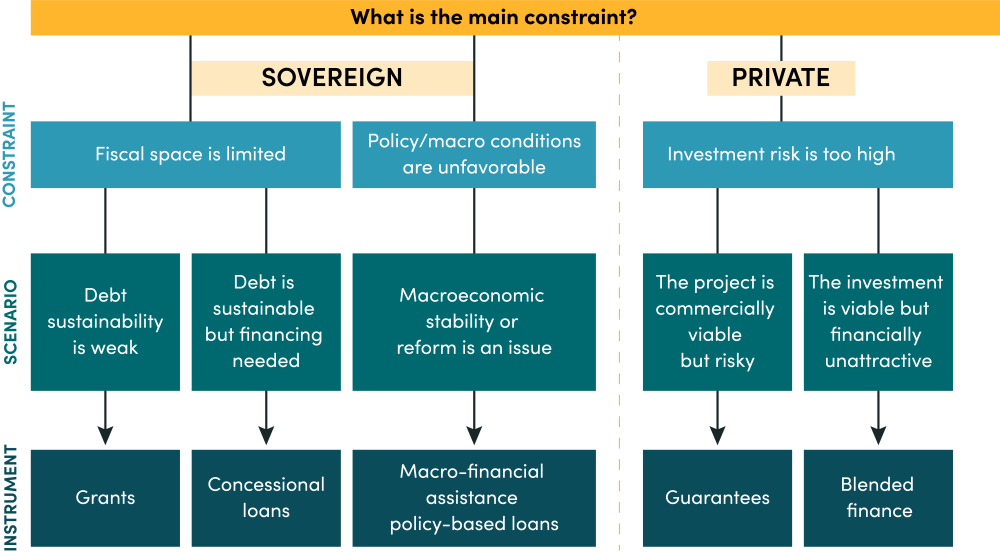
The central principle underpinning the EU financial toolbox is that public finance should address the binding constraint in each partner country while avoiding unnecessary displacement of private markets. Selecting the appropriate instrument, therefore, requires first identifying whether the key constraint relates to fiscal space, affordability of finance, investment risk, or policy and macroeconomic conditions.
As illustrated in the decision framework below, this implies a differentiated approach to instrument selection.
- Where fiscal space is limited or debt vulnerabilities are high, grants are the most appropriate instrument. In such contexts, additional borrowing may undermine fiscal sustainability.
- Where countries have borrowing capacity but face affordability constraints, concessional loans can finance infrastructure and productive investment.
- Where the key constraint relates to policy reform or macroeconomic instability, policy-based lending and macro-financial assistance provide financing linked to reform implementation and economic adjustment.
- Where viable investments exist but private investors remain reluctant due to perceived risks, guarantees and blended finance instruments can mobilise private capital.
Topics
CITATION
Gavas, Mikaela, and Laura Granito. 2026. The EU’s Financial Toolbox: Matching Instruments to Policy Objectives and Context. Center for Global Development.DISCLAIMER & PERMISSIONS
CGD's publications reflect the views of the authors, drawing on prior research and experience in their areas of expertise. CGD is a nonpartisan, independent organization and does not take institutional positions. You may use and disseminate CGD's publications under these conditions.