Recommended

Blog Post
What DFC’s 2025 Portfolio Reveals About What Comes Next

Blog Post
What a New House Bill Would Mean for DFC
When President Trump took to Truth Social in early March to announce he was tasking the US International Development Finance Corporation (DFC) with offering insurance to ships transiting the Strait of Hormuz, it thrust a spotlight on one of the agency’s lesser-known tools. DFC’s use of its political risk insurance (PRI) tool has increased in recent years (before a slowdown last year across the entire DFC portfolio) to help investors mitigate non-commercial risk—that is, political risks such as expropriation or currency inconvertibility. As PRI emerges as an increasingly bespoke US tool for anchoring debt exchanges or offering assurances to firms operating in war zones, the administration’s recent announcements raise questions about its use cases, its potential, and importantly, its limitations.
Figure 1. Insurance as a Component of DFC's Total Portfolio Exposure, FY22–FY26
What is PRI, and why does DFC provide it?
Not a new instrument, DFC’s political risk insurance was inherited from its predecessor, the Overseas Private Investment Corporation (OPIC). But the provision of PRI tends to be heavily dominated by private players—think Lloyd’s of London, AIG, or Chubb—and export credit agencies. DFC’s PRI product is unique in the bilateral development finance landscape; the Multilateral Investment Guarantee Agency (MIGA) is the only other major development finance organization to provide a comparable instrument. DFC’s mandate to go to riskier markets and pursue deals with positive development outcomes (in the form of positive social and/or economic returns for low- and middle-income countries) distinguishes its PRI from that of private investors, who are uniquely focused on their own financial return.
DFC’s PRI provides coverage of up to $1 billion to investors for losses arising from a broad range of political risks (Figure 2). The policies generally have terms of 3 to 20 years. In rarer cases, DFC reinsures licensed US or international insurance companies, effectively bolstering the overall underwriting capacity. Unlike multilateral development bank guarantees, which only provide partial coverage (generally 40 to 60 percent), PRI provides up to 100 percent coverage.
When DFC determines a claim is valid, the US government stands behind it. DFC held $6.4 billion in unobligated balances in its Corporate Capital Account in FY2025, specifically to satisfy any future insurance claims. If those balances ever run short, the agency can tap Treasury borrowing to cover what it owes.
Figure 2. PRI–How does it work?
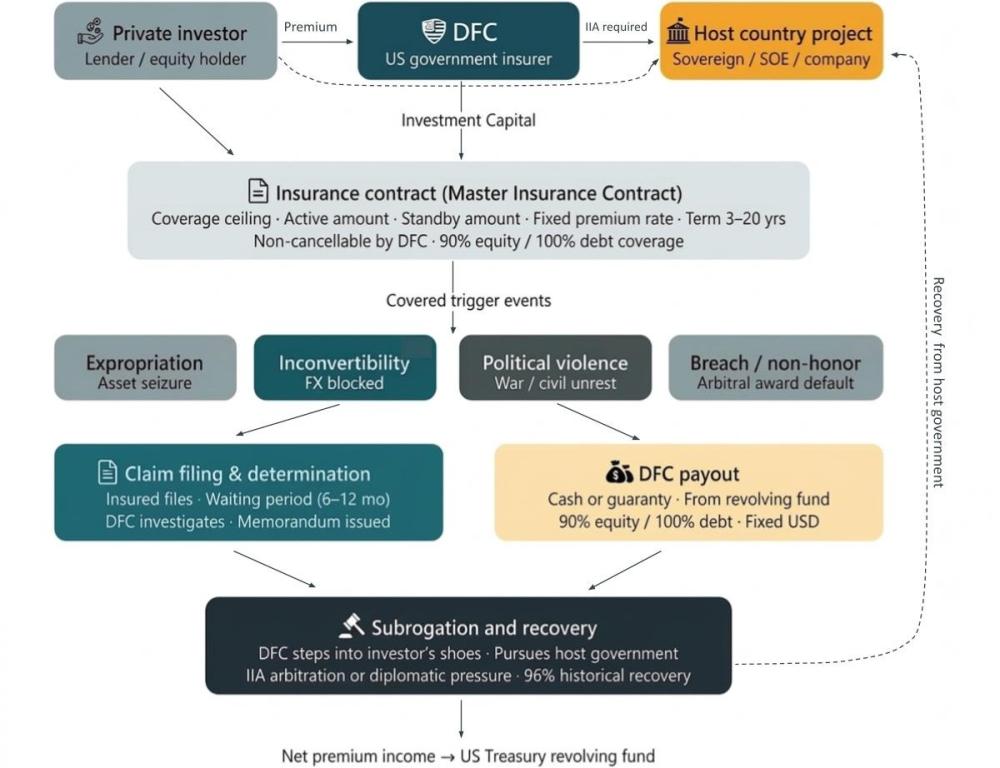
Constructed by CGD staff using Claude AI
In FY2024, DFC changed the budget treatment of PRI on debt transactions, which are now accounted for under the Fair Credit Reporting Act (as is done with the agency’s loans and loan guarantees).
DFC collects insurance premiums based on planned coverage and investment risk, amounting to nearly $1 billion in PRI-linked profits since the instrument's launch in 1971. The agency has the authority to retain the program’s proceeds and invest them in Treasury securities. As a result, in every fiscal year from 2021 to 2025, the PRI program's revenue exceeded costs, enabling it to be self-funded. This is because DFC (and OPIC) has a strong record of recovering paid claims: between 1971 and 2024, OPIC and DFC paid out 311 claims totaling approximately $1.06 billion but recovered $1.02 billion—a 96 percent recovery rate. DFC’s PRI has subrogation rights, which entitle the agency to seek reimbursement from the party responsible for triggering the insurance claim, typically the host country government.
A May 2023 McKinsey report commissioned by DFC found that DFC’s PRI exposure was concentrated in low- and lower-middle-income countries, including those with poor credit ratings, underscoring PRI’s important role in bringing private investors to markets they would likely otherwise deem too risky. In addition to bolstering confidence in an investment and helping investors reduce risk, the report highlighted the ancillary benefits that PRI can provide in these settings, including increasing a project’s valuation and attracting other investors.
According to DFC’s active project database as of December 2025, DFC had 83 active insurance projects, with the top 10 accounting for more than 80 percent of exposure (Figure 3).
Figure 3. DFC Country-Level Exposure and Active Insurance Projects as of December 2025
PRI in its element? Debt-for-nature swaps
In recent years, DFC’s PRI instrument has gained significant attention for its role in a series of debt-swap transactions in Belize (2021), Gabon (2023), Ecuador (2023 and 2024), and El Salvador (2024). In these transactions, governments were able to replace some of their external debt (generally Eurobonds trading at a discount) with cheaper debt (generally a bank loan), thereby reducing their external debt levels or debt service obligations. As part of these transactions, DFC provided PRI to the new private lenders (often via a special-purpose-vehicle intermediary) to protect them against sovereign non-payment, reducing their transaction risk and helping to make the new loan cheaper. Most of the fiscal savings generated by these transactions have been subsequently directed towards marine and other conservation projects.
Proponents of these transactions tend to see them as innovative solutions to help countries reprofile their debt and direct spending to donor priorities (The Nature Conservancy was the driver behind several of the DFC transactions). But detractors have argued that the transactions are administratively complex, expensive, and don’t always yield significant debt relief for the national government, especially when the savings are earmarked.
PRI under strain? Ukraine war risk reinsurance
Under the last administration, PRI was an important component of DFC’s footprint in Ukraine. These transactions pushed the boundaries of the PRI instrument by covering war damage rather than conventional political risks. Most private insurers had pulled out entirely after Russia’s annexation of Crimea in 2014, making DFC (and MIGA) last-resort insurers. Most transactions were not publicly disclosed, but those that were included a gas pipeline, agribusiness and manufacturing projects, healthcare, higher education, and a domestic reinsurance program.
Nevertheless, these deals remained relatively small as a share of DFC's portfolio and appeared backed by a genuine development rationale. Still, it’s not clear whether private reinsurers were crowded in.
PRI at its limits? The Strait of Hormuz
In the wake of President Trump’s Truth Social post in early March, DFC quickly moved to affirm it was up to the task, promising up to $20 billion in reinsurance, provided on a rolling basis to vessels that meet certain criteria—with an initial focus on hull and cargo, coordinated with CENTCOM. On March 11, the agency announced that Chubb would serve as the lead partner for the facility aimed at restarting commercial shipping through the Strait of Hormuz. Then on April 3, DFC announced that six additional American reinsurers would join, providing an additional $20 billion in coverage.
While $20 billion represents a very large commitment by DFC, which had total exposure of just over $42 billion at the end of the first quarter of FY2026, it would fall well short of the need, according to energy analysts at J.P. Morgan. They estimated that roughly 329 vessels were operating in the Persian Gulf, and that each would require “oil pollution, salvage, hull, and third-party liability insurance, implying about $352 billion of maximum insurance coverage.” Though top administration officials were quick to criticize the assessment, DFC has not released a comprehensive plan for how it would select projects or price the instrument.
Ultimately, the program is more showmanship than effective market signaling. Even the coverage DFC announced is a drop in the bucket compared to actual financing requirements and would not jumpstart commercial shipping absent a ceasefire.
Moreover, given the high likelihood of a payout, the pricing of such an instrument would be prohibitively expensive—and ultimately, US taxpayers would end up holding the bag for billions in claims, since subrogation would be impossible to enforce against Iran.
What to take away? Stick to your knitting
We like DFC going to markets where the private sector has pulled out and playing an “insurer of last resort " role, but the Strait of Hormuz isn’t that. Instead, the high-profile program could direct agency attention and resources to a problem it simply isn’t equipped to solve.
DFC’s PRI is most powerful when US backing does real work: deterring bad behavior, enabling diplomatic resolution, and, where feasible, providing credible leverage for recovery. In kinetic conflict with adversarial states, it is our view that none of those mechanisms is going to be responsive to the crisis at hand.
Topics
DISCLAIMER & PERMISSIONS
CGD's publications reflect the views of the authors, drawing on prior research and experience in their areas of expertise. CGD is a nonpartisan, independent organization and does not take institutional positions. You may use and disseminate CGD's publications under these conditions.
Thumbnail image by: Darren/ Adobe Stock