Recommended
The World Bank’s WHR has delivered real results for refugees in its first eight years. With IDA22 talks now underway, the WHR could enhance its impact even more with targeted reforms.
The World Bank’s Window for Host Communities and Refugees (WHR) was launched in 2017 to address major challenges in the way the international community responds to refugees.
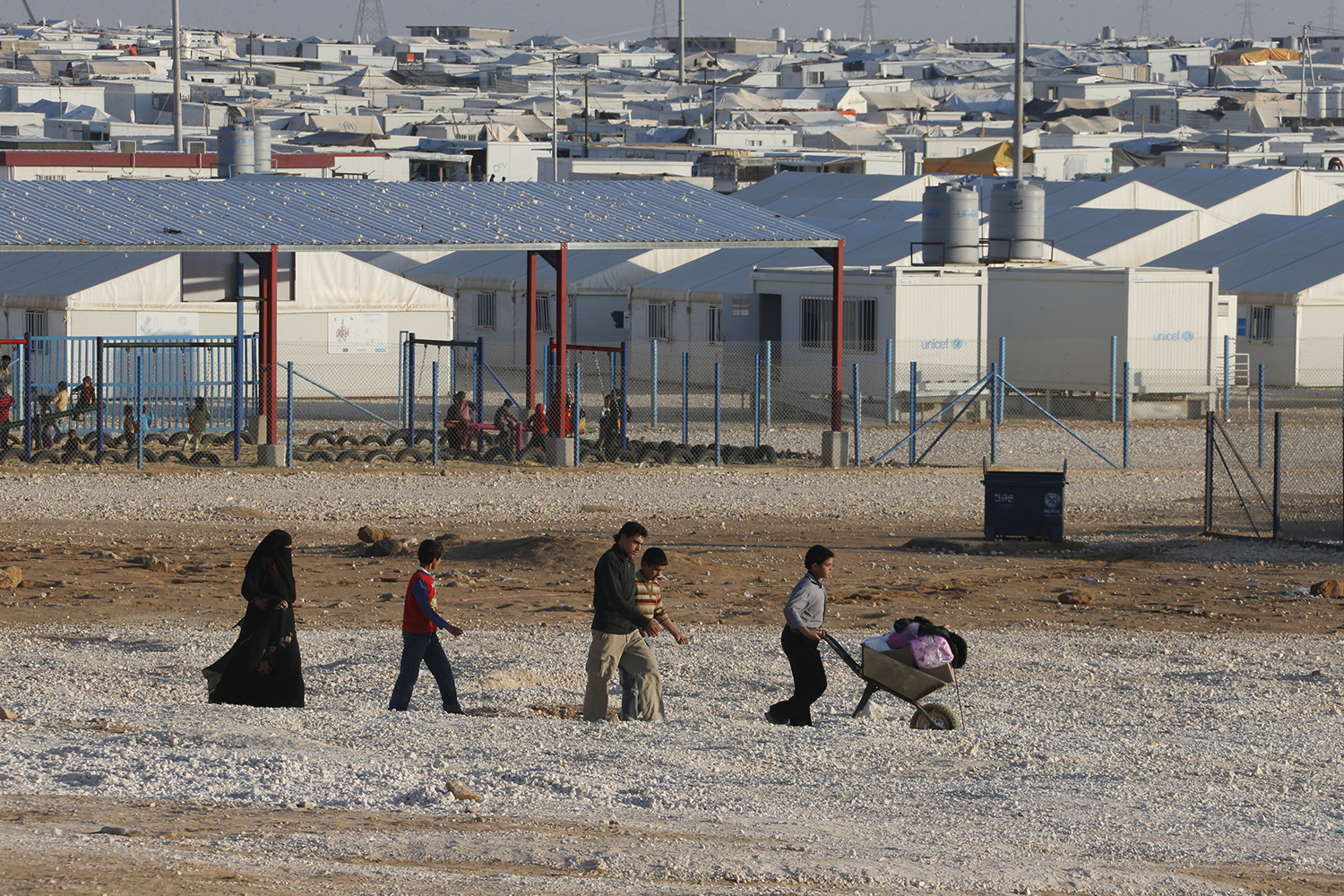
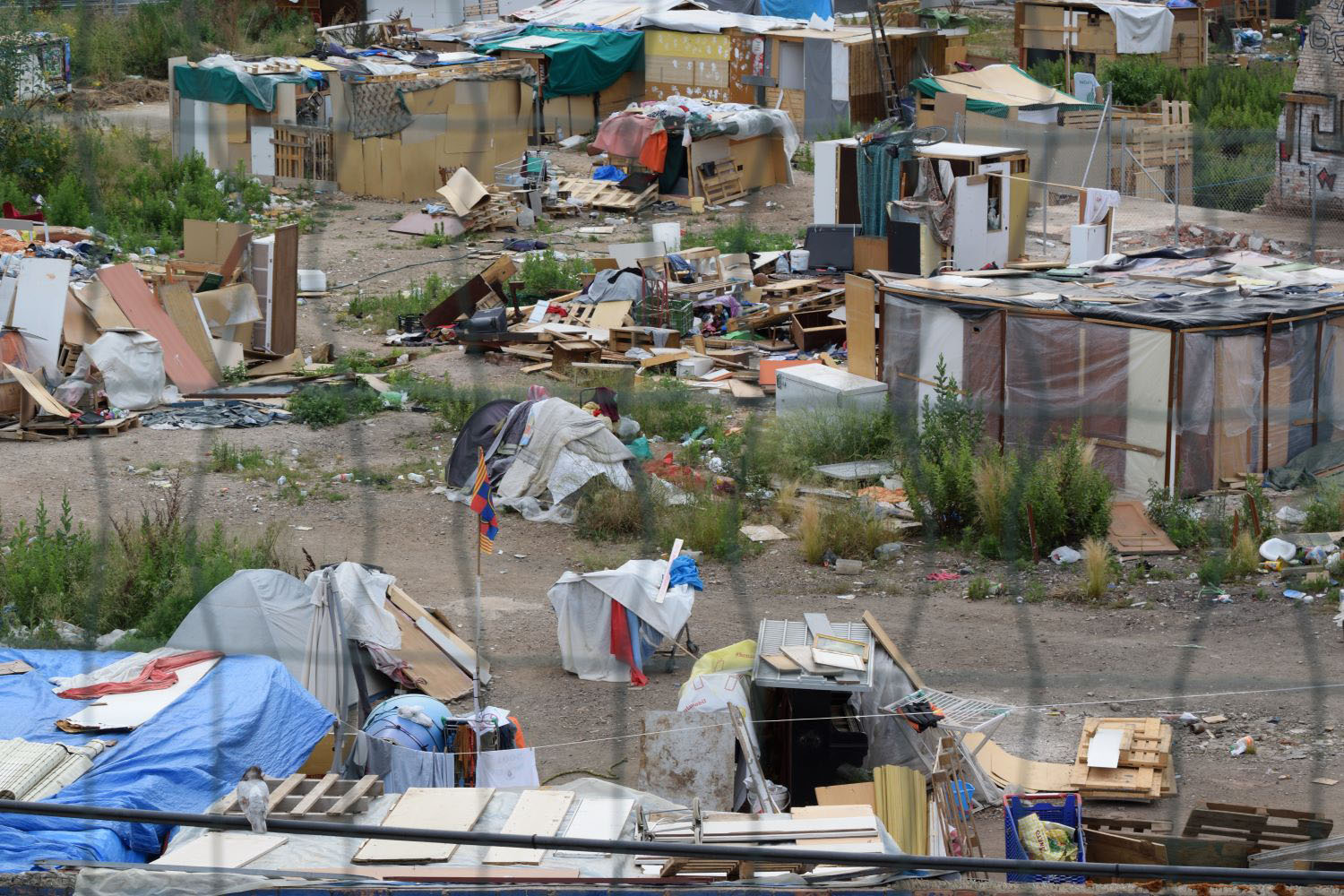
Many of the world’s 40 million refugees have lived in low- and middle-income countries for decades but are restricted from working and supporting themselves. In part because of these restrictions, the response is often short-term: emergency food aid, temporary shelters, parallel service delivery.
This approach must change. It violates refugees’ rights and international law; barely meets refugees’ basic needs—something which will become even more difficult in the wake of aid cuts—wastes scarce aid resources; and undercuts the economic benefits that refugees could bring to host countries.
The WHR therefore provides grants and concessional loans to low-income countries hosting significant refugee populations. Its goal is to move beyond short-term humanitarian aid towards medium- and long-term development solutions—both in terms of inclusive policies and development projects aiming for long-term returns—that integrate refugees into labor markets and national services while supporting host communities.
Our new paper asks a fundamental question: Is the WHR the right model to accomplish this goal? Drawing on 33 interviews and analysis of its 100 projects, we explain the WHR’s structure, how it differs from most other financing, and its impact over the first eight years. We argue the WHR’s model is strong and progress is significant.
At the same time, the WHR has missed important opportunities to accomplish more. As leaders gather next week for the World Bank’s Spring Meetings, we outline what management, staff, and the Board of Directors should do for the WHR to realize its full potential.
What is the WHR?
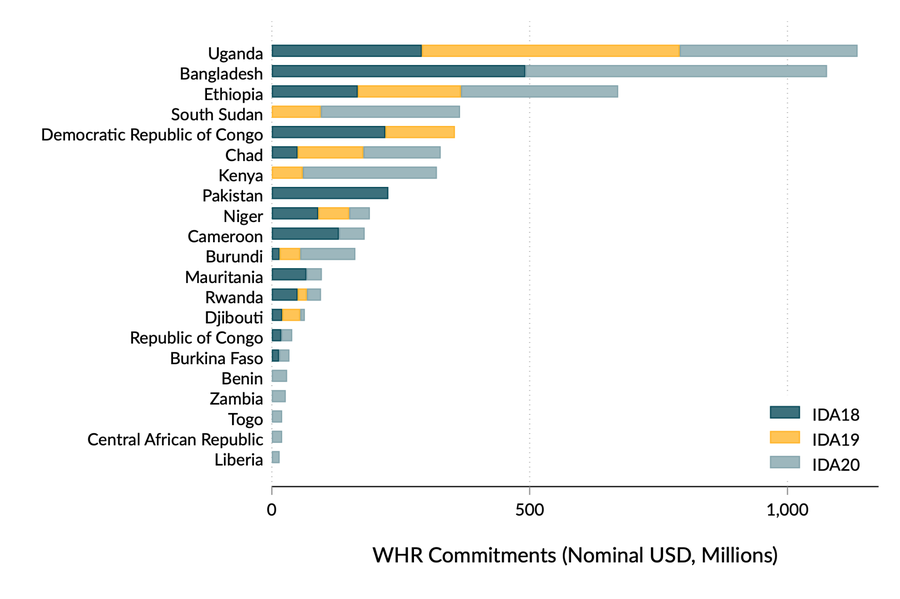
The WHR is a dedicated pot of IDA financing for low-income countries that meet three criteria: host at least 25,000 refugees (or 0.1 percent of the population); have an adequate protection framework; and put forth an action plan for advancing refugee inclusion. Through its first three cycles (IDA18, IDA19, and IDA20), the WHR committed $5.5 billion across 100 projects in 21 countries (Figure 1). These countries host 10.3 million refugees, 26 percent of the world’s total.
Figure 1. WHR commitments by country and IDA cycle
Source: Data shared by the World Bank
The World Bank is the largest provider of finance for development programs—and the third largest overall—supporting refugee situations globally. Within WHR countries, the WHR accounts for 44 percent of all refugee financing for development projects. Over 85 percent of WHR commitments go to long-term development and peace initiatives (compared with one percent of US bilateral aid for refugees), enabling sustained investment in livelihoods, education, and healthcare.
Under IDA21, the WHR is a sub-window under the new Global and Regional Opportunities Window (GROW). The allocation is the same as IDA20—$2.4 billion—but a policy commitment to secure “significant reforms” in 60 percent of eligible countries has been dropped. However, a new Policy and Procedures Framework articulates the same general priorities: (1) support policy and institutional measures that reduce external assistance over time, such as jobs and increased self-reliance for refugees; and (2) include refugees in national systems like healthcare and education.
How is the WHR different?
Restrictive hosting environments can emerge because of a commitment problem. Host governments worry donors will go elsewhere if refugees are integrated, and they will be left responsible for the costs of inclusive policies.
The WHR addresses this directly. It’s one of the first instruments to formalize a credible, medium-term financial commitment for host governments. In exchange, it pushes for more inclusive policy environments, leading to long-term returns for refugees and more effective aid spending. It presents host countries with a policy bargain: sharing some of the medium-term gains of transitioning from a humanitarian to a development response with the host government and host communities.
The WHR differs from traditional humanitarian assistance in three key ways:
- Medium-term commitment. The average WHR project is five years—far longer than typical humanitarian cycles—giving host governments stability to plan and act.
- Financing via governments. 96 percent of WHR disbursements flow through host governments (compared with 16 percent of all refugee assistance)—giving host governments ownership, benefits, and a seat at the table.
- An explicit policy lever. Unlike humanitarian aid, WHR funds can be tied directly to reforms such as new refugee laws or the issuance of work permits.
As part of the World Bank model, host governments own WHR projects. This is essential for a long-run development outlook and has clear benefits. For instance, financing for refugees can go through ministries rather than a refugee-specific agency. We encountered multiple examples where sectoral ministries like education and health were more open to reform because financing was available.
However, government ownership also represents real risk. Refugee inclusion is a politically sensitive topic in many places—more so than most World Bank initiatives. To accomplish the WHR’s goals, host governments often need strong, explicit incentives, monitoring, and regular dialogue and engagement.
The WHR represents a large share of the resources—and therefore leverage—of international financing for refugees. However, WHR resources represent only four percent of total IDA commitments in WHR countries. Country Management Units therefore have little incentive to actually use this leverage. Across our interviews and across contexts, stakeholders noticed. We offer recommendations for better use of this leverage below.
What impact is it having?
The WHR model targets a number of potential avenues for impact. The most ambitious and unique approach is through incentivizing policy changes for greater de jure and de facto inclusion. The World Bank notes it achieved its policy commitment from IDA20—of the 17 countries that were eligible for the WHR at the beginning of IDA20, 12 undertook “significant reform.” In the paper, we look at three prominent examples—new refugee laws in Ethiopia, Chad, and Kenya—and argue that the impact of the WHR was substantial.
We also document a number of other accomplishments, including progress—though slower—on the de facto implementation of these new laws; inclusion in national social protection, healthcare, and education systems; direct impacts on refugees’ and host communities’ well-being; and indirect impacts on how refugees are viewed within host and donor governments.
How could the WHR be even more effective?
Despite real successes, the WHR is not fully maximizing its impact. With donor budgets tightening and humanitarian needs growing, the following reforms are essential:
- Push harder for policy change. Inclusive environments—especially freedom of movement—are a medium-term investment and will make subsequent financing more effective. Country Management Units should receive more support and pressure from World Bank management and the Board of Directors to use its leverage, which requires regular, concerted engagement from World Bank staff.
- Link some allocations to policies. To create a real incentive for reform, some financing should be reserved for countries with inclusive environments or policy momentum. In practice, we find the opposite: the most restrictive WHR countries have received higher commitments per refugee than those with more inclusive practices (Figure 2). This is an unintended outcome of the current model, which allocates financing at the regional level, but further supports our call for change. More financing should be retained centrally to invest in the most promising opportunities.
Figure 2. WHR commitments by de facto work rights and access to services
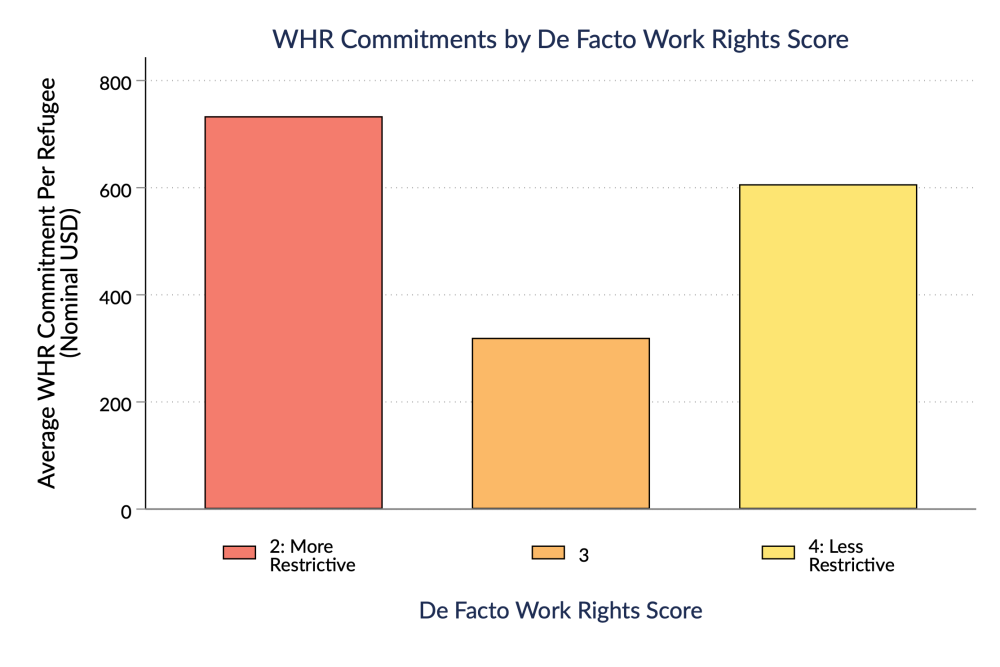
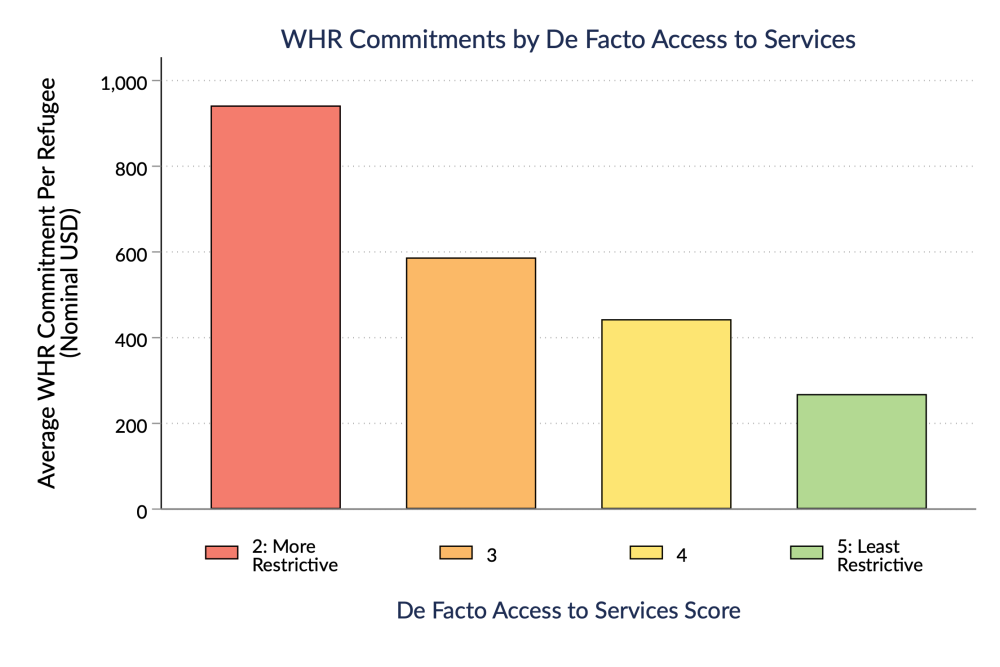
Sources: Data shared by the World Bank on WHR commitments across IDA18, IDA19, and IDA20. Scores on de facto work rights and access to services are from Ginn et al. (2022). Refugee population data are from UNHCR.
- Link disbursements to results. The use of Program-for-Results and Development Policy Financing instruments should be expanded, linking payments to measurable refugee outcomes, including jobs, work permits, residence outside of camps, school enrollment, and the passage of new policies.
- Focus on reducing needs. Investments in jobs and economic self-reliance should be the top priority. This aligns well with the World Bank’s jobs agenda. Healthcare, education, and social protection through national systems should be the next priority. Investments in short-term parallel systems should be minimal.
- Invest in the right people. Dedicated staff like Forced Displacement Coordinators support Task Team Leaders and Country Management Units with ongoing policy dialogues. Funding more of these positions is the best investment the Board of Directors can make in the WHR.
- Improve external collaboration. Meaningful ongoing discussion with in-country refugee stakeholders is often missing. Regular engagement with the sector and formal review mechanisms are critical for ensuring projects maximize benefits.
- Communicate more intentionally. Informing host communities about the benefits refugees bring can significantly improve social cohesion. More transparency about its successes would build the case for the WHR internally and with donor governments.
Moving forward
Aid cuts are forcing the conversation on the optimal approach to protracted displacement. In this environment, the WHR will also face more pressure to meet short-term needs. It must instead remain focused on its critical mandate to address medium- and long-term development solutions, in line with the World Bank’s jobs agenda, while remaining open to changes that could further maximize these resources for refugees’ well-being.
The upcoming Spring Meetings are therefore an important moment to take stock of the WHR’s substantial progress and, with the discussions on IDA22 already underway, examine ways the instrument can accomplish even more.
Topics
DISCLAIMER & PERMISSIONS
CGD's publications reflect the views of the authors, drawing on prior research and experience in their areas of expertise. CGD is a nonpartisan, independent organization and does not take institutional positions. You may use and disseminate CGD's publications under these conditions.
Thumbnail image by: UN Women/Allison Joyce