Recommended

Blog Post
Are The Kids Even Attending School?

Blog Post
Beyond Measuring Teacher Time on Task: Increasing It
In the wake of the COVID-19 pandemic, many education systems around the world recognized high rates of student absenteeism as a critical and enduring challenge. In the 2022-2023 school year, for example, almost one-third of all children in the US were chronically absent, with state-level rates as high as 47 percent. In India, more than one in four students are absent on any given day. High rates of student absenteeism are a challenge in many countries around the world.
These frequent student absences likely limit the effectiveness of any education intervention. Supporting teachers to teach more effectively? Providing in-school computer-assisted learning? These and other investments will likely fall far short of their potential if students consistently miss days in the classroom. For example, a randomized controlled trial in Chile found that a teacher professional development program improved classroom quality well after the program concluded, but students’ learning outcomes remained unchanged. It turns out the impact on students was almost entirely moderated by their attendance: only students with few absences gained from the program.
Building on previous work we’ve done both on how student attendance is a bellwether for broader data quality challenges and on how to measure it, we are excited to share about a new project focused on student absenteeism. We invite you to share any relevant work of your own!
The challenges
Student absenteeism is measured in many ways, but across methods, a consistent finding emerges: absenteeism is prevalent. For example, survey data from enumerators’ scheduled visits to schools show that across eight African countries, student absenteeism rates range from five percent in Morocco to 56 percent in Mozambique. (And those rates may still be lower when no outside visits are scheduled!) Self-reported student data also suggest high rates of absenteeism: in some areas of Uganda, more than 60 percent of students report being absent for at least one day in the previous week.
But while these data highlight that student absences are a major challenge, they are also rare and limited: they don’t tell us which students are chronically absent, whether there are days, seasons, schools, or regions where students are at high risk of missing school, or whether parts of the day are particularly high risk. They are generally from one-off surveys, so there is no way to know whether attendance is getting better or worse over time. Our experience working with governments suggests that schools’ daily data collection efforts are often incomplete and inaccurate.
Better routine data on student absences are crucial for many reasons. Chronic absenteeism can be a leading indicator for high risk of dropout or grade repetition. It also likely affects the effectiveness of interventions to improve education (like the Chile example above), but potentially not always in the same way. For example, school meals interventions may boost attendance among more food-insecure students, whereas better pedagogy may boost attendance among more motivated students. Some interventions may require more consistent attendance than others. Understanding patterns of attendance and how they interact with other efforts to improve schooling are fundamental to understanding how to help students thrive in school.
How to address the challenge: What we have planned
We are starting a research project to address the data challenge and improve how absenteeism is measured and understood. First, we will review existing impact evaluations of interventions to improve schooling outcomes in low- and middle-income countries to assess whether and how studies measure absenteeism, what approaches they use, and whether they analyze if program impact is moderated by attendance rates. We will synthesize these findings to provide a clearer picture of the current state of the evidence on absenteeism.
Second, in a sample of 80 government schools in Malawi, we’ve begun examining how schools currently monitor student attendance. While all the schools in our sample reported monitoring student attendance, our observations showed that fewer than half had a completed attendance registry for the past three days (Figure 1). The data we are already collecting will help us understand current challenges and test potential solutions.
Figure 1. Most schools do not complete the attendance registry daily
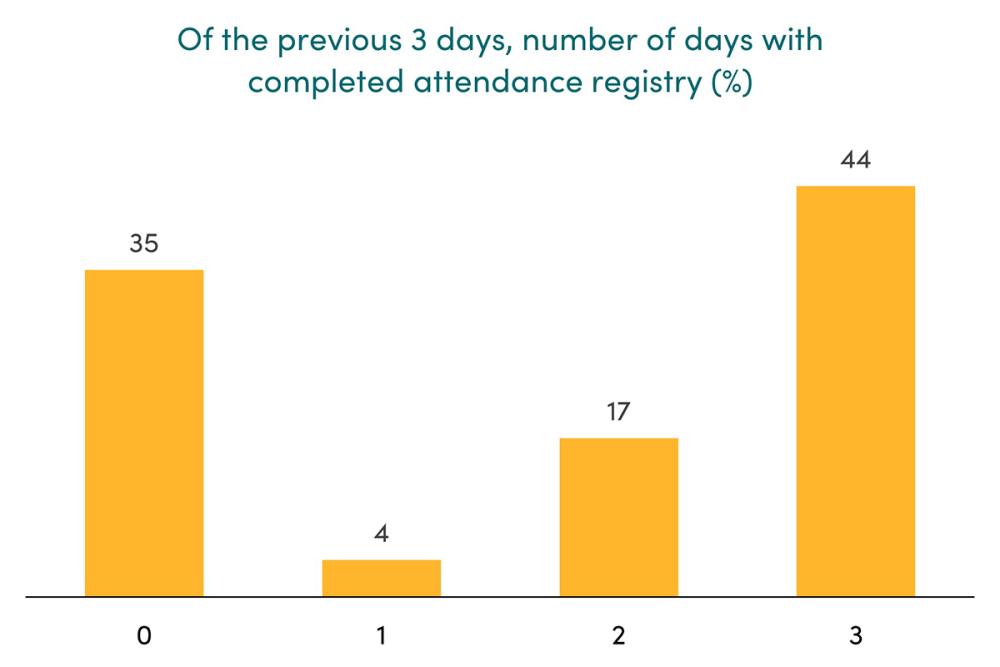
Source: Authors’ analysis of data from a sample of government schools in Malawi.
Third, we will explore ways to improve attendance monitoring. This includes testing different approaches (such as simple headcounts versus roll calls), assessing how long each method takes, and exploring whether it is feasible (and insightful) to measure attendance at multiple points during the school day. We plan to test how best to support schools in their own efforts to measure absenteeism in ways that are both feasible and actionable.
Finally, we will use these insights to include measurement of student absenteeism as a key moderator in the analysis of an upcoming study of an intervention to improve foundational skills in Malawi. Then, we will share what we’ve learned to inform efforts to improve attendance monitoring in other contexts.
If you’ve worked to monitor student attendance and measure absenteeism in a low- or middle-income country, we would love to hear from you! We are interested in compiling best practices and lessons learned across different contexts, along with insights to help draw attention to this critical and often overlooked issue. Please reach out to us via this form if you’d like to share!
Topics
DISCLAIMER & PERMISSIONS
CGD's publications reflect the views of the authors, drawing on prior research and experience in their areas of expertise. CGD is a nonpartisan, independent organization and does not take institutional positions. You may use and disseminate CGD's publications under these conditions.
Thumbnail image by: Raushan_films/ Adobe Stock