The world of work is at an inflection point—changing faster than arguably any other time in modern history. Three major transitions are converging simultaneously: technological transformation driven by artificial intelligence, deep demographic shifts, and the demands of the green economy. These are not additive pressures. They are multiplicative. And at the center of all three sits the same critical variable: skills.
These tectonic shifts are a vast opportunity for better policy. In this blog, we team up with H.E. Marina Elvira Calderone, Minister of Labour and Social Policies from Italy, to offer three ways forward. Michael Clemens makes the case that demographic collapse across OECD countries leaves no real choice but greatly enhanced skilled labor migration. He argues that Global Skill Partnerships, bilateral agreements that train workers in origin countries for jobs in destination countries, can make that migration work better for everyone.
Helen Dempster shows that the cross-border friction such partnerships have always faced—translating credentials, mapping qualification frameworks, verifying skills—can now be reduced dramatically by AI tools, provided they are regulated rather than blindly trusted. And Minister Calderone describes what this looks like when a government takes it seriously: Italy is pairing domestic skills infrastructure with bilateral partnerships through the Mattei Plan and a deliberately human-centered approach to AI in the labor market.
The common thread is straightforward. The future of work is a skills story, and getting it right requires demographic honesty, AI used carefully, and cooperation that pays off on both ends of the migration corridor.
Michael Clemens:
How would you regulate immigration if it weren’t optional?
By 2050, the prime working-age populations of OECD countries will have shrunk by more than 92 million people, while their populations over 65 years old will have grown by more than 100 million people. To maintain the current ratio of workers to elderly in 2050, OECD countries will need 400 million more workers.
Many OECD countries are refusing to confront this demographic collapse, instead moving through the five stages of grief:
- Denial: the idea that societies don’t need workers anymore, just a handful of owners of capital on couches served by an army of tender, empathetic robots.
- Anger: demands that military squadrons round up child-care and construction workers.
- Bargaining: pushing ineffective “cure-alls” like pronatalism and elderwork.
- Depression: simply accepting a darker, more authoritarian, more chaotic future.
It doesn’t have to be this way. We could proceed now to the fifth stage:
- Acceptance: innovating, promoting, and implementing models which link the global labor supply with demand, in ways that are lawful, controlled, and skilled, with an equitable allocation of costs and benefits.
One such model is the Global Skill Partnership, a model I proposed in 2012 (Figure 1). A GSP is a bilateral agreement for skilled, employment-based, permanent migration from a lower-income country to a higher-income country, in which the destination country gets actively involved in supporting the training of migrants and non migrants inside the origin country.
Figure 1. The Global Skill Partnership model
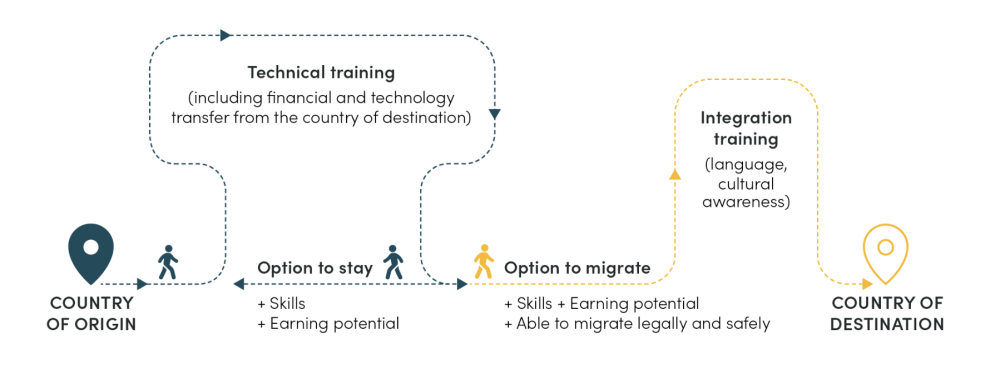
Destination countries get the workers they urgently need, with tailored skills, often leveraging the fiscal savings from training these workers in a different jurisdiction. Instead of “brain drain”, origin countries get more human capital and public finance, not less. And migrants and their families get the enormous professional and life opportunities guaranteed them by the right to emigrate under the Universal Declaration of Human Rights.
The Global Skill Partnership model is not ‘more migration’. A GSP changes what migration is.
Helen Dempster:
GSPs face many practical challenges, especially at scale. What is new in 2026 is that AI can now absorb most of the credential-recognition, framework-mapping, and skills-matching costs that have historically made this model slow and expensive to build. That is why much of what follows is about how to use those tools well.
The Global Skill Partnership model was designed to ensure that skilled migration doesn’t contribute to “brain drain” in origin countries, but instead leverages the financial contributions of destination countries to expand the global stock of skilled workers. From nursing to engineering to cyber security, some skills are needed everywhere. But to be used everywhere, they must be recognized everywhere.
These skills are often taught by technical and vocational education and training (TVET) providers, yet such providers have a poor track record. Meta-analyses have found that less than a third of TVET interventions have positive, significant, impacts on employment rates and earnings, with some interventions yielding no returns at all.
We recently argued that TVET providers could have a greater impact if they placed some of their trainees abroad. In many ways, this is the reverse of the current model: instead of providing training as a part of projects which facilitate labor mobility; provide mobility opportunities as a part of training-focused projects. Donors should support these providers in doing so: improving TVET outcomes, while also supporting employers and economic growth in high-income countries.
But practically how can this be done?
In one of our papers, we outline nine different options in two different buckets: align training content and quality with employer needs; and recognize certifications and qualifications. AI tools are already supporting the implementation of these nine options, and will increasingly be able to support the movement of skills across borders (Figure 2). Let’s take four examples.
Figure 2. Using AI to Support Skills Recognition
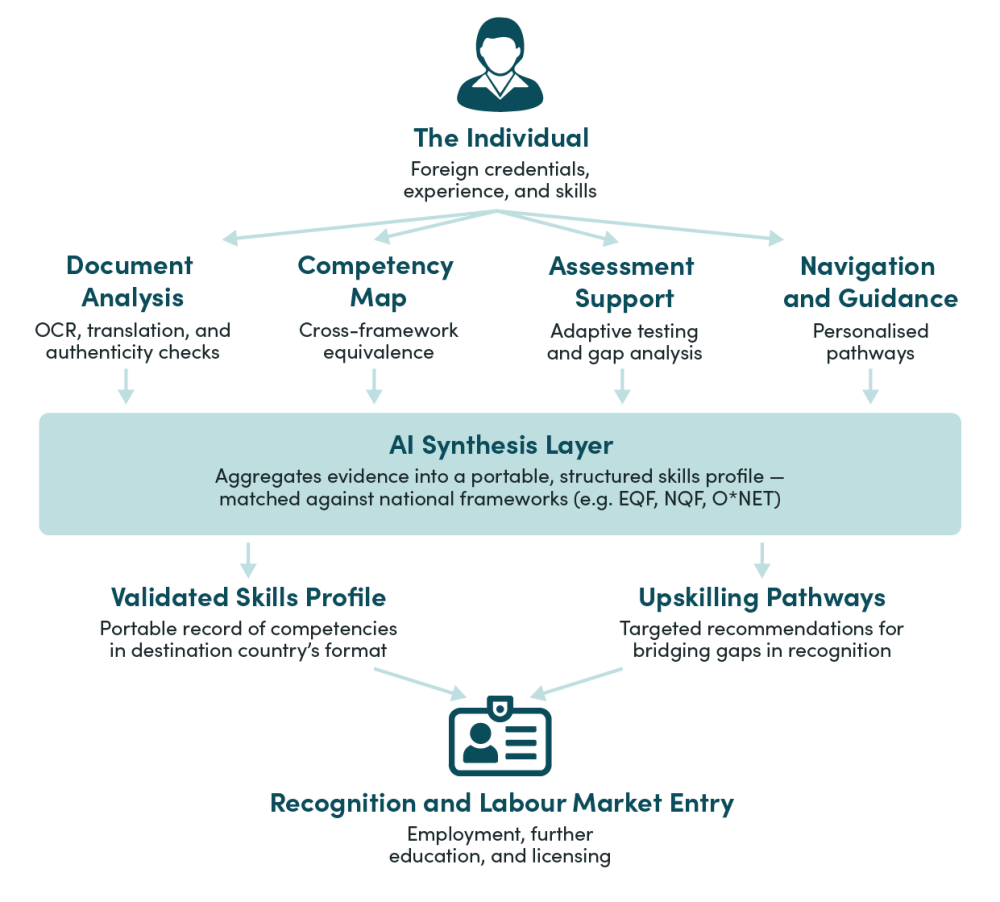
Firstly, AI tools can be used to support the recognition of an individuals’ skills. They can recognise and translate qualification documents, flag anomalies that might indicate fraud, and ensure that the training institution is valid and reputable. This can reduce the often months-long qualification recognition bottleneck that faces many skilled workers. They can also develop competency-based assessments (such as adaptive questions and simulation-based tests) to support candidates who may not have sufficient documentation (such as is often the case for skilled refugees).
Secondly, AI tools can map qualification frameworks, identifying similarities and differences. Different countries use different qualification frameworks, such as the European Qualifications Framework (EQF), National Qualifications Frameworks (NQF), or occupation taxonomies such as O*NET. These differences between these can create inefficiencies across borders, making mobility harder and more expensive. Yet AI can map someone’s individual qualifications onto the relevant local framework, identifying what is equivalent and what falls short. They can also help origin countries identify where they may need to improve the quality of particular programs, to meet international standards.
Thirdly, they can help the development and implementation of “Skills Passports”. Skills Passports are digital or physical records that consolidate someone’s qualifications, competencies, and work experience. They provide verified, portable proof of skills, enabling employers to easily recognize competencies and facilitate mobility. The European Commission is already pushing a “Skills Portability Initiative”—using AI tools effectively will make the implementation of this initiative much easier.
Of course, using such tools is not without risk. Given they leverage publicly available information, AI tools will bias towards certain countries with more developed skills systems and struggle with more niche languages. They should therefore be used to inform decisions as to the verification of someone’s skills, but should never be the final arbiter; additional safeguards and regular auditing must be put in place. It is incredibly important that destination countries, such as Italy, recognize the potential benefit of such tools but also put in place structures to regulate them, helping to expand the global stock of skills and skilled labour migration.
H.E. Marina Calderone, Minister of Labour and Social Policies:
The Case of Italy
Italy's experience navigating this convergence offers lessons that extend well beyond its borders, particularly for policymakers grappling with the twin imperatives of keeping domestic labor markets functional while managing international talent flows responsibly.
A country shaped by its demographics
From a demographic point of view, Italy is the oldest country in the European Union and the second oldest in the world, after Japan. Its birth rate is among the lowest globally. Each year, fewer young people enter the labor market, driving negative youth employment growth, while the elderly population grows more rapidly, contributing to an aging workforce. Of the approximately 24 million workers currently active, no fewer than three million are expected to retire over the next five years.
This is not a future scenario, it is happening now. And it shapes every labor market choice the Italian government makes. When the quantity of available labor shrinks, the quality of that labor, its adaptability, its skills, its productivity, must grow to compensate.
The lesson here is straightforward: skills are no longer just a social good. Skills are the foundation of economic growth.
The mismatch problem
Italy currently faces a structural skills mismatch that no amount of job creation alone can solve. Nearly 44.6 percent of the professional profiles businesses seek are difficult to fill, nearly one in two profiles. Over the second quarter of 2026, Italian companies are expected to need 1.6 million vacancies. The jobs are there. The skills, in many cases, are not.
This mismatch falls unevenly. Women over 40 with lower educational attainment, particularly in Italy's southern regions, represent a significant share of labor market inactivity. The problem, then, is not purely one of opportunity supply — it is one of preparation to seize those opportunities.
Italy's policy response has moved deliberately away from passive income support and toward active labor market policies that integrate training, digital tools, and personalized inclusion pathways. The New Skills Fund supports continuous training within firms. The digital platform SIISL (the Information System for Social and Labour Inclusion) connects citizens' professional profiles with job opportunities and training pathways, using AI-driven matching tools to generate affinity indices between individual skills and real labor market needs. The EDO program (Digital Education for Employment) has provided basic digital skills to over 100,000 people in a few months, more than half of them women, with a target of one million by the end of 2026.
These are not pilot programs. They constitute an integrated architecture and a deliberate shift in how the state engages with both job seekers and employers.
Governing AI, not chasing it
Italy's framing of the AI challenge is deliberate: the real risk is not that machines become too intelligent, but that humans stop exercising their own judgement by delegating decisions to systems that process information without genuine understanding or accountability. The governance response must be human-centered, in line with the G7 Action Plan for a human-centered development and use of safe, secure and trustworthy AI in the World of Work, adopted in Cagliari (Sardinia) in 2024.
Italy's Law 132 of 2025 aligns national law with the European AI Act, introducing transparency obligations, risk assessment requirements, and worker protections. A permanent Observatory on the Adoption of AI in Work has been established at the Ministry of Labour and Social Policies: not a consultative forum, but an operational body that monitors AI's effects on employment, identifies exposed sectors, and updates policy in real time. The AppLI platform, a multilingual public AI coach, allows individuals to define training pathways, draft CVs, and simulate job interviews, directly integrated with SIISL.
The message for other governments is simple: AI adoption in the labor market cannot be left unmanaged. Without active governance, it becomes a driver of exclusion rather than growth.
The global dimension: skill partnerships
Italy's experience with Global Skill Partnerships represents a relevant experience for development policy.
The broader framework, the Rome Process, is Italy's reference architecture for structured cooperation with Mediterranean and African partner countries. It is accompanied by the Mattei Plan, which identifies education and training as the foundation for human capital development in partner countries, promotes legal mobility channels, and aims explicitly at countering irregular migration and human trafficking through the creation of legitimate alternatives.
Over the period 2023–2025, Italy concluded bilateral agreements and memoranda of cooperation on international labor mobility with countries across Asia, Africa, and Latin America. Flow decrees — three-year instruments for planning the entry of foreign workers — have reserved dedicated quotas for these partner countries, with nearly 500,000 quotas envisaged for 2026–2028. From 2024 to today, 101 projects in 29 countries have been approved to train approximately 10,000 workers in sectors facing acute labor shortages.
Critically, this model allows trained workers to be employed either in Italy or in Italian companies operating in their countries of origin — including through autonomous entrepreneurial ventures. The key word is skills. Italy is not simply relying on labor inflows: it is co-investing in capacity, with the explicit aim of generating value both at home and in partner countries.
Conclusion
The future of work is a skills story. Not a technology story, not a migration story: a skills story, with technology and mobility as instruments. Italy's experience over the past several years, building active labor market infrastructure, governing AI adoption deliberately, and developing structured international partnerships, is an early iteration of what many countries will need to do.
The stakes are high. As the Anthropic Economic Index has noted, those who begin adopting AI earlier accumulate self-reinforcing advantages. The same logic applies to countries and to policy systems. Governments that build coherent skills ecosystems now, integrating domestic training, digital infrastructure, and international cooperation, will be better placed to manage the transitions ahead.
Work is not merely an economic variable. It is a constitutive element of social life, individual dignity, and collective progress. Getting skills policy right is not just good economics. It is a matter of social justice.
Notes:
On April 16, H.E. Marina Elvira Calderone (Minister of Labour and Social Policies, Italy) was due to speak at an event at Georgetown University with Professor Shanta Devarajan, Iffath Sharif (Global Director for Social Policy, World Bank), Michael Clemens, and Helen Dempster. Unfortunately, the event could not take place as planned, due to unexpected institutional commitments; but this blog provides a summary of the insights we intended to share.
This blog was edited with assistance from AI and reviewed by the authors and a human editor before publication.
Topics
DISCLAIMER & PERMISSIONS
CGD's publications reflect the views of the authors, drawing on prior research and experience in their areas of expertise. CGD is a nonpartisan, independent organization and does not take institutional positions. You may use and disseminate CGD's publications under these conditions.
Thumbnail image by: Adobe Stock Images