Recommended
CGD NOTE
Climate Vulnerability and Fragility
WORKING PAPER
Climate Finance Allocations and Vulnerability
Blog Post
US Aid Cuts Fueled Conflict in Africa

The intersections between conflict, fragility and climate risk are increasingly recognised and documented, yet climate adaptation finance remains insufficient in the places where people face the greatest combined risks.
The geopolitical landscape is shifting into what the International Rescue Committee (IRC) describes as a “New World Disorder,” marked by fragmentation, eroding multilateral cooperation, and declining political will to address shared challenges like climate change and poverty alleviation. These dynamics threaten to compound intersecting threats, exposing crisis affected communities to greater risks and more shocks with fewer shock absorbers.
Previous CGD analysis shows that least developed countries (LDCs) and low income countries (LICs) are more vulnerable than Small Island Developing States (SIDS), and that adaptation finance is poorly aligned with actual vulnerability to the impacts of climate change.
New CGD analysis in partnership with the IRC now zooms in on countries affected by conflict and fragility, identifying an even starker mismatch between climate finance and vulnerability.
Countries impacted by fragility and conflict, and especially those that are conflict-affected, emerge as among the most climate-vulnerable and among the least supported by climate adaptation finance.
What do climate vulnerability indices tell us?
We find that despite using different methodologies, climate vulnerability indices converge around a consistent pattern: conflict-affected countries are among the most climate-vulnerable group of countries. Countries affected by conflict and fragility based on the World Bank classification (FCS) are more vulnerable than both LDCs and SIDS, with those classified as conflict-affected more vulnerable than the FCS group overall.
Conflict-affected countries consistently rank lower on average across indices (ie. as more vulnerable) compared to LDCs and LICs. The chart below displays the average rank (out of 140, with 1 representing greatest vulnerability) of countries at three different levels: overall risk, vulnerability and exposure. Sixteen out of eighteen (89 percent) conflict-affected countries are among the countries most at risk, appearing in the top 25 percent ranked according to an average of all indices. 17 out of 18 (94 percent) feature in the top quartile when focusing on climate vulnerability. This means well over 90 percent of FCS populations (and nearly 100 percent of FCS-conflict populations) live in countries that feature in the top quartile countries at the overall risk and vulnerability levels.
When applying the broader OECD “States of Fragility” (SoF) classification, we find these countries have similar levels of vulnerability to LDCs overall. The 17 SoF countries exposed to extreme fragility are on par with the FCS-conflict group (with 11 countries being common to both groups).
Fig 1. Average Rank
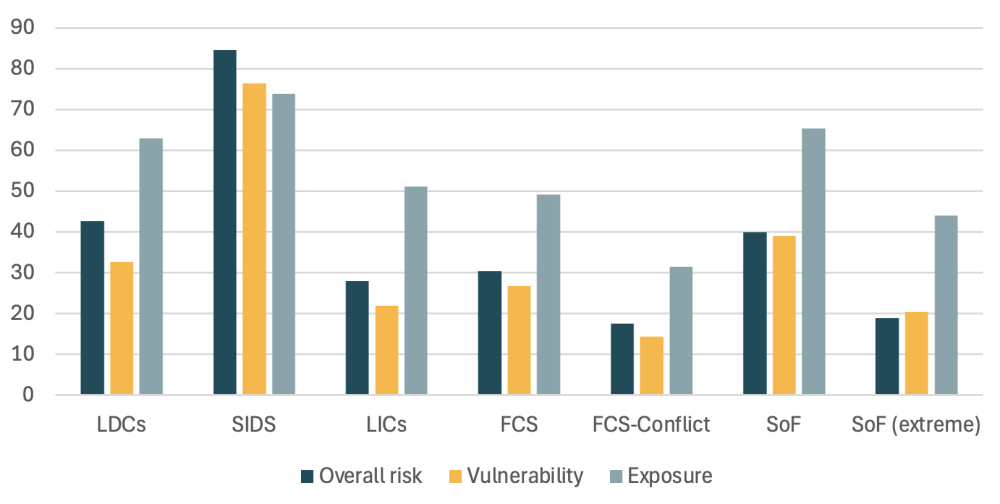
Note: Bars represent the average rank of countries in each country group using a normalised average of the five individual indices at each of the three levels (overall risk, vulnerability and exposure). The lower the rank, the greater the vulnerability. The World Bank FCS group (35 countries) excludes South Sudan, Ukraine, and West Bank & Gaza (WBG), and the OECD SoF group (59 countries) excludes South Sudan and WBG, as vulnerability data not available for all indices.
Countries affected by fragility that are also LDCs are on average even more climate vulnerable than the wider fragile group in every category of fragility.
These findings on relative climate vulnerability can help inform the allocation of climate adaptation finance to help communities and ecosystems withstand and recover from climate change impacts. Directing finance and support for impactful interventions towards the most climate vulnerable conflict settings would redress the climate finance/vulnerability mismatch and ensure that scarce climate finance is prioritised and invested where it is needed most.
Where does climate adaptation finance currently go?
Countries across these conflict and fragility classifications (FCS and SoF) consistently receive lower levels of adaptation finance per head compared to SIDS, LDCs, and LICs (see chart below). There is relatively little variation in average adaptation finance per head between conflict and fragility classification groups, but on average they have received only about two thirds the level of per capita adaptation finance in LDCs, and only about one third the level in SIDS between 2016-23.
Fig 2. Average adaptation finance $/hd per year (2016-2023)
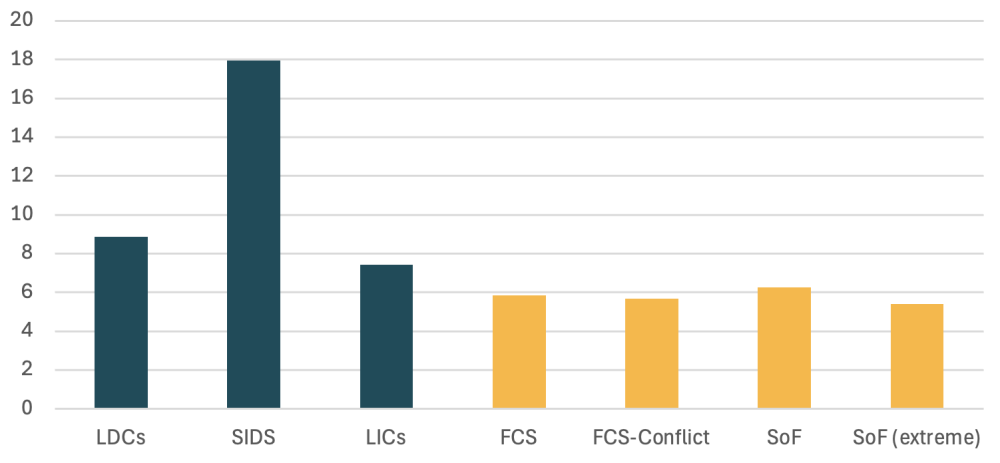
Source: derived from OECD Climate-Related Development Finance dataset
Importantly, we find very limited correlations between adaptation finance per capita and overall risk or vulnerability, demonstrating that climate finance allocations are currently not responsive to levels of climate vulnerability. Risk aversion and concerns about aid effectiveness and absorptive capacity play a defining role in this mismatch: donors and implementers tend to direct adaptation resources to more stable environments, via governments and institutions with available capacity and infrastructure where delivery and disbursement are straightforward. While limited governance, insecurity, access and operational challenges may make delivery harder in conflict settings, it increases the urgency and importance of adaptation support for crisis affected communities who are otherwise neglected.
Why the gap matters and the cost of inaction
Neglecting climate adaptation in conflict settings has consequences for communities’ resilience, rising humanitarian needs and security. Climate shocks can act as a “threat multiplier”, exacerbating drivers of conflict, including by intensifying communal tensions over increasingly scarce resources, driving displacement, and weakening institutions. These impacts are often most severe in areas that are already economically and politically marginalized, such as in the Central Sahel. Without adaptation investments, recovery costs escalate—humanitarian budgets are stretched, development gains collapse, and climate impacts become more severe and more expensive to address. Adaptation initiatives to break this cycle and avoid escalating impacts should include anticipatory action which protects rural livelihoods and assets using forecasting tools to resource and act before a climate shock hits, showing potential cost savings. IRC’s research showed that preshock cash assistance helped mitigate the impacts of shocks on livelihoods and food insecurity, and improved communities’ climate resilience.
But while scaling up adaptation finance is essential, it cannot substitute efforts to resolve and prevent conflict itself. Addressing climate vulnerability in these contexts requires a dual approach: investing in resilience while also tackling the political and security dynamics that drive instability. As highlighted in IRC’s Emergency Watchlist, diplomatic engagement, conflict resolution efforts, and strengthened international cooperation remain critical to breaking cycles of violence that amplify climate risks.
At the same time, broader political disengagement is exacerbating the problem. Cuts to official development assistance (ODA)—the main source of bilateral climate adaptation finance—are reducing access to food, protection and basic services, and crippling the very systems that enable communities to build resilience. The UK has reduced its annual climate finance ODA allocations for the next three years by 30 percent in real terms compared to its previous target, and a decline in climate finance allocations is anticipated from Germany following cuts to their ODA budgets. The US has effectively cut its international climate finance from several billion dollars a year to zero. Evidence suggests that such reductions can deepen fragility and further fuel conflict, including by weakening local economies and increasing incentives for violence.
Fragile contexts risk being drawn into a vicious cycle where a lack of funding, diplomatic engagement and compounding climate impacts fuel instability, which in turn blocks climate finance.
The way forward
To break this pattern, climate finance providers including bilateral and multilateral donors as well as vertical funds must confront this risk aversion, overcome operational challenges and find approaches toward evidence-based allocation and delivery proportionate to climate vulnerability. We know impactful adaptation and climate resilience in these settings is possible with the right tools and interventions.
First and foremost, adaptation finance should be allocated to where it is needed most, urgently scaling up support for conflict-affected and fragile countries. Adaptation finance targets should be set for the most vulnerable, particularly fragile and conflict-affected countries, to operationalise the new $300 billion climate finance target, based on the best available estimates of adaptation needs and assessments of vulnerability. Grant-based finance should be prioritised so the most vulnerable countries do not become subject to more loans and spiraling national debt to address a crisis they haven’t caused.
Secondly, evidence-based, conflict-sensitive, adaptive interventions should be prioritized and delivered through a wide range of partnerships including with civil society organisations (CSOs.) Effective climate adaptation in fragile and conflict settings is possible and can be de-risked when it is grounded in an understanding of local economic, political and cultural dynamics and rooted in local systems. Humanitarian actors, NGOs and local organizations can reach communities beyond the reach of governments or de facto authorities, delivering conflict-sensitive, locally-led adaptation. Multilateral climate finance mechanisms in particular should be made more easily accessible to CSOs. While commitments to localising by expanding engagements with NGOs and local organisations exist, implementation is slow or not yet reaching conflict settings.
Finally, adaptation finance should be flexible, allowing for quick pivots in volatile contexts, multi-year, and increasingly pre-arranged for anticipatory and early action to protect livelihoods and assets from predictable climate shocks. Short-term preparedness is an important complement for long-term strategies to improve systemic resilience to climate change. Both rely on early warning systems that reach the most vulnerable communities.
The evidence is clear: the countries most exposed to climate risk are not those receiving the most support to adapt. Correcting this imbalance is not only a matter of equity, but a prerequisite for effective climate action and path to stability.
Topics
DISCLAIMER & PERMISSIONS
CGD's publications reflect the views of the authors, drawing on prior research and experience in their areas of expertise. CGD is a nonpartisan, independent organization and does not take institutional positions. You may use and disseminate CGD's publications under these conditions.
Thumbnail image by: Adobe Stock Images