Recommended


Over the years, foreign aid has faced a persistent criticism: programs tend to pay for inputs—staff time, materials, activities—with too little regard for whether they deliver results. With US international assistance markedly scaled back, the critique takes on new urgency. As US decision-makers consider what overseas assistance should look like going forward, there's an opportunity to ask how it could be structured to make outcomes the central focus.
There are a few ways to tackle this. One is to use rigorous evidence to select interventions with a proven track record while taking context into account, setting programs up for success. This was a core activity undertaken by USAID's Office of the Chief Economist, drawing in part on the work of the UK Government's Department for International Development, and then the Foreign, Commonwealth & Development Office. Another, and the focus of this post, is designing programs that disburse only when verified results are achieved against an established baseline. While the concept is straightforward, getting it right in practice has proven considerably harder. Pay-for-performance approaches have been proposed and tested over the years, traveling under a rotating cast of names and three-letter acronyms. Only some tie disbursements to outcomes or at least get close. Genuine outcome-based models have remained the exception rather than the rule.
While terms such as “results-based” and “performance-based” are sometimes used interchangeably, I want to distinguish between my use of “outcome-based” aid. Outputs are the direct or immediate results of what a program does and are under the control of the implementer—generally, an intermediate product; outcomes are the actual impact a program intends to achieve. Often, pay-for-performance arrangements link disbursements to outputs. But not all outputs are equal. Some leave a longer causal chain to the ultimate result that can be difficult to verify. For instance, a trained health worker (output) may or may not deliver better care and thus may or may not improve patient health outcomes. Others are close enough to function as outcome proxies, such as an administered vaccine, which protects against disease.
With calls for a fundamentally different approach to US foreign assistance growing louder, it's worth considering whether the current moment might finally create the conditions for results-based approaches, including those that focus more precisely on outcomes, to receive a more serious look and benefit from more intentional implementation.
Before its closure, USAID managed the bulk of US foreign assistance awards. The agency's procurement rules were famously complex, in part due to layers of congressional requirements, necessitating specialized knowledge among the agency's staff, including contract and agreement officers, and prospective awardees alike. While the agency employed a host of procurement mechanisms, most ultimately paid for the intervention (with ample documentation) rather than for actual impact. To be clear, this is standard practice for many federal and state programs and shouldn't be read to suggest that the investments failed to achieve results (though at times they didn’t), but rather that the approaches weren’t explicitly structured to incentivize success.
The alternative, pay-for-performance arrangements, have been used sparingly—and more often to reimburse costs associated with a given output or service rather than to provide an agreed-upon sum for achieving an output or outcome not explicitly tied to costs. For some outputs, this may work well, but for others, the causal path remains uncertain.
What follows is a brief description of three promising pay-for-performance approaches that have been proposed and tested—each designed with results in mind, but varying in how consistently each ties disbursements to genuine outcomes and how widely each has been tried.
Most widely tried, but inconsistently outcome-focused: the World Bank's Program-for-Results
The World Bank launched its Program-for-Results (PforR) financing instrument in 2012, designed to place greater emphasis on results while strengthening country capacity and guarding against risks. PforR projects incorporate disbursement-linked indicators (DLIs). In the many PforR projects implemented since the program's start—across a whole range of sectors and countries—DLIs range from input-oriented (such as institutional requirements related to policy or administration) to outputs (intermediate results, for example, areas with new and improved irrigation services) and only occasionally outcomes (intended results, such as an increase in people with access to new or improved electricity service; or a reduction in rush-hour travel time for an urban bus system).
PforR's scale is what really stands out (more than 220 projects) with considerable variability in approaches and indicators that could offer lessons for future US bilateral assistance. A CGD paper by Alan Gelb, Anna Diofasi, and Hannah Postel analyzed the first 35 PforR investments. They hypothesized a few reasons why more DLIs didn’t extend as far down the results chain, suggesting that both Bank task teams and country governments might be exercising caution given that the provision of outputs is more squarely in the control of those implementing the program, while the influence on outcomes is often less clear and direct. They also noted that appropriately calibrating disbursements to the scale of outcome changes could be challenging. Further, changes in outcomes can be slow or difficult to measure, especially within the relatively narrow window during which disbursement is desired—in this case, even over several years. For a donor hoping to pursue results-based aid in a chosen sector, reviewing PforR project documents to identify projects with outcome DLIs that were clearly deemed contractually acceptable, and projects with payment indicators that don’t extend nearly as far into the results chain, could be a useful step in the scoping process.
The US test case: harnessing the private sector for development with Development Impact Bonds
Taking inspiration from Social Impact Bonds, which sought to harness private-sector innovation to tackle domestic challenges in the UK and the US, CGD experts worked with counterparts at Social Finance to convene a working group to scope the potential for Development Impact Bonds. The group's final report, co-chaired by the then-head of the Overseas Private Investment Corporation, was published in October 2013. The report highlighted the potential for this innovative financing mechanism and offered recommendations to key stakeholders, including donor agencies, private investors, service providers, intermediaries, and partner governments.
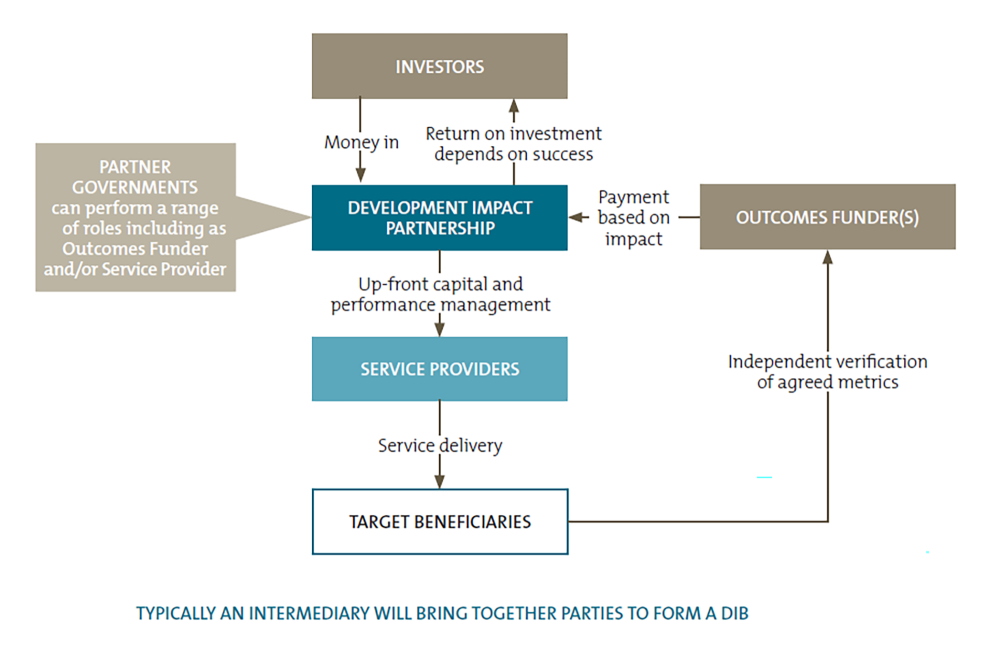
Not a true bond, a DIB refers to an arrangement in which private investors provide upfront financing for a program, which is channeled to another actor—generally a service provider. If the program achieves the desired outcomes (or deliberately selected intermediate outputs), independently measured and verified against a baseline, an outcomes funder (usually a donor agency) pays the private investors’ principal plus an agreed-upon financial return commensurate with the progress attained. A DIB’s key design feature is to align incentives around results, but ancillary benefits include flexibility—allowing implementation to be iterative, if and where needed—and the ability to bring additional actors to the table, such as social impact investors.
Figure 1. Development Impact Bond structure
In 2017, thanks to dedicated staff and political leadership, USAID helped launch two DIBs. The agency joined Merck for Mothers as an outcome funder for a DIB in Rajasthan, India, to improve maternal and newborn health. After deliberation, the group selected a key indicator for disbursement focused on private small health care organizations meeting quality-of-care standards that were found to be correlated with at least some improvements in health outcomes. The program’s final evaluation found it led to quality improvements in private facilities in the Indian state. While no evaluation explicitly linked these upgrades and improved practices to maternal and newborn health outcomes, the study relied on an evidence-informed tool to estimate results.
That same fall, USAID’s Development Innovation Ventures joined the UK’s Department for International Development as an outcome funder in a DIB to tackle poverty in Uganda and Kenya by scaling Village Enterprise’s ultra-poor graduation model. Investors in the project earned their full payout (including a rate of return) based on results achieved, which included increases in the households’ consumption and assets. Notably, the DIB delivered despite the advent of the COVID-19 pandemic.
In 2021, the US International Development Finance Corporation and Ferd (a Norwegian investment company) provided the upfront financing for a DIB to support the livelihoods of refugees and host communities in Jordan. DFC recouped its investment plus a return thanks to income-generating activities by those the program served and increases in household consumption.
DIBs have garnered interest from a range of actors and have been tested in several country contexts and sectors—alongside more popular, social impact bonds—but setting them up can be challenging, often requiring upfront investment in data collection and analysis to assess feasibility, and necessitating negotiations with the full range of actors to agree on terms.
Outcome-based aid by design, but limited real-world implementation: Cash on Delivery Aid
Designed by economists at the Center for Global Development, Cash on Delivery (COD) Aid aligns incentives to achieve a development outcome. With COD Aid, the donor makes a fixed payment to a partner government in exchange for measurable, verifiable progress toward an agreed-upon goal. The donor pays only for results delivered, while the partner enjoys the flexibility needed to learn, innovate, and drive impact—along with a clear financial incentive to move the needle. Payments are closely tied to outcome goals that can be accurately measured and are expected to improve over a relatively short period (months or years rather than decades). Potentially well-suited outcomes include reductions in transportation time and costs; increases in agricultural productivity; improvements in energy reliability; and greater access to water and sanitation. Underlying contract and measurement data are made publicly available to increase accountability. COD Aid funding is generally intended to complement domestic spending and other aid support.
Though COD Aid boasts intellectual groundwork, the real-world test cases have been limited. The UK government, under former International Development Secretary Andrew Mitchell, launched a "Payment by Results" education program in Ethiopia that piloted COD Aid. In that arrangement, the UK's aid agency agreed to pay the Ethiopian government for each additional student who completed grade 10 and passed the associated examination, with a premium for certain groups. Ultimately, the program disbursed £26.6 million to the Ethiopian government as more than 183,000 additional students sat for the grade 10 exam, and a comparable number passed. But the program got off to a slow start, was extended for a year, and did not undergo a rigorous evaluation. By the end of project year three, the reward payments from the three-year pilot had been fully disbursed to 10 of 11 regions after demonstrated increases in students sitting for and passing the grade 10 exams, but because the evaluation had not been designed with a control group, it wasn’t possible to assign the pilot responsibility for the results.
Why has outcome-based aid remained the exception?
There are a number of practical and bureaucratic reasons that results-based aid has less often taken center stage. The up-front design can be challenging and doesn't necessarily lend itself to simple replication. Since the central tenet of results-based aid is disbursement only upon achievement of the intended result, when the result is not a readily demonstrable output (such as a paved road), it requires investment in rigorous measurement. Results-based aid awards shift the financial risk to the implementing partner, who may lack the capacity or capital to front operations, and—particularly with outcome-based aid—failure to achieve the goal doesn't necessarily reflect poor performance. And while donors may view the opportunity to offload risk as appealing, many face their own institutional incentives to disburse rather than withhold funds.
Outcome-based financing approaches generally offer the implementing partner (public or private) substantial flexibility in exchange for taking on risk. Over the years, US foreign aid spending has been anything but flexible. At a minimum, multi-year funding budgeted up front and protected from rescissions would be crucial to making most of these arrangements feasible. Ultimately, statutory requirements combined with USAID's own policy guidance left limited room for innovative arrangements, with fixed-amount awards (an award type the US government uses to pay based on the achievement of agreed-upon milestones rather than reimbursing for costs) among the best for channeling support explicitly to a target result. However, more often these were outputs, which could remain some distance from the desired outcome.
Is there an opportunity in the current moment?
Much has changed in the US foreign assistance landscape over the last 18 months. While some of the bureaucratic challenges of the past no longer exist, others persist—and have been compounded by limited staff bandwidth. So where outcome-based aid may face fewer bureaucratic obstacles than before, it could prove more difficult to administer given limited institutional capacity, particularly in managing the critical design phase.
Nevertheless, given the pressure on US overseas investments to promote accountability and achieve impact, outcome-based approaches, if well designed, could offer a partial answer to calls for reform. If the goal is demonstrable impact with limited donor resources, combined with a desire to do things differently than before, building accountability for results into program architecture could be worth the additional design challenges and complexity that often accompany outcome-based aid. And even where true outcome-based assistance may be out of reach, other iterations of results-based financing—such as milestone payments and performance incentives—could attract renewed interest.
How do you start? One option would be to establish a US development impact fund to pilot results-based aid models using a modest share of the aid portfolio to start. This would require a degree of congressional buy-in—but outcome-based (or at least intermediate-output-based) disbursements might substitute for the more traditional guardrails (often extensive reporting requirements) that lawmakers regularly attach to aid spending, and a portfolio approach could help balance the risk of underspend.
Another option is to identify a multilateral institution or platform that could manage a pooled outcome fund to support DIBs and other arrangements. While the US might cede some control, the US could leverage contributions from other donors—and work around challenges in the US budget execution process. If the US is going to spend less abroad, the case for ensuring US spending pays for verified results is strong.
Topics
DISCLAIMER & PERMISSIONS
CGD's publications reflect the views of the authors, drawing on prior research and experience in their areas of expertise. CGD is a nonpartisan, independent organization and does not take institutional positions. You may use and disseminate CGD's publications under these conditions.
Thumbnail image by: World Bank Photo Collection/ Flickr