Recommended

Ireland’s Presidency of the Council of the European Union (EU) is attempting to break the deadlock among Member States over the EU’s long-term budget, the 2028-2034 Multiannual Financial Framework (MFF).
As negotiations continue and politicians are looking for savings, it is vital that decisionmakers know the real picture. The European Commission’s proposal shows a 70 percent increase in EU development cooperation spending, but in fact, the real increase is less than half that amount—at best 44 percent and most likely less than 30 percent. That leaves little funding to cover proliferating global challenges and crises, from Nepal's deadly recent floods to the mounting development needs of increasingly fragile countries. Here, we set out why that 70 percent figure is misleading.
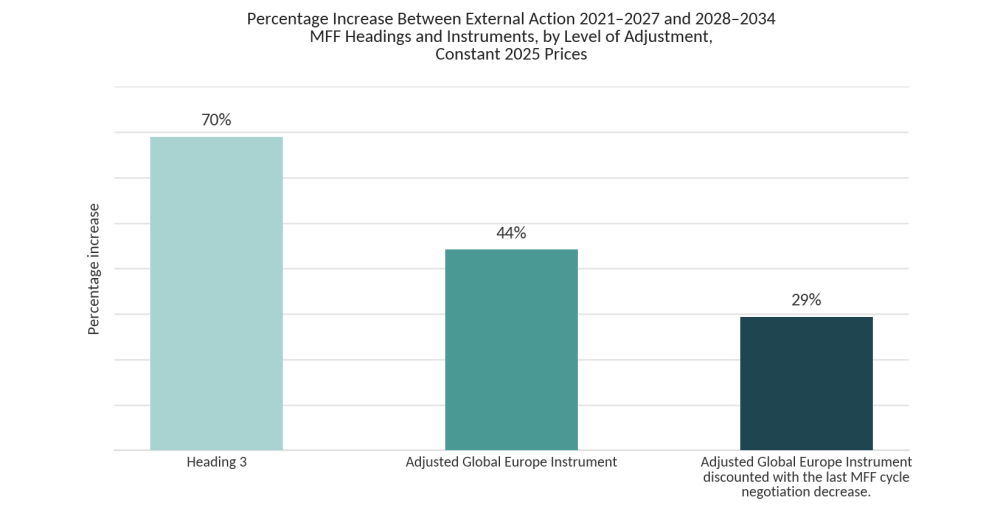
The European Commission has proposed an international cooperation and development instrument for the next MFF, the Global Europe Instrument, worth EUR 200.3 billion. However, this substantially overstates the real increase to the EU’s core development budget. Strip out what doesn’t belong in the comparison with the current instrument, the Neighbourhood, Development and International Cooperation Instrument (NDICI-Global Europe) and adjust for inflation, and the increase falls to 44 percent. Apply the cuts that MFF negotiations typically entail, and it falls again to around 29 percent.
With a new Council negotiating box (the Council presidency’s living document that sets out key contested elements with the MFF including budget figures) expected in the autumn, and with governments at odds on the budget’s overall shape, getting this number right now matters. It sets the baseline against which every concession on external action will be judged.
A like-for-like comparison, the “adjusted” Global Europe Instrument
Comparing the current external action budget (Heading 6: Neighbourhood and the World) with the proposed external action budget (Heading 3: Global Europe) gives a 70 percent increase.
In reality, two adjustments are necessary.
Firstly, we must convert the figures into constant 2025 prices, so spending from different periods reflects real purchasing power, rather than nominal totals inflated by rising prices. Second, we must establish what exactly is included in the new Global Europe Instrument.
The chart below breaks down the composition of both headings, in 2025 constant prices.
Figure 1: EU external action budget by instrument, Heading 6 (2021–2027) and Heading 3 (2028–2034), constant 2025 prices
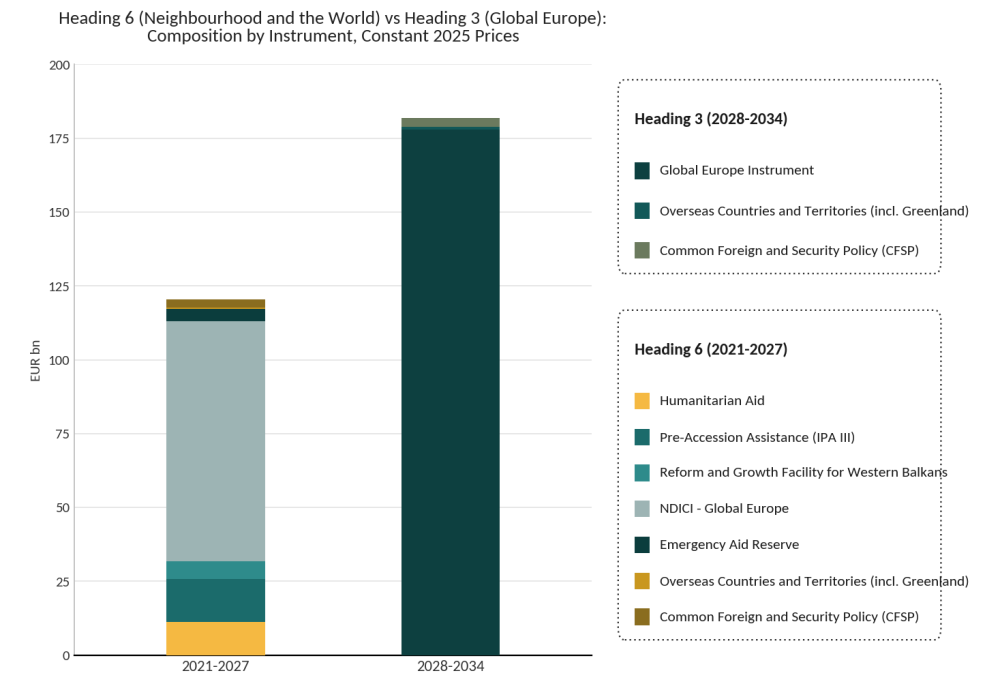
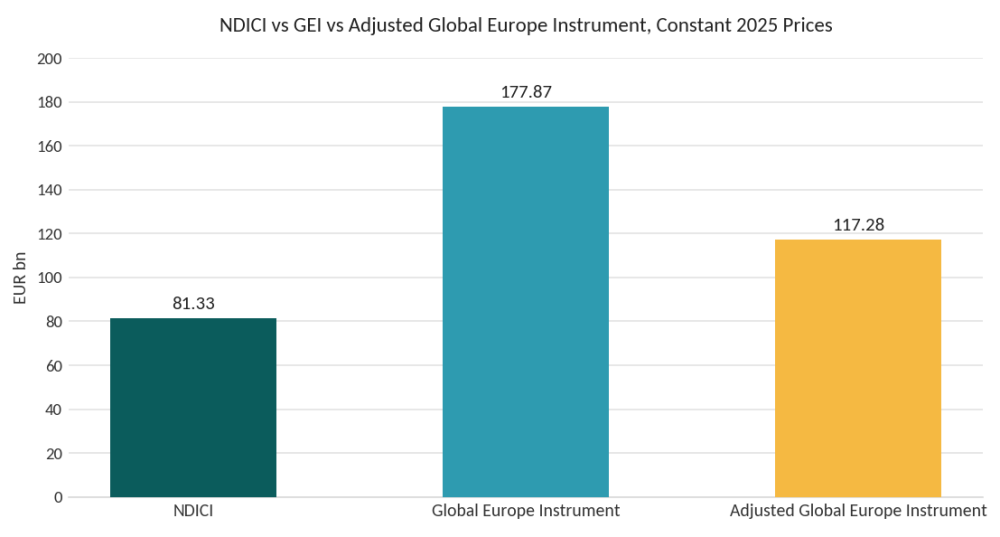
The Global Europe Instrument brings three separate funds—the development fund (NDICI), the enlargement fund (IPA III) and humanitarian aid (HUMA)—together under a single, geography-based structure, replacing NDICI’s previous thematic pillars. That simplification makes the instrument harder to compare against its predecessor. To isolate NDICI’s successor, we removed the Global Europe Instrument’s “Europe” geographic pillar (the old Instrument for Pre-Accession) and the EUR 25 billion earmarked for humanitarian aid. What remains (the “Adjusted Global Europe Instrument) comes to EUR 117.28 billion, against EUR 81.33 billion for NDICI.
That is a 44 percent real-terms increase, and not a 70 percent increase.
Figure 2: NDICI, Global Europe Instrument, and Adjusted Global Europe Instrument, constant 2025 prices
What the final increase is likely to look like, based on past negotiations
A 44 percent increase to core development funding would still be significant. However, MFF negotiations don't end where they start. During the negotiation process on the current MFF, NDICI was cut by around 10 percent between the Commission’s first proposal and the 2021-2027 final agreement. Apply that same rate cut to the Adjusted Global Europe Instrument figure and its EUR 117.28 billion falls to EUR 105.24 billion, a 29 percent increase over NDICI.
Figure 3: Percentage increase in external action spending between 2021–2027 and 2028–2034, by level of adjustment, constant 2025 prices
Two factors could bring this number even further down:
- The deflator may be too low. The Commission assumes a flat 2 percent annual rate of inflation, while ECB projections put euro-area inflation nearer 3 percent in 2026, easing to 2.0–2.3 percent in 2027. A higher deflator would shrink the real increase further.
- The final figure could shrink again after agreement. In the current MFF, when NDICI went through its Mid-Term Revision, the Commission requested an extra EUR 10.5 billion for Heading 6, but Member States approved just EUR 2 billion, a 7.48 percent pro rata cut across NDICI and IPA III, plus a real terms cut to the Emergency Aid Reserve, from EUR 615 million to EUR 508 million a year.
The bottom line is that the proposed Global Europe Instrument is bigger than NDICI, but at best case, around 44 percent bigger, and more realistically, less than 30 percent in real terms.
That smaller increase still must stretch to address global challenges, in-country development challenges, and the EU's push for "win-win" partnerships. As the Irish EU Presidency attempts to broker a deal among Member States still divided on the budget’s overall shape, negotiators should build that ambition into the number from the outset. That starts with using the right baseline.
Topics
DISCLAIMER & PERMISSIONS
CGD's publications reflect the views of the authors, drawing on prior research and experience in their areas of expertise. CGD is a nonpartisan, independent organization and does not take institutional positions. You may use and disseminate CGD's publications under these conditions.
Thumbnail image by: J-L Flémal - BE/ Adobe Stock