
Introduction
Criticism of US foreign assistance is hardly new. From the earliest instance of American overseas disaster relief (food aid sent to Venezuela following the 1812 Caracas earthquake, amid objections that federal resources should be directed towards needs at home [1]) to contemporary debates over aid effectiveness, foreign assistance has long been politically contested. Over time, critiques have emerged from across the ideological spectrum, as well as from scholars, journalists, and practitioners.
In 2025, that debate sharply intensified following the Trump administration’s decision to dismantle the U.S. Agency for International Development (USAID). While many defended the agency and the broader foreign assistance enterprise, the administration’s actions created space for a wider reexamination of how US aid is structured and delivered. Critiques from across the globe and the political divide, including from the left and from voices in the Global South, gained renewed prominence in questioning not only how aid is implemented, but who it ultimately serves and how power is exercised within the system.
While the dismantling of USAID was arguably the most consequential institutional change in the history of US foreign assistance, subsequent public opinion research highlighted in a recent Rockefeller Foundation report suggests it also created an unexpected opportunity. As USAID’s dismantling turned public attention to foreign aid, Americans became more informed about what it actually does, what it costs, and how it contributes to humanitarian, development, and national security objectives. Rather than favoring permanent retrenchment, 8 in 10 Americans said the path forward is to reform and strengthen what works in foreign aid programs, not eliminate them. Thus, there is evidence to suggest rebuilding the foreign assistance architecture on a stronger foundation may be politically possible. As the Rockefeller Foundation report states, “Americans are looking for reforms not termination.”
Some post-2025 commentary similarly assumes that the previous foreign assistance architecture is unlikely to be restored and instead considers what should succeed it, emphasizing adaptation, institutional redesign, local ownership, domestic financing, and sustainability. See Suzman in Foreign Affairs (2026).
Yet, much of the public debate has been shaped by outside critiques. Some of their concerns are legitimate; many adopt an explicitly political frame; others are less tethered to fact or operational reality. What’s missing is a systematic accounting of how experienced USAID practitioners themselves assessed the agency’s performance, constraints, and unrealized opportunities.
This note seeks to fill that gap by asking a forward-looking question: If those closest to the system had greater flexibility, what would they have done differently, and what does that imply for the next generation of US foreign assistance? In other words, how can the views of US development practitioners inform the path forward?
To answer this question, the note begins by reviewing major public critiques of USAID and its implementation of US development and humanitarian assistance, organizing them into six broad categories. The note does not consider military or other security assistance. It then draws on survey responses from former USAID personnel to examine where practitioners believed system constraints produced suboptimal outcomes, and where the agency itself could have performed more effectively. The survey instrument is available here.
In doing so, the analysis distinguishes between limitations imposed externally—through statute, appropriations, and political oversight—and those arising from institutional choices, incentives, and culture. The goal is neither to endorse nor indict the previous system, but to identify practical lessons for the future design of US foreign assistance, regardless of where institutional responsibility for managing it ultimately resides within the US government.
The survey results defend neither the status quo ante nor a wholesale abandonment of foreign assistance. Experienced practitioners traced USAID’s unrealized potential to the interaction of external constraints with internal challenges, including rigid rules, misaligned incentives, and weak workforce systems. They favored a future system organized around fewer strategic priorities, greater adaptability, deep development expertise, strong field relationships, meaningful local ownership, and accountability for results. At the same time, they resisted blunt reform prescriptions that could sacrifice valuable capabilities without fixing the underlying operating model itself. Their responses suggest that reform should give skilled practitioners in a future system greater space to exercise judgment and engage in development diplomacy while preserving responsible stewardship and strengthening congressional and public confidence.
Critiques of foreign assistance: An overview
The critiques cluster around a relatively consistent, though overlapping, set of themes. Organizing these critiques into six broad categories—political, strategic alignment, architectural, operational, effective use of evidence, and power-based—helps clarify where concerns are widely shared and where they diverge.
1. Politicized critiques: Waste, abuse, and ideological drift
The most visible critiques in 2025 came from the administration and its allies. These often centered on allegations of waste, fraud, and abuse, as well as on claims that foreign assistance promoted ideological agendas at odds with American values. These arguments featured prominently in executive branch communications and congressional hearings, where selected programs were presented as evidence that USAID had misused taxpayer resources or pursued objectives lacking public support. See, for example, the White House statement “At USAID, Waste and Abuse Runs Deep” and the House Oversight Committee hearing, “America Last: How Foreign Aid Undermined U.S. Interests Around the World.”
At their strongest, these critiques expressed substantive concerns about oversight, accountability, and the effective use of taxpayer resources, particularly because aid programs frequently operate in fragile and high-risk environments. Many prominent claims, however, were weakly substantiated or mischaracterized. FactCheck.org found that several high-profile allegations presented as evidence of waste, fraud, or abuse were inaccurate or wrongly attributed, while other critiques generalized from isolated cases to claims of systemic failure.
2. Strategic alignment critiques: Linking aid to US strategic interests
A second line of critique focuses on the purpose of foreign assistance and its relationship to US strategic interests. The Trump administration argued that foreign assistance was not adequately aligned with American interests and presidential foreign policy priorities. Other analysts have argued a related but distinct point: that US aid has been justified through a diffuse mix of humanitarian, development, and geopolitical goals, without a sufficiently clear framework for prioritization or communication to domestic audiences. See, for example, White House Executive Order on Foreign Aid Review (Jan 2025) and Council on Foreign Relations: Restoring Support for Foreign Assistance.
From the latter perspective, the challenge is not that foreign assistance lacks value, but that its objectives are too broad and insufficiently tied to measurable outcomes that resonate with US taxpayers and policymakers. This failure has contributed to persistent political vulnerability and fluctuating support for foreign assistance.
At the same time, critics of this view caution that narrowing foreign assistance too tightly to short-term geopolitical objectives risks undermining long-term development outcomes that contribute to stability and US influence abroad. The tension between strategic alignment and development effectiveness remains a central and unresolved issue in the design of foreign assistance (see, for example, Project Syndicate: Rethinking the Rationale for Foreign Aid), often putting practitioners, such as USAID staff, between a rock and a hard place.
3. Architecture critiques: Fragmentation and institutional design
A widely stated critique concerns the architecture of US foreign assistance. Responsibility for aid has long been dispersed across multiple agencies, with overlapping mandates and competing priorities. USAID operated alongside the Department of State, the Millennium Challenge Corporation, the US International Development Finance Corporation, and numerous other entities, often without clear lines of authority or obligations to coordinate with one another. In 2007 congressional testimony, Lael Brainard, then vice president and director of the Global Economy and Development Program at the Brookings Institution, illustrated this fragmentation with what became known as the foreign-assistance “spaghetti chart,” mapping approximately 50 executive-branch units involved in aid planning and delivery and a similarly large array of objectives.[2]
Ironically, fragmentation was one of the primary problems the Kennedy administration sought to address by creating USAID. In his March 1961 Special Message to Congress on Foreign Aid, President Kennedy described existing aid programs as “bureaucratically fragmented” and argued that the United States needed “a single agency” to administer development assistance more coherently. The resulting Foreign Assistance Act of 1961 consolidated previously dispersed aid functions and led to the establishment of USAID under Presidential Executive Order 10973.
Yet over subsequent decades, the system became fragmented again as new funding streams, specialized initiatives, and agencies were layered onto the foreign assistance architecture, often justified by criticisms of USAID’s effectiveness.[3] Critics argue that this diffusion of authority contributed to duplication, coordination challenges, and strategic incoherence, both in Washington and in the field. Thus, while there has been broad agreement that the system was imperfectly designed, there is far less consensus on what an improved architecture should look like.
4. Operational critiques: Procurement and compliance
Operational critiques concentrate on how USAID executed its mandate. They focus on the agency’s complex procurement systems, extensive compliance requirements, and overreliance on large implementing partners. Critics argue that these systems often prioritized risk mitigation and procedural accountability over effectiveness, innovation, and speed, while disadvantaging smaller and local organizations.
Concerns about procurement and compliance systems have been repeatedly documented in oversight reports and acknowledged in reform initiatives. The USAID Inspector General (e.g., USAID Office of Inspector General FY2025 Management Challenges Report) identified recurring problems involving procurement oversight, partner monitoring, data quality, and risk management, while USAID Forward (e.g., USAID Forward Procurement Reform Overview) sought to increase agility and expand partnerships with local organizations. Unlike some of the more politicized critiques, these operational concerns are widely acknowledged within the development community, including by former USAID personnel.
The challenge practitioners faced, however, was that efforts to reduce compliance burdens or increase flexibility often carried political risk. Failed or controversial projects, even when representing a small fraction of overall programming, could trigger allegations of waste, fraud, or abuse, frequently amplified through congressional oversight and partisan scrutiny. The Trump administration’s critiques since January 2025 illustrate this dynamic. Over time, this political risk created powerful institutional incentives to prioritize procedural compliance and risk avoidance, often at the expense of innovation, speed, and adaptability. Repeated oversight findings reinforced this dynamic by emphasizing procurement controls, risk management, and monitoring requirements, including audits by the USAID Office of Inspector General and congressional oversight hearings focused on accountability concerns.[4] Operational inefficiencies, therefore, were not always accidental or due to incompetence; in many cases, they reflected institutional adaptations to political risk.
5. Effectiveness and evidence critiques: Knowing what works
Another issue in how USAID executed its mandate concerns the critique that the agency consistently failed to use evidence effectively to guide its work. Critics have questioned whether objectives were clearly defined, evaluations were rigorous and timely, and findings were consistently incorporated into program design and management. In sum, critics argued that the agency’s systems and practices did not consistently produce sufficiently reliable information to determine which activities should have been continued, modified, or discontinued.
Various reviews have identified methodological weaknesses in some evaluations, as well as obstacles to disseminating and applying their findings across the agency.[5] From this perspective, the problem was not simply administrative inefficiency, but the risk of continuing programs without sufficiently reliable evidence about their results or cost-effectiveness. USAID leadership acknowledged that more work was needed to ensure that evaluation findings consistently informed current and future programming, and the agency took steps to strengthen evidence generation and use.[6] Nevertheless, a 2020 CGD assessment concluded that evidence still informed program decisions more episodically than systematically.[7]
Democracy and governance programming illustrates both the evidence problem and the need for care in interpreting it. A 2008 National Academies review called for a pilot program of rigorous impact evaluations and stronger capacity to determine the effects of USAID’s democracy and governance projects. A 2019 Inspector General audit subsequently found that the agency’s DRG Center had been slow to generate and disseminate knowledge through impact evaluations in Europe, Eurasia, and the Middle East. These gaps did not establish that democracy assistance was ineffective (a subsequent systematic review and comparative quantitative analysis found small but positive average effects), but they limited USAID’s ability to determine which interventions worked, in which settings, and why.[8]
The central criticism, therefore, was not that USAID lacked evaluation systems or evidence of positive results, but that the quality of evidence varied considerably and institutional processes did not consistently ensure that credible findings shaped program choices and resource allocation.
6. Power and localization critiques: Who designs and delivers aid
A final and increasingly prominent critique concerns power within the foreign assistance system. Scholars, practitioners, and voices from the Global South argue that US aid has remained overly donor-driven, with authority and resources concentrated in Washington and with large international organizations. Despite sustained commitments to locally led development across various administrations, procurement requirements and fiduciary concerns continued to impede the transfer of resources and decision-making authority to local actors.
This critique is reflected in both policy and media analysis. For example, The Guardian: “Why Not Everyone Is Mourning USAID” highlights concerns about donor-driven development models, reliance on foreign consultants, and the limited transfer of decision-making authority to local actors. Similarly, Project Syndicate: Rethinking the Rationale for Foreign Aid argues that the post-2025 debate presents an opportunity not only to reconsider aid effectiveness, but also to rethink the underlying power relationships embedded in the foreign assistance system.
A related critique concerns dependency and sustainability. Some country leaders and development officials argue that foreign assistance can become self-perpetuating when donor-created systems and institutional incentives favor continued programming rather than graduation, domestic resource mobilization, and durable local capacity.[9] From this perspective, effectiveness should be judged not only by near-term program results, but also by whether assistance strengthens institutions and enables countries ultimately to reduce their reliance on external support.
USAID itself recognized this concern. Under Administrator Mark Green, the agency’s Journey to Self-Reliance sought to help partner countries strengthen their capacity and commitment to lead their own development and ultimately reduce their reliance on foreign assistance. As Green put it, “The purpose of all foreign assistance should be ending its need to exist.”[10] Translating that principle into operational practice, however, remained a challenge. USAID piloted the Journey to Self-Reliance in 25 pilot missions. A 2020 USAID Inspector General audit of three pilot missions found that they had used the initiative’s metrics inconsistently and that their budget submissions did not fully reflect priorities identified through the Journey to Self-Reliance process. USAID revised its strategy and budget guidance during the audit to address these problems, and the Inspector General therefore issued no recommendations.[11]
At the same time, transferring greater responsibility to local actors raises legitimate questions about how donors and partners should share risk, strengthen organizational capacity, maintain accountability, and manage the transition.[12]
What the external critiques establish – and leave unanswered
Taken together, these critiques reveal both convergence and divergence. There is broad agreement on certain operational challenges, insufficient generation and systematic use of evidence, and aspects of institutional design, while political critiques diverge sharply in both diagnosis and proposed solutions.
The evidence critique also requires careful interpretation. Uneven evidence and inconsistent use of findings limited USAID’s ability to determine which interventions worked best, in which settings, and at what cost. Those shortcomings do not, however, establish that foreign assistance as a whole was ineffective, nor do they resolve how decision-makers should act when rigorous evidence is incomplete or when development results emerge only over long periods of time.
Perhaps most notably, much of the public debate focuses either on high-level structural issues or on individual programs invoked as examples of waste, ideological overreach, or ineffectiveness, while paying less attention to the day-to-day decisions, tradeoffs, and constraints experienced by those operating within the system. Many of the tensions described above were not invisible to practitioners. Rather, they reflected the complex balancing act of operating in an environment shaped simultaneously by congressional oversight, political scrutiny, fiduciary risk, bureaucratic incentives, foreign policy priorities, and development objectives. The survey analysis that follows examines how experienced USAID personnel navigated these competing pressures, where they believed meaningful reform was needed, and what capabilities they considered essential to preserve in any future system.
Survey methodology
The survey combined structured multiple-choice questions with open-ended responses. It drew on a purposive, referral-based sample of former USAID personnel with substantial firsthand experience of the agency. Of the 107 people who received the survey, 55 consented to participate, 53 answered the principal reform questions, and 49 completed the full survey. Because all respondents were former USAID personnel, their assessments, including their judgments about the agency’s effectiveness, constraints, and most important reforms, may reflect shared professional experiences and institutional perspectives.
The sample was exceptionally experienced but weighted toward senior leadership. Among respondents completing the professional-background questions, 69 percent had worked for USAID for at least 20 years, and again 69 percent identified mission leadership as one of their principal career roles. The findings should therefore be understood as the informed judgments of experienced institutional leaders, rather than as a statistically representative picture of former USAID personnel or related employment categories as a whole.
Open-ended responses were coded using a thematic framework tested on a pilot sample and refined before being applied to the full set of substantive responses.
The survey did not include personnel from implementing partners, other bilateral donors, or multilateral development institutions, whose perspectives may differ and would be valuable subjects for subsequent research.
The complete survey instrument, including response options and branching logic, is available in the online supplement.
Survey results
Experienced practitioners judged USAID as largely effective within the formidable constraints it operated under, while also believing it needed significant reform.[13] Although respondents supported reforms across many areas, the survey results pointed to a reform agenda built on two connected needs: (1) a clearer and narrower set of strategic development priorities, and (2) systems and processes that let practitioners exercise judgment and adapt programs as conditions change. Respondents identified deep technical expertise, strong field relationships and presence, local ownership, learning, and credible accountability as important features to retain in any future global development system. They named congressional directives and earmarks as the clearest obstacles to reform, and many also pointed to weak performance management systems that failed to recruit, train, and retain enough highly capable personnel.
Six important findings stand out.
1. Strategic discipline and adaptability formed one reform logic
Strategic focus and implementation flexibility tied as the most frequently selected reform priorities, with each chosen by 42 percent of respondents. When asked to select the reform with the greatest possible impact, however, strategic focus became the clear leader, chosen by 25 percent of respondents, more than twice the share choosing any other option.
Figure 1. Practitioners prioritized strategic focus and adaptability
If you had the authority to make three changes that would have significantly improved USAID's effectiveness, which would you have prioritized? Please select up to three options:
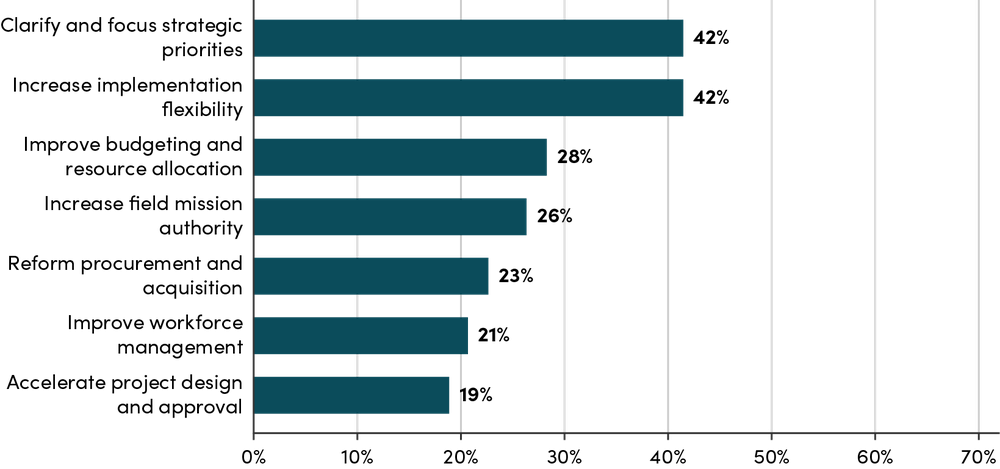
N=53. Multiple responses permitted; percentages do not sum to 100 percent.
The qualitative responses demonstrated that these priorities were complementary, not contradictory. Practitioners wanted fewer priorities, but they also wanted field teams to adjust programs as evidence and conditions changed.
“Most USAID missions worked in a half dozen sectors and managed 25–50 projects…. Inability to focus—whether because of earmarks, Washington priorities, or just lack of discipline—meant dollars, energies, and strategic capital were spread too thin to make a real, sustained, and visible impact the U.S. could point to and stand behind.”
— A former USAID practitioner
“USAID leaders often said ‘everything is a priority, and everything needs to be done well.’ In reality, the agency could not prioritize everything.… It also left some observers with the impression that USAID was operationally preoccupied, focused on the machinery instead of the diplomatic or development mission.”
— A former USAID practitioner
“No matter how well you design programs, conditions always change during implementation. Many times, assumptions made in the design process are wrong. But more important, you learn as you go about what is working and what isn’t.”
— A former USAID practitioner
2. Reform was constrained externally but translated internally
Congressional directives and earmarks were most frequently selected as the critical obstacle to reform by a wide margin: 64 percent, compared with 42 percent for political leadership priorities, and 38 percent for competing stakeholder interests. At the same time, respondents also placed the blame for reform resistance on USAID itself. Risk aversion, organizational culture, bureaucratic inertia, and insufficient leadership commitment formed a substantial cluster of internally generated constraints.
Figure 2. Congressional directives and earmarks were the clearest obstacle
What were the three most significant obstacles preventing these reforms from being implemented? Select only three.
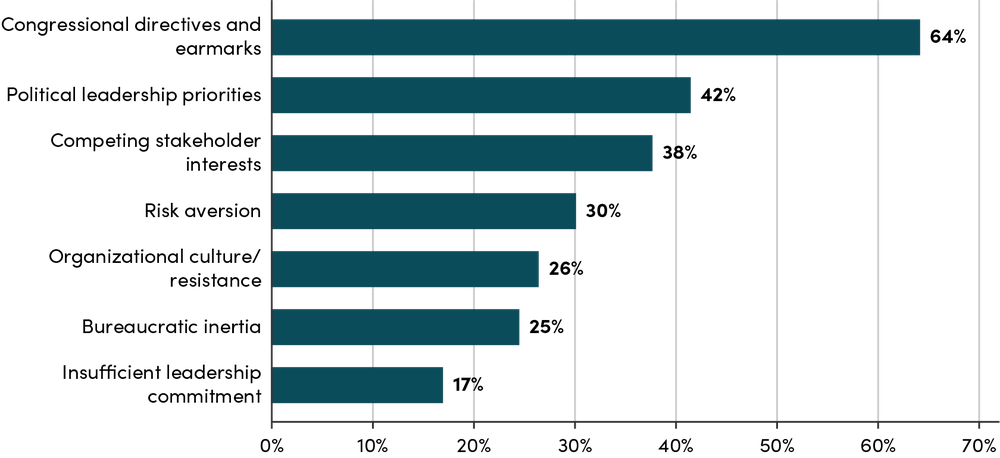
N=53. Multiple responses permitted; percentages do not sum to 100 percent.
The strongest interpretation of the data, as supported by qualitative responses, is that external and internal constraints were interactive. External controls not only narrowed USAID’s formal authority but also shaped its internal culture. Anticipation of congressional and political repercussions encouraged caution, extensive consultation, safe, readily defensible choices, and procedural safeguards that often exceeded formal requirements. Internal rules, incentives, and leadership therefore determined how strongly external pressures influenced everyday practice.
“USAID operated with significant risk aversion. This meant that even in situations in which there were no legal, statutory, or regulatory restrictions, we still felt the need to socialize every minor adaptation or shift in our approach with a broad range of stakeholders.”
— A former USAID practitioner
“USAID has increasingly become a ‘yes’ agency. Its approach to political and congressional leadership was one of ‘tell me to jump and I’ll ask how high.’ Afraid that any misstep would result in loss of interagency capital or budget, the Agency strove to please everybody … resulting in too much internal squabbling and too much staff time spent on Washington dynamics rather than the bread and butter of the Agency’s development goals.”
— A former USAID practitioner
“Congressional priorities very often did not match country priorities, leading to a misalignment between the goals the Agency was required to pursue and what would have made most sense for effective development.”
— A former USAID practitioner
3. Practitioners cautioned against blunt reform prescriptions
When asked which commonly proposed reforms were overstated, unrealistic, or likely to produce unintended negative consequences if pursued too aggressively, respondents expressed the greatest concern about further integration into the State Department and dramatic increases in direct local funding. Sixty-four percent warned that further integration into the State Department could be harmful if pursued too aggressively; 44 percent cautioned against dramatic increases in direct local funding; 38 percent warned against shifting resources from long-term development toward humanitarian assistance; and 26 percent cautioned against reducing oversight too aggressively.
The sections that follow examine the reasoning behind these cautions, beginning with State Department integration and then considering local funding and oversight.
Figure 3. Respondents warned against blunt institutional and financing reforms
Which of the following commonly proposed reforms do you believe are overstated, unrealistic, or likely to produce unintended negative consequences if pursued too aggressively? Select up to three.
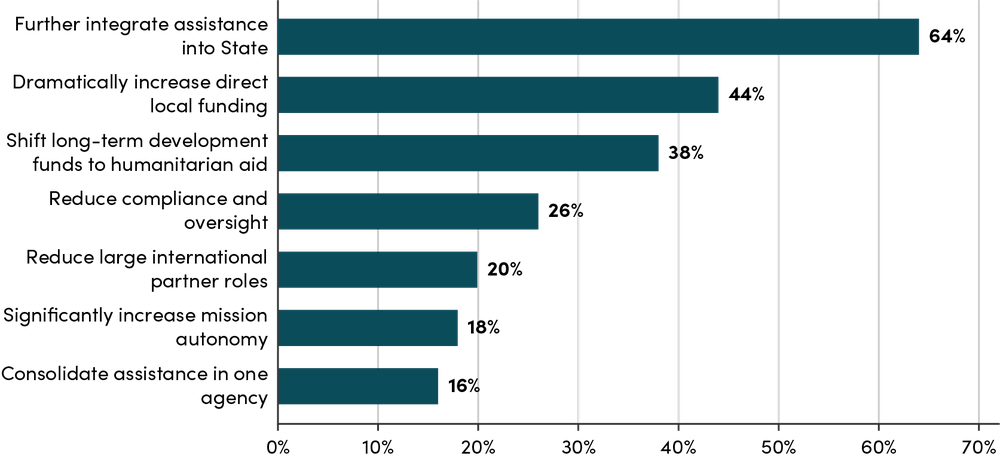
N=50. Multiple responses permitted; percentages do not sum to 100 percent. The question measures caution about aggressive implementation, not categorical opposition.
One caveat shapes how these findings should be read. As former USAID personnel, respondents had professional experiences and identities shaped by the agency and might be expected to value its institutional autonomy, expertise, and role in managing foreign assistance. Their caution about further State Department integration or rapid increases in direct local funding could therefore reflect some degree of institutional attachment, in addition to their judgment about development effectiveness. Their responses may also have been shaped by the circumstances in which the survey was administered, following USAID’s rapid and wrenching dismantling and the transfer of its remaining functions to the State Department. Views might have differed if respondents had been assessing a more deliberate, carefully planned integration designed to preserve development expertise and operational capacity. This possibility does not negate their concerns, but it does make the reasoning provided in their qualitative responses particularly important.
An exploratory comparison of the responses by tenure provides some support for this concern, while also adding nuance. Seventy-one percent of those respondents with 20 or more years of USAID service (24 of 34) cautioned against further State Department integration, compared with 47 percent of those with shorter tenures (7 of 15). The difference is consistent with the possibility that institutional attachment was stronger among longer-serving personnel. Yet nearly half of the less-tenured respondents expressed the same concern, suggesting that it was not limited to the agency’s longest-serving veterans. Given the small subgroup sizes, this comparison is descriptive rather than conclusive.
Acknowledging these cautions, the qualitative responses suggest that respondents’ resistance to blunt solutions reflected a broader skepticism toward universal reform prescriptions in a field where context and time horizons matter greatly. That skepticism also extended to proposals commonly presented as alternatives to traditional assistance, including greater reliance on domestic resource mobilization.
“Development is a long-term, generational endeavor, without a one-size-fits-all answer. What works in one country is not easily transferred to another, even in the same region.”
— A former USAID practitioner
“USAID worked for decades on tax reform, fiscal policy, and private sector engagement, and has had significant success. However, this experience has made clear the natural limits of domestic funding, depending on the country and income level.… It is not a catch-all solution.”
— A former USAID practitioner
With many of the functions of USAID already subsumed into the Department of State, practitioners’ concern about further integration might seem misplaced or appear to reflect resistance to greater alignment between development and foreign policy. The qualitative responses suggest, however, that the concern was not a vote against coordination. Respondents supported alignment with foreign policy and integrated country planning, but they worried that institutional integration would erode specialized development expertise that was essential for development effectiveness. Their qualitative responses suggest that what must be preserved is not only individual technical expertise, but the institutional memory, learning systems, operational knowledge, and relationships that allow that expertise to be used effectively.
“The cultures of diplomacy and development—in terms of training, experience, and objectives—are different, and the merger of development assistance into State fails to recognize this. USAID’s programs were always a tool of U.S. foreign policy, and the incorporation of [USAID’s country strategy] into the overall country strategy was a critical interface. Nevertheless, the loss of development practitioners has created weaker country strategies—and weakened the ability to implement them effectively using a development lens.”
— A former USAID practitioner
4. Local leadership was broader than a funding channel
Locally led development has been a clarion call for reform of international development for several years, forming an important subset of external critiques of US assistance. When asked to select three changes that would have significantly improved USAID’s effectiveness, however, only 9 percent of experienced practitioners selected increased direct local funding as a top reform, while 44 percent warned against pursuing it too aggressively. The qualitative evidence provides important context for understanding this result. In open-ended responses, respondents highlighted meaningful local ownership as an important contributor to development impact and sustainability. They strongly valued country ownership, local professionals, consultation, field relationships, and use of country systems. At the same time, respondents questioned whether an approach focused solely or principally on tracking direct-award percentages measured a genuine transfer of voice, authority, and leadership, or adequately addressed differences in context, fiduciary readiness, and organizational sustainability.
“Our strategic planning processes greatly improved … because of our more focused efforts to listen to host-country stakeholders, demonstrate that their views were reflected in our strategies, and increase local ownership and engagement…. We often heard people say, ‘No one has ever asked us.’”
— A former USAID practitioner
“Solving development challenges often requires hard political decisions by local actors. Resources alone, used as a carrot, [do not] lead to sustainable change. You end up with pilots or short-lived gains which fade with time, because the reform lacked political/local buy-in.”
— A former USAID practitioner
“Forcing missions to give a significant percentage of the money they manage to local organizations may make some in Washington feel like they are advancing local development, but it can lead to poor outcomes and weak results…. There are better, more country- and case-specific ways to empower local organizations. Field missions are better placed to determine what those are.”
— A former USAID practitioner
A more meaningful assessment of locally led development would therefore examine whether local actors helped establish priorities, shaped strategies and program designs, exercised substantive decision-making authority, and believed that their knowledge and perspectives influenced the development process, not only what percentage of funding they received directly.
5. Accountability needed redesign, not abandonment
Perhaps the most unexpected finding was that reducing compliance requirements, often cited in the literature as a key problem, did not rise to the top of the list of prioritized reforms. Only 9 percent of respondents selected reduced compliance and reporting as a top-three reform, and 26 percent warned against reducing oversight too aggressively. While respondents identified excessive compliance burdens and internal risk aversion as obstacles to impact, their qualitative responses made an important distinction. Their concern was primarily with process-compliance requirements, such as duplicative clearances and additive reporting, that consumed time without improving decisions. They favored streamlining those requirements while strongly supporting retention of accountability for strategic outcomes, transparency, and responsible stewardship of taxpayer resources. The policy implication for future US global development is smarter and more proportionate accountability that facilitates more rapid decision-making and adaptation while ensuring responsibility for results.
“The over-reliance on program approval documentation was a burden…. These approvals were integrated into the procurement process and were duplicative. We spent more time on activity approval documents than reviewing actual proposals for selection. This process did not improve the overall outcome and merely wasted time.”
— A former USAID practitioner
“Each new reform or initiative would add more requirements—the old requirements would never simply go away. A 20-page report became a 30-page report…. Program managers would need to hound implementing partners for additional data, and missions would need to carve out chunks of time to prepare reporting for Washington. Was the time spent on these additive exercises really worth it?”
— A former USAID practitioner
“A U.S. foreign assistance program uses taxpayer funds appropriated by Congress. Americans deserve to have their money spent in the most effective and efficient manner possible, without fraud, waste, and abuse…. Strong oversight procedures go a long way toward maintaining congressional and public support.”
— A former USAID practitioner
The distinction between formal compliance and genuine accountability also revealed an important underlying theme concerning transparency. Several respondents connected transparency with responsible stewardship of taxpayer resources, congressional credibility, and public trust. But transparency requires more than producing information. As one respondent observed, “USAID was excellent at transparent reporting that went up on websites or over to Congress and which no one ever read.” Another argued that if foreign assistance is truly to be “From the American People,” it requires “intentional and consistent two-way engagement with the taxpaying public.” These responses suggest that respondents saw a need for more than streamlined reporting or additional published data. They emphasized clearer communication about what foreign assistance is intended to accomplish, how decisions are made, what results have been achieved, and what has been learned when programs fall short.
6. Workforce capability—and the space to use it—was critical to effectiveness
Respondents identified longstanding problems with the workforce system as a key obstacle to effective foreign assistance. Respondents noted shortages and the erosion of technical expertise, as well as weaknesses in recruitment, training, performance management, and leadership selection, all predating the agency’s 2025 dismantling. Together, these problems impaired agency performance. The central issue was not simply whether USAID employed capable people, but whether its personnel and operating systems enabled them to use their expertise effectively. Respondents associated stronger development performance with circumstances in which the overall workforce system gave staff the authority, time, and support to use their expertise.
“The decision to make USAID staff ‘managers of managers’ was the beginning of a significant decline in USAID staff capabilities. As the world requires more technical solutions, perhaps a ‘new USAID’ should stop trying to do everything ... enhance staff technical capability… and stop focusing on internal administrative processes.”
— A former USAID practitioner
The qualitative responses also suggest that workforce capability should not be understood simply as possessing technical expertise. Respondents did not value technical expertise merely as a static organizational asset. Rather, they valued knowledgeable practitioners’ ability to combine expertise, relationships, authority, and institutional standing to influence development outcomes. USAID personnel were valued not only for managing programs, but more importantly for engaging in policy dialogue, convening stakeholders, building coalitions, and cultivating local relationships to influence the institutions and policies that ultimately determine whether development gains are achieved and endure—in short, their ability to engage in effective development diplomacy. Respondents emphasized that this capability rested heavily on experienced local staff who brought trusted relationships and deep knowledge of national institutions and political conditions.
“We should not underestimate the convening power and influence that USAID development leadership … had overseas. As a result of our authorities, expertise, and … distinction from State, we had gravitas and a focus that fueled our success in development diplomacy.”
— A former USAID practitioner
“The hiring of local experts as the main staff in-country wherever development work is happening, and their empowerment to the greatest extent possible, foster relationships of trust with local stakeholders, provide deep insight into local socioeconomic and political conditions, and monitor program performance as both partner-country nationals and development experts.”
— A former USAID practitioner
Practitioner perspectives and external critiques: Agreement, qualification, and divergence
Comparing the survey findings with the external critiques reveals substantial agreement about USAID’s weaknesses, important differences over proposed solutions, and a distinctive practitioner perspective on how the agency’s constraints interacted in practice.
Areas of convergence
Experienced practitioners agreed with important elements of some external critiques. They believed that USAID needed substantial reform. In particular, they agreed that priorities had become diffuse, with many political directives and fragmented, often competing, demands that undermined strategic coherence. They agreed that procedural burdens and organizational risk aversion impeded adaptability, and many associated meaningful local ownership with stronger and more sustainable development outcomes. The results show that experienced insiders did not simply defend USAID or dismiss criticism.
Areas of qualification or divergence
Respondents often disagreed with how external critiques framed issues or with proposed reform solutions. Importantly, while they supported strong alignment of foreign policy and development goals, they feared that further State Department integration would weaken development expertise, fiduciary responsibility, and long-term impact rather than strengthen foreign-policy alignment. They viewed direct-award percentages as an inadequate measure of local ownership, and they counseled caution against significant reductions in oversight without ensuring accountability for results. While they consistently favored reform, they did not validate the broad portrayal of USAID as fundamentally wasteful or ineffective, and they strongly resisted blunt solutions.
What the practitioner perspective adds—and leaves unresolved
Perhaps the survey’s most distinctive contribution is explaining how the various concerns were connected. Externally imposed constraints, competing priorities, internal risk aversion, burdensome procurement rules, excessive reporting demands, and weak workforce systems together formed an operating model that constrained judgment and diverted staff time from their primary development mission. Thus, experienced practitioners highlighted something not prominent in external critiques: development effectiveness depended not only on designing and administering awards, but on development diplomacy, the use of expertise, relationships, convening power, and policy dialogue to influence institutions and produce change beyond individual projects.
This finding also introduces a tension that the survey cannot resolve. Although respondents feared that further integration into the State Department would erode development expertise and long-term effectiveness, the functions they valued (policy dialogue, convening, coalition building, and institutional influence) overlap substantially with traditional diplomacy. This could support the argument that closer integration would allow diplomacy and development to reinforce one another. The Modernizing Foreign Assistance Network (MFAN) has proposed one possible hybrid approach. While continuing to favor an independent assistance agency, MFAN has argued that, if development and humanitarian functions are permanently housed within the State Department, they should retain a coherent organizational structure, substantial autonomy, and senior leadership capable of bringing the development perspective into high-level policy deliberations.[14]
Further research and structured discussions among development practitioners, diplomats, and local counterparts would help identify the institutional arrangements most likely to achieve complementarity while preserving specialized expertise, field relationships, implementation capabilities, and a long-term development perspective.
Conclusion and key policy areas for reform
The survey results make it clear that those with extensive knowledge and experience of USAID did not believe the status quo was adequate. They generally regarded the agency as capable of producing important results, but they also saw substantial unrealized potential and a compelling need for reform. The reforms they prioritized, the obstacles they identified, and the capabilities they wanted preserved offer guidance for the future of US global development.
Their responses point toward a system:
- organized around fewer strategic priorities;
- flexible enough to adapt as evidence and conditions change;
- grounded in deep development expertise, strong field relationships, and local ownership; and
- accountable for results and responsible stewardship rather than procedural compliance alone.
Such a system would give skilled practitioners more room to exercise judgment and engage in development diplomacy—using policy dialogue, convening, coalition building, and sustained local relationships to shape the policies and institutions that transformational and enduring development requires.
Agreeing that the system should focus on fewer priorities does not resolve the important and difficult question of what those priorities should be. The survey did not ask respondents to choose among humanitarian, development, economic, or geopolitical objectives, or within development, among areas such as global health, climate change, education, democracy and governance, and private-sector growth. Those choices are inherently political and will require explicit deliberation among the executive branch, Congress, and, most importantly, partner countries. The survey’s narrower contribution is to underscore the need to do the work upfront: agree on a limited set of coherent priorities that can set realistic expectations for what is achievable and guide resource allocation.
Such work will be difficult because setting strategic priorities ultimately means deciding what not to do, what issues the United States will not address in a given country. USAID’s moral impulse, and the commitment of personnel who devoted their careers to improving the lives of others, understandably made it difficult to leave compelling needs unmet. Washington’s political realities reinforced that impulse: issue-specific constituencies mobilize forcefully if a sector they champion is excluded from a country program. Yet the difficulty of making such choices is not an argument against prioritization. Efforts to accommodate every worthy need and constituency spread resources, leadership attention, and technical capacity too thinly to achieve transformational results. USAID’s dismantling, wrenching as it was, has created an opening for the executive branch, Congress, partner countries, and other stakeholders to confront these tradeoffs explicitly and acknowledge that aid effectiveness requires saying no to some worthwhile activities in some places. Durable agreement on those limits would make genuine strategic focus—and demonstrable progress that can help rebuild public confidence—possible.
Strategic focus matters not only at the agency and sector levels, but also within individual operating units, especially field missions if they continue to exist. Missions of the future should work hand-in-hand with local actors to identify a limited number of consequential policy or institutional reforms and build shared, deliberate strategies for advancing them, combining programs, relationships, senior-level advocacy, donor coordination, and private-sector engagement. Local ownership, therefore, would be a matter of who establishes priorities, shapes strategies, and exercises substantive decision-making authority, not simply the percentage of funding awarded directly to local organizations.
Addressing weaknesses in the workforce system will be a major undertaking. The findings indicate that recruitment, training, performance management, and leadership selection all mattered, as did the operating environment in which personnel worked. As the workforce system is reimagined, recruitment, training, work objectives, and promotion criteria will need to reward the capabilities development diplomacy requires: political and institutional analysis, policy dialogue, convening, coalition building, and judgment under uncertain conditions. Otherwise, personnel systems will continue to signal that administering awards and satisfying procedural requirements matter more than influencing the policies and institutions on which enduring development depends.
The unexpectedly low priority assigned to procurement and compliance reform suggests that practitioners viewed these burdens as part of a larger operating system characterized by proliferating demands, conflicting priorities, rigid requirements, and risk-averse incentives, not as a discrete problem that procurement reform alone could solve. These forces together limited adaptability and focused accountability on low-value processes, rather than achieving the results that mattered most. Reforming procurement rules alone would therefore be insufficient. A future system must distinguish between controls essential to responsible stewardship and accumulated requirements that add little value, while creating greater clarity about priorities and accountability for outcomes. Doing so would not merely make program administration more efficient, but would also allow skilled professionals to devote more time to policy dialogue, coalition building, and institutional influence.
Respondents did not say so directly, but their findings carry a further implication: a future foreign-assistance architecture and system will require active and meaningful congressional participation in its design. Agreeing on a limited set of strategic priorities and reimagining the compliance and workforce systems are each a tall order. Reform developed solely or primarily within the executive branch, even if technically sound, is unlikely to endure if Congress does not share its strategic priorities, accept its allocation framework, and have confidence in its accountability mechanisms. Congress should be treated as a co-author of durable reform, not merely as an external constraint to be managed. Otherwise, congressional directives and earmarks will persist as constraints well into the future.
Finally, the durability of any reformed foreign assistance system will depend not only on better strategy, greater flexibility, and congressional agreement, but also on rebuilding a constituency among the American people, as several respondents noted. Rebuilding that trust will require transparency designed to foster understanding, not simply reports that satisfy formal requirements but attract little attention. Building that understanding and trust will be essential to recreating a foreign assistance system capable not only of producing results, but of sustaining the political support required to pursue them over time.
OpenAI’s ChatGPT was used as an analytical and editorial aid in developing and applying the qualitative coding framework, conducting exploratory cross-tabulations, organizing the findings, drafting initial data interpretation, and refining the manuscript. The author reviewed the outputs, made all final analytical, interpretive, and editorial judgments, and takes full responsibility for the analysis and conclusions
Appendix: Additional survey methodological information
Initial participants were drawn from the author’s professional network of former senior USAID officials, who in turn were asked to recommend other experienced practitioners whose perspectives should be included. Recruitment sought a range of experience across six broad practitioner lenses:
- agency and mission leadership
- technical and sectoral expertise
- program and operational management
- acquisition, contracting, and financial management
- legal, monitoring, and evaluation functions
- policy, legislative, and interagency coordination
Despite these efforts, the completed sample included relatively fewer respondents from acquisition and assistance, humanitarian assistance, legal, and certain management specialties.
The survey was administered online through Qualtrics. Invitations were distributed in two waves, with invitations and reminders sent between July 12 and August 7, 2026. Of the 49 respondents who completed the professional-background questions, 43 percent reported that their most senior position had been in Washington leadership, 27 percent had served as office directors, and 16 percent as mission directors. The survey is available here.
The open-ended questions generated 283 response records from 52 respondents, of which 279 were considered substantive and coded. A preliminary thematic framework was tested on a varied pilot sample drawn from all six open-ended questions and revised before being applied to the full set of responses. The resulting 26-code framework preserved distinctions among related issues—including technical expertise, personnel systems, staff capacity and time, and development diplomacy—while allowing unanticipated themes to emerge. Primary and secondary themes were recorded, and ambiguous or overlapping responses were reviewed during the synthesis. Qualitative findings were then compared with the quantitative results to identify areas of convergence, qualification, and disagreement. Quotations considered for publication were separately screened for relevance, context, and possible identification risk.
Exploratory cross-tabulations by tenure, departure year, and most senior position indicated that the principal findings were broadly consistent across respondent groups. Strategic focus and implementation flexibility remained leading priorities, and congressional directives remained the most frequently identified obstacle. Some suggestive differences emerged: respondents with 20 or more years at USAID expressed greater caution about further State Department integration, while less-tenured respondents more frequently identified organizational culture and resistance to change as obstacles. Given the small and uneven subgroup sizes, these differences should be treated as descriptive and as possible subjects for further research rather than as statistically conclusive findings.
The survey was deliberately limited to former USAID personnel to keep the initial inquiry manageable and to focus on the perspectives of people who had worked within the agency. It did not include personnel from USAID contractors and grantees, other implementing partners, or multilateral development institutions. These groups would bring valuable, and potentially different perspectives on USAID’s strengths, limitations, and relationships with external partners. Comparative research involving them would therefore be a promising area for subsequent inquiry. Future research could also examine whether Washington- and field-based practitioners differ in how they view organizational risk, implementation flexibility, and the appropriate distribution of decision-making authority.
Thanks to Marcelo Silva Oliveira Goncalves, who assisted with the survey administration and data collection for this note.
[1] Julia F. Irwin, “The Origins of U.S. Foreign Disaster Assistance,” The American Historian 15 (2018): 43–49, https://www.oah.org/tah/february-4/the-origins-of-u-s-foreign-disaster-assistance/
[2] Lael Brainard, “Foreign Assistance Reform: Successes, Failures, and Next Steps,” testimony before the Subcommittee on International Development and Foreign Assistance, Economic Affairs, and International Environmental Protection, Committee on Foreign Relations, U.S. Senate, June 12, 2007.
[3] In her 2007 Senate testimony, Brainard identified PEPFAR, the Millennium Challenge Corporation, the State Department’s Office of the Director of Foreign Assistance, and assistance administered by the Departments of Defense, Agriculture, and Treasury as examples of the proliferating institutional arrangements and overlapping jurisdictions.
[4] See, for example, USAID OIG Audit on Global Health Supply Chain Oversight Weaknesses and House Oversight Hearing: “How Foreign Aid Lost Its Way”.
[5] CGD, Advancing the Evidence Agenda at USAID (2017).
[6] The Role of Science, Technology, Innovation, and Partnerships in the Future of USAID (National Academies 2017).
[7] Establishing USAID as a Leader in Evidence-Based Foreign Aid (CGD 2020).
[8] National Research Council, Improving Democracy Assistance: Building Knowledge Through Evaluations and Research (Washington, DC: National Academies Press, 2008); USAID Office of Inspector General, Additional Actions Are Needed to Improve USAID’s Democracy, Human Rights, and Governance Programs, Audit Report 8-000-20-001-P, November 26, 2019; Miguel Niño-Zarazúa et al., Effects of Swedish and International Democracy Aid (Stockholm: Expert Group for Aid Studies, 2020).
[9] See, for example, Tedros Ghebreyesus, The end of aid is an opportunity for sustainable self-reliance.
[10] Mark Green, An American Approach to Foreign Assistance (2025).
[11] USAID Updated Guidance to Address Inconsistent Use of Journey to Self-Reliance Metrics and Misalignment of Missions’ Budgets (2020).
[12] Fine, Patrick. “USAID Can’t Go It Alone on Localization.” Brookings Institution. February 5, 2024.
[13] Ninety percent of respondents rated USAID very or somewhat effective, while 59 percent said it needed significant reform, fundamental restructuring, or complete redesign.
[14] Modernizing Foreign Assistance Network, The Future of U.S. Development and Humanitarian Assistance: Recommendations for Influence and Impact (March 2025). The author serves on MFAN’s steering committee.
Topics
CITATION
Weisenfeld, Paul. 2026. What Would We Have Done Differently? Insider Lessons for the Future of US Foreign Assistance. Center for Global Development.DISCLAIMER & PERMISSIONS
CGD's publications reflect the views of the authors, drawing on prior research and experience in their areas of expertise. CGD is a nonpartisan, independent organization and does not take institutional positions. You may use and disseminate CGD's publications under these conditions.
Thumbnail image by: R.Gustafson / USAID