Recommended
Blog Post
A Surplus of Workers, a Shortage of Jobs

CGD NOTE
Do We Have Enough Workers?

Developing countries have made real progress in getting young people through school, and much less progress in giving them somewhere to work once they finish.
According to the World Bank, the lower-secondary completion rate in sub-Saharan Africa went from 27 to 44 percent between 2000 and 2023, and in South Asia from 56 to 87 percent between 2001 and 2024 (see figure). Tertiary enrollment in sub-Saharan Africa more than tripled between 2000 and 2018 (the latest year in the series used here). Granted, years in school do not tell us everything about what children learn, but it is indisputable that far more young people are completing school, and they have good reason to expect that effort to improve their working lives.
However, over the same period, wage employment (workers earning a wage or salary) has expanded much more slowly as a share of total employment. Between 2000 and 2024, the share of sub-Saharan Africans with wage jobs went from 19 to just 22 percent (as an aside, let’s remember that a wage job does not necessarily pay well, or is a good fit for someone's education, so this figure describe the changing size of the wage labor market rather than whether the jobs available fits what people trained for). My calculations using World Bank data put the number of wage jobs at about 107 million in 2024, more than double than there were in 2000. That sounds good, but the population aged 15 to 64 also roughly doubled. That leaves about 15 wage jobs for every 100 people in that age group, slightly up from about 14 in 2000.
Pulling these two sets of data together tell us an underlying and undeniable reality: This generation has been getting more educated much faster than the economies around it have been creating the kind of work that education is supposed to lead to.
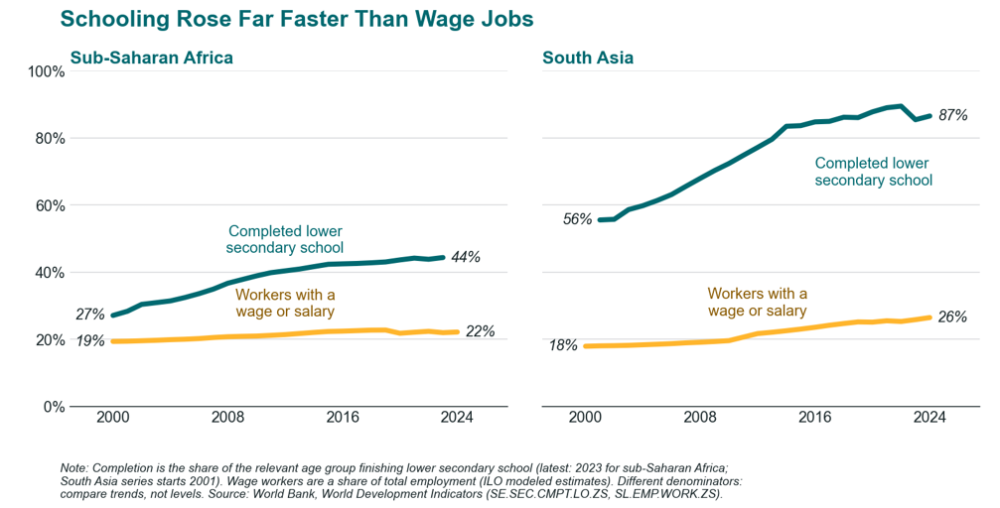
Source: World Bank, World Development Indicators.
Unsurprisingly, given this all, the World Bank has made jobs a priority. In February, Ajay Banga wrote that 1.2 billion young people in developing countries will reach working age over the next ten to fifteen years, while those economies are expected to generate about 400 million jobs on current trajectories.
But this realization (though a welcome development) comes a little too late. For decades the development community invested heavily in building skills and human capital across developing countries, without an equivalent investment to ensure there would be a local labor market to demand that talent. The challenge now is to close that huge gap—within the next few years—through investing in domestic job creation.
I am rooting for this to succeed, and investing in the conditions for firms to hire is essential. But creating jobs on that scale is, like most things, easier said than done. Even the Bank's own World Development Report said as much in 2023: many of these economies "are unlikely to grow sufficiently fast to generate the jobs needed to absorb their young and growing populations," and they "will need additional mechanisms to relieve pressures on the labor market and to offer their youth development opportunities."
That is, I think, a polite way of saying migration.
Lant Pritchett calculates that without migration, the rich democracies would lose 121 million working-age people between 2020 and 2050, while Africa and South Asia together would gain more than a billion. Connecting the two requires visas, language preparation and recognition of qualifications.
There are programs that already do much of this work. By October 2025, Germany's Triple Win program had placed more than eight thousand nursing professionals and trainees with employers, and more than six thousand had arrived in Germany. It provides language preparation and support with qualification recognition. The Global Skill Partnerships that Michael Clemens proposed while at CGD go further, with destination countries financing training in origin countries for people who then migrate or stay. Funding training for both groups can help origin countries build their own workforce as well.
The experience of the Australia Pacific Training Coalition shows why the employment side needs attention. According to CGD's account, only 1.2 percent of graduates had migrated to Australia by 2014, and the program later put more effort into connecting graduates to jobs abroad.
Training people to an employer's standards is only part of the work. Development institutions should acknowledge that many of those jobs they want to create already exist, except that in other countries. Finance the language courses and credential recognition might be a more cost-effective way to give more people a chance to use the education they have already worked so hard to acquire.
Jobs for those 1.2 billion people looking for one already exist, but many of them are in another country. It is time to admit that reality, and work to facilitate that obvious match.
Topics
DISCLAIMER & PERMISSIONS
CGD's publications reflect the views of the authors, drawing on prior research and experience in their areas of expertise. CGD is a nonpartisan, independent organization and does not take institutional positions. You may use and disseminate CGD's publications under these conditions.
Thumbnail image by: Sergej/ Adobe Stock