Recommended
Blog Post
Impact Data Helped Save PEPFAR. What About Everything Else?
Blog Post
Update on Lives Lost from USAID Cuts
Earlier this year, Refugees International undertook a survey of the evidence regarding the impact of humanitarian assistance cuts. Across countries it found reduced service delivery, including the removal of food rations and basic healthcare, and increasing examples of the use of coping mechanisms that are damaging in the long term, but suggests it had “not identified abrupt spikes in mortality rates in available humanitarian reporting.” The group suggests this “reflects an absence of evidence rather than evidence of absence.” I agree that this is the problem, and think we should urgently address it: we need representative data from humanitarian settings not just to understand the impact of recent aid cuts, but more importantly, to improve our ability to monitor and evaluate humanitarian assistance, and to hold national and global leaders to account. Absence of evidence is an excuse for inaction which ends up with more people dead.
Clarity regarding the impact of aid cuts varies significantly
The picture regarding the impact of US foreign assistance cuts on outcomes is becoming clearer in some health settings. Given the extent of the cuts—as well as the level of disruption caused by stop-work orders—what we do know regarding health outcomes is somewhat reassuring. With regard to HIV services delivered under PEPFAR, for example, we have seen widespread recovery in antiretroviral (ARV) coverage that points to a relatively limited immediate mortality impact. But lower testing, less outreach, and far slower progress in extending ARV coverage points to the risk of more deaths in the future, if not reversed. Regarding Gavi-supplied vaccines, 2025 saw rising vaccination rates and coverage in the poorest countries, including those in conflict, but this may not be sustained in the face of funding shortfalls. And seasonal malaria chemoprevention may have reached more children than ever in 2025, but again, future progress is uncertain.
That said, the picture is considerably less clear with regard to maternal and child health, nutrition, and in particular, outcomes in humanitarian settings. It is hard to estimate or even model the impact of humanitarian cuts because there is little public analysis or data on humanitarian outcomes, and especially representative data and analysis that goes beyond camps—a problem that has, if anything, become worse since the aid cuts.
Data on humanitarian finance and inputs
We know that the US was a dominant financier in some of the countries most at need and in some of the most vital humanitarian sectors. For example, it was responsible for 50 percent or more of recent humanitarian funding supporting nutrition. We know that US foreign assistance disbursements for humanitarian assistance fell from $13 billion in FY2024 to $9 billion in FY2025 (obligations fell from $15 billion to $6 billion). And we know broadly that lives are saved by humanitarian services: (limited) cross-country evidence suggests crude death rates can be as low as background (non-crisis) death rates amongst refugees (largely in camps) and much higher amongst internally displaced: annualized death rates of 22.4 per 100,000 for internally displaced, compared to 5.8 per 100,000 in camps. But how reduced finance translated to outcomes—and in particular mortality—last year is not clear.
The complex links from finance to reach, inputs to outcomes
Take the countries that have UN Humanitarian Response, Flash Appeal, or similar plans. There is a relationship between how reliant countries were on US humanitarian funding in 2024 and the success of 2025 appeals funding, as well as the percentage of targeted populations reached in 2025—but it isn’t that strong. Figures 1 and 2 use humanitarian spending as reported by the UN FTS. On this measure, US humanitarian spending fell from $14 billion to $4 billion between 2024 and 2025, accounting for pretty much all of the global decline from $37 billion to $28 billion. There is a link between a higher dependence on US humanitarian funding in 2024 (as a percentage of global humanitarian funding) and lower total humanitarian spending in 2025, but it is noisy. Again, the link between the percentage of people targeted for support that were reached and the percentage of funding requirements met, is significant, but not overwhelming. And there will be another significant gap between “being reached” and outcomes depending on, for example, the extent of that reach, the depth of need, and available coping strategies. All of this makes the relationship between US funding cuts and health/mortality outcomes complex.
Figure 1. Humanitarian situations historically more reliant on US funding saw bigger funding shortfalls in 2025
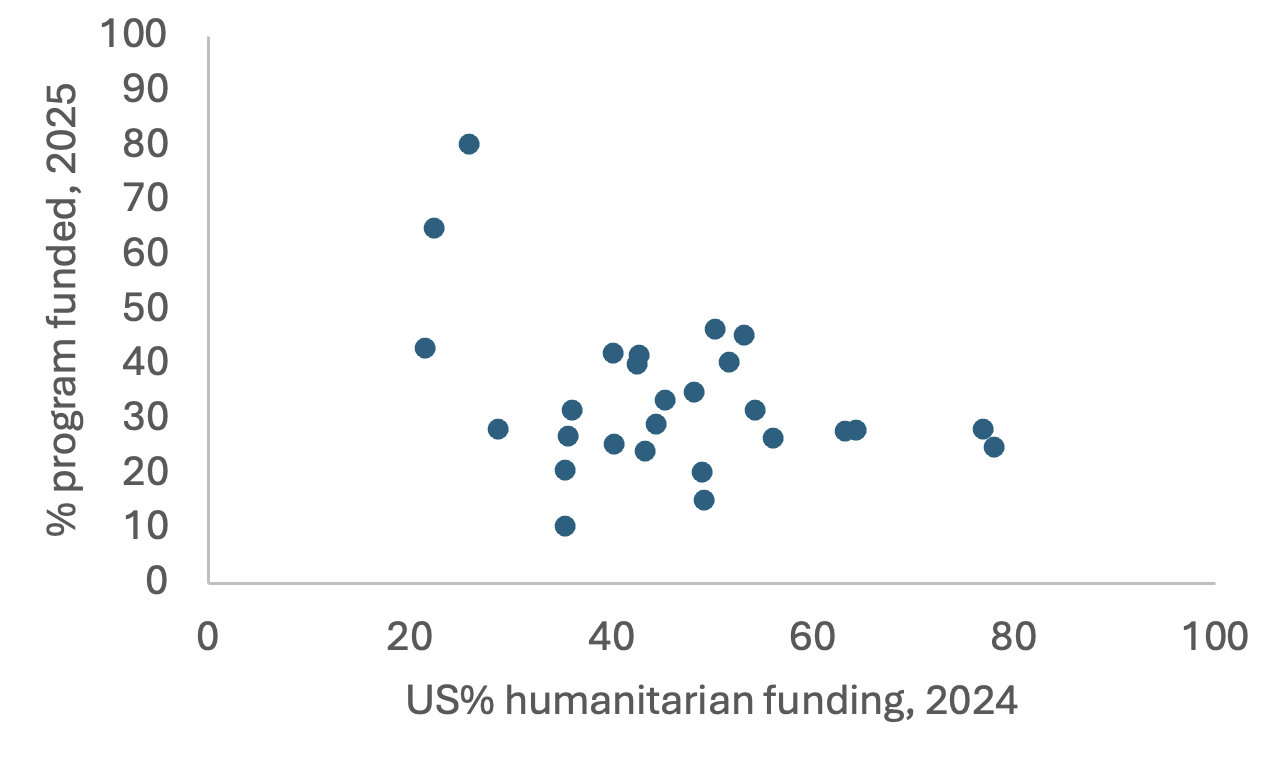
Notes: Humanitarian funding data for 2024 from FTS, humanitarian appeal funding percentage for 2025 from OCHA. Graph excludes outlier, the Philippines: 30% 2024 US funded, 144% 2025 program funded.
Figure 2. Humanitarian situations historically more reliant on US funding saw bigger shortfalls in populations reached by humanitarian assistance in 2025
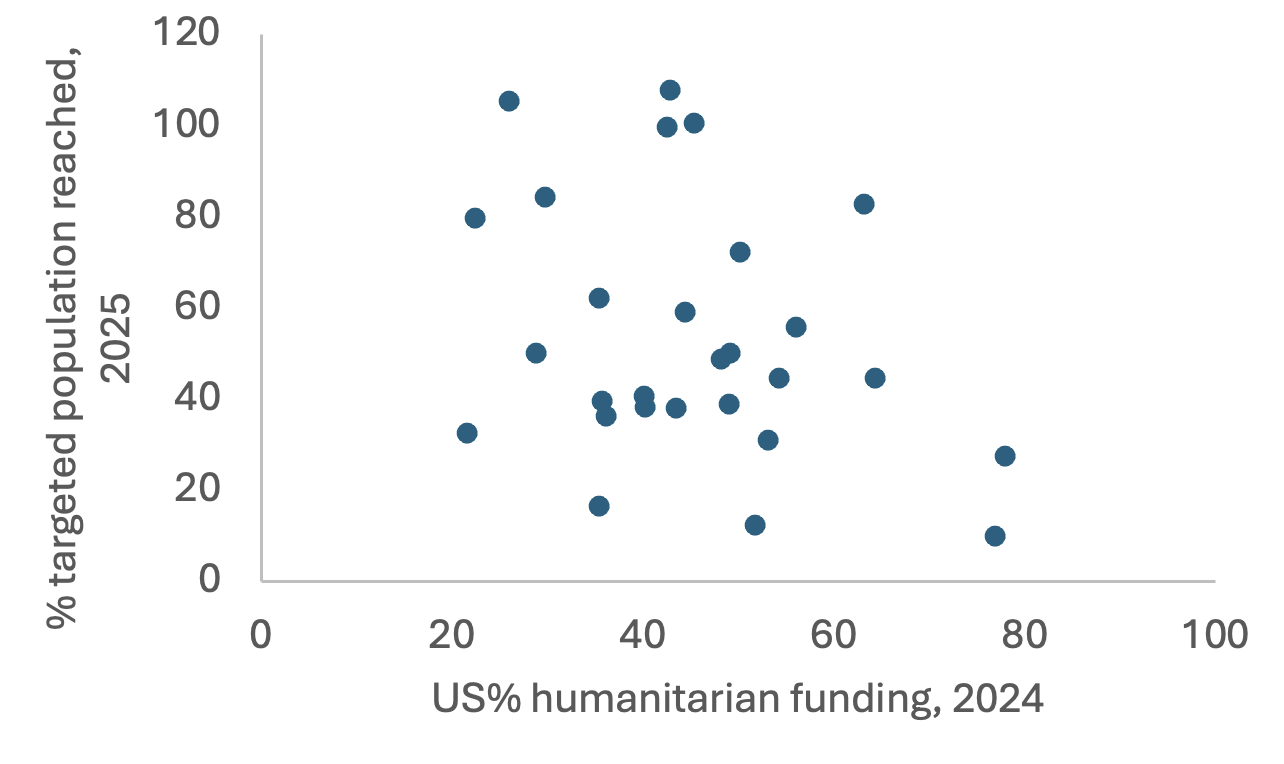
Notes: Humanitarian funding data for 2024 from FTS, % population reached for 2025 from OCHA.
Regarding inputs, the WHO reports that global funding cuts “directly affected 5,687 health facilities across 20 humanitarian settings, including 2,038 that suspended operations, reducing access to services for 53.3 million people (65 percent of the 81.4 million people targeted for humanitarian health assistance)” and that “[d]isruptions to nutrition services are expected to affect 14 million children, including more than 2.4 million who are already suffering from severe acute malnutrition.” But once again, there are not the representative data to translate these input measures to outcomes.
From finance to food insecurity
The humanitarian sector constructs an Integrated Food Security Phase Classification (IPC) covering subnational regions at risk of shortages or famine: phase three implies low enough food consumption that households face high or above-usual acute malnutrition or are depleting essential livelihood assets to avoid that, phase five communities face destitution, acute malnutrition, starvation, and widespread death. This is an extremely important targeting tool for assistance, and can be used to estimate the needs likely to be unmet with humanitarian support.
A recent paper by Marcella Nicolini and Fabio Sabatini looked at IPC outcomes and historical reliance on US humanitarian funding. In the 27 African countries where IPC analyses are produced, regions historically exposed to USAID saw a relative increase in the share of population classified at Phase Four (Emergency) or worse after January 2025. Aggregating across approximately 400 million people in the region in September 2025 suggests 1.6 million additional people in Phase Four and 2.7 million additional people in Phase Three or higher potentially attributable to the US assistance cuts. This will likely have been associated with increased death rates—the IPC classification suggests Phase Four is associated with increased mortality of two to four times the background rate. Over a year of exposure for 1.3 million people would suggest 60,000 or more deaths—but any such estimate would have very large error bars.
Rare (public) data on outcomes
There are periodic efforts to collect and analyze available representative mortality data from humanitarian settings, but these tend to be considerably delayed. More immediate data is available from specifically designed surveys including an in-person household mortality survey in the Democratic Republic of the Congo (DRC) last year, covering North and South Kivu. It suggests a doubling of mortality in the provinces between the periods August 1, 2024 to January 31, 2025 and February 1, 2025 to an August/September interview. The survey reports 165,000 excess deaths in the post-crisis period, equating to 245,000 annual excess deaths, with cause of death dominated by malaria, neonatal causes, and diarrhea.
The survey period coincided with both significant US humanitarian cuts and an M23 rebel offensive in the region. US emergency response disbursements to DRC fell from $805 million to $373 million FY2024 to FY2025. Meanwhile, M23 seized Goma (the capital of North Kivu) on January 27, 2025, a day before the USAID stop-work order, and the capital of South Kivu on February 16. The survey finds that most health facilities in North and South Kivu saw both funding cuts and declining attendance. But it is still hard to disentangle the impact of the intensifying fighting from the humanitarian cuts (it is suggestive that mortality rose similarly in M23-held and government-held areas but government-held areas in this period were themselves also conflict-affected and some changed hands).
The role of conflict in health outcomes is suggested by contemporary Famine Early Warning Systems Network (FEWSNET) analysis. Before the cuts, a March 2024 FEWSNET forecast expected a peak 15 million in need in October to December 2024 concentrated in North Kivu, Ituri, and South Kivu due to population displacement and disruptions to crop cultivation and market functioning. An August 2025 FEWSNET report suggested the peak for the period August 2024 to July 2025 would reach 16 million, occurring in February to April, and this number would go higher because the “rapid intensification and territorial expansion of conflict in early 2025 in North Kivu, South Kivu, and Ituri provinces caused massive population displacement, reduced the Season 2 harvest and Season 1 planting, and drove up staple food and non-food prices.”
The DRC case provides an example of why it will always be difficult to make clean estimates of lives saved by humanitarian assistance or lives lost due to its absence in a particular setting, even with outcome data. But the Nicolini and Sabatini paper using IPC classifications demonstrates that with sufficient repeated data, it is possible to estimate effects over time and across settings—and better mortality data from repeated surveys would allow for far more accurate estimates. That suggests the need for far more timely, published data on outcomes in humanitarian settings if we are to measure the impact of events including funding cuts.
Patchy, confusing unpublished outcome data
In that regard, there is more data collected than published. Humanitarian organizations do frequently track outcomes for the populations they serve. For example, a recent story in the Independent newspaper reports on UNHCR data on more than three million refugee women across 20 countries. It suggests neonatal mortality rose by 81 percent between 2025 and 2026, deaths within the first year of life increased from 8.3 to 17.5 per 1,000, and under-five mortality increased by 50 percent. But again this unpublished data seem likely limited to outcomes in camps (average sub-Saharan infant mortality in 2024 was 47 per 1,000).
While the humanitarian sector regularly collects data on food prices in markets to feed into food security data, and these are sometimes accompanied by household food security surveys, there is considerably less representative data collection on mortality outcomes. This isn’t and shouldn’t be the job of individual humanitarian organizations carrying out relief work, but is needed by the system as a whole, especially at a time when cuts mean that organizations are collectively reaching fewer of those who are food insecure.
Doing better
The humanitarian community should do a far better job of rapidly publishing the data it has on outcomes in a usable format to the Humanitarian Data Exchange, and there should be a greater effort to aggregate the information. But we also need regular representative outcome data.
This is not a new idea, it was suggested by Francesco Checchi and Les Roberts (one of the authors on the DRC study) in 2008. They noted it can face opposition from governments and combatants, as well as at least potential resistance from some humanitarian actors. It is past time to mitigate that resistance through the creation of a technical, apolitical body dedicated to timely, systematic collection of valid mortality data as Checchi and Roberts proposed.
For that, there is an ongoing effort funded by the UK , US, and the EU to track mortality in humanitarian settings. The write-up of the initiative by Adrienne Testa provides examples of cases where mortality metrics have moved policymakers faster and further than input or malnutrition numbers did. As she notes “mortality evidence can't be optional because uncounted deaths represent a failure of accountability, a gap in our understanding, and a missed opportunity to prevent more.” We need to rapidly extend this effort.
There should be a global, sustained, independent institutionalized system to produce public, representative survey data in regions that are in or enter IPC3 or above status, covering a select few outcomes including mortality. These surveys should be rapidly repeated. It may be that mobile phone surveys are an option in many cases (although results are mixed). A better but more expensive option would be representative household surveys like that carried out in the DRC. As well, it would be valuable to extend and improve in-person nutrition surveys like the SMART system more broadly across IPC status regions, to provide representative data and improve their mortality data collection (at the moment, we are headed in the opposite direction).
The last year has shown how fragile the coalition behind global humanitarian response can become. I think the evidence is consistent with many lives lost as a result of US humanitarian cuts, quite plausibly in the tens of thousands or more, but there simply isn’t the data to make a reliable estimate. In the short term, far stronger data on outcomes could give a better sense of impact and hopefully drive a return to greater financing, but at least as importantly it could improve both the efficacy and sustainability of humanitarian response into the future, allowing a better understanding of drivers of mortality, and better, quicker, more widespread responses.
We are too frequently letting thousands die without even the recognition that their deaths happened. That is a global moral failure, but it is also a failure of the international system we have built to prevent these deaths. The system cannot work more effectively if it does not know where it is working and where it is not, freeing itself, but also perpetrators from accountability.
Thanks to Jeremy Konyndyk, Chris Porter, Nick Leader, and Les Roberts for comments.
Topics
DISCLAIMER & PERMISSIONS
CGD's publications reflect the views of the authors, drawing on prior research and experience in their areas of expertise. CGD is a nonpartisan, independent organization and does not take institutional positions. You may use and disseminate CGD's publications under these conditions.
Thumbnail image by: USAID in Africa/ Flickr