Recommended
Common humanity demands that no one should die of easily preventable conditions, even in the poorest countries and even when local governments are unable to meet needs. The US has played the lead role in a global humanitarian effort responding to that demand, especially with regard to HIV, malaria, and nutrition, alongside maternal and child health. Reforms to US foreign assistance can both honor the compassionate imperative while also improving efficiency, country leadership, and a transition to country financing. But to do so, those reforms must account for the differing capacities of the countries that are part of the process, and design responses appropriately. The rollout of the new Global Health Strategy should be adjusted accordingly. This note outlines the core components of the Memoranda of Understanding (MOUs) that cut against US goals for global health spending and concludes with recommendations for updated approaches: limiting results-based payments to improvement, using fewer indicators, preserving legacy backstops until new systems are operational, guaranteeing a service floor, and, where necessary, continuing support well beyond five years.
The Global Health Strategy points in the right direction
There have long been bipartisan calls for reform to US global health assistance, to break down silos between assistance aimed at different diseases, move toward provision by recipient governments through general health systems, and set a path to transition to domestic recipient financing. These are core elements of the administration’s Global Health Strategy, reflected in country-specific MoUs being agreed with recipient governments.[i]
PEPFAR’s partial transition to government-to-government support in Zambia demonstrates the potential of such an approach if developed over time with sufficient resources: from FY19 to the end of FY24, the number of people on antiretroviral treatment increased by 31 percent, among other improvements. Again, the Global Fund’s agreement with Rwanda involved results-based payments across a number of targets and achieved more with less funding than prior approaches. And many countries have the capacity to deliver more health services through government infrastructure rather than relying on nonprofit and contracted services.[ii] Again, many recipients of global health assistance are comparatively rich, high-capacity countries that should graduate from US assistance so that resources can be focused where they are most needed. Others are approaching that level of capacity and resources, and so a time-bound strategy is appropriate.
At the same time, it is important to remember who the clients are for US global health assistance, and what that implies about the design and pacing of reform.
The clients are people, not ministries
In his State of the Union address that launched PEPFAR, President Bush argued that “our founders dedicated this country to the cause of human dignity, the rights of every person, and the possibilities of every life.” And it was because of those founding principles that the US should “lead the world in sparing innocent people from a plague of nature.” Signing the legislation for PEPFAR a few months later, he declared, “America makes this commitment for a clear reason, directly rooted in our founding. We believe in the value and dignity of every human life. In the face of preventable death and suffering, we have a moral duty to act, and we are acting.”
Similarly, Secretary of State Rubio backed continued financing for PEPFAR as a Senator because "every victim of HIV/AIDS deserves to live a stigma-free life with dignity, respect, and a chance to fight the disease and fulfill their God-given potential." Elsewhere, Rubio argued PEPFAR and related programs "have been able to move the needle closer to an AIDS-free future." And he suggested: "we have come so far in fighting this global crisis since the dark early days of the HIV/AIDS epidemic . . . now is not the time to retreat from the critical work ahead."
President Bush, then-Senator Rubio, and others added that a healthier world—a world made healthier by America—was something that served US national interests. But, like a considerable bipartisan majority of American people, political leaders support providing health assistance and saving lives first and foremost because it is simply the right thing to do.
And this makes clear who the clients are for US health assistance: not governments, bureaucrats, or contractors, but the infected newborn, the malnourished child, the person with HIV, alongside those at risk of infection or illness. If they do not receive the prophylactics, the medicines, and nutrition they need, US assistance has failed. While working with and through local governments is usually the most efficient and sustainable way to meet those needs, if recipient governments do not provide the health services, US assistance has failed as well—just as much as if the contractors or nonprofits previously financed to provide health services had not delivered, this too would have been a failure of US assistance.
Forgetting who the client is has already had dire consequences: in February 2026, Zimbabwe rejected a proposed MoU covering $367 million in health funding because of conditions around data sharing. As a result, more than 100 community health organizations scaled back services and US bridge funding for antiretroviral therapies expired in March. There is a significant risk that HIV rebounds as a result because PEPFAR funding accounted for more than 40 percent of total HIV spending in the country. Modeled estimates suggest there could be tens of thousands of new infections within a year and the potential for tens of thousands of deaths by 2030. The burden of this failure falls on those who have lost access to services; surely the failure is owned in some significant part by those who demanded dramatic systemic change in delivery modality, funding, and attached conditions in a matter of months, potentially without considering a backstop approach. Similarly, Zambia—the model of government-to-government mechanisms under PEPFAR—has walked away from the MoU framework, discontinuing negotiations over demands for a mining access agreement.
Focusing on the client suggests it is vital for the State Department to consider the capacity of partner governments to deliver, the different levels and modalities of support they might need to do so, and/or second-best approaches including continued delivery through non-government channels where necessary. It is also vital to consider the plausible financial burden on recipient countries in terms of cofinancing. And in particular, it suggests the need for caution in the use of results-based approaches.
Payment-for-results agreements with ministries are not with parliaments, providers, or patients
The 34 MoUs issued by August have presented tables of targets for financing, staffing, service delivery, and outcomes covering disease and overall health outcomes. These targets are to be met by recipient governments, and US funding will eventually be allocated on a performance or milestone basis related to them, although many countries will not receive on-budget funding in the short term. For countries that will, available MoU data suggest that proposed State Department awards to governments account for only 8 percent to 29 percent of total FY2026 funding committed in signed MoUs.
The template language for MoUs states that: “In the event that [country] does not make the required co-investment within the specified calendar year, the U.S. Government may unilaterally reduce or cease providing funding to [country] under this MOU in future years . . . In the event [country] does not maintain the [outcome] baselines . . . or achieve the [improvement] metrics . . . the U.S. Government may substantially decrease or eliminate funding for one or more Area of Cooperation in future years.” Specific memoranda suggest if a country misses budget targets, for example, there will be 1:1 or more punishing reductions in US funding.
When they have been signed, MoUs are usually agreed by Ministers of Health. But the documents involve budgetary commitments, in turn usually decided by parliaments. In addition, it is not clear how much the minister can commit in countries with devolved health systems (such as Kenya and Nigeria, for example). Given that, the MoUs can only be contingent. Indeed, US financing under the commitments is specifically contingent on available resources from Congress, while the switch to on-budget funding may take years in some cases. Nonetheless, recipient failure to meet these contingent benchmarks over which signatories have little control will be a trigger for reduced US support, and so failed service delivery.
This is one reason why the results-based approach is not the right model for supporting the continuation of existing life-saving care. Results-based financing approaches have seen some success in expanding and improving services in cases with the recipient government as client (the World Bank’s track record is broadly positive). Such approaches support country ownership and mean that funders pay less if a service is undelivered. But they are the wrong instrument for sustaining a floor of lifesaving service because they are not designed around ensuring that service delivery.
The results-based targets are plentiful and extremely ambitious
Beyond concerns over authority to deliver are those around capacity to deliver. MoUs provide a long list of performance-based targets to be met. Liberia’s has eight outcome metrics and 10 process metrics,[iii] alongside measures of funding in various sub-areas, and counts of lab workers and frontline health workers. Again, MoUs also require countries to fully and rapidly implement a system based on global barcode standards for tracing commodities funded by the US government, set up a national health data warehouse and electronic medical records systems, put in place a system of rewards and penalties for healthcare providers who don’t use those systems, and collect and share a range of outcome and process metrics on a yearly basis. Apparently, failure to meet targets in any of these areas is a reason to reduce US support and additional metrics and conditions may be included in MoU implementation plans.[iv]
It is worth emphasizing the considerable progress expected under the MoUs. In Côte d’Ivoire, the maternal mortality rate is targeted to drop from 385/100,000 to 140/100,000, a 64 percent decline in five years. Child mortality is targeted to fall by nearly three-quarters. Only four countries in the world are reported to have seen that kind of decline in child mortality in five years since 1960, all after prior increases: in Bosnia-Herzegovina 1992–97 (at the end of the war), Cambodia 1976–81 (post-genocide), North Korea 1998–2003 (after a massive famine), and South Sudan 2017–2022 (after the civil war).
Results prescribed under the five-year MoUs in other countries include childhood malaria deaths falling by nearly two-thirds in Kenya and Uganda, a decline of more than 28 percent in maternal mortality in Ethiopia, and of more than 60 percent in Mozambique, and measles cases dropping by more than 90 percent in Liberia. According to the South Sudan MoU, the proportion of people with HIV who know their status will climb from 55 percent baseline to 78 percent, child mortality from 99 to 78/1000 over the same period, and polio vaccination from 67 percent to 85 percent.
And across all countries, the proposed transition period to government provision can be measured in months. As of 30 September 2026, support for PEPFAR by the US Centers for Disease Control and Prevention will end in most countries. The US is shutting down the main global health supply chain contract: most countries have been given a four-month transition period (from May) to find a new system covering procurement, shipment, storage, distribution, forecasting, inventory, and last-mile delivery. Even in countries given additional time such as Liberia, the shift from commodity delivery through U.S. implementing partners is to end in 2027. This is despite the fact that none of the MoUs are yet operational when implementation was planned from April.
The expert consultation commissioned by the State Department on transitioning disease-specific programs into integrated country-led systems suggests the considerable risks of such rushed approaches to service delivery, and the many prerequisites of a successful transition. One reason why this is such a challenge is suggested by surveys of health clinic quality in a number of major US global health finance recipients. Across the Africa region, correct diagnosis of common conditions only occurs in about 62 percent of cases and correct treatment in 40 percent of cases.
Finally, it is worth noting that while MoU performance-based targets are numerous and ambitious, when it comes to being used as the basis for payments, they are simultaneously inadequate as a measure of the health outcomes that the US has traditionally focused on. Survey evidence of the impact of cuts to PEPFAR programming in FY2025 suggests disruptions and program terminations were especially widespread in preventative services (including condom distribution and Lenacapavir provision) and outreach and services to population groups that face a relatively high risk of contracting HIV. Both are threats to the long term goal of the program: to end the HIV/AIDS pandemic as a public health threat by 2030. The fact that prevention and outreach are not part of standard MoU targeting points to this threat persisting, and there are no targets to roll out better bed nets or vaccines against malaria are all signs of a move away from long-term commitments by the US to deliver on an AIDS-free generation and end the scourge of malaria.
Funding goals are unrealistic
Across the MoUs, the transition to domestic government funding is steep and short, involving a decline in US direct support in the first three years alone averaging 30 percent.[v] In Liberia, one of the world’s poorest countries with an income per head of less than 1 percent of the US, the last year of global health funding is 2030, and 2026–2029 funding for commodities will halve from the 2024 level. The US is currently supporting 1,851 frontline care workers in the country. That number will be zero in 2030. South Sudan’s considerable increases in service reach are to occur as the country lifts related health spending from $5 million to $9 million and US support falls from $52 million to $44 million, a net $4 million decline.
While there is considerable variation in country spending commitments under MoUs and some variation in targeted outputs and outcomes, this variation is weakly related to country capacity—despite capacity varying significantly among PEPFAR countries. Not least, while all PEPFAR recipients spend a fraction of the amount that the US does on healthcare per person, the within-recipient range is considerable. Botswana’s health spending per capita is about eighteen-fold that of Burundi’s (Figure 1).
Figure 1. Health spending per capita (USD)
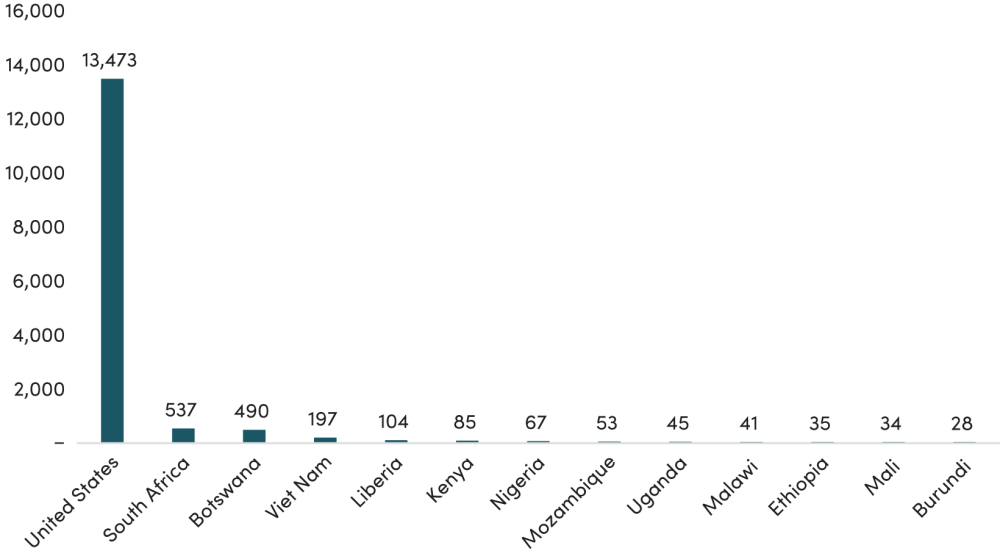
Figure 2. MOU final year country spending commitment as proportion of current health budget
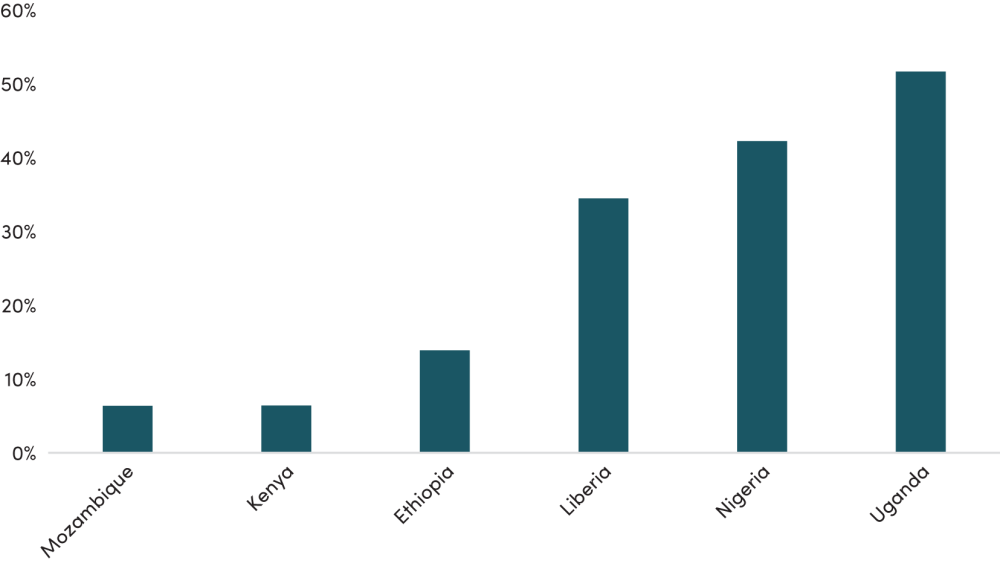
Source (final year from linked MoUs, 2023 health budget, 2030 MoU commitment)
Low-income countries, in particular, have seen very slow growth rates since 2000 and that, alongside a stagnant share of total expenditure, has been reflected in per capita government health expenditures that have hardly changed since then. But Think Global Health’s MoU tracker estimates that the spending commitments in the MoUs suggest the health budget will rise from 5 percent to 10 percent of Nigeria’s budget, 7 percent to 16 percent of Malawi’s, 9 percent to 20 percent of Tanzania’s, and 15 percent to 23 percent of Lesotho’s total budget (the Abuja Declaration set a target of 15 percent of government spending going to health) (Figure 2).
Despite this rapid increase in domestic spend, total health spending in Liberia is projected to be six percent lower in 2030 because of US funding reductions. In Mozambique that drop will be 17 percent. In Ethiopia, Kenya, Nigeria, Rwanda, and Uganda, the net increase will be between zero and eight percent. Alongside rapid improvement in health delivery and outcomes, that implies extremely rapid improvement in the cost-effectiveness of spending.
It is true that the considerable progress against HIV, maternal and child mortality since 2000 in low-income countries has been driven in part by greater spending efficiency: the same dollars producing better outcomes. And moving to country-led service delivery might save 9 percent to 21 percent of total costs from reduced overhead. But the evidence that performance-based approaches in particular save money is contested, and while PEPFAR’s partial transition to government-to-government support in Zambia saw services expand and antiretrovirals delivered at a considerably reduced cost per patient, it is notable that this was a years-long process during which overall PEPFAR spending also increased by 25 percent.[vi]
The journey to self-reliance will take more than five years for many countries
The world’s poorest countries, many included among MoU signatories, will not be in a position to fund basic healthcare without considerable external support in 2030. This is recognized by the administration, which has suggested some countries may need support for up to 15 years, but even that deadline is extremely optimistic.
Countries that reached the Abuja Declaration commitment to spend 15 percent of government budgets on healthcare and had a share of government in GNI of 20 percent would see public spending on health of 3 percent of GNI. A package of the 108 most cost-effective and high-priority health interventions suitable for low-income countries is estimated to cost 5.1 percent of average low-income country GNI. That proportion will be higher in the poorest countries.
Optimistically, with a considerably improved global economic environment, and long-term growth rates largely unprecedented for the group, it is possible to imagine all low-income countries graduating to middle-income status in the 2040s (above $1,145 GNI per capita, with plausible government health spending at that point of about $35 per person per year). This is a more likely (if still exceedingly ambitious) timetable for domestic financing to cover the most basic healthcare. Graduation from US assistance prior to that would need to involve transition to greater support from another agency as part of a multilateral effort to guarantee the most basic care, perhaps based at UNICEF.[vii] It cannot involve simply walking away from existing bilateral commitments.[viii]
And even in the shorter term there is no relationship between the scale of US global health assistance cuts proposed by MoUs at the country level and country capacity: low-income countries Sierra Leone, Burundi, and Niger see annualized cuts in US assistance of over 75 percent, while high-income Panama is the only country to see an annualized increase in US assistance of 42 percent.
Pay for improvement in (a few) outputs, guarantee a support minimum
The record of both government-to-government and program-for-results in health in developing countries suggests some success but also grounds for caution, especially regarding the speed of transition. A (rare) example of using payments-for-results to cover financing outcomes in particular is a World Bank-financed project in Uganda for intergovernmental fiscal transfers including health spending. The project has been broadly successful (and extended), but it took two years from board approval to become effective because parliamentary approval was required (again, parliaments set budgets).
A better approach to moving healthcare to government provision in low-capacity settings—one acknowledged as an option for many countries by the State Department—might build on the experience of the US-funded partnership contracts for health program in Afghanistan that was associated with considerable health gains over 2000 to 2010. While formally run through Afghanistan’s Ministry of Public Health, the program contracted service providers at program start, switching over to government provision as capacity increased. Regarding government expenditures themselves, cost-based reimbursements for commodities and salaries are more appropriate than results-based approaches.
The World Bank’s Independent Evaluation Group suggests that the Bank’s program for results operations nearly always use output (health services delivered) rather than outcome (health gains achieved) indicators to link to disbursements because outcomes take time, are hard to measure accurately, and have multiple contributing factors. World Bank experience also suggests that triggers for disbursements should be few in number, linked to a relatively small share of total program disbursements, and (again) usually for improvement in routine actions. (It is interesting to compare the World Bank’s Ethiopia health program-for results project where some disbursement is linked to a relatively narrow set of indicators to the Ethiopia MoU where all metrics are expected to be met annually for full disbursement). In the case of global health agreements, that suggests results-based payments should be linked (and limited) to improved outcomes in new areas such as delivering malaria vaccines or Lenacapavir.
The key focus of the administration’s global health strategy should be on preserving continuity of lifesaving service provision. This means guaranteeing new service delivery systems are in place with adequate, sustained, and appropriated domestic funding before the old systems are defunded. It suggests focusing in particular on service provision to key populations most at risk. And that all suggests a system where some countries will see at least some parts of health service delivery outsourced into the medium term, results-based payments are limited to improvement over the existing quality of care, and US support continues considerably beyond five years.
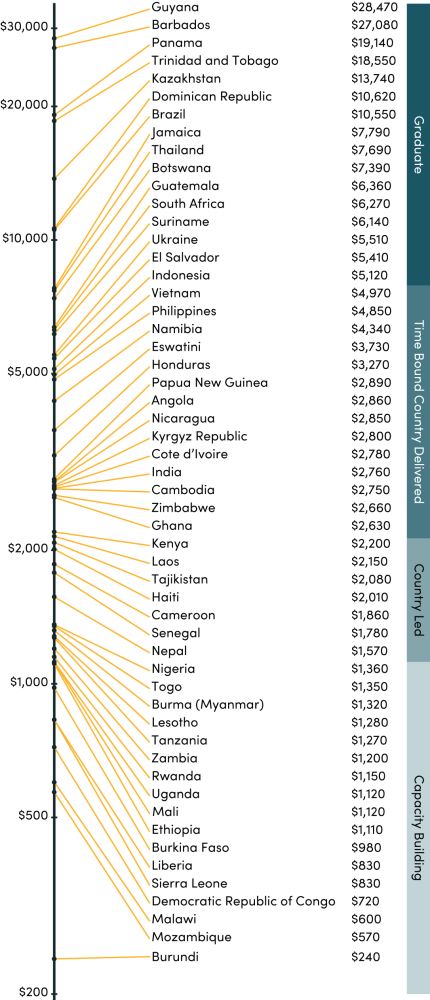
An illustrative cut at sorting countries for suitable approaches toward graduation timelines and levels of country delivery can be based on income per capita (Figure 3, based on PEPFAR countries). Countries with a GNI per capita of greater than $5,000 (a little above the $4,635 cutoff between lower- and upper-middle-income countries) should under usual circumstances be able to afford and deliver a basic package of healthcare without US bilateral assistance and short (five-year) graduations may be appropriate.
Those with a GNI per capita of above around $2,500 should be capable of taking the lead on both finance and delivery even if some additional assistance is needed, and a timebound pathway to graduation may be appropriate as they move toward the upper end of this income band (Gavi’s eligibility threshold is $2,300 and the initiative has successfully graduated 19 countries using a rules-based model).
Countries above $1,500 per capita should be increasingly delivering services, even if still reliant on significant financial and some delivery support. Below that level (and the low-income cutoff is $1,175), while capacity building and a shift toward country provision should be a key component of support, a backstop or even dominant alternative delivery mechanism to ensure countrywide coverage of a basic package of services will often be required (alongside considerable finance).
This categorization should only be seen as a very rough first cut; countries with higher background disease burdens, for example, will require more support for longer, and many other factors come into play. CGD’s Rachel Bonnifield and Janeen Madan Keller have previously suggested a similar but more nuanced division that includes health expenditure and conflict status.
The MoU process as it stands appears to be driven by the goal of reducing US financial inputs by a particular deadline rather than guaranteeing health outcomes. But to quote President Bush, “more Americans are recognizing the timeless truth, ‘to whom much is given, much is required.’ It should be the—and is—the cornerstone of American foreign policy.” Survey evidence suggests Americans still believe that truth, with strong bipartisan support for providing health services and nutrition to those who need it. Countries should be on a journey to self-reliance, backed by support for the international exchange of goods, services, investment, ideas, and people, but for the poorest countries this journey will take decades, not years.
Deliver on the goal
The direction of travel laid out in the Global Health Strategy is correct. To the extent possible, health services should be provided and funded by the countries home to those receiving those services. But MoUs are overestimating the extent to which this is possible, especially in the short term and in the poorest countries, and thereby they are putting lifesaving assistance at risk. In many cases, it is (or should be) clear to the parties involved that MoUs are contracts signed under financial duress with a service provider that cannot credibly commit to the terms. There are additional appropriated funds available to the administration, some already being spent on activities outside of the MoUs, that should be used to ensure backstop continuation of lifesaving health service delivery.
With bipartisan support from Congress, US presidents of both parties have promised to fight the global scourges of HIV and malaria alongside the tragedy of mass child death. We have come so far in the fight, now is not the time to retreat from the critical work ahead. And if the US walks away from that fight before it is sustainably won, there will be nowhere to shift the blame for the deaths that will result.
Figure 3. Country strategy
With many thanks to Jocilyn Estes and Ainhoa Petri-Hidalgo for detailed comments/additions.
[i] Especially given commodity- and disease-specific costs are a declining part of overall assistance, these shifts make ever more sense. For example, PEPFAR-supported drug procurement and delivery through the supply chain costs about $58 per person, per year. Given there are about 23 million people living with HIV in low- and lower-middle-income countries, total drug and supply costs for all of them would cost only about $1.3 billion a year. The far greater costs are around the infrastructure, and that infrastructure should be ‘general purpose’ to the extent it isn’t already.
[ii] Already 75 percent of PEPFAR-supported facilities reporting data in 2024 were government-owned and the proportion may be higher outside of South Africa.
[iii] The targets: % People With HIV Who Know Their Status, % People Who Know Their HIV Status on Treatment, % People On Antiretroviral Treatment (ART) Who Are Virally Suppressed, # of confirmed Malaria Deaths in Children Under 5, # Polio Cases, # Measles Cases Maternal Mortality Rate / 100000, Children Under 5 Mortality Rate / 1000, # people on ART, # new HIV diagnoses among infants (0-18 months), # new HIV diagnoses among children and adults (age 18 months or older), % pregnant and breastfeeding women living with HIV who receive ART, % confirmed malaria cases that receive first-line antimalarial treatment, # insecticide-treated nets distributed to populations at risk of malaria, % surviving infants who received at least one dose of inactivated polio vaccine, % of children aged 12–23 months who received one dose of measles containing vaccine, median number of antenatal care visits for pregnant women, % accuracy of data fields assessed during the annual data audit.
[iv] There are considerable concerns with a number of the measures’ suitability for results-based payments. For example, the HIV outcome metrics are based around targets that 95% of people living with HIV know their status, 95% of those that know their status are on treatment, and 95% of those on treatment are virally suppressed. The statistic regarding the percent of people living with HIV know that their status is uncertain, and in the best of cases subject to error that might reach ten percent or more. Again, HIV-related process metrics around the number of people newly diagnosed with HIV and the number of people on treatment appear to be set with little link between the two, when a successful program would see a clear relationship between more being diagnosed and more on treatment.
[v] Including Global Fund finance the average decline is likely to be closer to 24 percent.
[vi] See also within-country evidence on results-based approaches.
[vii] The World Bank would be another option, although that institution has governments as clients and so may suffer the same weaknesses as the current MoUs in that regard.
[viii]Note a multilateral solution based on fair shares might be unlikely to drive overall US foreign assistance savings given the US still ranks at the bottom of the list of major donors in terms of aid as a percentage of GNI, at less than 0.1 percent.
Topics
CITATION
Kenny, Charles. 2026. Protecting the Client in US Global Health Agreements. Center for Global Development.DISCLAIMER & PERMISSIONS
CGD's publications reflect the views of the authors, drawing on prior research and experience in their areas of expertise. CGD is a nonpartisan, independent organization and does not take institutional positions. You may use and disseminate CGD's publications under these conditions.
Thumbnail image by: Pix4Ads/ Adobe Stock