Recommended

Blog Post
The Development Assistance Committee Sinks to the Occasion?
Blog Post
DAC Chair: We’re Getting There
Which countries should be eligible to receive official development assistance (ODA), and which should no longer qualify? Aid budgets are shrinking, so unless keeping more countries eligible reverses this trend (which is vanishingly unlikely) there is a trade-off: including more countries could mean less aid for others that need it more. Aid is already spread thinly across 141 countries and territories, and so there is a substantial opportunity cost for any expansion in eligibility.
This trade-off is at the heart of an ongoing debate: the OECD’s Development Assistance Committee or DAC (who set the rules on ODA) are considering additional criteria that could be used to determine eligibility, following concerns that gross national income (GNI) per capita (the sole, current criterion) does not capture the vulnerability faced by some countries, especially small island developing states (SIDs). One of the indicators that the DAC have suggested to include is ODA received relative to GDP, with higher values indicating that countries are less ready to graduate.
In this blog I argue that if this is the case, the reverse is also true: that countries with low ODA/GDP ratios are more ready to graduate than GNI per capita alone implies. I examine seven relatively wealthy countries that receive bilateral ODA/GDP below 0.1 percent. Most of the aid they “receive” is either spent in donor countries or is provided as not-that-concessional loans. It is tiny compared to the other flows they receive, and their development outcomes are comparable with the OECD. As my colleague Charles Kenny has noted: aid is not fairy dust and cannot be expected to achieve much where it is macroeconomically insignificant. There are countries that need ODA more.
DAC logic on aid dependency works both ways
Colleagues and I have argued against changing the ODA criteria just to preserve eligibility for a few comparatively wealthy SIDs. This is not because we are dismissive of the vulnerabilities that SIDs face (or any other group), or that we think they will receive too much concessional finance despite not being sufficiently deserving. It is that the average (and certainly the poorest) ODA-eligible countries may be even more deserving, and that they will be the ones to lose out. I simply do not trust that DAC members would rebalance their portfolio in a needs-based way following the addition of new countries.
One way to ensure that such additions to ODA would not come at the expense of needier countries is to look at the other end of the spectrum. If we accept the logic that countries with high ODA/GDP ratios are in particular need, as suggested by the DAC’s recent note on eligibility criteria (“Modernising the DAC Graduation Framework”, July 2026), then we should apply that logic both ways and examine the countries that are comparatively wealthy where aid is essentially irrelevant.
There are seven countries that in 2024, had GNI per capita (measured in purchasing power parity (PPP) terms) above $20,000 and also received less than 0.1 percent of their GDP in ODA from bilateral DAC providers: Argentina, China, Costa Rica, Kazakhstan, Malaysia, Mexico and Türkiye. Each also had GNI per capita above $11,000 measured by the Atlas method (although the PPP measure is a superior metric) and some are already on the verge of graduation.
Total bilateral ODA received by these seven countries was $2.57 billion (which is tiny relative to their economies). But it’s more than half the amount of bilateral ODA received by all SIDs in the same year, and a billion more than SIDs that are within 50 percent of the high-income-country (HIC) threshold.
What does bilateral ODA to richer, low-aid countries look like?
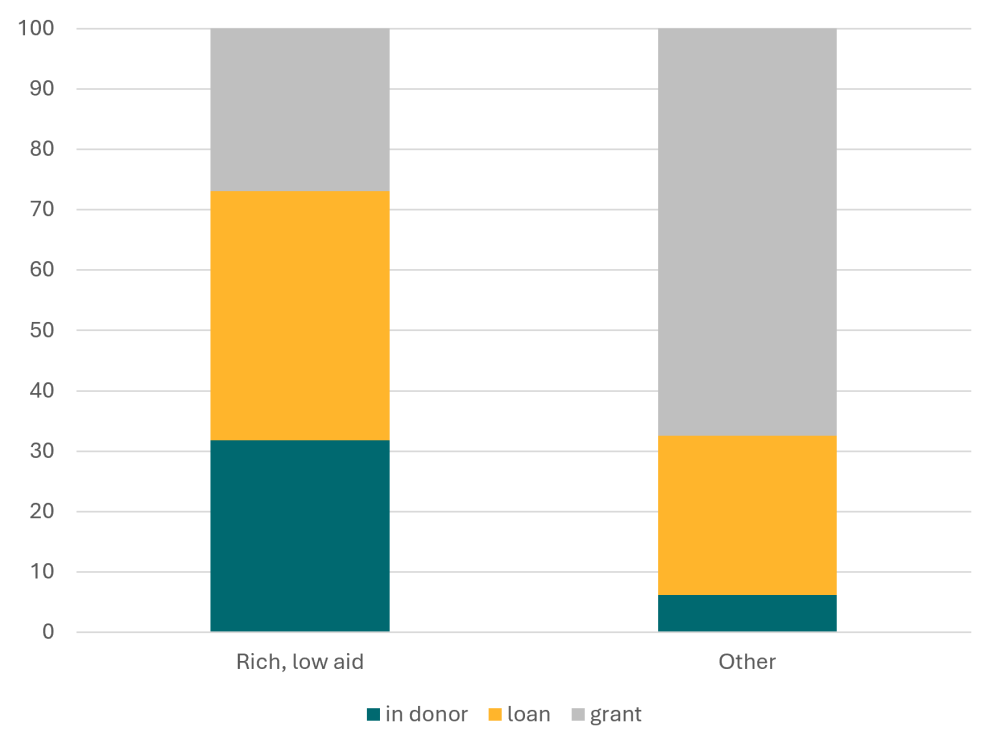
The bilateral ODA profile for these countries (from DAC members) is substantially different from other countries. Nearly one third of bilateral aid “to” these seven countries is spent in donor countries (largely imputed student costs), compared to an average of 6 percent for other countries. Of the bilateral aid that does reach them, 60 percent is in the form of loans, twice the share in other countries. These loans are also much less concessional: the average grant element on loans to the seven countries was 31 percent in 2024, compared to 52 percent for other countries. In other words, far less bilateral ODA actually reaches these countries, and the ODA that does is much more expensive.
Figure 1: Composition of bilateral ODA
Source: OECD CRS
How significant is bilateral ODA to richer, low-aid countries relative to other flows?
In short, not very. Bilateral aid from DAC members to these seven countries comprised just short of 10 percent of total official flows (concessional and non-concessional from DAC and multilaterals). This is in comparison to 40 percent for other countries. That 10 percent is really 7 percent, given the share of bilateral ODA that is spent in donor countries. And of that, most is already loans. It is hard to imagine these countries getting thrown into turmoil because 7 percent of the official finance they receive becomes slightly less concessional.
These countries are also much more likely to have access to international credit markets. All of them have a credit rating, and four of those are investment grade. We can also compare bilateral ODA to broader debt flows from the World Bank International Debt Statistics (although Costa Rica is not included as it is high income, and Malaysia isn’t because it has actively chosen not to borrow from the World Bank). Bilateral ODA is worth 14 percent of such debt flows to other countries, but only 0.7 percent for these seven. It is tiny not just to the size of their economies, but also to the scale of finance they are already getting from elsewhere.
Figure 2: Composition of official flows by country group
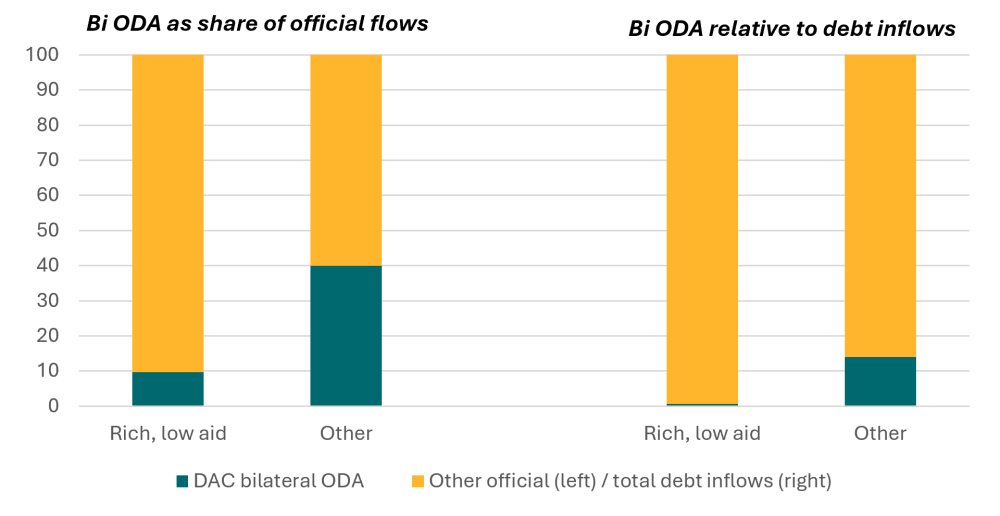
Note: Showing ODA as a share of total debt flows is artificial given that not all ODA is debt, or even reaches the country, but this gives a sense of the relative magnitudes
Source: OECD CRS, World Bank IDS
What are development outcomes like in these countries?
Good, largely. Four of the countries have poverty rates lower than the average among OECD members according to World Bank estimates (two of the remaining—Costa Rica and Mexico— actually are OECD members, despite being ODA-eligible). This is true at both the $3 and $4.2 poverty lines. On human development indicators, as measured by the Human Development Index (HDI), they still lag slightly further behind. But they are generally still much closer to OECD member levels than they are to the average ODA-eligible country. The country with the lowest HDI score is around half-way between the OECD and ODA-eligible country average. China has a similar score, and the rest are well above. There is still progress to be made, but it is hard to make the case that these are needy countries.
Figure 3: Human development index by country
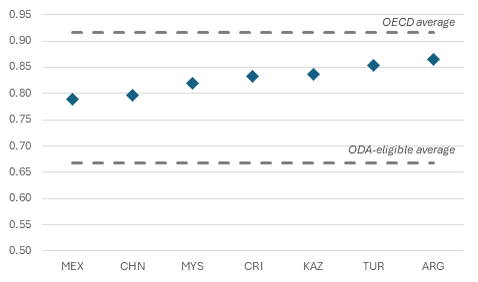
Source: OECD CRS, UNDP Human Development Index
Removing ODA eligibility for richer, low-aid countries will make little difference to them, and could help others a lot
These countries do not need to be ODA-eligible. If they graduated, they would still be eligible to receive climate finance, still receive finance from multilateral development banks, and of course, DAC countries can still provide whatever type of financial assistance they wish. But the $2.57 billion spent in 2024 means little to these countries, and if spread across the poorest 20 countries, would have increased their bilateral ODA by around 15 percent. Their removal from ODA-eligibility follows directly from the logic proposed by the DAC of using ODA/GDP as a measure of aid dependency.
But the broader point is that the DAC should acknowledge the opportunity cost when changing the rules. For every country that the DAC is proposing to add (or for which to delay graduation) because of vulnerability or aid dependency, they should simultaneously ask: “is there a currently eligible country that clearly is not in need of ODA”? That would go a long way towards making this review seem less like a self-serving exercise, and more like a genuine discussion on how ODA can best be prioritised.
If there is any point to the threshold for ODA eligibility, it is to prioritise spending in the countries that need it the most. These are not those countries. Their continued ODA-eligibility suggests that the eligibility criteria are not doing their job.
Topics
DISCLAIMER & PERMISSIONS
CGD's publications reflect the views of the authors, drawing on prior research and experience in their areas of expertise. CGD is a nonpartisan, independent organization and does not take institutional positions. You may use and disseminate CGD's publications under these conditions.
Thumbnail image by: Pexels/Munzir