
Recommended
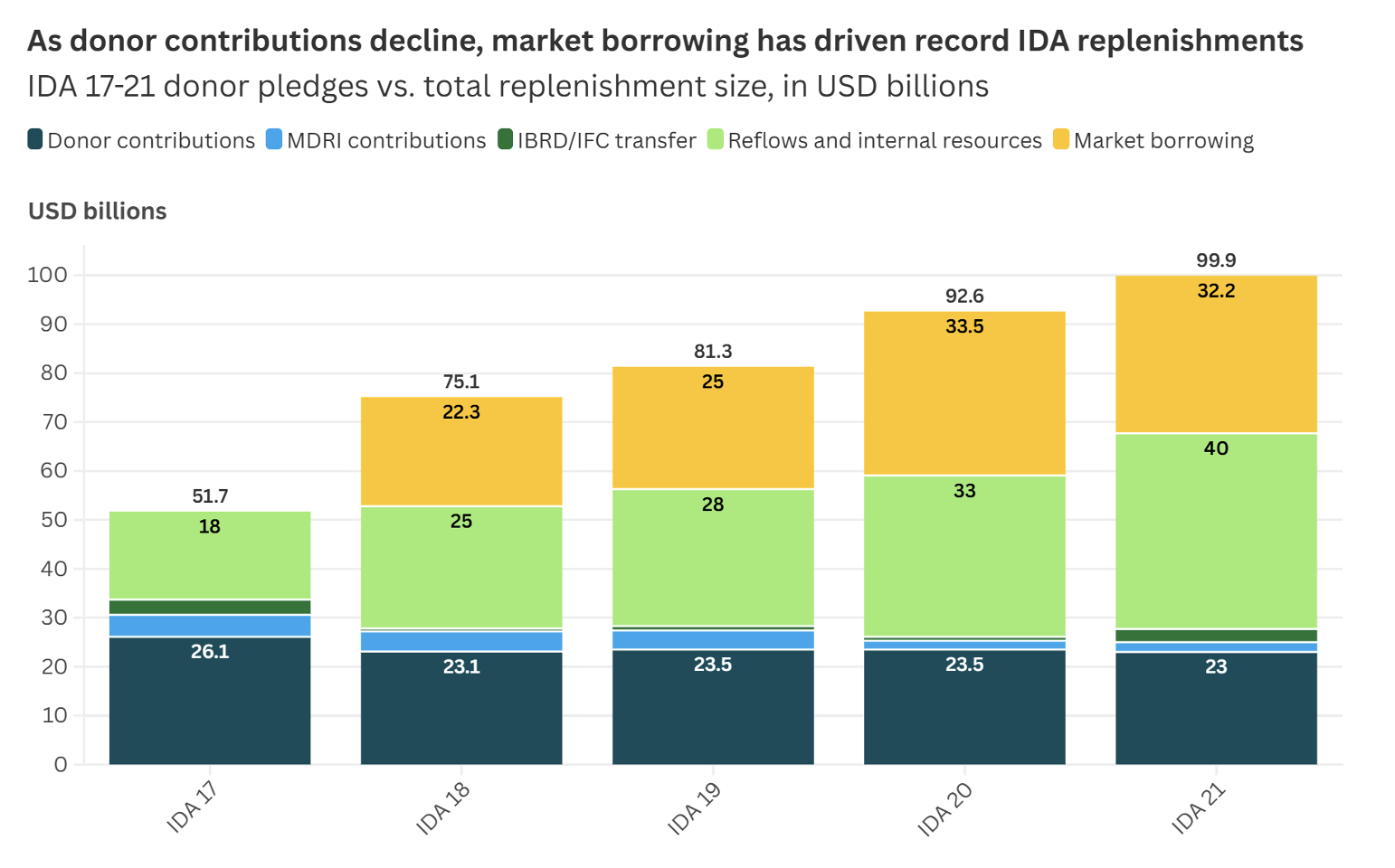
In December 2024, donors agreed to a record $100 billion replenishment for IDA21, the World Bank's fund for the poorest countries (mostly), with just under 25 percent of the total coming from donors themselves. Donor grants are fundamental to IDA’s model because they enable IDA to offer loans on very generous terms to very poor countries. But donor support has been declining. Even in nominal terms, donors provided fewer grants to back IDA21 than IDA17: $23.7 billion down from $26.1 billion. And yet the IDA21 replenishment was $100 billion, about twice the size of IDA17.
The magic of more money to IDA clients out of less money from IDA donors was accomplished in part with the help of larger repayment flows from earlier IDA credits, but the key ingredient was the decision to start issuing debt. All that borrowed money must be repaid at market interest rates while most IDA financing to clients takes the form of grants or below-market credits—a drain on IDA's capital. Declining donor financing makes IDA more dependent on loan reflows to support its replenishments, and means that future IDA replenishments will be smaller, all else equal. And because of high interest rates, which increase the cost of IDA borrowing, it means those future IDA rounds might be considerably smaller. How much smaller and how soon is not easy to estimate, but the World Bank has the numbers and should publish them so that donors and borrowers both understand the increasingly hard tradeoffs involved.
How IDA got bigger without more donor money—and at what cost
IDA replenishments are funded by four sources: donor financing (mostly grants, but some in the form of concessional partner loans), IDA reflows and earnings, annual income transfers from the IBRD (and sometimes the IFC), and debt issuances (Figure 1). Funding from the debt issuances is blended with the other three income sources to produce highly concessional loans. As interest rates rise, these blends consume more grant financing, so additional grants are needed to support the same financing envelope.
Figure 1. As donor contributions decline, market borrowing has driven record IDA replenishments
Source: IDA Deputies Reports
In IDA17 a donor dollar supported about $2.00 in final envelope size. In IDA21 that had increased to $4.20 (Table 1). Larger reflows from earlier IDA credits filled part of the gap. Borrowing filled most of the rest. IDA issued its first bond in 2018, and its debt reached $68 billion by June 2026.
Table 1. IDA’s market borrowing has enabled big replenishment increases
| Round | Years | Envelope (US$ bn) | Donor contributions (US$ bn) | Envelope per donor $ |
|---|---|---|---|---|
| IDA16 | FY12–14 | 49.3 | 26.4 | 1.9x |
| IDA17 | FY15–17 | 52.1 | 26.1 | 2.0x |
| IDA18 | FY18–20 | 75.0 | 23.1 | 3.2x |
| IDA19 | FY21–22 | 82.0 | 23.5 | 3.5x |
| IDA20 | FY23–25 | 93.0 | 23.5 | 4.0x |
| IDA21 | FY26–28 | 100.0 | 23.7 | 4.2x |
Source: IDA Deputies' Reports IDA16–IDA21, nominal. Donor money includes the grant element of partner loans and HIPC costs but excludes MDRI (both are debt forgiveness initiatives). IDA19 was cut to two years from three due to the COVID crisis; IDA20 includes about $11 billion carried over. Market borrowing began in IDA18 (first bond April 2018), leading to a significant increase in the resource envelope.
A dollar grant costs IDA a dollar. The cost of an IDA credit (or highly concessional loan) depends on the loan terms and interest rates. When rates are low, a 40-year credit—even at 0 percent—is still worth most of its face value. When rates are high, most of its value is lost to IDA. Table 2 estimates costs to IDA21 for its first year of commitments at two market rates: about 1.7 percent (which applied to IDA around June 2021) and about 3.7 percent (June 2026). Every $100 IDA21 commits at its current product mix costs IDA $50 at June 2026 rates, against $35 for the same products at 2021 interest rates. At the current 10-year Treasury yield of 5.15 percent, the cost would be $58. Because these rates are fixed, the real value of reflows also depends on the inflationary environment. A high-inflation, high-interest-rate environment makes IDA more costly to administer.
Table 2. High interest rates are pushing up IDA’s cost of doing business
| IDA21 product | Share of FY26 commitments (July 1, 2025–June 30, 2026) | Cost to IDA per $, at 2021 rates (1.7%) | At June 2026 rates (3.7%) |
|---|---|---|---|
| Grant | 27% | $1.00 | $1.00 |
| 40-year credit (mostly 0% interest) | 21% | $0.33 | $0.58 |
| Blend credit (26 years, 1.55%) | 42% | $0.02 | $0.25 |
| Shorter-maturity loan (12 years, 0%) | 4% | $0.15 | $0.29 |
| Near-market loan | 6% | about $0 | about $0 |
| Whole IDA21 mix | $0.35 | $0.50 |
Rising IDA costs are reducing resources for future replenishments
Of the $100 billion replenishment in IDA21, costs to IDA are about $50 billion at June 2026 interest rates (3.7 percent). Optimistically, about $35 billion of that comes from the combination of IDA's own earnings (the market return on its capital, less running costs), IBRD transfers, and donor contributions. The other $15 billion likely comes out of IDA's capital. That suggests perhaps $30 billion of IDA21's $100 billion envelope is being paid for out of future reflows.
Table 3. IDA20 versus IDA21
| US$ billion, over the three years of the round | IDA20 (agreed Dec 2021) | IDA21 (agreed Dec 2024) |
|---|---|---|
| Envelope | 93 | 100 |
| Cost to IDA (envelope × cost per $) | 33 | 50 |
| Donor contributions | 23.5 | 23.7 |
| IBRD transfers | 0.9 | 2.7 |
| IDA's own earnings | 3.0 | 8.4 |
| Total earnings/transfers/contributions | 27 | 35 |
| Drawn from IDA's capital | 6 | 15 |
| Envelope that pays for itself (money in ÷ cost per $) | 78 | 70 |
Notes: Earnings assume IDA's capital earns the market rate, less running costs. Transfers assume IDA21 gets $0.9 billion every year from IBRD. Not counted for IDA21 is an IFC set-aside of $500 million for IDA’s private sector window. This table ignores inflation, which erodes about $7 billion of the real value of IDA's capital each round.
IDA20 also drew on IDA capital, but far less (and likely unintentionally) because when it was negotiated in 2021, interest rates were low. IDA's own balance sheet points the same way. Count IDA's loans at the fair value IDA itself reports and subtract approved grants: on that basis, IDA's equity climbed to $153 billion in June 2021, then fell back to $124 billion by June 2026, even as donors paid in $49 billion (Table 4). Much of the decline came in 2022, when rising rates cut the value of IDA's outstanding low-interest loans.
Table 4. IDA equity, 2011–2026
| Year | IDA equity, loans at fair value (US$ billion) |
|---|---|
| 2011 | 91 |
| 2012 | 101 |
| 2013 | 102 |
| 2014 | 118 |
| 2015 | 115 |
| 2016 | 134 |
| 2017 | 132 |
| 2018 | 137 |
| 2019 | 145 |
| 2020 | 151 |
| 2021 | 153 |
| 2022 | 121 |
| 2023 | 112 |
| 2024 | 114 |
| 2025 | 123 |
| 2026 | 124 |
Source: IDA balance sheets and fair-value notes. Equity − (net loans − their fair value) − grants approved but not yet expensed. IDA's reported fair value is the present value of expected loan repayments discounted at market interest rates, so equity on this basis falls when rates rise.
IDA22 faces an even bigger challenge
IDA22 will be negotiated in 2027, in worsening economic and geopolitical conditions and very high demand for grants and concessional resources. The 10-year US Treasury yield was 5.15 percent on November 13, 2026, compared to 4.2 percent when IDA21 was pledged and 1.5 percent for IDA20. And donor contributions will likely shrink, at least in real terms. OECD preliminary data show aid fell 23.1 percent in real terms in 2025, the largest drop on record. Aid to multilateral institutions fell 12.7 percent, and the OECD projects a further 6.9 percent fall in total aid in 2026.
The prognosis for donor generosity in IDA22 is not good. A 20 percent decline in IDA pledges may be optimistic. Under those circumstances, perhaps $19 billion would be drawn from IDA's capital, meaning about $39 billion of a $100 billion envelope would be paid for out of future reflows, bringing the sustainable size of a replenishment closer to $61 billion (Table 5). These estimates are conservative, as they use the June 2026 rate (3.7 percent). At the current 5.15 percent Treasury yield, the same $100 billion would cost IDA about $58 billion, and the sustainable replenishment would fall closer to $59 billion. In short, a bigger IDA22 will need a greater share of future reflows to cover costs, reducing the volume available to finance subsequent replenishments. Unless this shortfall is covered by other sources of income (e.g., donors and income transfers from the IBRD and the IFC), IDA’s financing capacity will fall.
Table 5. IDA22 cost projections
| US$ billion | IDA22 at $100bn, donors flat ($23.7bn) | IDA22 at $100bn, donors down 20% ($19.0bn) |
|---|---|---|
| Cost to IDA | 50 | 50 |
| Total money in | 35 | 31 |
| Drawn from IDA's capital | 15 | 19 |
| Envelope that pays for itself | 71 | 61 |
The IDA21 agreement says that three key principles guide IDA’s borrowing: preserving IDA’s ability to continue fulfilling its mission, including predictability and stability of financing for clients; establishing IDA’s ability to service debt without restricting future lending capacity or creating unexpected future contribution requirements for donors; and maintaining IDA’s ability to adjust its policies at future replenishments. IDA21 surely strained those promises. A $100 billion IDA22 at current interest rates and declining donor contributions would surely break them.
All that said, this analysis was a considerable simplification of what is in fact a very complex modeling challenge, and the exercise cannot predict the exact cost of IDA21 in future reflows or how much future IDA rounds would be constrained by repeating it. The World Bank has those models but does not publish their results. It is time that changed. The IDA21 mid-term review coming up shortly in Tashkent should have a discussion about IDA21 front-loading and its implications, informed by the release of World Bank Treasury modeling results. Otherwise, donors risk facing a cliff scenario: give IDA a lot more money or else it can’t deliver.
Topics
DISCLAIMER & PERMISSIONS
CGD's publications reflect the views of the authors, drawing on prior research and experience in their areas of expertise. CGD is a nonpartisan, independent organization and does not take institutional positions. You may use and disseminate CGD's publications under these conditions.
Thumbnail image by: Kristina Blokhin/ Adobe Stock