

With widespread aid cuts, Gavi, the Global Fund, and the WHO face funding shortfalls of more than a fifth of their planned budgets. To help chart a path forward, CGD launched the Tough Times, Tough Choices policy briefs, offering practical recommendations for how the three agencies can allocate resources more effectively. The briefs informed deliberations by the boards of each agency on resource allocation and drew engagement from many donors. Gavi and the Global Fund have since updated their strategies in line with CGD experts’ recommendations, and the WHO has recommitted to its core global mandate, also consistent with CGD experts’ recommendations.
The challenge
Governments are cutting aid budgets and multilateralism is on the retreat, with significant implications for the global health architecture. Three global health heavyweights—Gavi, the Vaccine Alliance (Gavi); the Global Fund to Fight AIDS, Tuberculosis, and Malaria (the Global Fund); and the World Health Organization (WHO)—face funding shortfalls of more than a fifth of their planned budgets.
At the same time, low- and middle-income countries are calling for greater sovereignty over their health systems. Ghanaian President John Dramani Mahama captured this sentiment at the 2025 Africa Health Sovereignty Summit when he asserted that “Africa must no longer be the patient. It must be the driver, the author, the architect, and the advocate of its own health destiny.”
The push for greater health sovereignty, coupled with deep aid cuts, is forcing global health agencies to make difficult choices about what to fund and what to scale back if they are to remain fit for purpose in a post-aid world.
What we did
To inform these decisions, in 2025 CGD launched Tough Times, Tough Choices, a flagship initiative providing practical guidance on how Gavi, the Global Fund, and the WHO can allocate scarce resources more effectively. With nearly two decades of expertise in the operational and technical challenges these agencies face—and a longstanding reputation for impartial, evidence-based research—CGD was well positioned to advise them on critical next steps.
Strategically published ahead of key board meetings, the Tough Times, Tough Choices policy briefs made targeted recommendations for each organization:
- Gavi: the brief identified approximately $2.5 billion in potential efficiency savings through procurement and programmatic adjustments, and recommended that Gavi prioritize its dual mandate by focusing on the poorest countries and adopting a radically simplified “new compact envelope financing” approach.
- The Global Fund: the brief proposed radical simplification across three dimensions, including concentrating resources in “fewer countries where the need is greatest.”
- The WHO: the brief recommended a leaner WHO, more focused on its global mandate—leadership, security, and public goods.
Since the launch of the Tough Times, Tough Choices series, its findings have circulated widely among the leadership and donors of Gavi, the Global Fund, and WHO, directly informing board discussions on resource allocation and efficiency. The WHO and Global Fund briefs were used to inform the first report of the WHO’s Joint Task Force on the Reform of the Global Health Architecture. The proposals have been positively received by the UK Foreign, Commonwealth and Development Office, the Norwegian Agency for Development Cooperation, GIZ (the German agency for international cooperation), the Africa Centres for Disease Control and Prevention, former WHO leaders, and the World Bank.
CGD experts were invited to present the series to the UK All-Party Parliamentary Group on Global Health and Security, and key ideas from the series were reflected in the group’s position paper and subsequent policy discussions. CGD experts also raised the findings at the Europe/North America regional arm of Wellcome Trust’s high-level global dialogue on global health reform.
CGD drew on its role as a trusted convenor to host a public event on the sidelines of the World Bank-IMF Annual Meetings, bringing together the CEOs of Gavi and the Wellcome Trust, the vice president of Japan’s development agency, and a World Bank representative to engage with the series’ recommendations and share their visions of a reimagined global health architecture.
The Tough Times, Tough Choices series also gained traction beyond CGD’s direct engagement with policymakers and health agencies. The WHO brief was cited in a European Commission report and referenced in multiple Devex articles as WHO leaders grappled with significant cost-cutting decisions. Findings from the Global Fund brief were referenced in the Financial Times.
What we helped achieve
Evolving strategy shifts at all three agencies include changes consistent with CGD experts’ recommendations:
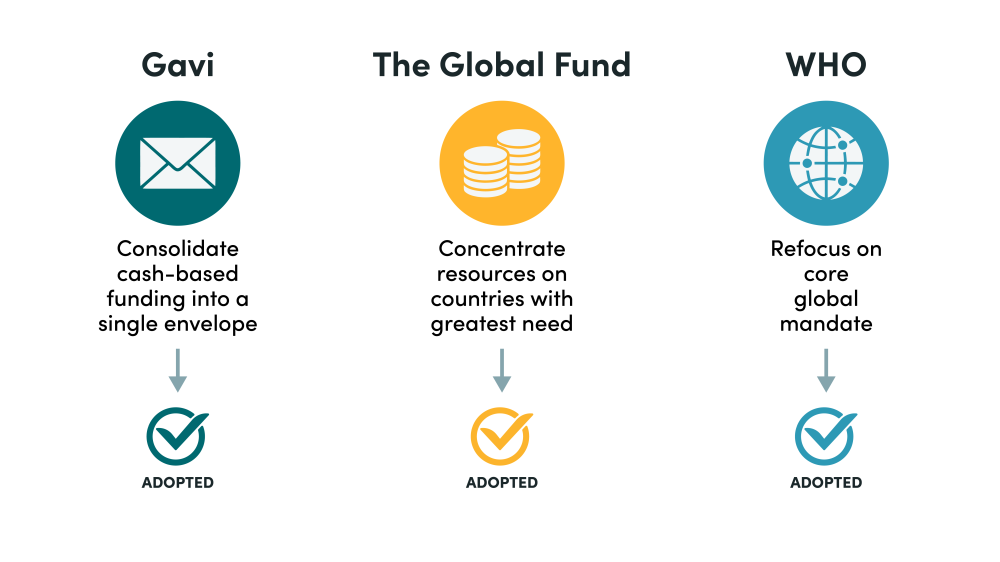
- Gavi announced that, as part of its Gavi 6.0 strategy, it was “consolidating Gavi’s cash-based funding into a single envelope focusing on immunization delivery outcomes,” in line with the recommendations of CGD experts.
- The Global Fund announced it would allocate a larger share of its grant resources to low-income countries, adopting a key element of CGD’s proposals. These cuts have most closely focused on upper-middle-income countries, freeing up resources for the poorest states.
- The World Health Assembly closely aligned with CGD experts’ recommendations when it approved a resolution calling for the WHO to focus on its core global mandate, noting the importance of “safeguarding WHO’s core functions and its unique mandate in the global health system.”
While the secretariats of the three agencies were already considering many of these reforms, CGD’s timely, evidence-based analysis strengthened the case for change, helping build support for their adoption by their respective boards.
What’s next
CGD’s work to date has focused on encouraging Gavi, the Global Fund, and the WHO to double down on their comparative advantages and focus on the poorest countries where they can have the greatest impact. CGD experts have now shifted to the second phase of work on global health architecture reform, including a proposal for a new IDA Health Window, housed at the World Bank.
The idea of an IDA Health Window has already been shared with key donors and stakeholders and was met with a positive response. The result was a supportive G7 Ministerial Declaration, which focused on advancing the role of multilateral development banks in health. CGD has secured funding from the UK Foreign, Commonwealth and Development Office to turn the idea into concrete action by producing a full proposal for the Window, with the aim of informing the steps taken by the World Bank’s top decision-makers and donors.
Related Work
Publication
A Radically Simplified Global Fund to Meet the Moment
Support More Work Like This.
Your contribution makes it possible for the Center’s researchers to devise practical, evidence-based solutions for today’s most pressing development challenges.