Recommended
POLICY PAPER
Decreasing Domestic Drudgery
Child marriage is an economic issue, not purely a human rights issue. The Institute for Global Politics Women’s Initiative at Columbia University launched a report yesterday titled “Accelerating Efforts to End Child Marriage.” The report features new CGD analysis, in which we examine three questions: 1) What are the economic implications of child marriage? 2) What is the state of global funding to address this issue? and 3) How could global funding change to address it more effectively? Here’s what we find.
Child marriage costs countries billions of dollars each year
In 2017, the World Bank and the International Center for Research on Women (ICRW) published a report on the economic impacts of child marriage. At that time, almost one in four women had experienced child, early, or forced marriage or union before age 18 (broadly referred to as “child marriage”). Although the prevalence has now fallen below one in five, child marriage still has large cost implications for low- and middle-income countries (LMICs). Using Demographic and Health Survey data for 27 strategically selected countries, which make up 70 percent of the global burden of child marriage, we examine the mortality, morbidity, and education consequences of child marriage. This work builds on approaches used by Fang et al. (2024) to examine child marriage in Nigeria as well as the World Bank and ICRW 2017 global report.
We estimate that the costs of child marriage from deaths, health declines, and lost earnings alone amount to up to $175 billion per year (adjusted for purchasing power parity):
- Child marriage is associated with between 100,000 and 190,000 deaths of children under age 5 and up to 14,000 maternal deaths annually, along with increased risks of experiencing intimate partner violence, miscarriage, stillbirth, or abortion. These increases in mortality and morbidity result in an estimated economic cost of up to $130 billion per year (see Table 1).
- Child marriage is also associated with weakened education and employment outcomes, due to lower school attainment. The costs from lost earnings as a result of this amount to an estimated $45 billion.
Table 1. Deaths, DALYs, and economic costs associated with child marriage
| Under-5 mortality | Maternal mortality | Intimate partner violence | Miscarriage or abortion | Total | ||
|---|---|---|---|---|---|---|
| Deaths | more than | 108,676 | 4,885 | - | - | 113,561 |
| DALYs lost (thousands) | more than | 10,315.1 | 368.3 | 77.7 | 0.4 | 10,761.5 |
| Economic costs (US$ millions) | more than | 72,943.4 | 2,074.1 | 793.1 | 5.9 | 75,816.5 |
| Deaths | up to | 190,651 | 14,655 | - | - | 205,306 |
| DALYs lost (thousands) | up to | 17,925.6 | 1,104.4 | 77.8 | 0.4 | 19,108.2 |
| Economic costs (US$ millions) | up to | 122,952.1 | 6,222.5 | 795.0 | 6.2 | 129,975.8 |
Note: DALYs=Disability-Adjusted Life Years. The analysis followed three steps: (i) estimate the relationship between child marriage and child and maternal health outcomes using logistic regressions; (ii) estimate the population-attributable fractions based on Greenland and Drescher (1993); and, (iii) convert the estimated effects into DALYs, and the DALY loss into a monetary value assuming one DALY is equal to the country’s per capita GDP. The first three rows only include countries for which there was a statistically significant correlation between early marriage and the outcomes of interest (conservative approach), while the last three rows include all countries regardless of statistical significance (inclusive approach).
This analysis draws on observed correlations between child marriage and women’s and children’s outcomes. We would ideally draw on results from studies using causal identification strategies to determine what would have happened to child brides had they not married early, but existing causal evidence unfortunately comes from a small number of countries and focuses on a limited set of outcomes. To estimate a global cost, we instead use regression analysis to compare outcomes for women and girls who experienced child marriage to peers who were not child brides, after controlling for differences in observable characteristics. While we can’t definitively determine what would have happened in the absence of child marriage, our analysis provides suggestive insight into associated differences in outcomes. (Check out our technical appendix for more methodological details.)
Global funding to end child marriage is at risk of decline
Given the substantial economic costs of child marriage, it’s crucial to understand what is being done to address this issue. In a new report, researchers from Girls Not Brides, Girls First Fund, and Publish What You Fund find that between 2015 and 2023, only 0.025 percent of total official development assistance (ODA) funding went to projects with a primary objective of ending child marriage (primary ECM funding), and 0.081 percent of total ODA went to projects addressing child marriage as one of several objectives or as a result indicator (secondary ECM funding). Primary ECM funding has declined since 2019, while secondary ECM funding has increased (Figure 1). However, it’s impossible to determine how much of this secondary ECM funding is being allocated toward ending child marriage.
Figure 1: Trends in global funding to end child marriage (2015–2023)
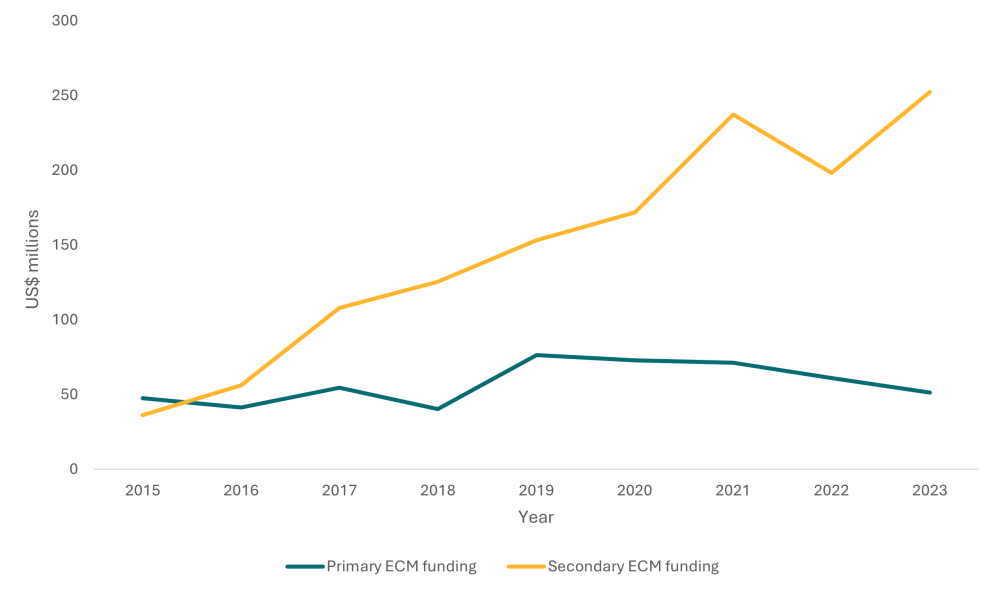
Source: Data analysis by Publish What You Fund for “International Funding to End Child Marriage: Reviewing a Decade of Investment” Girls Not Brides and Girls First Fund, March 2026. https://www.girlsnotbrides.org/learning-resources/resource-centre/international-funding-end-child-marriage-2015-2024-report
The funding landscape has changed dramatically since 2023. Many of the top bilateral ECM funders are cutting back ODA. Donor Tracker’s analysis of bilateral funding announcements projects larger funding cuts among top ECM funders (including Belgium, Canada, the Netherlands, the United Kingdom, and the United States) compared to the expected cuts from other large OECD Development Assistance Committee (DAC) donors (Figure 2). Beyond announcing overall cuts in funding, several of these bilateral donors are also shifting away from focusing on gender equality as a foreign policy priority, suggesting that cuts to ECM funding could be even more severe than cuts to overall ODA. Some prominent philanthropic funding has also wound down (such as the Kendeda Fund). These developments show that the future of funding to end child marriage is at risk.
Figure 2: Projected ODA changes for the 18 largest OECD DAC donors
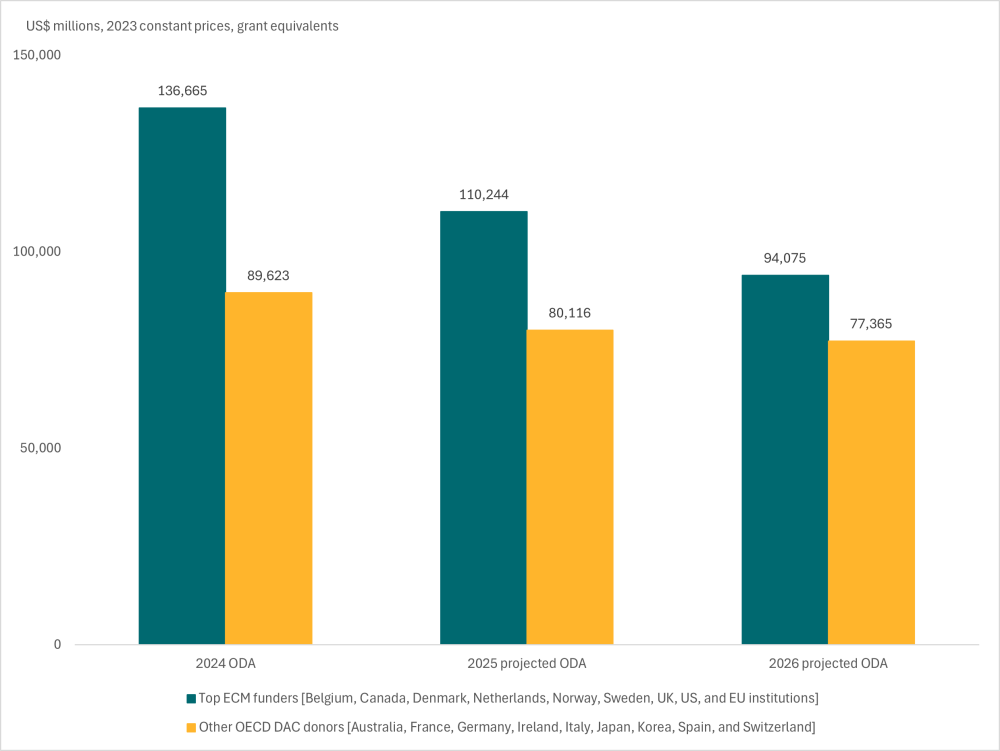
Source: Original figure by authors using data on top ECM funders from data analysis by Publish What You Fund for "International Funding to End Child Marriage: Reviewing a Decade of Investment" Girls Not Brides and Girls First Fund, March 2026 https://www.girlsnotbrides.org/learning-resources/resource-centre/international-funding-end-child-marriage-2015-2024-report; and data on projected funding from Donor Tracker’s analysis of bilateral funding announcements, Kristin Laub, Nadia Setiabudi et al., “The Budget Cuts Tracker,” Donor Tracker, July 4, 2025, https://donortracker.org/publications/budget-cuts-tracker/.
Note: Top ECM funders are those that were among the top 10 primary or secondary ECM funders between 2015 and 2023.
Strategic funding increases and improvements in funding efficiency are necessary
To estimate the funding shifts required to accelerate progress toward the Sustainable Development Goal of eliminating child marriage by 2030, our analysis outlines an illustrative example in which we assume all girls at risk of child marriage are served with the most cost-effective documented intervention. Drawing on evidence from impact evaluations and emerging simulations of scaling NGO-led programs, we identified the Accelerate Hub’s simulated costs and economic benefits of scaling up the Adolescent Girls Initiative implemented by the Center for Girls Education in Northern Nigeria to be the most cost-effective scenario documented. We use this as our cost benchmark but remain agnostic about the specific type of intervention that would be most effective in different contexts at scale. Additionally, we use UNICEF data on the global prevalence of child marriage and UN DESA current population estimates to calculate the number of girls at-risk of child marriage between now and 2030.
Combining benchmark intervention costs with the number of girls at risk suggests that it would take a minimum of $4.3 billion annually for the next five years to delay all child marriages under a best-case scenario in which all girls in LMICs are served through a one-off investment. In a resource-constrained environment, this goal can be accomplished by strategically setting interim funding targets. If the aim is to decrease global child marriage prevalence from, for example, one in five to one in seven, it would take a minimum investment of $1.3 billion annually for the next five years.
This analysis has several caveats worth noting. It assumes that the most cost-effective documented approach could feasibly reach all at-risk girls. This is an ambitious assumption as, in practice, intervention effectiveness and implementation costs vary across contexts (by geographic region and country income levels), and results from one program may not be generalized elsewhere. Thus, actual costs to avert child marriages could be higher. Additionally, this analysis assumes a one-off investment for all girls at risk, whereas in practice, larger annual investments may be required, particularly for interventions such as scholarships or reforms providing free secondary education.
Nonetheless, the estimated minimum investment is substantially larger than current global primary ECM funding (averaging $61.2 million per year in recent years). Ending child marriage will require strategic increases in funding.
What can be done to address this funding gap? Some investment could come from domestically mobilized resources instead of exclusively from international funding. We need improved data on domestic investment to track this, yet we can already learn from growing examples of increased domestic investments in adolescent girls, such as the Adolescent Girls Initiative for Learning and Empowerment (AGILE) project, co-financed by the Government of Nigeria and the World Bank. Other options include blended commercial and enterprise-based financing models, such as the one used by BRAC in Bangladesh.
An additional dimension of strategic funding improvements is better targeting— ensuring implementers direct interventions toward girls who are at risk and most likely to benefit. Targeting, however, remains challenging in practice, so prioritizing the interventions that are most likely to benefit girls at risk is crucial (even when targeting multiple populations). For instance, some degree of ECM funding will end up flowing to some individuals who are not at risk of child marriage and will nevertheless impact the well-being of all recipients (e.g., funding for free secondary schooling will cover education costs for all students in the eligible age group, not only those at risk of child marriage).
What’s next?
Our analysis of the costs of inaction indicates that increases in investments to address child marriage will likely yield substantial returns. Encouragingly, exciting work is on the horizon to advance progress toward ending child marriage and deepen our understanding of effective interventions. While our estimates provide a global view of investments needed to end child marriage, localized assessments are necessary to identify context-specific, cost-effective interventions —like the Accelerate Hub’s work modeling returns on investment in adolescent girls in Kenya and Nigeria.
Turning this growing body of evidence into action will require cross-sector collaboration, a topic we expect to see raised at the UN’s Commission on the Status of Women next week. In the meantime, you can dive deeper into the economic impacts of child marriage in the latest CGD podcast episode and watch the Columbia University report launch event here.
We are very grateful to Rory Todd for excellent research assistance and to our colleagues and collaborators for valuable comments.
Topics
DISCLAIMER & PERMISSIONS
CGD's publications reflect the views of the authors, drawing on prior research and experience in their areas of expertise. CGD is a nonpartisan, independent organization and does not take institutional positions. You may use and disseminate CGD's publications under these conditions.
Thumbnail image by: Riccardo Niels Mayer/ Adobe Stock