Recommended
The PEPFAR program is still emerging from recent aid cuts and award terminations, but we do know a significant number of PEPFAR awards have been cancelled. In a new note, Ramona Godbole, formerly of USAID, has provided a detailed analysis of the likely status of delivery, drawing on data on cancelled and retained awards and what those awards were financed to deliver.
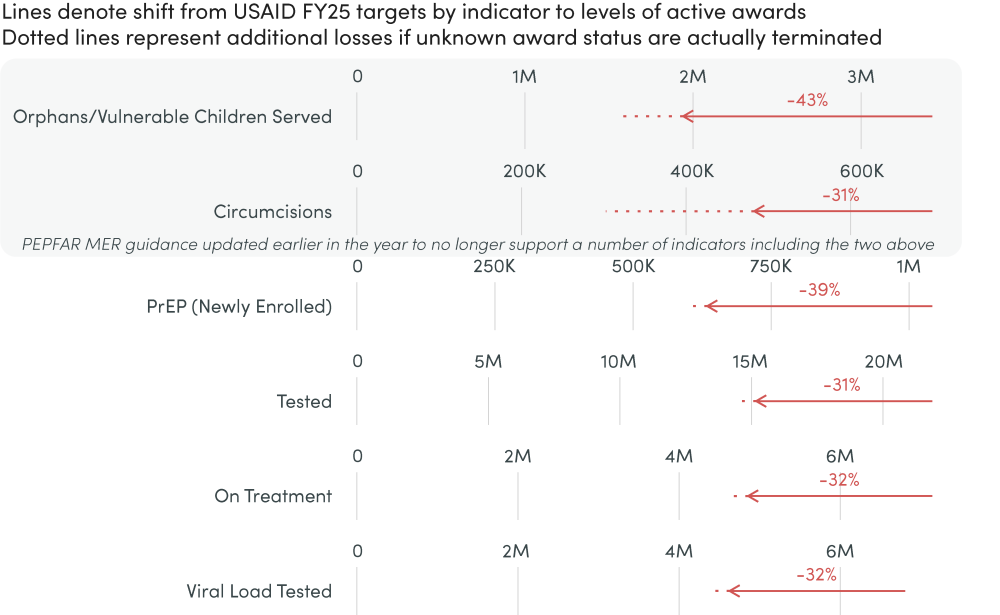
While oversight responsibility for PEPFAR rests with the US Global AIDS Coordinator at the Department of State, USAID historically managed the implementation of a large share of PEPFAR programming. About 65 percent of USAID’s PEPFAR awards have been reported terminated, accounting for 24 percent of planned funding. Using what we know of the administration’s own definition of what constitutes lifesaving support, Godbole estimates 16 percent of USAID’s lifesaving HIV programming—as measured by the planned FY25 budget—was to be implemented by terminated awards. In particular, 23 percent of the budget for HIV treatment programming, including drugs, laboratory services, and HIV/TB care, was directed to cancelled or unknown status awards. Terminated USAID awards were responsible for supporting an estimated 2.3 million people on lifesaving treatment—representing approximately 1 in 10 of all patients supported by the PEPFAR program.
In addition, more than 200,000 planned circumcisions were to be provided under terminated awards, along with nearly one third of viral load testing services and over a third of new pre-exposure prophylaxis users—over 300,000 people. All of this suggests a risk of higher HIV infection rates in the future.
Godbole reports strikingly different impacts of the award terminations at the national level. In Malawi, Tanzania, Zimbabwe, Uganda, and the Democratic Republic of Congo, terminated PEPFAR awards accounted for 25 to 50 percent of planned resources. In South Africa, terminated awards accounted for more than 75 percent of the total. Of the 2.3 million people on treatment to be covered by terminated awards globally, South Africa accounts for over 50 percent, followed by Uganda, India, and Eswatini. These four countries make up nearly 80 percent of all treatments associated with terminated awards.
Figure 1. Terminations affect an outsized share of prevention activities
Source: MyCareerPivot USAID Award Status as of 2025-08-01 + PEPFAR Spotlight [FY24Q4] | Ref id: 462a989f
This outcome is perhaps less dire than predicted in March, based on the then-available data. Early estimates that I produced with Justin Sandefur, based on an estimated 18 percent funding cut, suggested that 200,000 deaths a year could result. Godbole’s work suggests 2.3 million people on treatment were covered by the awards which, even with no others stepping in, would unlikely result in such a high mortality rate, at least in the short term.
And as Godbole points out, there is some evidence of modifications to still extant PEPFAR awards to pick up the slack from cancelled activities, including improving the supply of medications in Kenya. Meanwhile in South Africa, the country with the largest absolute number of people receiving treatment under PEPFAR awards that have been cancelled, the government has pledged additional funding to maintain treatment provision.
The picture in other highly affected countries including Uganda and Eswatini is less reassuring. And this doesn’t even account for the longer-term impacts of higher infection rates due to lower ART coverage, disruption of PrEP, and cancellation of male circumcision programs.
But the full extent of both ongoing service cuts and health impacts remains opaque. PEPFAR's own reporting for the first three quarters of this year has been postponed indefinitely. Until that reporting recommences, Godbole’s study is the best we have to judge the administration’s performance against its commitment to preserve lifesaving assistance.
Topics
DISCLAIMER & PERMISSIONS
CGD's publications reflect the views of the authors, drawing on prior research and experience in their areas of expertise. CGD is a nonpartisan, independent organization and does not take institutional positions. You may use and disseminate CGD's publications under these conditions.
Thumbnail image by: USAID/ Flickr