Recommended

Blog Post
Development Agencies on What Being Effective Means to Them


For development agencies, changing financial and political realities are forcing many to rethink their strategic direction. This not only involves tough choices related to where and on what issues agencies engage, but also about the types of knowledge, skills, and structures that are needed to deliver on shifting priorities now and in the years ahead. In essence, the question facing many agencies is how they can remain efficient, effective, and resilient at a time when they face increasingly complex development challenges, working conditions, and public skepticism.
As part of an ongoing research series, we’ve asked officials about how their agencies understand their own effectiveness and what it means to be an effective agency in the changing development landscape. We find that increasingly, agency officials view leveraging their comparative advantage as a way to deepen efficiencies and improve impact. This includes thinking about how budget cuts—both their own and cuts by other agencies—are shifting the cooperation landscape, and their relative strengths in this new normal. As a result, some are thinking more actively about what their comparative advantages are in the current landscape, and how to integrate them into their strategies and operations to support effectiveness. In this blog, we explore how agencies can strategically leverage their comparative advantage, the challenges they may face, and propose a simple framework for identifying and operationalizing their strengths.
Why are development agencies considering their comparative advantage?
The general logic is that deeper specialization can improve both the efficiency and effectiveness of development spending by encouraging providers to do more of what they do well. In a context where development budgets are under pressure, calls for agencies to strengthen their impact through focusing their resources more strategically are being amplified. For many, this means (re)considering how to leverage their comparative advantage in the current development landscape to improve organizational effectiveness and development outcomes. For the purpose of this exercise, we understand the comparative advantage of development agencies as the activities, competencies, ways of working, or networks that allow an agency to deliver outcomes more efficiently or effectively than peers in a given context.
Typically, the comparative advantage of development agencies is discussed in two ways. The first relates to allocation, where leveraging comparative advantage means reducing the geographic or sectoral spread of resources based on a strategic advantage (geographical proximity, history, shared language/culture, strong domestic knowledge). For example, New Zealand focuses two-thirds of its cooperation in the Pacific, leveraging an advantage that stems from geographic proximity and long-standing cultural and political ties. This may improve efficiencies for providers and partner countries by reducing the transaction costs associated with fragmentation and strengthen outcomes by allowing providers to develop and utilize expertise in a given area. This could also support a clearer division of labor among providers, assuming that there are mechanisms and support for cross-provider coordination. The second relates to operational comparative advantages that make some agencies better at engaging in certain contexts or types of activities. For example, the OECD’s 2025 Peer Review of Switzerland notes that its “long-term and patient approach to achieving results” forms part of its comparative advantage as an actor known for prioritizing complex interventions aimed at transformational change. From this perspective, operational specializations based on unique organizational features such as risk tolerance, adaptability, or even the types of finance agencies command (i.e., ability to use grants, loans, innovative financial mechanisms, etc.) can give agencies a comparative advantage working in specific development contexts such as fragile states or middle-income countries.
What are the challenges to leveraging comparative advantages?
The ability for agencies to strategically harness and prioritize their comparative advantage often bumps against three key challenges.
The first is practical. In development, comparative advantage should be based on being more effective in specific contexts or sectors, rather than focusing squarely on efficiency. This means that identifying an agency’s advantage could be limited by the challenge of measuring the relative effectiveness of interventions across providers. Moreover, understanding that agencies change focus, competencies, and priorities over time means that comparative advantages are likely dynamic, with the relative effectiveness of different actors shifting alongside normal changes in organization capacity or developmental priorities (e.g., increasing focus on global public goods). In the absence of comparative, robust data on agency impact, some providers (particularly newer actors or those with diverse portfolios) may find it difficult to locate their strategic niche.
The second is political. The reality is that development agencies often serve a range of motivations, which means that allocations are at least partially driven by the interests of providers. This leads to two potential challenges. In some cases, the use of development resources to support diplomatic or commercial ties could provide a disincentive for specialization if provider governments view maintaining a large array of partnerships as in their strategic interests. This is particularly true if specialization based on comparative advantage could lead to allocation patterns that deviate from countries or regions where providers have strategic interests. In other cases, focusing on sectoral comparative advantages based on domestic knowledge or expertise runs the risk of creating a domestic lobby if leveraging such advantage is used to funnel development resources through domestic entities. This lobby, in turn, could aim to influence allocation decisions in line with its interests, which likely runs counter to the logic of comparative advantage as a way to deepen effectiveness. Presumably, political factors could also affect operational advantages if political shifts influence the organizational cultures or practices (such as risk tolerance) that underlie specific strengths.
The third is normative. Comparative advantage is defined by what an agency does well, rather than by partner country needs. While in theory, focusing on comparative advantages should support better development outcomes, extracting such benefits requires that agency strengths are well-matched with local priorities or needs. This not only means that advantages will need to be adapted to local contexts but raises questions about the degree to which comparative advantages should drive agency strategies. The challenge may be navigating the tension between investing in the capacities needed to deepen specializations, versus remaining versatile enough to ensure that engagements remain driven by partner priorities and contexts.
How can agencies integrate comparative advantages in their strategies?
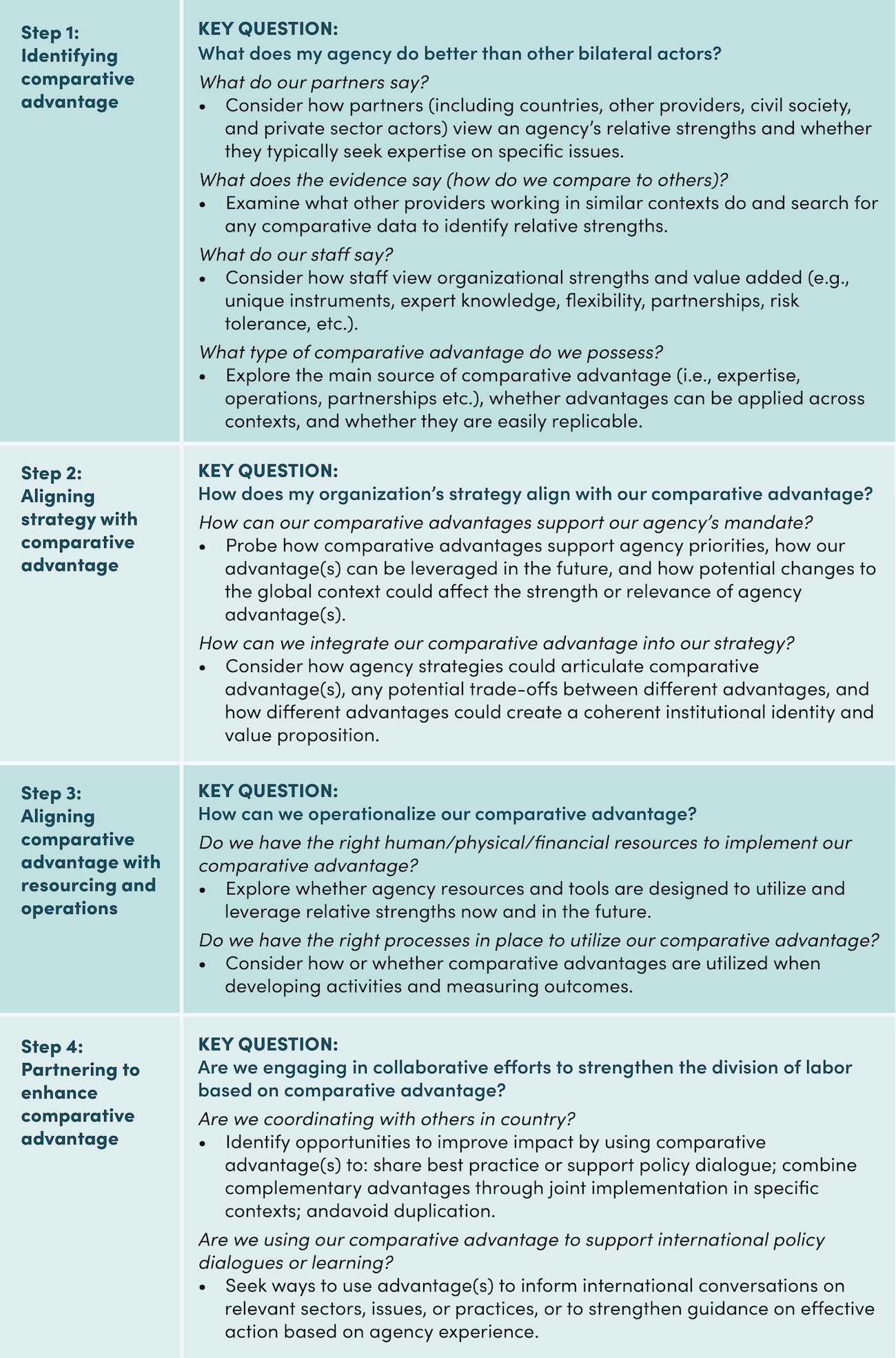
With these challenges in mind, leveraging comparative advantage as a driver of agency strategy will inevitably require balancing strengths with the many other considerations that inform development action. To support agencies as they think this through, we’re proposing a set of four broad steps and questions to help identify and operationalize agency advantages (Figure 1). While our focus here is on the use of comparative advantage at the strategic level, in practice, it might also be beneficial to assess comparative advantage at the country level.
The logic underpinning the proposed steps draws from the Multilateral Performance Network (MOPAN) assessments of multilateral agencies, which views comparative advantage as a driver of organizational effectiveness. In the MOPAN methodology, comparative advantage supports agency effectiveness by informing an agency’s strategic positioning, which is then operationalized through alignment with human resource management, internal process, and strategic partnerships. For this exercise, we assume that comparative advantage can play a similar role in supporting the organizational effectiveness of bilateral actors, while recognizing that political drivers will be more acute in bilateral contexts. While we focus on comparative advantage at the organizational level, assessment tools at country or activity level are also available; see, for example, CGIAR’s tool for identifying comparative advantage.
Figure 1. Four steps for integrating comparative advantage in agency strategies
Doing well to do good?
While development agencies navigate the tensions and challenges of today’s development landscape, better integrating their comparative advantage into mandates and strategies provides a starting point for utilizing relative strengths to support better outcomes and differentiate themselves from their peers. Making the most of these strengths, however, not only requires ensuring that agency strengths are matched with partner country priorities but also requires better coordination—especially in country— to support the most efficient division of labor between partners.
As agencies feel the pinch, now more than ever, there is an opportunity to invest in ways to improve impact through leveraging the strengths that exist across the development system.
Topics
DISCLAIMER & PERMISSIONS
CGD's publications reflect the views of the authors, drawing on prior research and experience in their areas of expertise. CGD is a nonpartisan, independent organization and does not take institutional positions. You may use and disseminate CGD's publications under these conditions.