
Recommended
Blog Post
Governing Tax Expenditures
BRIEF
Health Taxes and the IMF
India has made substantial progress in strengthening its public finances since the pandemic. Between 2020–21 and 2025–26, the general government deficit (the central government—“the Centre”—and states combined) fell by about 6 percentage points of GDP, and the debt-to-GDP ratio declined by about 7.5 percentage points. The deficit fell mainly as pandemic support was withdrawn and revenue recovered. The decline in debt owed much to nominal GDP growth exceeding the effective interest rate on government debt, supported by macroeconomic stability.
Yet debt, at about 84 percent of GDP, remains high, and servicing it is costly. Interest payments absorbed 25.2 percent of general government revenue in 2025, the highest share among the ten emerging-market G20 economies (Figure 1). At the Centre, interest payments are projected to absorb 40 percent of revenue receipts in 2026–27, more than the Centre’s entire capital outlay. That leaves less room for investment, health, and education spending, and limits the capacity to respond to future shocks.
In this post, we argue that the conditions behind the recent fall in debt are weakening: at today’s gap between growth and interest rates, the primary deficit is too large to stabilize debt. The next phase of consolidation should rest mainly on a broader tax base, together with subsidy reform and less reliance on one-off receipts, as argued in a recent policy brief from the Indian Council for Research on International Economic Relations (ICRIER).
Figure 1. Interest payments, 2025 (percent of general government revenue)
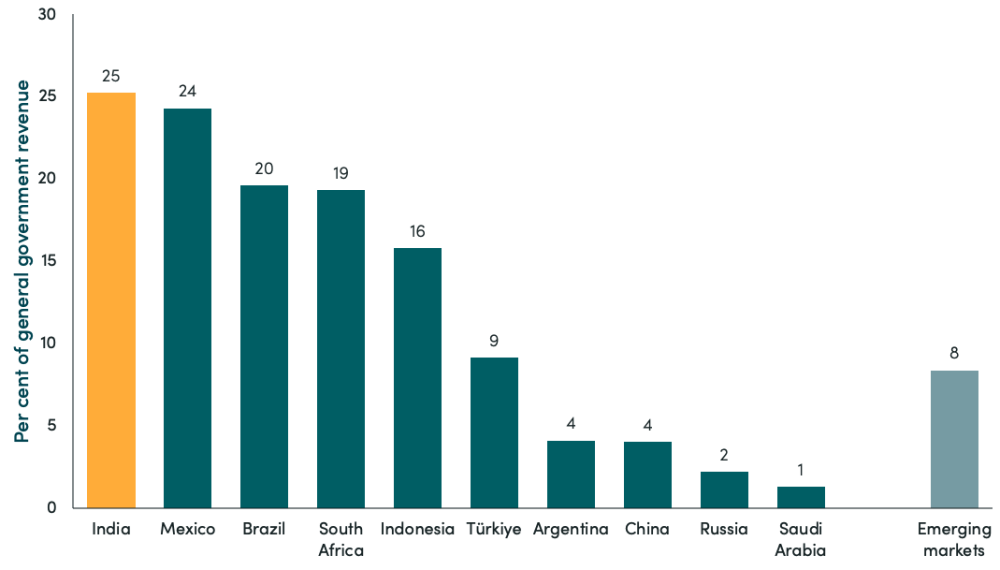
Notes: (i) Interest payments are derived as the difference between the general government primary and overall balances, and are therefore subject to rounding in the underlying series. The derivation gives gross interest for most countries, but approximates net interest for those with large interest receipts on government financial assets, which understates the figures for Saudi Arabia and Russia.
(ii) Fiscal coverage differs across countries.
(iii) The bar for emerging markets represents the average across emerging market economies.
(iv) All figures refer to the general government for a single year, 2025, and are not comparable with the World Bank’s series on interest payments as a share of revenue, which covers the central government alone and reports a different latest year for each country.
Source: IMF Fiscal Monitor, April 2026, Tables A9, A10 and A13; authors’ calculations
The cushion from growth is thinning
Much of the fall in the debt ratio has come from nominal growth running ahead of the interest rate on debt. That gap averaged about 5 percentage points between 2008–09 and 2018–19. It has narrowed every year since 2021–22, to about 1.6–1.9 percentage points in 2025–26. The narrowing reflects slower nominal growth, down from about 13 percent to under 9 percent, while the effective interest rate has stayed near 7 percent.
At today’s gap, general government debt stabilizes only if the primary deficit (the deficit excluding interest) is about 1.2–1.4 percent of GDP. The current primary deficit is about 1.9 percent, so if these conditions persist, the debt ratio would rise by roughly half a percentage point of GDP a year. The gap could narrow further. India’s borrowing costs have been held down partly by regulations requiring banks to hold government securities. As these requirements ease and foreign holdings increase following India’s inclusion in global bond indices, borrowing costs could become more sensitive to international market conditions.
Windfalls in, investment out
Two features of recent budgets deserve attention. First, part of the improvement has come from outside the tax system. Reserve Bank of India (RBI) surplus transfers averaged 0.3 percent of GDP between 2008–09 and 2017–18, compared with about 0.8 percent in each of the last two accounting years (Figure 2). Had they stayed at the earlier average, the Centre’s 2025–26 deficit would have been about half a percentage point of GDP higher.
Some of these increases reflect lasting changes, such as a larger RBI balance sheet and a rules-based framework for its buffers. Others include exchange rate gains and high foreign yields, which are less likely to last. The special swap window opened in June 2026, which lets banks swap foreign currency deposits from nonresident Indians with the RBI without paying the usual cost of hedging, could reduce the RBI’s income further for several years.
Figure 2. RBI surplus transfer to the central government (percent of GDP)
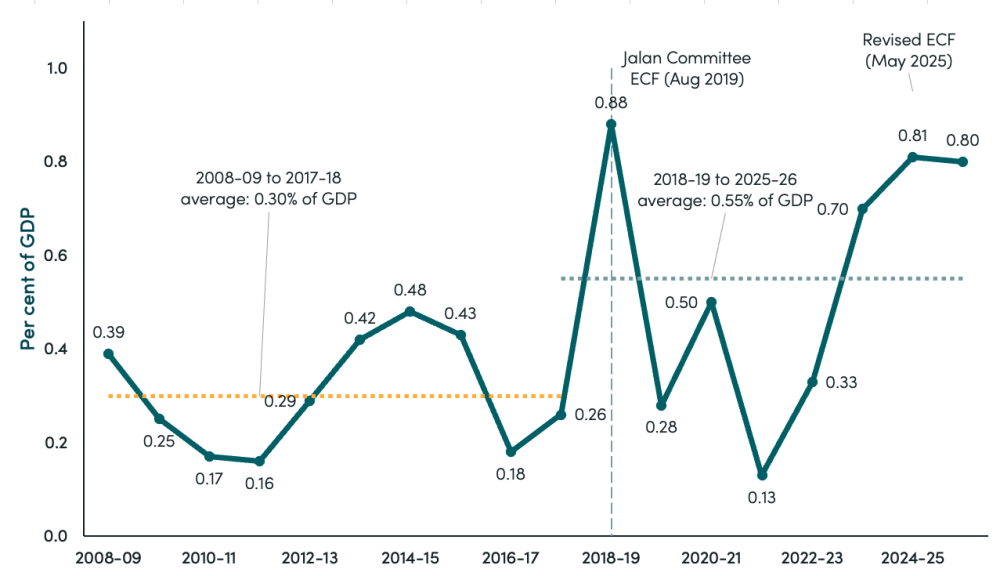
Note: Years refer to the RBI’s accounting year. Sources: RBI Annual Reports and press releases; MoSPI; authors’ calculations.
Second, capital spending often bears the brunt when receipts fall short of budget. Disinvestment proceeds have missed their targets every year since 2019–20, while the Centre’s actual capital outlay has fallen short of budget each year since 2022–23; the gap peaked at 8.3 percent of the budgeted amount in 2024–25 (Figure 3). The states show a similar pattern: between 2015–16 and 2023–24, their capital outlay was, on average, 20 percent below budget.
Figure 3. Actual minus budgeted capital expenditure at the Centre (percent of budgeted capital expenditure)
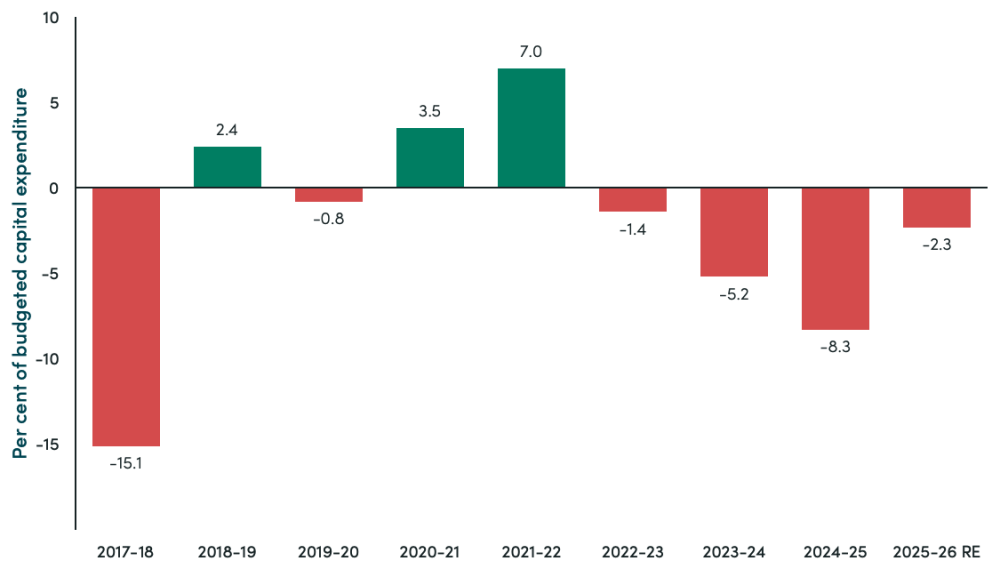
Note: Figures for 2025–26 are revised estimates. Source: Union Budget documents, various years.
Why revenue should carry the adjustment
India’s own history offers guidance. Measuring policy effort by the cyclically adjusted primary balance, which strips out the effect of the business cycle, we identify three consolidation episodes since 1996–97 (Figure 4). The 1999–2001 and 2004–08 episodes were driven mainly by higher revenue. The 2011–14 episode relied on spending cuts, and its durability owed much to fuel subsidy reform and falling oil prices. India’s record on durability is mixed: the 1999–2001 gains were lost within a year, and the 2004–08 gains were reversed by the deliberate fiscal response to the global financial crisis. In cyclically adjusted terms, the general government’s primary position in 2025–26 is slightly weaker than in 2019–20. Higher fertilizer and fuel costs following the war in Iran could also erase the improvement projected for 2026–27.
Figure 4. Cyclically adjusted primary deficit (percent of potential GDP)
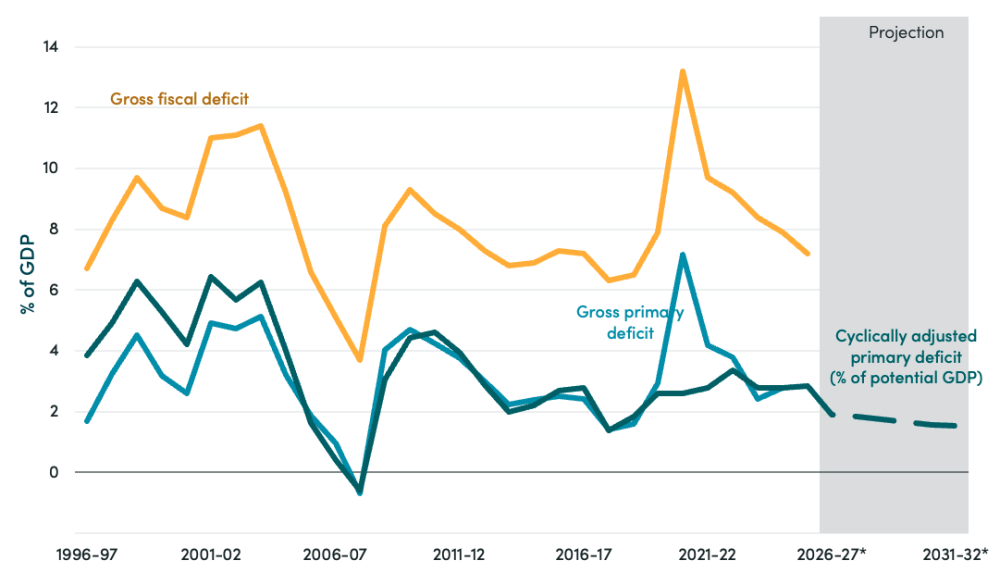
Note: Values before and after 2010 are not strictly comparable. Source: IMF Fiscal Monitor, April 2026; RBI.
General government tax revenue rose from 13.3 percent of GDP in 2001–02 to 19.1 percent in 2024–25, and total revenue stood at 21 percent in the same year. Even so, India’s revenue mobilization remains below that of all emerging-market G20 economies except Indonesia.
The literature on what makes consolidation last points to revenue-led adjustment as the better option for India. In emerging markets, consolidations based on revenue increases tend to be more durable, especially where tax ratios are relatively low. Spending-based adjustments prove more lasting mainly where tax revenue exceeds about 25 percent of GDP, well above India’s level of about 19 percent.
There is scope to raise more revenue. India collects about four-fifths of its estimated tax capacity, leaving roughly 3.5 percent of GDP untapped. The Goods and Services Tax (GST) offers the clearest opportunity. Exemptions, reduced rates, and exclusions account for about 42 percent of potential revenue—roughly five times the 8 percent lost to noncompliance. Yet most measures since 2017, including e-way bills and e-invoicing, have focused on evasion. Bringing petroleum products, electricity, and real estate into the GST would broaden the base and allow businesses to claim credits for taxes paid on these inputs.
Subsidy reform can also create fiscal space. Subsidies for fertilizer and liquefied petroleum gas (LPG) are delivered mainly by holding retail prices below cost, leaving the budget exposed to swings in international prices. The 2026–27 Budget provides about 0.4 percent of GDP for fertilizer. This allocation preceded the conflict in Iran. Holding petrol and diesel prices largely unchanged after the conflict could add a further cost, estimated at 0.6 percent of GDP in 2026–27. This cost initially falls first on oil marketing companies but is likely to reach the budget.
What the next phase needs
The Centre’s new debt target of 50 percent of GDP by 2030–31 gives further adjustment a clear objective. The challenge is to reach it without repeating two features of past consolidations: gains that were later reversed, and cuts that fell on investment. Five priorities follow from the analysis.
- Plan for a less favorable growth-interest gap. The medium-term framework could show how the debt target would be met if the gap narrows further.
- Make revenue the main source of adjustment. That means broadening the GST base rather than raising rates, widening a direct tax base that remains narrow relative to the formal workforce, and updating property registers and valuations for municipal taxes.
- Budget windfalls conservatively. Using conservative assumptions for RBI transfers and disinvestment receipts, and using any excess to reduce debt, would keep one-off receipts from artificially improving the appearance of the deficit.
- Protect capital spending through realistic budgets. More realistic revenue estimates, a small contingency reserve, and up-front provision for compensating oil marketing companies would reduce the risk of in-year cuts to capital outlays.
- Reform subsidies. The Economic Survey 2025–26 proposal for a modest rise in urea prices, offset by a per-acre transfer, would reduce both fiscal cost and overuse of nitrogen, provided the transfer can also reach tenant farmers. LPG prices should be allowed to move more closely with international prices, with support for poor households through direct transfers. The space created should help prioritize health and education, where public spending is low by peer standards.
Topics
DISCLAIMER & PERMISSIONS
CGD's publications reflect the views of the authors, drawing on prior research and experience in their areas of expertise. CGD is a nonpartisan, independent organization and does not take institutional positions. You may use and disseminate CGD's publications under these conditions.
Thumbnail image by: Travel Wild/ Adobe Stock