Recommended

POLICY PAPER
China as a Provider of International Climate Finance
India’s income levels remain well below those of China, and it continues to face significant financing needs of its own. Yet over the past decade, India has provided enough finance to place it ahead of most OECD Development Assistance Committee (DAC) providers, and in line with countries such as Australia and Switzerland. What’s more, while commitments slowed in 2024, India’s economy is expected to grow by around 50 percent between 2025 and 2030 (in nominal terms), so there is potential for its development cooperation to increase, at a time when aid from most providers is falling.
While India’s cooperation is undeniably strategic in nature, it demonstrates that even lower-income countries see the value in international cooperation. India has been and is a critic of the lack of transparency in others’ provision of finance—and it could maximise the diplomatic benefits of its assistance and set an example to other providers by being more transparent about it. One opportunity would be for India to consolidate all data sources into a more accessible database, and to report to the UNDP-hosted International Aid Transparency Initiative.
India’s rise as a development partner went under the radar
India is not new to development cooperation: it has extended concessional loans to other countries as far back as the 1940s, and its formal technical assistance programme has been ongoing since the 1960s. But for much of that period, the monetary value of the assistance it provided has remained small and garnered little attention (at least in Western countries).
Now, India’s development contributions are more substantial. At its peak in 2023, India disbursed $4.3 billion in development finance (354.4 billion Indian rupees) (figure 1). This is largely through grants and technical assistance from the Ministry of External Affairs, lines of credit from its Exim bank, and contributions to multilateral organisations that primarily come from the Ministry of Finance.
Table 1. India’s key forms of development cooperation
| Type of cooperation | Source of finance | Data source |
|---|---|---|
| Grants and loans | Ministry of External Affairs | MEA dashboard, annual reports |
| Technical assistance | MEA – ITEC programme | MEA annual reports (missing prior to 2017) |
| Humanitarian | MEA - HADR | Missing – couldn’t find data |
| Lines of credit | EXIM bank | EXIM LOC statistics, and World Bank IDS to proxy disbursements |
| MDB contributions | MOF | MDB accounts |
| UN contributions | MOF | UN CEB |
But India still rarely features in discussions as a provider of development finance. One reason is that the data is patchy and must be cobbled together from different sources. We attempt to combine this data to obtain an estimate of India’s development finance. This is an underestimate: for example, it doesn’t include the humanitarian assistance and disaster relief programme, for which we could not find financial data. But it likely captures the most significant components.
In addition, the change over time in US dollars masks the impact of the exchange rate. India’s effort is better judged in its own currency, and that shows a sharper increase: even with the dip in 2024, it is up 43 percent over the last decade.
Figure 1. India’s development finance over the past decade
India’s international finance is in line with DAC providers
Comparing India’s international finance with other providers is challenging because of different definitions. But taking the OECD’s official development assistance (ODA) measure, and focussing only on the finance elements, then India would have been the 10th largest provider in 2023, ahead of Korea or Australia, and roughly on par with Italy, a G7 member (although among non-DAC countries, Saudi Arabia and China are also bigger). In 2024, finance provision fell back to below its 10-year average, but many lines of credit remain operative, so there is scope for this to increase again.
To compare the fiscal effort involved in development finance, we need to adjust finance according to its grant equivalent. India has standardised terms on its lines of credit that depend on the borrower. Using DAC discount rates for comparability (although these have their critics), the grant element of Indian loans averaged 63 percent between 2021 and 2024, making them much more concessional than either France’s (38 percent over the same period) or Germany’s (30 percent). The preponderance of loans in India’s finance means it falls down the rankings, to a peak of 16th among DAC countries in 2023. But it still provided more development support than over half (17) of DAC countries.
Figure 2. India’s development finance provision is among mid-tier DAC providers
ODA disbursements from DAC providers (excluding five largest, and excluding in donor costs) and India, current USD billion
Who is India supporting with its bilateral efforts?
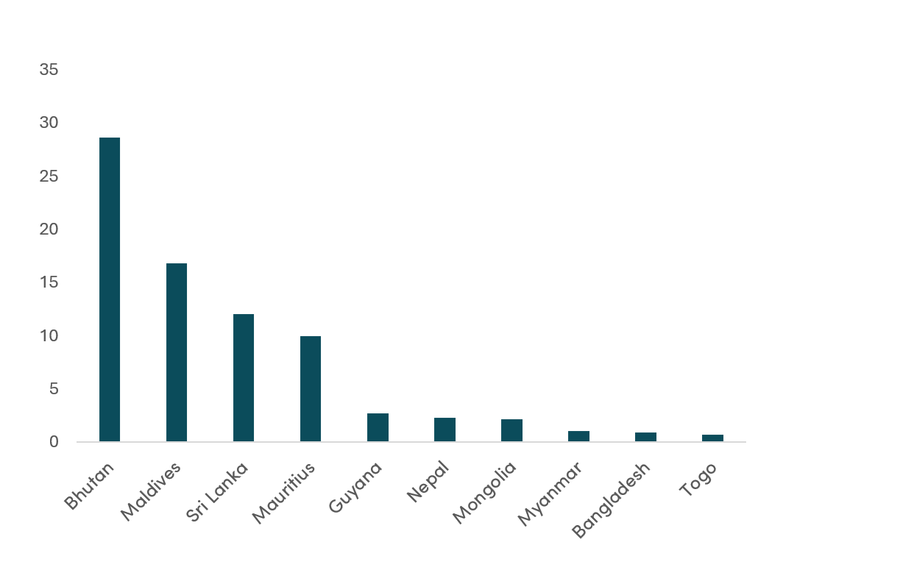
India concentrates its development cooperation in certain countries with which it has strong diplomatic ties. For those countries, finance from India is a substantial share of the total they receive. India accounted for over a quarter of all finance received by Bhutan during this period; for four countries, it accounted for over 10 percent (see Figure 3). Measured against ODA alone – a subset of total finance—it rises above 30 percent. China’s data is incomplete for the period and therefore excluded.
Figure 3. Percent of total development finance that came from India
These figures do not include expenditure on the Indian Technical and Economic Cooperation (ITEC) programme, a technical assistance programme which has long been a key part of India’s development cooperation offer. In 2024-25, this was $19 million, and so modest compared to the grants and loans provided. It likely also reflects significantly greater technical advice than the equivalent spend by higher-income providers. The average UK salary is roughly 10 times higher than in India, but this reflects purchasing power parity rather than the value of expertise to recipients. So whereas the cost of the ITEC programme was roughly $109 million over the last five years, a technical assistance programme from the UK with similar staffing would cost around $1 billion in UK technical assistance (very roughly).
India recognises importance of cooperation despite domestic challenges
India has one of the largest populations of people in extreme poverty in the world. Its GNI per capita is about 3 percent that of the US (by one measure). In fact, its GNI per capita is substantially lower than that of some of the countries to which it provides finance: Bhutan, India’s largest development cooperation partner, has a GNI per capita about 40 percent higher. India is also the largest recipient of development finance aside from Ukraine, receiving $18 billion in 2024. Why then, is India using its scarce capital to help other countries develop?
India recognises the domestic benefits that can accrue from engaging in international cooperation. Motivations for providing aid differ by country and instrument: aid to Afghanistan is largely about India’s dispute with its neighbour Pakistan. Bhutan is a strategic partner given its economic interdependence with India and the perceived shared threat from China. Clearly, this aid is geopolitical and not entirely altruistic. This is also true of the lines of credit, which provide cheap finance but also require 75 percent of procurement to be from Indian firms, and are partly about helping Indian firms access new markets. But this is not so different from other providers—the US has long tied much of its aid to domestic producers, and others are becoming more explicit about “national interest” motivations for giving aid: slowing migrant flows, securing access to critical minerals, or covering costs in donor countries themselves.
Better transparency could unlock greater reputational gain
India might receive more credit for its development contribution if it consolidated such data and produced one, coherent summary of its development projects. It has made steps in that direction: the Ministry of External Affairs Dashboard summarises grants given and committed lines of credit by country but is still aggregated at the country level. Similarly, the Exim bank produces lines of credit information at near-project level but doesn’t say what is disbursed.
India seems highly unlikely to report to the OECD DAC in the near future. But it could report to the International Aid Transparency Initiative, (hosted by the United Nations Development Programme), which was also endorsed in last year’s UN Financing for Development Conference. Doing so would not only make India’s international cooperation more visible, but would also set a good example to laggards on transparency in both China and the DAC.
India should not be ignored as a development actor
It may be overshadowed by its neighbour, China, when it comes to the provision of development finance, but India is already playing a substantial role in development, with the potential to increase in the coming years. India may emphasise the “mutual benefit” aspect of this finance, and it has substantial scope to improve on transparency. But the fact that it is willing to forego scarce resources to give grants to develop strategic relationships is something Western countries should take note of.
Topics
DISCLAIMER & PERMISSIONS
CGD's publications reflect the views of the authors, drawing on prior research and experience in their areas of expertise. CGD is a nonpartisan, independent organization and does not take institutional positions. You may use and disseminate CGD's publications under these conditions.
Thumbnail image by: pinan/ Adobe Stock