Recommended

Blog Post
MCC’s New Scorecards Discriminate Against Development Impact
The Millennium Challenge Corporation (MCC) recently introduced big changes to its country scorecards, which inform partner selection. Here’s a quick rundown of what’s new and what it portends for the agency’s future programming.
Remind me, what’s the purpose of the scorecard?
From the very start, MCC was designed to be selective. When President George W. Bush announced the concept for the agency in 2002, he laid out a vision of US partnership with relatively well-governed, reform-oriented countries, as determined by objective criteria. He specified identifying countries that commit to “ruling justly, investing in their people, and encouraging economic freedom.” MCC’s scorecards manifested President Bush’s vision by compiling third-party indicators across those three categories and assessing country performance, often through comparison to their income group peers but occasionally based on an absolute threshold. These high standards have led some to equate MCC eligibility and partnership with the Good Housekeeping Seal of Approval—and the agency has boasted about the “MCC effect”—the idea that prospective partner countries have implemented productive reforms in the hope of being selected by the agency to develop a compact, which typically comes with significant grant support.
MCC publishes scorecards annually for countries in its candidate pool, which is determined by income. In December 2024, Congress expanded that candidate pool to include a subset of upper-middle-income countries. Importantly, scorecards are not determinative. Countries that pass the scorecard are not necessarily selected as partners, and the agency’s board of directors is empowered to consider supplemental information during the selection process. Still, over its more than 20-year history, the vast majority of countries selected by MCC’s board to develop compacts in a given fiscal year passed the scorecard.
What’s new and different?
As referenced above, MCC’s scorecard is divided into three categories, each featuring a number of third-party independent indicators (in many cases, data from multiple indicators are used in tandem to develop scores unique to MCC).
Historically, scorecard passage has required three things:
- Achieving a passing score on the Control of Corruption indicator (this was known as a hard hurdle since there was no alternative);
- Attaining a sufficiently high score on at least one of two other indicators: Political Rights and Civil Liberties; and
- Receiving sufficiently high marks on at least half of the total number of scorecard indicators
The most significant change is that the new scorecards do away with the Control of Corruption hard hurdle, which has been the subject of serious consternation over the years from development experts (including some of our colleagues) who bemoaned placing such consequence on relatively fuzzy data dependent on perception surveys. While the Control of Corruption indicator remains, it is paired with a new Government Accountability indicator. The Government Accountability measure draws from the TRACE Bribery Risk Matrix and the Political Transformation criteria of the Bertelsmann Stiftung’s Transformation Index. Countries can pass either score to get the green light.
The scorecard introduces a new hard hurdle, dubbed personal freedom, informed by the World Bank’s Voice and Accountability indicator—constructed annually using a whole host of sources (largely perception-based), including political rights and civil liberties measures that previously appeared on the scorecard as standalone indicators. Both the Government Accountability and Personal Freedom indicators are assigned absolute thresholds that countries must meet regardless of income. (You can read more about why this is important in a post from Charles Kenny.)
Figure 1. MCC scorecard indicators, 2005 v. 2006
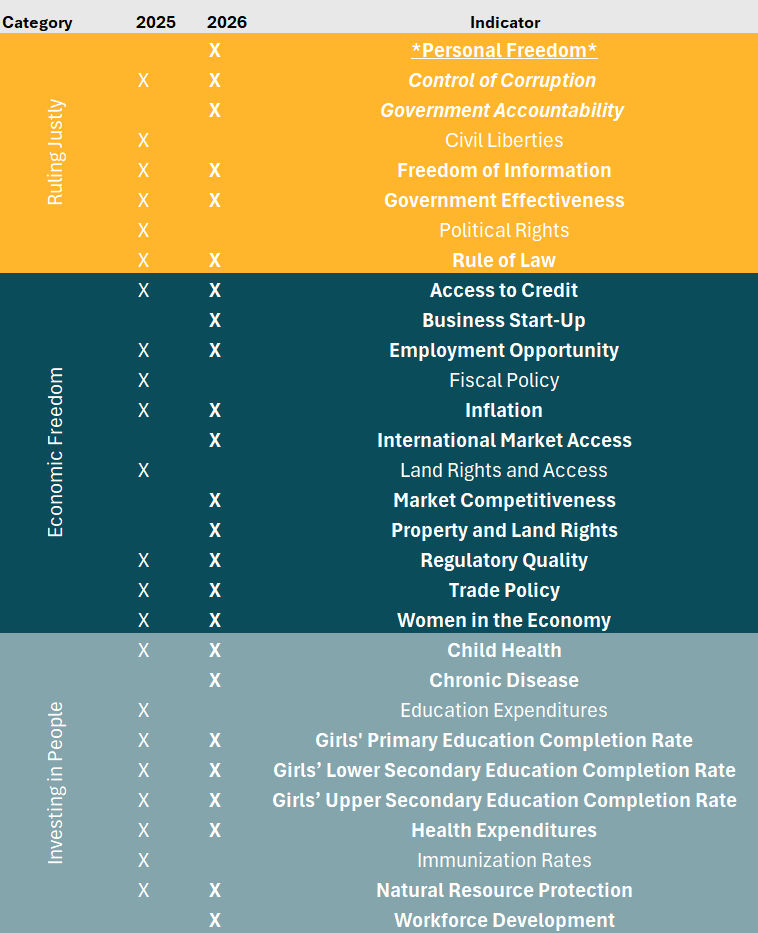
Other changes include the return of a Business Start-up Measure, which relies in part on data from the World Bank’s Business Ready (B-READY)—successor to the Doing Business Report. (MCC’s scorecards used data from the Doing Business Report until it was discontinued.) B-READY data also informs new International Market Access and Market Competitiveness indicators and is incorporated into indicators that assess land rights and measure employment opportunities.
The new scorecards drop education expenditure, which previously appeared alongside other measures in the Investing in People section. And in a move that could raise some eyebrows, the new scorecards ditch vaccination rate in favor of a new chronic disease indicator. As the agency’s guide to the new scorecard indicators notes, chronic diseases account for a growing share of the disease burden in low- and middle-income countries. But while vaccination rates provide insight into just one critical component of a health system, a committed government may have greater success moving the needle by investing in immunization than in addressing the complex factors that contribute to the mortality of individuals aged 30 to 70 from cardiovascular disease, cancer, diabetes, or chronic respiratory disease.
What does it mean?
Between the recent expansion of MCC’s country candidate pool and the latest scorecard changes, MCC’s list of potential partners looks different from that in many recent years. The changes could put new partners on the table or, in some cases, old partners back on the table.
One feature of the new scorecards appears to be a substantial uptick in the passage rate of countries in the upper range of incomes that MCC can consider—those with per capita GNIs between $4,496 and $7,855. (Again, check out a new post from our colleague, Charles Kenny, voicing concerns about the plausible implications of this shift.)
The recently released National Security Strategy references MCC just once—in the section discussing plans for greater engagement in the Western Hemisphere. And indeed, this region appears to hold more promise on the agency’s latest potential partner map.
MCC’s board will meet this Wednesday—and is expected to select new partners. We’ll be watching to see whether the board’s selections align with recent shifts and what they reveal about MCC’s priorities in this new era of US development policy.
Topics
DISCLAIMER & PERMISSIONS
CGD's publications reflect the views of the authors, drawing on prior research and experience in their areas of expertise. CGD is a nonpartisan, independent organization and does not take institutional positions. You may use and disseminate CGD's publications under these conditions.
Thumbnail image by: USAID/Flickr